

A growth factor is not, by itself, a research question. The relevance of growth factor research compounds depends on the specific material, its proposed role in an experiment and the evidence available for that use. When a product category or listing leaves these details unclear, evaluate the material against a defined laboratory question rather than relying on the label.
Research terminology can be difficult to interpret. A “research use” label does not establish a compound’s biological role, the strength of evidence behind it or its status as a therapeutic product. In Australia, the TGA identified unapproved peptide products as a compliance priority for 2026, making it especially important to distinguish laboratory research from consumer health claims.
This guide explains the terminology and major research categories, then provides a practical framework for assessing identity, literature relevance and evidence limitations. Use it to match a compound class to a clear research question and recognise the boundaries that apply to research-use materials. The focus is on precise, appropriately controlled study, not claims of clinical benefit.
Key Takeaways
- Distinguish biological growth factors from broader peptide research categories before comparing materials.
- Assess growth factor research compounds by proposed target, experimental model, endpoint and evidence type.
- Keep in vitro, animal and human evidence separate when judging how well a finding supports a research question.
- Use a structured laboratory checklist to define the question, identify the material, review documentation and plan controls.
- Follow a clear decision sequence to keep compound selection aligned with the literature and an appropriately controlled study.
What Are Growth Factor Research Compounds? Define the Category Before Comparing It
Growth factor research compounds is a broad label, not the name of one molecule or a single class of substances. In biological research, growth factors are signalling molecules that interact with cells and can influence processes such as proliferation, differentiation and survival. The term may also refer to a signalling pathway under investigation or to a supplier’s broader research category, which can include related peptides and compounds.
That distinction matters when comparing materials. A compound grouped under a growth factor category is not necessarily a biological growth factor itself. The category name alone does not establish its target, sequence or relevance to a particular experiment. Similarly, “research use” describes the context in which a material is studied. It does not demonstrate an approved therapy or support claims about human treatment, performance or health outcomes.
Growth factors, growth-factor peptides and related research compounds
Scientific families include epidermal growth factor (EGF), insulin-like growth factor 1 (IGF-1), fibroblast growth factors (FGFs) and platelet-derived growth factors (PDGFs). These are distinct biological families, each with its own molecular characteristics and research context. A foundational overview of growth factor biology can help clarify the term and its functions.
A supplier category may group growth factors with peptides or other materials investigated in related areas. A peptide may interact with a pathway without being the naturally occurring growth factor. Another related compound may be studied for a different experimental role. Treat the category as a starting point for investigation, not as a precise biological classification.
Why terminology matters when reading research
Similar labels can conceal important differences. Molecules may vary in sequence or structure, interact with different targets, or be examined in different cell types and models. A finding about one material in a particular experimental system cannot automatically be applied to another compound with a similar category label.
A “research compound” is a study material, not evidence of an approved therapy or established clinical effect. Interpret claims against the specific material and study conditions described in the literature. For more category-specific context, see the growth factor peptides research guide.
Ascend Labs supplies growth factor peptides for scientific research purposes, not as prescription medicines for human consumption. Start by identifying what a compound is, how it relates to growth factor biology and whether its documented role fits the research question.
How Growth Factor Signalling Works: Receptors, Pathways and Research Questions
Growth factor signalling describes how a cell detects an extracellular cue and translates it into intracellular activity. In receptor-mediated signalling, a ligand binds a compatible cell-surface receptor, prompting receptor activation and downstream molecular events that can alter cellular behaviour. This is a general framework, not one mechanism shared by every growth factor.
The response depends on more than the ligand. Receptor abundance, cell type, cell state and experimental conditions can all affect whether a signal is detected and what response is measured. Findings from one cell system should not be assumed to apply to another without supporting evidence.
Receptor binding and downstream cellular signalling
Receptor tyrosine kinases (RTKs) are one important receptor class in growth factor biology. In many RTK systems, ligand binding promotes receptor activation and phosphorylation, which can recruit or regulate intracellular signalling proteins. Pathways commonly examined downstream include MAPK/ERK and PI3K/AKT, but their contribution varies with the ligand, receptor and model under study.
Separate established biological descriptions from proposed explanations. A measured change in a downstream marker may be consistent with pathway activity, but it does not by itself prove a complete mechanism. Describe emerging or model-specific hypotheses as such, and tie interpretation to the experiments that support them.
From pathway interest to a testable research question
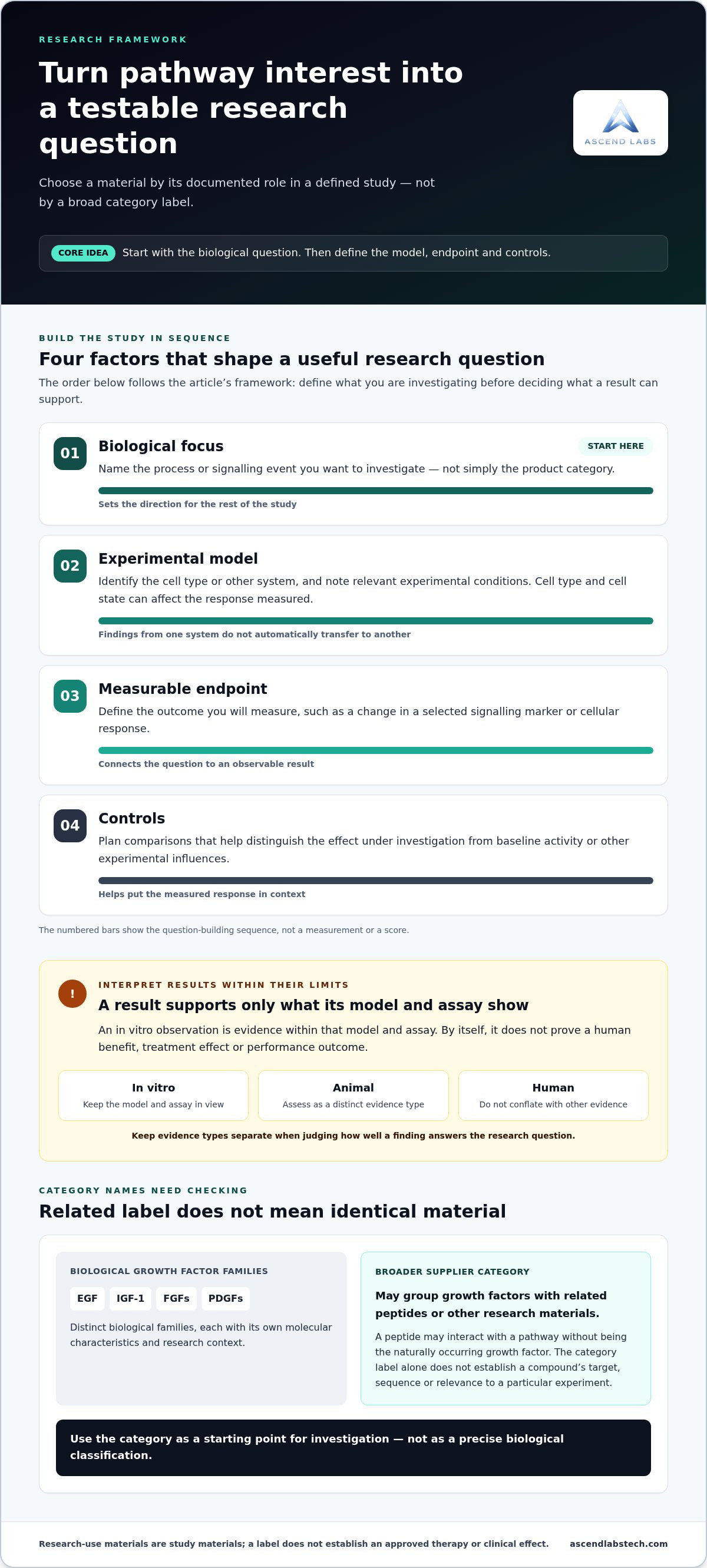
Begin with the biological process or pathway, not a product label. Then specify the experimental model, the response to be measured and the controls needed to interpret it. This turns a broad area of interest into a research question that can guide material selection and study design.
- Biological focus: State the process or signalling event being investigated.
- Model: Identify the cell type or other system, including relevant experimental conditions.
- Endpoint: Define the measurable outcome, such as a change in a selected signalling marker or cellular response.
- Controls: Plan comparisons that help distinguish the effect under investigation from baseline activity or other experimental influences.
These details determine what a result can reasonably support. An in vitro observation is evidence within that model and assay. It is not proof of a human benefit, treatment effect or performance outcome. Evaluate growth factor research compounds in relation to a defined question and the evidence appropriate to it.
To consider research materials in context, review the research compound categories alongside the biological question your study is designed to address.
How to Compare Growth Factor Research Compounds and Interpret the Evidence
A shared category label does not make compounds interchangeable. Compare each material against its proposed biological target, the model used to study it, the measured endpoint and the type of evidence available. This keeps growth factor research compounds connected to specific research questions rather than broad claims about a pathway.
Compare research classes by biological target and model
EGF, IGF-1, FGF and PDGF are distinct biological families. Their receptors, responsive cell types and experimental contexts differ, so evidence relating to one family cannot automatically support conclusions about another. Use the table as a framework for organising a literature search. It is not a claim that every example has the same evidence base or is a supplier product.
| Illustrative class | Proposed target | Model to identify | Endpoint to define | Evidence type to record |
|---|---|---|---|---|
| EGF family | EGF receptor (EGFR) | Specified cell or tissue model | Selected receptor or cellular response | In vitro, animal or human study |
| IGF-1 | IGF-1 receptor (IGF-1R) | Specified cell or tissue model | Defined signalling or cellular measure | In vitro, animal or human study |
| FGF family | Relevant FGF receptor (FGFR) | Model and conditions reported by the study | Measured pathway or cell response | In vitro, animal or human study |
| PDGF family | Relevant PDGF receptor (PDGFR) | Model and conditions reported by the study | Defined receptor or cellular endpoint | In vitro, animal or human study |
Use these as comparison prompts, not interchangeable predictions. Check the exact molecule, receptor context, target tissue and assay used in each paper. A pathway name alone does not establish that two materials act identically or produce the same measured response.
Assess evidence strength without overstating results
Different evidence types answer different questions. In vitro studies examine effects in cells or other controlled systems. Animal studies add organism-level context but remain specific to the model. Human studies address outcomes in people, but their relevance depends on the compound, study design and endpoint. One type of evidence should not be treated as a substitute for another.
Before summarising a result, note the study design, controls, sample context, measured endpoint and stated limitations. A plausible mechanism can justify further investigation, but it is not equivalent to replicated findings or clinical evidence. Even a human study does not establish a practical outcome for a different material or use.
Analytical identity and purity are separate from biological evidence: one concerns what a material is, the other what studies show. For an overview of verification concepts, see the peptide purity testing protocol.
A Laboratory Checklist for Evaluating Growth Factor Research Materials
A disciplined material review links the research question to what is known about the compound and the limits of its documentation. Use this sequence before incorporating growth factor research compounds into a study.
- Define the question. State the biological process you are investigating and the result that would address your hypothesis. A clear question helps determine whether a material’s documented identity and proposed role are relevant.
- Identify the material. Record its stated name and, where the documentation supports it, sequence or other molecular information. Do not infer identity from a broad category label alone.
- Review the documentation. Examine the analytical method, the sample or batch it relates to, and traceability. A purity figure or certificate is information to interpret in context, not a complete account of identity or suitability.
- Plan the study and controls. Specify the model, endpoint, comparison groups and record-keeping before the work begins. These details support reproducibility and help distinguish an observed effect from other experimental influences.
Review identity, analytical documentation and traceability
Identity and analytical method matter because results are interpretable only when the material is characterised sufficiently for the question being tested. Documentation may include molecular or sequence information and analytical results, but the details can vary. Do not assume that a stated purity value establishes biological activity, performance in a particular assay or equivalence to another material.
When batch-specific documentation is supplied, relate it to the material under review and record the method and sample context. Keep the information with the study materials so the basis for selection remains clear. For a category overview, see the research compound catalogue.
Keep the study design and research-use boundaries clear
Record the model, controls and endpoint alongside the material’s identifying information. This helps other researchers understand what was tested and what conclusions the data can support. Research compounds are supplied for scientific research purposes; they are not prescription medicines or intended for human consumption.
Australian regulatory and research-compliance requirements depend on the material and activity. Verify applicable requirements against current authoritative Australian guidance before proceeding. A research-use label is not regulatory advice.
Explore the research compound catalogue to review Ascend Labs’ research categories.
Growth Factor Research Compounds in Australia: Responsible Next Steps
Responsible selection follows a clear sequence: clarify what the category means, define the research question, compare the evidence and assess the material documentation. This keeps compound selection tied to a specific laboratory purpose rather than a broad label or an assumption about outcomes.
What Australian research teams should keep in view
Three considerations are related but distinct: the material’s stated research purpose, the processes that apply within your institution, and any requirements relevant to the planned activity. A research-use description does not replace institutional review or determine which requirements apply. For Australian work, consult current authoritative guidance relevant to the material and activity; this overview is not legal advice.
Ascend Labs is an Australian-owned supplier serving the national market, with products supplied for scientific research purposes. Domestic supply is an operational detail, not an indication of clinical suitability. Research compounds are not prescription medicines for human consumption, and research findings should not be presented as treatment, performance or health claims.
Explore the relevant research compound categories
Once the study question and selection criteria are clear, category information can help orient a literature and material review. Ascend Labs’ growth factor and recovery research categories are relevant starting points for laboratory researchers considering these areas. A category label alone does not establish a material’s biological identity, evidence base or fit for a particular model.
Use the framework in this guide to keep the decision evidence-led: define the question, assess relevant studies and review the documentation available for the material. Then consider whether the information supports its proposed role in your controlled study. Do not extend laboratory observations into claims about human use.
Review Ascend Labs’ research compound categories as part of your material and literature review.
Make Your Next Research Decision Evidence-Led
The term growth factor research compounds can cover distinct molecules and broader research categories, so begin by clarifying what a material is and how it relates to your question. Compare studies by target, model, endpoint and evidence type. In vitro, animal and human findings provide different kinds of information and should not be treated as interchangeable.
Before selecting a material, define the study question, review available identity and analytical documentation, and plan controls that support reproducibility. Keep conclusions within the limits of the evidence and the laboratory context.
Ascend Labs is an Australian-owned supplier serving the national market, with growth factor and recovery peptide categories in its research catalogue. Products are supplied for scientific research purposes, not human consumption. A careful review of the relevant category can help inform your next research decision.
With clear terminology and careful evaluation, research decisions can stay focused, rigorous and aligned with the question being studied.
Frequently Asked Questions
What are growth factor research compounds?
Growth factor research compounds are materials investigated in laboratory studies of cellular signalling and related biological processes. The term may refer to biological growth factors themselves or be used more broadly for a supplier category that includes related peptides and compounds. Examples of biological families include EGF, IGF-1, FGF and PDGF. A category label alone does not establish a material’s identity, target, evidence base or relevance to a particular study.
Are growth factors and growth factor peptides the same thing?
No. A growth factor is a signalling molecule, while “growth factor peptide” may describe a peptide studied in a related context or a supplier’s product category. Some growth factors are proteins, and terminology can vary across research and product listings. Do not assume that a peptide is identical to a naturally occurring growth factor or acts through the same target. Check the specific material’s molecular information and the literature relevant to its proposed role.
How do growth factors influence cellular signalling in laboratory research?
Growth factors can bind compatible cell-surface receptors, initiating intracellular signalling events that researchers measure in a defined model. Some receptors are receptor tyrosine kinases, but mechanisms differ across growth factor families. Receptor expression, cell type, assay design and experimental conditions can all shape the observed response. A result in one cell model describes that experimental context; it does not, by itself, establish a human treatment effect or health outcome.
Can different growth factor research compounds be compared directly?
Only with care and a clear basis for comparison. First identify each material’s molecular class, proposed target, model, measured endpoint and evidence type. Two materials grouped under the same label may differ in sequence, receptor interaction or experimental context. In vitro, animal and human evidence also answer different questions. A shared pathway or category name does not make compounds interchangeable or show that one result predicts another material’s effects.
How can researchers assess the identity and purity of a research peptide?
Review the available material identification and analytical documentation, including the method used and the sample or batch to which results apply. Where provided, sequence or other molecular information may help assess identity. Treat a purity figure or certificate as information that needs method, sample and traceability context, not proof of biological activity or suitability for every assay. Record what the documentation supports, and do not infer details it does not state.
Are growth factor research compounds approved medicines for human use?
A research-use material should not be assumed to be an approved medicine. Therapeutic approval applies to specific products and uses, so a research category or laboratory finding does not establish approval for human treatment. Ascend Labs supplies research compounds for scientific research, not as prescription medicines for human consumption. In Australia, consult current Therapeutic Goods Administration information for questions about the status of a particular therapeutic product.
What should an Australian laboratory consider before selecting a research compound?
Start by clarifying the biological question, then identify the material and compare relevant evidence by model, endpoint and study type. Review available documentation for identity and analytical context, and plan controls and record-keeping to support reproducibility. Separately consider intended research use, institutional processes and requirements that may apply to the planned activity. These are distinct considerations; consult current authoritative Australian guidance relevant to the material and work.


