
The volume you add can be exact, yet your calculated peptide concentration can still be wrong. When calculating peptide concentration for experiments, small unit errors and assumptions about vial contents can undermine otherwise careful work.
If you’ve hesitated over milligrams versus micrograms, or wondered whether a purity percentage should be applied directly to the powder’s labelled mass, those are important questions. Reliable results depend on two checks: accurate volume measurements and appropriate data about the peptide’s actual content. This guide sets out a repeatable formula, explains how to measure diluent carefully and clarifies the difference between HPLC purity and net peptide content. It also shows how to use relevant information on a lot-specific Certificate of Analysis (COA), rather than treating purity as a substitute for mass data.
Ascend Labs supplies research peptides described as verified using HPLC and mass spectrometry. For rigorous calculations, consult the applicable COA and record your units, measurements and assumptions. This guidance applies to research use only; these compounds are not for human consumption.
Key Takeaways
- Use the mass-and-volume formula, then convert units carefully if your protocol requires micrograms per microlitre.
- When calculating peptide concentration for experiments, distinguish the labelled powder mass from the net peptide content reported in the lot-specific COA.
- Check the measuring device’s capacity and graduation marks before interpreting a volume. Small reading errors can affect the calculated concentration.
- HPLC purity and net peptide content describe different properties. Use the relevant COA data for your calculation.
- For research-use-only work, supplier documentation matters. Ascend Labs describes its research peptides as verified using HPLC and mass spectrometry.
Understanding the Fundamentals of Peptide Reconstitution
Peptide reconstitution is the controlled return of a lyophilised, or freeze-dried, powder to a liquid state. For research calculations, the key variables are the peptide mass and the final diluent volume. Keep them distinct: the powder’s visible size is not a measurement of its mass, and the volume used determines the resulting concentration.
Accurate records support reproducible experiments. A calculation can only be as reliable as its inputs, including the mass basis and measured final volume. The principles behind concentration calculations apply here, but the solvent and handling conditions must also suit the specific peptide and assay.
The following video demonstrates a peptide calculator. Treat it as a general calculation aid, not as guidance for dosing or human use.
The State of Lyophilised Peptides
Lyophilisation removes water under controlled conditions to produce a dry material that can be more stable for storage than a solution. It does not make a peptide immune to heat, moisture, light or handling. Follow the lot-specific storage and handling information supplied with the material, and record relevant conditions before beginning calculations.
A powder “puck” can vary in shape and apparent size because of how it was dried and settled. Its dimensions do not indicate how many milligrams it contains. Use the stated mass and, where available, the Certificate of Analysis (COA), rather than estimating by appearance.
Choosing the Correct Solvent for Research
Select a diluent specified by the validated research protocol and compatible with the peptide and assay. Sterile water contains no antimicrobial preservative, while bacteriostatic water contains one that may affect experimental outcomes. Saline may suit particular methods, but its salts can also influence an assay. Don’t substitute solvents without checking compatibility.
Peptide sequence and formulation affect solubility. Hydrophilic sequences generally interact more readily with aqueous solvents; hydrophobic sequences may require conditions specified by the research method. pH also influences solubility, charge and stability, so avoid adjusting it by guesswork. When calculating peptide concentration for experiments, document the mass basis, chosen diluent and measured final volume. This section concerns research use only; these compounds are not for human consumption.
Calculating Peptide Concentration for Experiments: The Core Mathematics
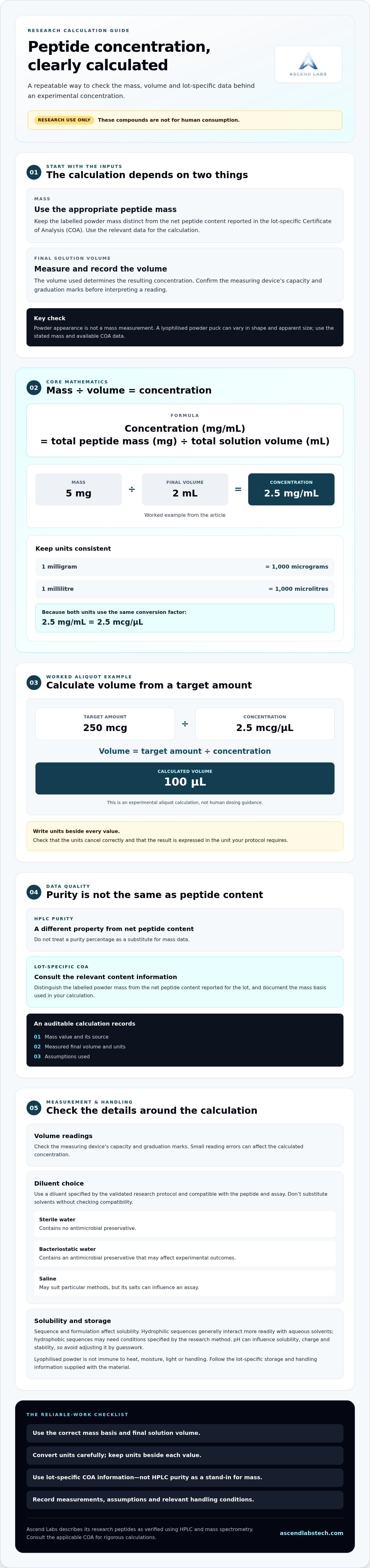
Manual calculation makes the logic auditable, even when you use a calculator or spreadsheet as a secondary check. The basic formula is:
Concentration (mg/mL) = total peptide mass (mg) ÷ total solution volume (mL)
For example, if a sample contains 5 mg of peptide and the final solution volume is 2 mL, the concentration is 2.5 mg/mL. Use the appropriate mass value for the material being calculated, and make sure the volume is the final solution volume specified by your protocol.
Mastering Unit Conversions
Unit conversion is a common source of avoidable errors. One milligram (mg) equals 1,000 micrograms (mcg), and one millilitre (mL) equals 1,000 microlitres (µL). Because both units use the same conversion factor, 2.5 mg/mL is numerically equivalent to 2.5 mcg/µL.
Using the 5 mg sample in 2 mL as an example, the concentration is 2.5 mcg/µL. To calculate the volume containing a target experimental amount of 250 mcg:
- Volume = target amount ÷ concentration
- 250 mcg ÷ 2.5 mcg/µL = 100 µL
This is a calculation of an experimental aliquot, not human dosing guidance. When calculating peptide concentration for experiments, keep the units beside each value so they cancel correctly and the result is expressed in the intended unit.
The Relationship Between Volume and Potency
For a fixed peptide mass, increasing the solvent volume decreases the solution concentration. The formula makes this relationship clear: the same mass divided by a larger volume produces a smaller value in mg/mL.
Choose a working concentration that allows the required aliquot to be measured reliably with the available calibrated pipette or other volumetric instrument. Very small transfer volumes may be difficult to measure precisely. Follow the instrument’s operating range and the experimental protocol rather than relying on extra decimal places in a calculation.
Verify Before Use
Ask a second researcher to repeat the calculation independently using the recorded mass, final volume and target amount. Compare the formula, units, conversion steps and final volume, not just the final number. Record both checks in the experiment notes. Ascend Labs describes its research peptides as verified using HPLC and mass spectrometry. Consult lot-specific documentation when establishing calculation inputs. These compounds are for research use only, not human consumption.
Syringe Calibration and Volumetric Accuracy
A correct concentration calculation still depends on measuring the intended volume accurately. Before using a syringe or pipette, confirm its scale, units and measurement range. Don’t assume that a graduation labelled in “units” represents a universal volume. Its meaning depends on the device specification.
Use this sequence to translate a calculated experimental aliquot into a volume:
- Identify the device capacity and units. Check whether the scale is in microlitres, millilitres or device-specific units.
- Determine the value of each graduation. Divide the marked volume between two numbered lines by the number of equal intervals.
- Calculate the amount per mark. Divide the total peptide amount in the solution by the total number of equivalent marks.
- Locate the required volume. Use the calculated aliquot volume to identify the corresponding mark, then check the reading against the instrument’s specifications.
For example, if a hypothetical solution contains 2,000 mcg across 100 equal volume divisions, each division represents 20 mcg. This is a laboratory calculation example, not guidance for human dosing or administration. Record the device, units and calculation basis alongside the result.
Choose and check the measuring instrument
For small in-vitro transfers, a suitable laboratory micropipette can provide more controlled volume selection than a coarse-graduated syringe. Use it only within its specified operating range, with compatible tips, and follow the laboratory’s documented calibration and maintenance procedures. ISO 8655:2022 is a relevant reference for piston-operated volumetric apparatus. Confirm which requirements apply to the instrument in use and maintain traceable calibration records.
Standard syringes can have residual, or dead-space, volume in the hub and needle. That retained liquid may affect the volume actually delivered, depending on syringe design and technique. Account for this in the validated method rather than assuming the graduations alone describe every transfer.
Read the scale, not the barrel size
A 0.5 mL and a 1.0 mL barrel may have different graduation intervals. Count the spaces between numbered lines and confirm the printed capacity before calculating. Don’t transfer a “units” conversion from one device to another without checking its labelling and documentation.
Read the scale at eye level to reduce parallax. For a syringe, use the specified edge of the plunger stopper as the reference point; a liquid meniscus is not the reading reference. When calculating peptide concentration for experiments, a second researcher can independently verify both the arithmetic and the selected instrument mark.
For research-use-only compounds to support carefully documented laboratory work, see Ascend Labs research peptides. These compounds are not for human consumption.
Accounting for Purity and Net Peptide Content
The mass printed on a vial and the amount of peptide represented by that mass are not always equivalent. Gross mass is the weighed sample; net peptide content (NPC) estimates the actual peptide mass, accounting for water, counter-ions and other non-peptide components. HPLC purity describes the proportion of target peptide-related material in an analytical result. It is not automatically the sample’s mass fraction.
This distinction matters when calculating peptide concentration for experiments. If the COA reports NPC as a mass fraction, calculate concentration using that value:
Peptide concentration = gross sample mass × NPC fraction ÷ final solution volume
For example, if a hypothetical 5 mg sample has an NPC of 80% and is brought to a final volume of 2 mL, the estimated peptide concentration is (5 mg × 0.80) ÷ 2 mL = 2 mg/mL. Apply an adjustment only when the COA provides a suitable quantitative mass value. Multiplying gross mass by an HPLC area-purity percentage may produce a misleading result because chromatographic purity and NPC measure different things.
Interpreting HPLC data for concentration
An HPLC chromatogram displays signals from compounds separated under the method’s conditions. The target peptide is typically identified by its retention time and reference data, while peak-area percentages indicate relative signal, not necessarily the sample’s peptide mass fraction. Review the COA’s method, identity confirmation and reported results together. HPLC may not quantify water or counter-ions such as trifluoroacetate (TFA) as peptide-related peaks, so a high purity result alone does not establish NPC.
For a closer explanation of verification documents, see Interpreting HPLC and COA in Peptide Verification.
Purity, counter-ions and calculation inputs
Counter-ions can contribute to the powder’s gross mass without being part of the peptide sequence. A COA may therefore report high HPLC purity alongside a lower peptide content by weight. A 99% HPLC-purity peptide may still have an NPC of 80% because salts and other non-peptide material contribute to the weighed sample.
Neglecting a documented NPC value can make the calculated concentration higher than the actual peptide concentration, affecting the amount delivered to a sensitive assay. The often-used expression (total mass × purity fraction) ÷ volume is appropriate only when “purity” is explicitly a validated mass fraction for the sample, not merely an HPLC area percentage. Check the lot-specific COA for NPC or equivalent quantitative content data. If it is absent, don’t treat HPLC purity as a substitute.
Securing High-Purity Compounds for Precise Australian Studies
A concentration calculation is only as dependable as its inputs. Supplier documentation helps establish what material is present, which batch it came from and what analytical information is available. Without suitable identity and quality data, precise arithmetic cannot resolve uncertainty about the starting sample.
For Australian research settings, Ascend Labs supplies research peptides including Retatrutide, Tirzepatide and MOTS-C. Its compounds are described as verified using HPLC and mass spectrometry. When calculating peptide concentration for experiments, use the relevant batch documentation and check whether it reports the specific mass-content data required by your method. HPLC purity alone should not be treated as net peptide content.
Domestic supply and study continuity
Domestic Australian supply can make procurement more straightforward for local laboratories. It also avoids relying on an international shipment route, though it doesn’t remove the need to follow the material’s storage instructions or assess transport conditions. On receipt, record the batch identifier and review the accompanying documentation before adding a compound to a study.
For longitudinal research, keep procurement and batch records with the experimental data. If a study uses material from different batches, document that change and review the relevant analytical information rather than assuming the batches are interchangeable. This supports traceability and gives researchers a basis for assessing any batch-related differences.
Researchers considering MOTS-C for Australian procurement can consult Purchase MOTS-C Australia: A Technical Resource. Review the applicable supply and documentation details against your laboratory’s research requirements.
Build supplier data into the protocol
Before a study begins, establish how supplier information will be recorded and used. Confirm that the material identity matches the protocol, retain the lot-specific COA and note which reported value supports each calculation. If the COA doesn’t provide net peptide content or another suitable mass basis, don’t infer it from an HPLC purity result. Seek clarification or document the limitation.
Ascend Labs lists research compounds and categories relevant to metabolic and growth factor investigations. Treat supplier verification as one part of a broader quality process: confirm the batch records, follow laboratory handling procedures and retain calculation checks in the study file. These compounds are for research use only and are not for human consumption.
Make Every Calculation Traceable
Reliable concentration data starts with clear inputs. Record the final solution volume, use a suitable mass value from the lot-specific COA, and distinguish HPLC purity from net peptide content. Then check unit conversions and confirm the measured volume against your instrument’s graduations. These steps make calculating peptide concentration for experiments more repeatable and your research records easier to review.
Supplier documentation is part of that process. Ascend Labs is an Australian-owned supplier offering domestic shipping and research compounds including Retatrutide and MOTS-C. Its compounds are described as verified using HPLC and mass spectrometry. Review batch documentation for the values your calculation requires, and follow your laboratory’s handling and storage protocols. These compounds are for research use only, not human consumption.
With careful measurement, transparent batch information and independent calculation checks, you can approach each study with greater confidence in the integrity of its concentration data.
Frequently Asked Questions
How do I calculate peptide concentration if the vial has no listed mass?
Don’t estimate the mass from the powder’s appearance or the size of its lyophilised “puck”. Check the lot-specific Certificate of Analysis (COA) or contact the supplier for traceable mass and peptide-content information. Without a reliable mass value, you can’t calculate a defensible concentration from volume alone. When calculating peptide concentration for experiments, document the missing information and don’t treat an assumed amount as a verified input.
Can I use the same concentration calculation for all research peptides?
The basic mass concentration formula, mass divided by final volume, applies broadly, but the inputs and preparation conditions aren’t interchangeable. Peptides may differ in solubility, suitable diluent, pH sensitivity and net peptide content. Follow the relevant research protocol and use lot-specific documentation to establish the mass basis. If converting to molar concentration, also use the peptide’s molecular weight, as the same mass concentration can represent different molar concentrations.
What is the most common mistake when calculating peptide concentration?
A frequent avoidable error is mixing units, such as dividing milligrams by microlitres without converting one quantity first. Keep units beside every value, convert consistently, and check that they cancel to the intended result. Another important source of error is treating HPLC purity as if it were net peptide content by mass. Review the COA carefully and have another researcher independently check the calculation and instrument reading.
How does bacteriostatic water volume affect the stability of the concentration?
The volume determines the initial concentration: for a fixed peptide mass, adding more diluent produces a lower mass per unit volume. Bacteriostatic water also contains a preservative, which may affect a peptide or assay, so use it only if the validated research method specifies it. It doesn’t guarantee solution stability. Follow the peptide’s storage instructions and protocol, and don’t assume a solution remains unchanged over time.
Does the peptide sequence length impact the concentration maths?
Sequence length doesn’t change the mass-per-volume formula, but it can matter when converting a mass concentration to molar concentration. That conversion requires the peptide’s molecular weight, which depends on its chemical composition and modifications, not simply a count of amino acids. Sequence characteristics can also affect solubility and handling. Use verified identity and molecular-weight information, and follow the method’s specifications rather than relying on sequence length alone.
What should I do if my calculated dose exceeds the syringe volume?
For a research aliquot, don’t force a transfer beyond the device’s capacity. Check the calculation, units and syringe scale, then use a calibrated instrument with a suitable range if the protocol permits. Splitting a transfer into measured portions may be appropriate only if the method supports it and the total delivered volume can be verified. This guidance concerns laboratory research, not human dosing or administration.
How often should I re-calculate concentration for stored peptide solutions?
Recalculate whenever the solution’s mass or final volume basis changes, such as after a documented dilution or when preparing a new batch. Storage alone doesn’t change the original arithmetic, but it may affect solution integrity; a calculation cannot establish how much intact peptide remains. Follow validated stability and storage guidance for the specific material. Record preparation details, storage conditions and any permitted use period in the research documentation.
Is there a difference between concentration for in-vitro and in-vivo research?
The concentration arithmetic can be the same, but the experimental context, units, method and interpretation differ. In-vitro work may specify a concentration in the assay medium, while in-vivo research involves additional protocol and oversight considerations that a simple solution calculation can’t address. Don’t transfer a concentration or preparation method between study types without scientific review. Research peptides discussed here are for research use only, not human consumption.


