

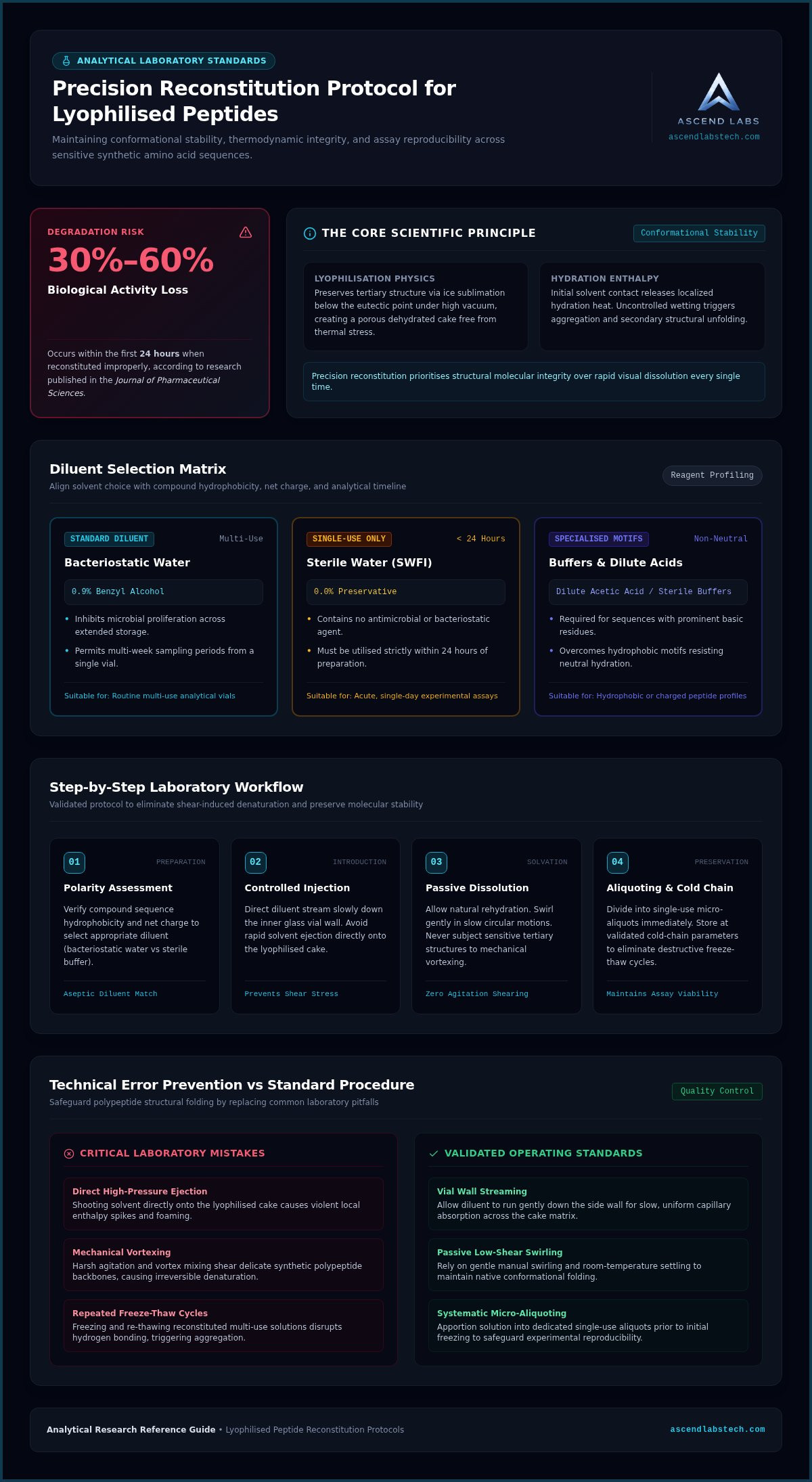
Improperly reconstituted peptides can lose 30 to 60 percent of their biological activity within the first 24 hours, according to findings published in the Journal of Pharmaceutical Sciences. For laboratory researchers working with delicate amino acid sequences, understanding how to reconstitute lyophilized peptides correctly is not merely a procedural step; it is the single variable that determines assay reproducibility. Precision reconstitution prioritises structural molecular integrity over rapid visual dissolution every single time.
You already know the frustration of handling stubborn hydrophobic cakes that refuse to dissolve, or the anxiety of shearing fragile tertiary structures through simple vortexing or mechanical agitation. You shouldn't have to second-guess whether your solvent choice compromised an entire study. This guide provides an exact, aseptic laboratory protocol to reconstitute lyophilised research compounds with absolute confidence, calculate precise diluent volumes, and safeguard molecular stability for long-term experimental assays.
Below, we outline the step-by-step workflow for solvent selection, controlled reconstitution techniques, and validated storage parameters designed for reproducible laboratory outcomes.
Key Takeaways
- Understand the underlying thermodynamics of lyophilisation to protect delicate synthetic peptide structures during solvent reintroduction.
- Select the precise diluent matching your compound's polarity, learning when to deploy bacteriostatic water versus dilute acetic acid or sterile buffers.
- Master the exact laboratory protocol for how to reconstitute lyophilized peptides without causing shear-induced structural denaturation.
- Identify and eliminate common technical mistakes, from rapid solvent ejection to destructive freeze-thaw cycles.
- Implement rigorous aliquoting workflows and cold-chain storage parameters to maintain assay reproducibility over extended timelines.
Understanding Lyophilised Peptides and the Science of Reconstitution
Lyophilisation, or freeze-drying, is the standard method for stabilising synthetic research peptides. By removing solvent via ice sublimation under a high vacuum, the process preserves the delicate tertiary structure of amino acid chains without exposing them to destructive thermal stress. The outcome is a porous, dehydrated matrix known as a lyophilised cake. When researchers study how to reconstitute lyophilized peptides effectively, they aren't merely dissolving a powder; they are facilitating a precise thermodynamic rehydration that returns a desiccated molecule to its native, active state for experimental evaluation.
Analytical purity depends entirely on maintaining conformational stability throughout this solvent transition. If you disturb the intricate hydrogen bonding network during rehydration, the peptide chains can unfold and aggregate irreversibly. Starting with high-purity, analytical-grade material, such as the vacuum-sealed cakes supplied across the Ascend Labs research range, ensures that researchers work with uniform crystalline cakes designed specifically to prevent insolubility artefacts during reconstitution.
To better understand this physical conversion, watch this demonstration of the baseline technique:
The Role of Freeze-Drying in Peptide Preservation
The industrial science of lyophilization lowers compound temperature below its eutectic point, converting free moisture into crystalline ice before drawing it off through controlled sublimation. This mechanism ensures that heat-labile functional groups remain intact. Sealing the resulting cake under an inert vacuum atmosphere shields the polypeptide backbone from ambient moisture and atmospheric oxidation, both of which trigger hydrolytic cleavage over time. The porous architecture of this cake is engineered specifically to draw diluent evenly throughout the matrix, facilitating uniform solvation.
Molecular Vulnerability During the Solvation Phase
The initial wetting phase presents significant physical hazards to synthetic compounds. When diluent contacts the dry cake, the rapid formation of a hydration shell releases local enthalpy, creating micro-zones of hydration heat. In sensitive sequences, this thermal spike can disrupt secondary folding. Hydrophobic amino acid segments tend to resist aqueous contact, driving molecules to self-associate rather than disperse. Researchers mastering how to reconstitute lyophilized peptides must therefore manage solvent addition rates and osmotic pressure carefully to safeguard polypeptide integrity for subsequent analytical assays.
Essential Reagents, Diluents, and Laboratory Equipment Preparation
Reconstitution success hinges on aligning your diluent choice with compound hydrophobicity, overall net charge, and planned analytical timelines. Many general guides suggest that sterile water works universally. That assumption compromises experimental integrity. Peptides with prominent basic residues or large hydrophobic motifs resist neutral hydration, demanding tailored solvent strategies. For laboratories procuring analytical compounds like Retatrutide, MOTS-C, or specialised growth factor peptides, consulting the Ascend Labs research catalogue ensures you start with detailed documentation to match diluent selection with each compound's specific chemical profile.
Diluent Selection: Bacteriostatic Water Versus Alternative Solvents
Bacteriostatic water containing 0.9% benzyl alcohol serves as the standard medium for multi-use laboratory vials. The bacteriostatic agent inhibits microbial proliferation, allowing stored solutions to remain viable across multi-week sampling periods. Sterile water for injection, by contrast, contains no antimicrobial preservative. You must utilise sterile water solutions within 24 hours to avoid bioburden accumulation, making it suitable exclusively for acute, single-day assays where benzyl alcohol could disrupt cellular assays.
Hydrophobic or basic sequences require alternative solubilisation agents before aqueous dilution:
- Sterile 0.1% to 1% Acetic Acid: Lowers solvent pH to protonate basic amino acids, dispersing recalcitrant residues without cleaving amide backbones.
- Phosphate-Buffered Saline (PBS): Provides physiological ionic strength and pH buffering for sensitive metabolic peptides susceptible to charge-induced aggregation.
- Sterile Dimethyl Sulfoxide (DMSO): Acts as a polar aprotic co-solvent for extreme lipophilic sequences, requiring subsequent dilution into standard buffer to maintain compound solubility.
Aseptic Workspace and Consumables Checklist
Maintain strict sterility by working inside a certified laminar flow cabinet or a thoroughly sanitised laboratory bench wiped down with sterile 70% isopropyl alcohol. Your workstation requires:
- Sterile single-use insulin syringes or low-retention calibrated pipettes to minimise compound loss on plastic surfaces.
- Sterile 21G to 25G drawing needles to prevent coring the vial septum during penetration.
- Medical-grade 70% isopropyl alcohol prep swabs for continuous barrier disinfection.
- Low-binding polypropylene microcentrifuge tubes to prevent hydrophobic peptides from adhering to laboratory-grade borosilicate or untreated plastics during aliquoting.
Calculating Reconstitution Volume and Target Concentrations
Executing accurate calculations is central when learning how to reconstitute lyophilized peptides to exact concentrations. Determine working stock molarity using a direct formula: Diluent Volume (mL) equals Peptide Mass (mg) divided by Desired Concentration (mg/mL). If preparing a 5 mg vial to a standard 2 mg/mL concentration, introduce exactly 2.5 mL of solvent. Always review the batch Certificate of Analysis; high-purity lyophilised cakes contain a defined peptide purity percentage, which informs precise molar adjustments in quantitative assays.
Step-by-Step Protocol: How to Reconstitute Lyophilised Peptides
Precision execution during solvent addition protects peptide integrity. Many informal online sources instruct users to blast water directly onto the lyophilised cake and shake the vial vigorously. Doing so introduces severe kinetic shear forces that fragment delicate tertiary structures. Knowing how to reconstitute lyophilized peptides correctly requires a controlled, three-phase protocol that respects thermodynamic equilibration and controlled fluid dynamics.
Phase 1: Thermal Equilibration and Vial Preparation
Thermal shocks destabilise sensitive amino acid backbones. Remove the vacuum-sealed vial from -20°C storage and let it sit at controlled ambient room temperature (20°C to 25°C) for 20 to 30 minutes before unsealing. Opening a frozen vial immediately introduces warm ambient air, causing rapid atmospheric condensation inside the container. That microscopic moisture hydrolyses vulnerable peptide bonds before reconstitution even begins. Once equilibrated, pop off the protective plastic flip-top cap, wipe the rubber septum firmly using a fresh 70% isopropyl alcohol swab in a single unidirectional stroke, and let it air-dry completely under the hood.
Phase 2: Controlled Diluent Aspiration and Injection
Controlled delivery avoids kinetic stress. Aspirate your calculated volume of diluent using a sterile, low-retention syringe fitted with a fine-gauge needle (21G to 25G). Pierce the centre of the sanitised septum at a 45-degree angle before straightening to 90 degrees, preventing rubber coring.
Follow these specific physical injection rules:
- Target the interior glass wall: Direct the needle tip toward the inner glass surface above the cake, never directly into the lyophilised matrix.
- Manage internal negative pressure: Vacuum-sealed research vials will draw fluid automatically. Maintain firm thumb pressure on the plunger to restrain the flow, ensuring the diluent trickles down the glass slowly.
- Equalise atmospheric pressure: After dispensing the liquid, aspirate an equivalent volume of headspace air into the syringe barrel before withdrawing the needle to neutralise internal vial pressure.
Phase 3: Solvation and Gentle Homogenisation
Allow the fluid to penetrate the porous cake naturally through capillary action. Most analytical-grade synthetic peptides dissolve spontaneously within two to five minutes of contact. If visual inspection reveals floating particulate or unmixed compound, gently rotate the vial between your palms or swirl it slowly along a flat bench surface.
Never invert the vial violently or introduce vortex agitation. Mechanical shaking produces foaming, creating air-liquid interfaces that shear peptide bonds and cause irreversible aggregation. Hold the vial up to a focused light source against a dark background to verify complete optical clarity. A fully solvated solution should appear crystal clear and free of suspended flakes or cloudiness before proceeding to downstream analytical assays.
Preventing Molecular Degradation: Critical Laboratory Errors to Avoid
Peptide stability drops rapidly once a solvent enters the vial. While dry lyophilised powder resists ambient degradation for extensive periods, aqueous solutions are inherently vulnerable to physical, thermal, and chemical cleavage. A 2014 investigation in the Journal of Pharmaceutical Sciences established that improper handling during the first 24 hours of rehydration can destroy up to 60 percent of a peptide's measurable activity. Knowing how to reconstitute lyophilized peptides requires equal parts mechanical precision and biochemical vigilance to safeguard your research specimens.
The Mechanical Hazards of Shaking and Vortexing
Mechanical shearing is the most frequent cause of structural loss in research laboratories. Vortexing generates violent fluid velocity gradients and cavitation bubbles, forming an expanded air-liquid interface. Sensitive peptide chains migrate toward this hydrophobic boundary, uncoiling their alpha-helices or beta-sheets to minimise energetic tension. Once unfolded, exposed hydrophobic patches align and precipitate as biologically inert fibrils. Always replace mechanical agitation with a patient, horizontal swirling motion across your workbench.
Thermal Fluctuations and Photolytic Degradation
Reconstituted solutions left on ambient benchtops experience exponential rates of hydrolytic cleavage. Elevated temperatures accelerate deamidation at asparagine and glutamine residues, modifying overall molecular weight and charge profiles. Simultaneously, light exposure poses severe photolytic risks; UV and standard fluorescent laboratory lighting can erode 15 to 30 percent of peptide potency over several weeks if vials remain unprotected. Residues like tryptophan, tyrosine, and methionine undergo rapid photo-oxidation under ambient light, shifting baseline chromatographic profiles. Keep reconstituted vials shielded in amber containers or foil-wrapped racks at 2°C to 8°C immediately following solvation.
Review our peptide purity testing protocol to track degradation peaks and secondary impurities via analytical HPLC.
Contamination Vectors and Septum Coring
Physical particulate represents an insidious degradation vector. Forcing blunt or wide-bore needles through synthetic chlorobutyl stoppers causes coring, shedding microscopic elastomer fragments into the sterile solution. These fragments introduce non-specific binding sites and particulates that foul HPLC fluidics. Minimise this risk by penetrating the septum bevel-up at 45 degrees before rotating vertically. Single-draw aliquoting into dedicated microcentrifuge tubes eliminates repetitive septum punctures entirely, preserving sterility and solution purity throughout extended research assays.
Post-Reconstitution Storage, Aliquoting, and Verification Protocols
Reconstitution represents merely half the stability equation; how you handle, subdivide, and preserve the resulting liquid solution dictates assay reproducibility over weeks of experimental inquiry. Data from a 2017 study in Pharmaceutical Development and Technology demonstrated that peptides reconstituted in bacteriostatic water and held at 2°C to 8°C preserved over 95 percent of their baseline potency at day 28. However, most peptides lose 10 to 15 percent of their activity after 30 days in refrigeration, with degradation reaching up to 25 percent at 60 days. Protecting your experimental specimens requires rigorous aliquoting regimens paired with tight thermal control.
Aliquoting Strategies for Long-Term Laboratory Stability
Repeated thermal cycling destroys tertiary peptide confirmations. To bypass this hazard, subdivide the master solution into sterile, low-binding polypropylene microcentrifuge tubes immediately following initial dissolution. Prepare single-use aliquot volumes tailored to your planned analytical runs. When working with complex multi-receptor agonists, reviewing Retatrutide research in Australia provides helpful context on how delicate multi-pathway sequences behave under repeated handling. Never return a thawed aliquot to deep storage; thaw each micro-tube once immediately prior to assay execution, discarding any residual fluid.
Document each aliquot meticulously with the following parameters:
- Compound identity and lot number: Links the working tube directly to the analytical Certificate of Analysis.
- Exact concentration: Stated clearly in mg/mL or µg/µL to eliminate pipetting errors.
- Solvent formulation: Specifies bacteriostatic water, acetic acid dilution, or buffer chemistry.
- Reconstitution timestamp: Establishes the exact viability window for experimental auditing.
Refrigeration Parameters and Stability Windows
Short-term storage demands dedicated laboratory refrigeration calibrated strictly between 2°C and 8°C. Never store working vials inside door shelves, where cycling door swings trigger continuous temperature shifts. Avoid standard auto-defrost or "frost-free" laboratory freezers for prolonged compound holding; these appliances cycle through internal heating phases to melt ice, causing microscopic freeze-thaw cycles that fracture amide backbones. For solutions requiring preservation beyond 28 days, store cryogenic aliquots at -20°C or -80°C in manual-defrost freezers.
Assay Integrity and Certified Research Procurement
Consistent results require flawless starting material. Understanding how to reconstitute lyophilized peptides cannot compensate for irregular synthesis purity or unverified counter-ion content. When examining stability variances between different compound classes, our comparative analysis of KLOW vs MOTS-C research demonstrates how molecular structure influences dissolution resilience. Procuring compounds through Ascend Labs provides Australian researchers with HPLC-verified and mass-spectrometry-tested lyophilised cakes, ensuring zero baseline contamination and exceptional batch-to-batch consistency across domestic scientific investigations.
Advancing Laboratory Precision in Peptide Research
Maintaining molecular integrity requires an uncompromising commitment to analytical rigor. Mastering how to reconstitute lyophilized peptides comes down to respecting the physical forces governing solvation: allowing ambient thermal equilibration, eliminating shear stresses from vortexing, and aligning solvent chemistry with compound polarity. Paired with immediate single-use aliquoting and strict thermal management, this disciplined workflow protects primary sequences and ensures repeatable experimental outcomes.
Analytical accuracy begins with certified synthesis. Ascend Labs provides Australian researchers with analytical-grade lyophilised cakes engineered specifically for clean reconstitution and experimental stability. Every batch undergoes rigorous HPLC and mass spectrometry verification, backed by reliable domestic cold-chain distribution to ensure uncompromised quality upon arrival at your laboratory bench.
By standardising these aseptic rehydration parameters across your laboratory workflows, you safeguard your compounds and position every downstream assay for definitive scientific reproducibility.
Frequently Asked Questions
Can you shake a peptide vial to dissolve the powder faster?
No, you should never shake or vortex a peptide vial during laboratory preparation. Mechanical agitation generates high fluid shear forces and creates air-liquid interfaces that disrupt secondary and tertiary folding. This physical stress causes delicate synthetic chains to denature and form insoluble aggregates. Instead, rotate the vial gently between your palms or swirl it slowly across a flat surface until the lyophilised cake dissolves completely.
What is the difference between bacteriostatic water and sterile water for reconstitution?
Bacteriostatic water contains sterile water supplemented with 0.9% benzyl alcohol, which functions as an antimicrobial preservative to suppress bacterial growth over multiple vial entries. This enables refrigerated solution storage for up to 28 days. Sterile water for injection lacks preservatives entirely. While ideal for sensitive cellular assays where benzyl alcohol might cause cytotoxicity, sterile water solutions must be used within 24 hours.
How much bacteriostatic water should be added to a lyophilised peptide vial?
The required volume of bacteriostatic water depends entirely on your targeted experimental concentration rather than a fixed standard. Calculate the volume by dividing the total peptide mass in milligrams by your desired concentration in milligrams per millilitre. For example, dissolving a 5 mg peptide cake in 2.5 mL of diluent produces a standardised working concentration of 2 mg/mL, simplifying subsequent assay pipetting.
What should you do if a peptide does not dissolve completely in water?
If a compound fails to clear after gentle swirling, avoid excessive agitation and evaluate its amino acid polarity. Hydrophobic or basic sequences often resist neutral aqueous solvation. Adding a minute volume of sterile 0.1% to 1% acetic acid protonates basic residues to enhance solubility before bringing the solution to final volume with standard buffer. Alternatively, introduce a sterile polar co-solvent like DMSO for highly lipophilic research compounds.
How long do reconstituted research peptides remain stable in refrigeration?
Reconstituted solutions prepared with bacteriostatic water generally retain over 95% potency for up to 28 days when stored continuously between 2°C and 8°C. After 30 days, progressive hydrolysis reduces activity by 10% to 15%, with degradation reaching up to 25% by day 60. Solutions reconstituted using preservative-free sterile water must be deployed within 24 hours to prevent bioburden contamination and hydrolytic loss.
Why is it important to equalise the vial temperature before reconstitution?
Allowing a vial to reach ambient room temperature for 20 to 30 minutes prevents atmospheric condensation from forming on the lyophilised cake. When cold glass contacts warmer ambient air, microscopic moisture droplets condense instantly inside the unsealed container. This uncontrolled water introduction initiates premature hydrolytic cleavage and alters the precise solvent concentration ratios required when mastering how to reconstitute lyophilized peptides for quantitative assays.
Can reconstituted peptides be frozen and thawed multiple times for assays?
No, repetitive freeze-thaw cycles must be strictly avoided. Ice crystal propagation during subsequent freezing steps mechanically shears peptide backbones and promotes rapid intermolecular aggregation. To preserve structural stability across longitudinal studies, divide the freshly reconstituted solution into single-use polypropylene aliquots immediately after initial dissolution. Freeze those individual tubes once at -20°C or -80°C, thawing each aliquot only when needed.
What causes a cloudy or precipitate appearance after reconstituting a peptide?
A cloudy solution indicates peptide aggregation, insoluble precipitation, or incorrect solvent selection. When investigating how to reconstitute lyophilized peptides, precipitation typically occurs when hydrophobic sequences are introduced to neutral water, or when solvent is injected directly onto the dry cake with excessive kinetic force. Starting with analytical-grade, vacuum-sealed cakes verified by HPLC ensures uniform solubility and prevents precipitation caused by synthesis impurities.


