

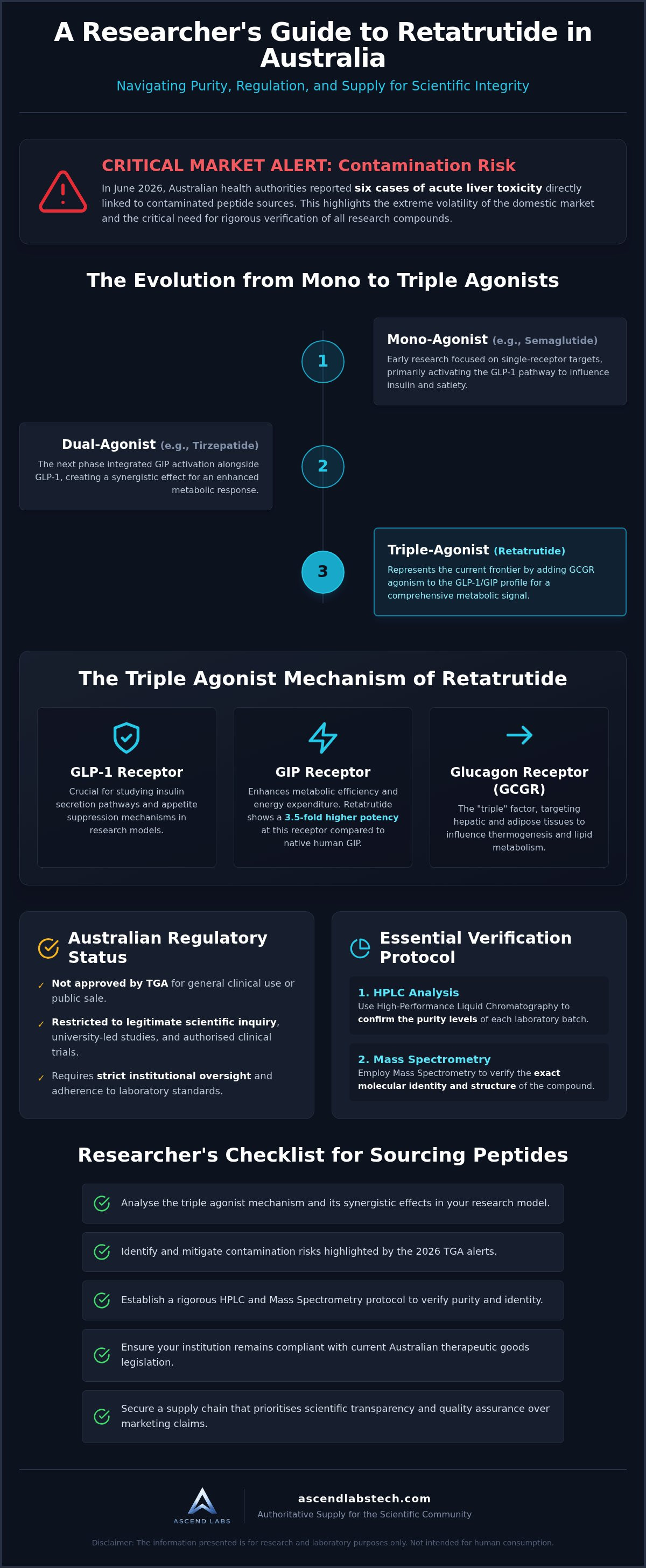
In June 2026, Australian health authorities reported six cases of acute liver toxicity directly linked to contaminated peptide sources. This data underscores the extreme volatility of the current Australian market for retatrutide, a triple hormone receptor agonist that represents a sophisticated frontier in metabolic research. You likely recognise that while the synergistic potential of GLP-1, GIP, and glucagon receptor agonism is profound, the validity of any laboratory finding depends entirely on the chemical absolute of the compound used.
This technical overview provides a structured framework for navigating the complexities of the domestic research landscape. It delivers a clear understanding of triple agonism while establishing rigorous standards for purity verification. We will examine the biochemical mechanisms of the molecule, the specific regulatory warnings issued by the TGA in April 2026, and the analytical methodologies required to accurately interpret HPLC and mass spectrometry data. By the conclusion of this briefing, you will possess a reliable protocol for identifying high-integrity research materials and mitigating the risks associated with inconsistent domestic supply chains.
Key Takeaways
- Analyse the triple agonist mechanism of retatrutide, focusing on its synergistic activation of GLP-1, GIP, and glucagon receptors within metabolic research models.
- Identify the specific contamination risks highlighted by the 2026 TGA alerts and learn to distinguish between unverified black-market products and legitimate research-grade compounds.
- Establish a rigorous verification protocol using HPLC and Mass Spectrometry data to confirm the exact molecular identity and purity levels of your laboratory batches.
- Navigate the Australian regulatory landscape for experimental peptides to ensure your institution remains compliant with current therapeutic goods legislation.
- Secure a reliable domestic supply chain that prioritises scientific transparency and meticulous quality assurance over retail-driven marketing claims.
Defining Retatrutide in the Australian Research Landscape
Retatrutide represents a sophisticated milestone in the study of metabolic pathways within Australian research institutions. As a synthetic peptide, it's currently the subject of intense investigation due to its unique classification as a triple hormone receptor agonist. Unlike previous generations of metabolic compounds, it targets three distinct hormonal pathways simultaneously. This multi-faceted approach makes it a priority for studies focused on weight regulation and glucose management. It's essential to clarify that within the Australian context, these compounds are strictly designated for in-vitro and laboratory research. They aren't intended for human consumption or therapeutic use outside of authorised clinical trials.
The Australian scientific community views retatrutide as a high-priority investigational molecule. Its structure is designed to interact with specific receptors that govern insulin secretion, satiety, and energy expenditure. Because the compound is still in the experimental phase, the focus remains on understanding the long-term biochemical implications of triple agonism. Researchers prioritising precision must ensure that their supply chains provide compounds that match the exact molecular specifications required for reproducible results. This commitment to accuracy is the foundation of any serious inquiry into triple agonist behaviour.
The Evolution from Mono to Triple Agonists
The trajectory of peptide research has moved from single-receptor targets to complex multi-agonism. Early studies focused on GLP-1 (Glucagon-like peptide-1) mono-agonists, which laid the foundation for compounds like Semaglutide. The subsequent development of dual agonists, such as Tirzepatide, integrated GIP (Glucose-dependent insulinotropic polypeptide) to enhance metabolic response. Retatrutide represents the next phase of this progression by incorporating the glucagon receptor (GCGR) into the agonist profile. This Retatrutide overview highlights how the addition of glucagon agonism potentially modulates energy expenditure and hepatic glucose production, distinguishing it from its predecessors. This three-pronged activation creates a more comprehensive metabolic signal than earlier mono or dual-targeted substances.
Legal Status for Scientific Research in Australia
The regulatory environment in Australia maintains a clear distinction between therapeutic goods and experimental research chemicals. As of mid-2026, the Therapeutic Goods Administration (TGA) hasn't approved retatrutide for general clinical use or public sale. Its presence in Australia is restricted to legitimate scientific inquiry, university-led studies, and clinical trials. Researchers must adhere to strict laboratory standards to ensure the integrity of their data and remain compliant with local regulations. Possession for experimental purposes requires institutional oversight and a commitment to maintaining the substance's status as a non-therapeutic research compound. Using unverified sources for these materials carries significant legal and scientific risks, particularly given the recent alerts regarding market contamination.
The Triple Agonist Mechanism: GLP-1, GIP, and GCGR
Retatrutide functions through a sophisticated mechanism known as triple agonism. This involves the simultaneous activation of three key metabolic receptors: the glucagon-like peptide-1 (GLP-1) receptor, the glucose-dependent insulinotropic polypeptide (GIP) receptor, and the glucagon receptor (GCGR). While previous research focused on the dual agonism of GLP-1 and GIP, the integration of glucagon signalling creates a distinct biochemical profile. This three-pronged approach allows for a more comprehensive investigation into metabolic regulation than was possible with earlier mono or dual-agonist compounds.
In a laboratory setting, the synergy of these pathways is the primary area of interest. Researchers observe how these interactions produce outcomes that exceed the sum of their individual parts. The specific roles include:
- GLP-1: Crucial for studying insulin secretion pathways and appetite suppression mechanisms in research models.
- GIP: Enhances metabolic efficiency and energy expenditure, with data suggesting retatrutide possesses a 3.5-fold higher potency at this receptor compared to native human GIP.
- GCGR: Acts as the "triple" factor, influencing thermogenesis and lipid metabolism studies by targeting hepatic and adipose tissues.
Researchers investigating these interactions must ensure their samples maintain the intended receptor binding profile to produce valid data. Securing high-purity metabolic research compounds is a prerequisite for any study aiming to replicate these complex synergistic effects.
Glucagon Receptor Agonism: The New Frontier
The inclusion of GCGR agonism marks a significant breakthrough in peptide science. Traditionally, glucagon was viewed solely as a counter-regulatory hormone to insulin. However, recent research models demonstrate that activating the glucagon receptor can increase energy expenditure and stimulate thermogenesis. The challenge for researchers lies in balancing this glucagon activity with insulinotropic signals to maintain metabolic stability. When these forces are correctly aligned, the resulting increase in lipid oxidation and metabolic rate provides a robust framework for studying advanced weight regulation.
Molecular Structure and Binding Affinity
Retatrutide is built upon a 39-amino acid backbone, which has been structurally modified to optimise its interaction with all three target receptors. These modifications include the incorporation of non-coded amino acids and a specific fatty acid side chain that extends the compound's half-life. Data indicates high binding potency across the GLP-1, GIP, and GCGR sites, ensuring that no single pathway dominates the biochemical response. The peptide possesses a molecular weight of approximately 4.7 kDa and exhibits high structural stability when maintained in appropriate laboratory conditions.
Purity Standards and the 2026 Research Alerts
In June 2026, the Victorian Department of Health reported six cases of acute liver toxicity linked to unapproved peptide products. While these reports often focus on the public health risk, they signal a catastrophic failure in chemical verification within the broader Australian supply chain. For a researcher investigating retatrutide, these alerts aren't merely regulatory noise; they're evidence of widespread contamination. Black-market or unverified peptides introduce variables that compromise laboratory integrity and render experimental data useless.
Analytical laboratories frequently identify residual solvents like acetonitrile or trifluoroacetic acid (TFA) in sub-standard batches. Heavy metals, such as lead or arsenic, can also persist if the synthesis process isn't meticulously managed. When a batch contains these impurities, any observed metabolic change in a research model can't be definitively attributed to the peptide itself. High-purity standards are the only mechanism to ensure that the triple agonist mechanism remains the sole focus of the study. An investigation by ABC News even found that some vials purchased online contained almost double the concentration indicated on the packaging, further complicating dosage precision.
Contamination vs. Compound Action
Distinguishing between the biochemical signalling of retatrutide and the toxicological profile of an impurity is impossible without rigorous testing. Poor manufacturing processes frequently result in truncated peptide sequences or residual reagents. These contaminants don't just skew metabolic data; they trigger unintended inflammatory responses in research models. Such responses can mask the true physiological effects of the triple agonist, leading to false-positive results that derail long-term inquiry.
The Role of Australian Regulatory Warnings
The TGA's April 2026 warning explicitly named retatrutide as a compound of concern due to its prevalence in unregulated markets. These alerts highlight the danger of sourcing from entities that circumvent standard verification protocols. Researchers maintain compliance and data validity by avoiding these high-risk channels. Sourcing from established domestic suppliers like Ascend Labs ensures that the compound has undergone the necessary verification to bypass these 2026 contamination issues. This approach prioritises scientific truth over the convenience of unverified supply chains.
Methodologies for Verifying Research Grade Peptides
Analytical precision is the only safeguard against the market volatility described in previous sections. For a complex triple agonist like retatrutide, visual inspection or basic solubility tests are insufficient. High-level metabolic studies require empirical proof of a compound's identity and concentration. This verification relies on two primary methodologies: High-Performance Liquid Chromatography (HPLC) and Mass Spectrometry. These tools allow researchers to look past the branding and evaluate the actual chemical composition of a batch.
While a vendor might claim high purity, the objective evidence provided by a third-party laboratory remains the only definitive proof of chemical integrity. Relying on internal testing alone creates a conflict of interest that serious institutions cannot afford. For researchers seeking verified materials, you can buy retatrutide that has undergone these exact analytical protocols to ensure data reproducibility.
Reading the HPLC Chromatogram
HPLC is the gold standard for determining the purity percentage of a peptide. The process involves passing the compound through a column under high pressure to separate its individual components. On the resulting chromatogram, the main peak represents the target peptide, while smaller peaks indicate impurities or synthesis byproducts. A clean baseline with minimal noise suggests a disciplined manufacturing process. Any purity level below 98% is scientifically unacceptable for high-precision metabolic research because even minor contaminants can skew receptor binding affinities.
Mass Spec Verification
While HPLC measures purity, Mass Spectrometry confirms identity. It determines the precise molecular mass of the sample by measuring the mass-to-charge ratio of its ions. This data is compared against the theoretical molecular weight of the 39-amino acid retatrutide sequence. If the observed mass deviates from the theoretical value, the batch may contain truncated sequences or unintended modifications. Batch-to-batch consistency is vital for long-term studies; even slight variations in molecular structure can lead to inconsistent metabolic responses across different phases of an experiment.
Interpreting a Certificate of Analysis (COA)
A Certificate of Analysis should be viewed as a technical manual for the specific batch in your laboratory. It must include the HPLC trace, the Mass Spec report, and a clear statement of the final purity percentage. Researchers should verify that the COA is batch-specific rather than a generic template used for every shipment. Transparent domestic suppliers prioritise this level of detail, providing the necessary documentation to satisfy institutional safety boards and ensure the integrity of the Australian research ecosystem. Data doesn't lie, provided the methodology used to gather it remains beyond reproach.
Ascend Labs: Authoritative Supply for the Scientific Community
Ascend Labs operates as a disciplined gatekeeper for the Australian scientific community. We provide a sophisticated, boutique approach to the supply of high-purity peptides, ensuring that researchers aren't forced to rely on the precarious international black market. Our supply of retatrutide is defined by a commitment to transparency and technical accuracy. We understand that in a laboratory environment, the compound's chemical absolute is the only metric that matters. Every vial we provide is a reflection of our dedication to scientific truth.
By focusing on domestic operations, we eliminate the complexities of international customs and the risks of degraded materials during transit. Our service model prioritises the needs of advanced practitioners who require consistent, verified compounds for metabolic inquiry. We don't engage in the hyperbolic marketing common in the retail sector. Instead, we provide the raw data and technical support necessary for professional validation. This approach ensures that your research remains focused on biochemical outcomes rather than supply chain uncertainties.
The Ascend Labs Quality Protocol
Our verification process is methodical and uncompromising. Every batch undergoes a multi-stage protocol to ensure it meets our internal purity benchmarks. This begins with rigorous synthesis oversight and concludes with third-party HPLC and Mass Spectrometry analysis. We organise our catalogue to serve specific research requirements, focusing on compounds that are at the frontier of metabolic science. The philosophy of "substance over style" is central to our operation. We provide accessible COA data for every compound, allowing researchers to verify the molecular identity of their materials before beginning an experiment. This level of scrutiny ensures that your findings are based on a stable, high-integrity chemical foundation.
Sourcing Domestic Research Compounds
Logistical reliability is a critical component of successful long-term studies. Choosing an Australian-owned and operated supplier ensures that your laboratory has a dependable partner for recurring supply needs. We provide discreet domestic shipping across the country, maintaining the security and stability of the research compounds from our facility to your lab. This domestic focus allows us to respond quickly to the evolving needs of the Australian scientific landscape. As researchers continue to explore the implications of triple hormone receptor agonism, we remain committed to providing the latest tools with unmatched purity standards. You can explore our verified Retatrutide research compound to ensure your laboratory is equipped with materials that meet the highest professional expectations. Scientific truth is only achievable when the reagents used are beyond reproach.
Advancing Metabolic Research with Analytical Precision
The evolution of metabolic inquiry in Australia now hinges on the ability to distinguish between experimental potential and chemical reality. As we've examined, the triple agonist mechanism offers a significant leap forward from earlier mono and dual-agonist models. However, the 2026 contamination reports serve as a stark reminder that laboratory integrity is only as robust as the verification protocols of the supplier. High-purity standards, confirmed through HPLC and Mass Spectrometry, aren't optional; they're the foundational requirements for any replicable study.
Securing a reliable domestic supply chain allows your institution to bypass the risks of unverified international markets. By prioritising analytical data over retail claims, you ensure that your investigation into retatrutide remains focused on biochemical truths rather than synthesis errors. Ascend Labs maintains clinical-grade research standards, providing the transparency and logistical security needed for advanced metabolic studies through secure Australian domestic shipping.
Order HPLC-Verified Retatrutide for Research and ensure your laboratory operates with the highest degree of scientific certainty. We look forward to supporting your next phase of discovery with meticulously verified compounds.
Frequently Asked Questions
What is Retatrutide in the context of Australian research?
Retatrutide is a synthetic peptide currently utilised in Australian laboratory settings as a triple hormone receptor agonist. It targets the GLP-1, GIP, and glucagon receptors simultaneously to study complex metabolic interactions. This multi-pathway activation distinguishes it from earlier generations of metabolic compounds. Its application is strictly limited to in-vitro and animal models within authorised research institutions to explore energy expenditure and glucose homeostasis.
Is Retatrutide approved for human use in Australia by the TGA?
No, retatrutide isn't approved for human consumption or therapeutic use by the Therapeutic Goods Administration (TGA). As of July 2026, it remains an investigational molecule restricted to authorised clinical trials and legitimate laboratory research. The TGA issued a specific warning in April 2026 regarding the risks of unapproved peptide products. Possession for personal use without a valid prescription or research authority is illegal under Australian law.
How does the triple agonist mechanism differ from Tirzepatide?
Retatrutide expands upon the dual-agonist profile of Tirzepatide by incorporating the glucagon receptor (GCGR) into its mechanism. While Tirzepatide targets GLP-1 and GIP, retatrutide activates three distinct pathways. The addition of glucagon agonism is particularly significant for research into thermogenesis and hepatic lipid metabolism. This triple-agonist approach allows for a more comprehensive analysis of energy expenditure than dual-targeted compounds can provide.
Why were there health alerts regarding Retatrutide in 2026?
The health alerts issued in 2026 were primarily driven by acute liver toxicity cases linked to contaminated, unverified peptide batches. In June 2026, Victoria reported six such cases involving individuals who sourced products from unregulated online markets. These incidents highlight the dangers of residual solvents and heavy metals often found in black-market supplies. Such contamination compromises both safety and the integrity of any scientific data gathered using these materials.
What purity percentage is required for Retatrutide research?
High-precision metabolic research requires a minimum purity level of 98% for all peptide batches. Purity below this threshold introduces chemical variables, such as truncated sequences or synthesis byproducts, which can interfere with receptor binding. For researchers, anything less than 98% purity risks producing inconsistent or false-positive results. Maintaining this standard is essential for ensuring that observed metabolic changes are solely attributable to the peptide's intended mechanism.
How do I interpret the HPLC report for a peptide batch?
Interpreting an HPLC report involves analysing the chromatogram for a single, prominent peak that represents the target peptide. The area under this peak is used to calculate the final purity percentage of the batch. Significant baseline noise or secondary peaks indicate the presence of impurities or synthesis errors. Researchers should ensure the report is batch-specific and provides a clear, high-resolution trace to confirm the compound's chemical integrity.
Does Ascend Labs provide domestic shipping within Australia?
Yes, Ascend Labs provides secure and discreet domestic shipping across Australia for all research compounds. Sourcing domestically eliminates the risks associated with international customs delays and potential product degradation during long-transit periods. This ensures that laboratories receive their materials quickly and in optimal condition. Our logistical framework is designed to support the specific requirements of Australian scientific institutions while maintaining a reliable domestic supply chain.
What are the storage requirements for Retatrutide research compounds?
Retatrutide research compounds should be stored as a lyophilised powder at -20°C for long-term stability. For short-term use, maintaining the compound at 2-8°C is generally sufficient, provided it's protected from light and moisture. Once reconstituted, the peptide's stability decreases significantly, requiring immediate use or storage at -80°C to prevent degradation. Adhering to these storage protocols is vital for maintaining the structural integrity of the 39-amino acid sequence.


