

What if the primary barrier to breakthroughs in tissue repair isn't the biological hypothesis, but the analytical integrity of the synthetic reagents themselves? In the rigorous environment of Australian biotechnology, you likely recognise that a study's validity is only as robust as its most volatile variable. Sourcing high-purity cellular regeneration research peptides has become increasingly complex as domestic regulatory oversight tightens and the global market for these compounds approaches a projected A$245 billion valuation in 2026.
We understand the frustration of interpreting a landscape where quality claims often lack the necessary verification to satisfy NATA-accredited standards. You're looking for precision, not marketing rhetoric. This scientific overview provides a definitive roadmap for identifying reputable Australian sources and understanding the specific mechanisms of compounds like MOTS-C and growth factor peptides. We'll examine the technical requirements for HPLC and mass spectrometry verification, ensure you're aligned with the latest TGA scheduling decisions, and outline the protocols essential for successful in vitro regeneration studies in a contemporary laboratory setting.
Key Takeaways
- Gain technical insights into how cellular regeneration research peptides modulate mitochondrial-derived signaling and metabolic pathways to influence tissue repair.
- Evaluate the unique research profiles of compounds such as KLOW and MOTS-C for their specific roles in advanced longevity and energy homeostasis studies.
- Master the interpretation of Certificates of Analysis by applying Australian-standard benchmarks for HPLC purity and mass spectrometry verification.
- Secure laboratory outcomes by identifying reputable domestic suppliers that prioritise compound stability through specialised Australian shipping protocols.
- Align your procurement strategy with the 2026 regulatory framework to ensure all research chemicals meet rigorous scientific and legal thresholds.
Defining Cellular Regeneration Research Peptides and Their Significance
Peptides are short chains of amino acids that function as precise biological messengers within the extracellular matrix. In the context of cellular regeneration research peptides, these compounds are designed to trigger specific intracellular responses rather than generic systemic growth. Traditional research relied on broad growth factors, which often lacked the granularity required for complex tissue repair models. Today, the focus has shifted toward metabolic agonists and mitochondrial-derived peptides that offer higher receptor affinity. Understanding the nuances of peptide synthesis and molecular properties is fundamental for researchers seeking to replicate biological repair sequences in a controlled laboratory environment. High-purity compounds are the foundation of this work; without them, reproducibility remains an elusive goal for even the most sophisticated Australian laboratories.
To better understand how specific compounds influence tissue repair mechanisms, watch this scientific breakdown:
The Shift Towards Targeted Signaling
Modern inquiry prioritises precision. We've moved beyond general systemic responses toward the targeted activation of specific intracellular pathways. High-affinity sequences allow researchers to mimic endogenous repair signals with exceptional accuracy. This evolution requires meticulous attention to molecular weight and sequence integrity. If a peptide sequence deviates by even a single amino acid, the resulting data can be compromised. Precise signaling depends on several factors:
- Exact amino acid sequence alignment to the target receptor.
- Minimal counter-ion interference from the synthesis process.
- Structural stability during long-term cryogenic storage.
You can explore a range of high-purity metabolic research compounds to support these specific signaling objectives. Maintaining a chain of custody through a domestic supplier is often the only way to ensure these delicate sequences haven't degraded during transit.
Regenerative Research Objectives in 2026
Current scientific focus in Australia has pivoted toward cellular senescence and mitochondrial resilience. Researchers are investigating how metabolic health intersects with longevity, particularly through the use of mitochondrial-derived peptides like MOTS-C. These studies often examine repair at the epigenetic level, aiming to reverse age-related cellular decline. Australian researchers recognise that achieving reproducible results in these sensitive models requires compounds that meet rigorous national standards. In 2026, the benchmark for high-integrity research is a minimum of 98% purity, verified through High-Performance Liquid Chromatography (HPLC) and Mass Spectrometry. This level of verification ensures that artifactual immune activation doesn't interfere with cellular assays. It's essential to remember that these substances are strictly for laboratory research use only, and they aren't intended for human consumption.
Mechanisms of Action: How Peptides Influence Cellular Repair Pathways
Peptides function as high-affinity ligands that bind to specific cell-surface receptors, initiating signal transduction cascades that alter gene expression and protein synthesis. In the study of cellular regeneration research peptides, the primary objective is often the modulation of the cellular microenvironment. By downregulating pro-inflammatory cytokines and upregulating anti-inflammatory signaling, these compounds create a biological state that is permissive to tissue repair. This precise modulation is essential for investigating cellular repair and tissue regeneration pathways within complex laboratory models. The focus has moved toward understanding how receptor agonism, particularly involving the GIP and GLP-1 pathways, influences metabolic regeneration and energy homeostasis.
Mitochondrial Signaling and MDPs
Mitochondrial-derived peptides (MDPs) represent a sophisticated class of signaling molecules encoded within the mitochondrial genome. MOTS-C is a primary focus of current inquiry due to its ability to translocate to the nucleus during periods of cellular stress. Once in the nucleus, it acts as a metabolic regulator, enhancing metabolic flexibility and promoting energy homeostasis. This mechanism is distinct from traditional growth factors as it addresses the energetic requirements of the cell directly. Researchers utilize synthetic MDPs to explore several critical areas:
- The restoration of insulin sensitivity in senescent cell models.
- The activation of AMPK pathways to simulate caloric restriction effects.
- The mitigation of oxidative stress during accelerated cellular repair cycles.
By comparing natural mitochondrial signaling with synthetic analogues, laboratories can identify the specific sequences required to optimise cellular resilience. To support these high-precision models, sourcing verified metabolic research compounds is essential for maintaining experimental integrity and avoiding data contamination.
Triple Agonist Pathways in Tissue Research
The contemporary frontier of metabolic inquiry involves multi-receptor agonists that target several pathways simultaneously. Retatrutide represents a significant advancement in this category, functioning as a triple agonist for the glucagon, glucose-dependent insulinotropic polypeptide (GIP), and glucagon-like peptide-1 (GLP-1) receptors. This integrated approach allows for a comprehensive analysis of metabolic regeneration that single-receptor agonists cannot replicate. Researchers employ these compounds to study the synergy between lipid metabolism and glucose regulation, providing a clearer picture of how systemic health influences local tissue repair. For a technical breakdown of this mechanism in the local context, see Retatrutide: The Frontier of Triple Agonist Research in Australia. The use of such sophisticated compounds requires a disciplined approach to purity, as any deviation in the peptide sequence can alter receptor binding affinity and compromise the validity of the research findings.
Key Compounds in Modern Regeneration and Anti-Ageing Research
The identification of high-integrity compounds is the primary step in successful laboratory inquiry. While early studies focused heavily on single-pathway repair, 2026 research prioritises the synergy between mitochondrial signaling and traditional growth factors. This integrated approach defines the current application of cellular regeneration research peptides in Australian scientific facilities. By moving beyond isolated mechanisms, researchers can now observe how metabolic agonists interact with cellular repair sequences to drive more robust regenerative outcomes. The focus has shifted toward compounds that not only stimulate growth but also address the underlying metabolic health of the cell.
Longevity and Anti-Ageing Frontiers
KLOW and MOTS-C represent the vanguard of longevity research. KLOW is increasingly investigated for its potential to modulate cellular senescence pathways, assisting researchers in understanding how to clear or rejuvenate aged cell populations. In contrast, MOTS-C functions as a mitochondrial-derived signaling molecule, regulating metabolic flexibility and energy production at the organelle level. The intersection of these two compounds allows for a dual-targeted approach to age-related decline. For a detailed breakdown of their unique research profiles, consult our KLOW vs MOTS-C Research: A Comparative Analysis. This line of inquiry often utilises peptide biomaterials in cellular regeneration to create scaffolds that support sustained cellular signaling in in vitro environments.
Recovery and Growth Factor Research
Growth factor peptides remain a staple of connective tissue and musculoskeletal studies. However, the field has evolved from basic angiogenic agents to more stable, next-generation recovery compounds. These peptides are essential for studying the repair of ligaments, tendons, and bone density in controlled models. The stability of these sequences is paramount; any degradation in the peptide chain can lead to inconsistent activation of tissue repair pathways. Researchers can find comprehensive protocols and compound specifications in the Growth Factor Peptides Australia: Scientific Research Guide. These compounds are often paired with metabolic agonists to observe how systemic energy balance affects local tissue recovery rates.
The integration of metabolic research compounds like Retatrutide and Tirzepatide has established a new benchmark for complexity in cellular studies. These multi-receptor agonists allow for the simultaneous study of glucose regulation and tissue repair, providing a holistic view of the regenerative process. For laboratories requiring verified materials, high-purity research compounds are the only viable choice to ensure data accuracy and experimental reproducibility. All materials discussed are strictly for laboratory research use only and are not intended for human consumption or therapeutic use in Australia.
Ensuring Integrity: Purity Standards for Australian Research Laboratories
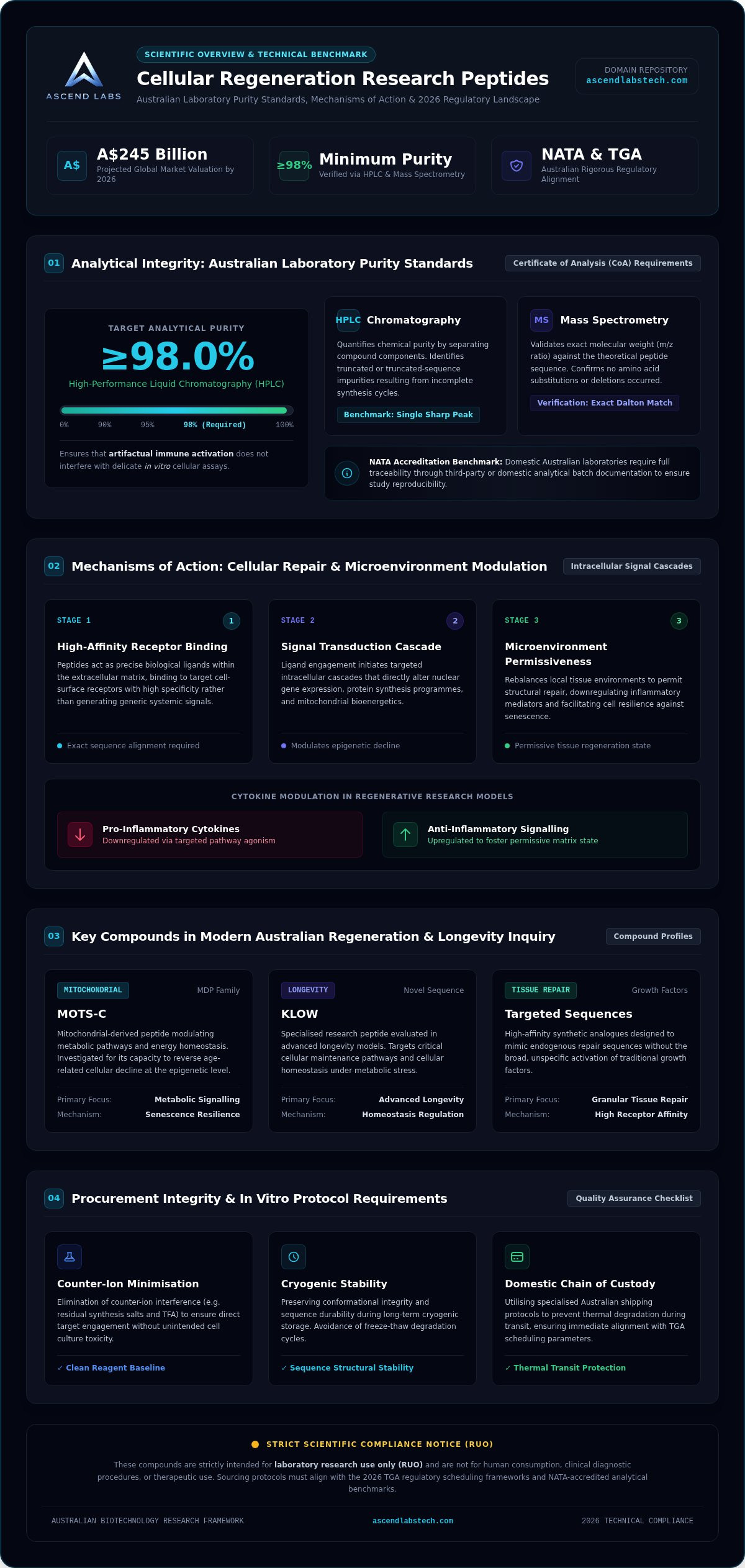
Scientific validity in 2026 depends entirely on chemical precision. When investigating cellular regeneration research peptides, the presence of even minor impurities can trigger artifactual immune activation, effectively masking the true biological response of the target pathway. For Australian laboratories, the 98.0% purity threshold is the minimum industry standard for general inquiry, while sensitive receptor-binding assays often require ≥99.0% purity. Verifying these levels requires a rigorous analytical approach, combining High-Performance Liquid Chromatography (HPLC) at 214 nm with Liquid Chromatography-Mass Spectrometry (LC-MS) to confirm the exact molecular weight within a ±0.5 Da variance.
A Certificate of Analysis (COA) is the primary document for establishing this integrity. However, its value depends on the transparency of the testing facility. Leading Australian suppliers now utilise blockchain-verified COAs and QR-coded portals linked directly to ISO/IEC 17025-accredited laboratory systems. This prevents the document forgery that has historically plagued the research chemical market. Interpreting these reports requires a focus on net peptide content and the absence of residual solvents or counter-ions like trifluoroacetate (TFA), which can be cytotoxic in cellular repair models.
Verification Protocols and HPLC Analysis
Purity claims are meaningless without chromatographic evidence. HPLC analysis provides a visual and data-driven confirmation of a compound's homogeneity, ensuring that no truncated sequences or synthesis by-products are present. Mass spectrometry then serves as the fingerprint, confirming the molecular identity of the peptide against its theoretical sequence. For a detailed technical guide on these processes, refer to Peptide Purity Testing: A Professional Protocol. These verification steps are non-negotiable for researchers who require reproducible data in tissue repair studies.
The Australian Domestic Advantage
The volatility of international logistics represents a significant risk to peptide stability. Peptides are sensitive to light, moisture, and temperature fluctuations. International shipping often involves prolonged exposure to uncontrolled environments at customs hubs, where temperatures can exceed the stability thresholds for lyophilised compounds. Domestic Australian supply eliminates these variables by ensuring a shorter chain of custody and maintained cold-chain integrity. Working with an Australian-owned supplier also ensures compliance with local TGA scheduling and Australian Border Force regulations, providing a secure and reliable pathway for procurement.
Utilising unverified or low-purity reagents introduces unnecessary noise into complex research models. In a landscape where the global regenerative medicine sector is expanding rapidly, the ability to produce reliable, high-fidelity results is what distinguishes elite research institutions. Ensuring that every compound meets these rigorous standards isn't just a matter of protocol; it's a commitment to the integrity of the scientific process. These substances are strictly for laboratory research use only and are not intended for human consumption or therapeutic use within Australia.
Procuring High-Purity Peptides for Australian Scientific Inquiry
Procuring high-quality reagents is the final, most critical step in translating a research hypothesis into a verifiable experiment. In the Australian scientific community, the selection of a supplier for cellular regeneration research peptides is often the determining factor in achieving reproducible data. A reputable partner must offer more than just chemical supply; they must act as a clinical gatekeeper, ensuring that every compound maintains its molecular integrity from the point of synthesis to the moment of laboratory application. As we move through 2026, the complexity of these compounds requires a procurement strategy that prioritises substance over style.
Selecting Your Research Partner
Transparency and technical support are the hallmarks of a professional supplier. When evaluating a source, researchers should prioritise entities that provide comprehensive verification data, including HPLC and mass spectrometry reports for every batch. Ascend Labs has established itself as a preferred choice for Australian institutions by focusing exclusively on high-purity metabolic and growth factor research. By maintaining a specialised focus, we ensure that our inventory aligns with the rigorous expectations of advanced practitioners. Our commitment to integrity means we provide the precision required for complex studies without the hyperbolic claims common in the retail sector. You can view the full range of research peptides and compounds within our curated selection.
Streamlining Laboratory Procurement
Efficient procurement extends beyond the purchase itself; it encompasses the logistics of sensitive material handling and laboratory readiness. To organise domestic shipping for sensitive research materials, it's essential to work with a provider that understands the volatility of lyophilised peptides. Ascend Labs ensures that all compounds, from Tirzepatide to Neuromodulator Peptides, are handled with the professional discretion and security required by Australian research entities. This streamlined domestic approach minimises the risk of degradation and ensures that your laboratory is always equipped with verified, high-purity standards.
To successfully integrate these compounds into your 2026 research protocols, ensure your laboratory has established clear chain-of-custody procedures. The transition from general growth studies to targeted mitochondrial and metabolic inquiry requires a disciplined approach to supply. We invite you to explore the Ascend Labs product catalogue for your next study, ensuring your inquiry is supported by the highest purity standards available in the domestic market. All materials discussed are strictly for laboratory research use only and are not intended for human consumption or therapeutic use in Australia.
Advancing the Frontier of Australian Regenerative Inquiry
The successful application of cellular regeneration research peptides in 2026 relies on a convergence of precise mitochondrial signaling and uncompromising analytical standards. We've established that the shift toward targeted metabolic agonists like MOTS-C and KLOW requires a rigorous verification framework to ensure experimental reproducibility. Maintaining these standards within the Australian laboratory environment is only possible through a secure domestic chain of custody that protects compound stability from environmental degradation.
Our operational model prioritises HPLC verified purity and mass spectrometry confirmation for every batch. This commitment ensures that your inquiry is supported by the highest calibre of reagents, delivered via discreet Australian domestic shipping to maintain cold-chain integrity. By eliminating the variables associated with unverified international supply, you can focus entirely on the data and the discovery.
We're dedicated to acting as the clinical gatekeeper for your laboratory needs. Your pursuit of biological truth deserves the highest tier of chemical precision available in the Australian market.
Frequently Asked Questions
What are cellular regeneration research peptides?
Cellular regeneration research peptides are short chains of amino acids that serve as precise biochemical messengers in laboratory models. These compounds are designed to activate specific intracellular signaling pathways associated with tissue repair and cellular maintenance. In contemporary Australian research, they are utilised to study the orchestration of growth factors and metabolic signaling without the systemic variables introduced by broader biological agents. High-purity sequences are essential for ensuring that observed biological responses are accurate and reproducible.
How do mitochondrial peptides like MOTS-C assist in regeneration research?
Mitochondrial-derived peptides like MOTS-C are essential for investigating metabolic flexibility and energy homeostasis at the organelle level. Research focuses on how these sequences translocate to the nucleus during periods of cellular stress to regulate metabolic gene expression. This assists scientists in understanding the energetic requirements of tissue repair and the role of mitochondrial signaling in combating cellular senescence within controlled in vitro environments, providing a deeper look at systemic metabolic health.
Why is peptide purity critical for Australian laboratory studies?
High-purity standards are vital to ensure that experimental data is not compromised by synthesis by-products or residual solvents. In Australian laboratory settings, impurities can lead to artifactual immune activation, which effectively masks the true biological response being studied. Maintaining a purity threshold of at least 98.0% ensures that the observed effects result from the peptide sequence itself rather than contaminating variables or degraded fragments that could skew the final research outcomes.
What is the role of KLOW in anti-ageing research protocols?
KLOW is an advanced research compound investigated for its capacity to modulate cellular senescence and rejuvenate aged cell populations. Scientists utilise KLOW to study the mechanisms of biological age reversal and the restoration of cellular function in senescent models. It's often paired with mitochondrial agonists in comparative studies to observe how different signaling pathways influence the overall longevity and repair capacity of the cellular microenvironment in a laboratory setting.
Can I buy Retatrutide for research purposes in Australia?
Yes, Retatrutide is available for procurement in Australia specifically for laboratory research purposes. As a triple agonist targeting the GIP, GLP-1, and glucagon receptors, it represents the contemporary frontier of metabolic inquiry. Reliable domestic suppliers like Ascend Labs provide verified Retatrutide for scientific use, ensuring that the compound meets rigorous purity standards while complying with all relevant Australian Border Force and TGA regulations for research chemicals. This compound is strictly not for human consumption.
How should research peptides be stored to maintain cellular signaling integrity?
Research peptides should be stored in a lyophilised state at temperatures of -20°C or -80°C for long-term stability. Protection from light, moisture, and temperature fluctuations is essential to prevent the degradation of delicate amino acid sequences. Once reconstituted for laboratory use, peptides should be kept refrigerated and used within a short timeframe to ensure the integrity of cellular signaling pathways is not compromised by peptide fragmentation or chemical instability during the study.
What verification should I look for in an Australian peptide supplier?
You should prioritise suppliers that provide batch-specific verification through High-Performance Liquid Chromatography (HPLC) and Mass Spectrometry. These analytical methods confirm both the chromatographic purity and the molecular identity of the compound. Additionally, look for Australian-owned suppliers that offer blockchain-verified Certificates of Analysis. Domestic supply is crucial for maintaining the integrity of sensitive cellular regeneration research peptides by avoiding the stability risks associated with prolonged international transit and customs delays.
Are these peptides intended for human consumption?
No, these peptides are strictly for laboratory research and scientific inquiry only. They are not intended for human consumption, therapeutic use, or medical administration. In Australia, supplying or using these compounds for human use without a valid prescription is unlawful and carries significant health risks. Ascend Labs operates as a dedicated supplier to the scientific community, ensuring that all compounds are utilised within a professional research framework and not for any form of personal application.


