

Is your research data reflecting the true potential of your compound, or is it merely a snapshot of early-stage molecular decay? Within the precise world of peptide synthesis, the gap between theoretical stability and laboratory reality is where many projects falter. This peptide stability assay guide provides a rigorous technical framework for researchers who require absolute certainty in their experimental outcomes. Whether you're investigating metabolic analogues like Retatrutide or mitochondrial-derived peptides such as MOTS-C, maintaining chemical integrity is the baseline for credible, reproducible data.
You've likely experienced the frustration of inconsistent results across biological matrices or the difficulty of selecting the perfect quenching method for rapid enzymatic reactions. It's a common pain point that compromises the reliability of your findings. This guide promises a repeatable protocol to standardise your stability testing and deepen your understanding of degradation mechanisms. We'll examine the specific protocols used in Australian laboratories, from initial design to the interpretation of complex data sets, ensuring your compounds remain viable from the bench to the final analysis.
Key Takeaways
- Identify specific enzymatic cleavage sites and chemical transformation pathways, such as deamidation and oxidation, to accurately predict the metabolic fate of your research peptides.
- Utilise this peptide stability assay guide to establish rigorous incubation parameters and precise quenching protocols that prevent post-sampling degradation and ensure data integrity.
- Master the nuances of the Australian cold chain and laboratory storage to maintain the structural integrity of sensitive compounds like Retatrutide and MOTS-C during domestic transit.
- Evaluate the necessity of COA-verified purity through HPLC and Mass Spectrometry to ensure your baseline stability data is not skewed by pre-existing synthetic impurities.
The Critical Role of Stability Assays in Peptide Research
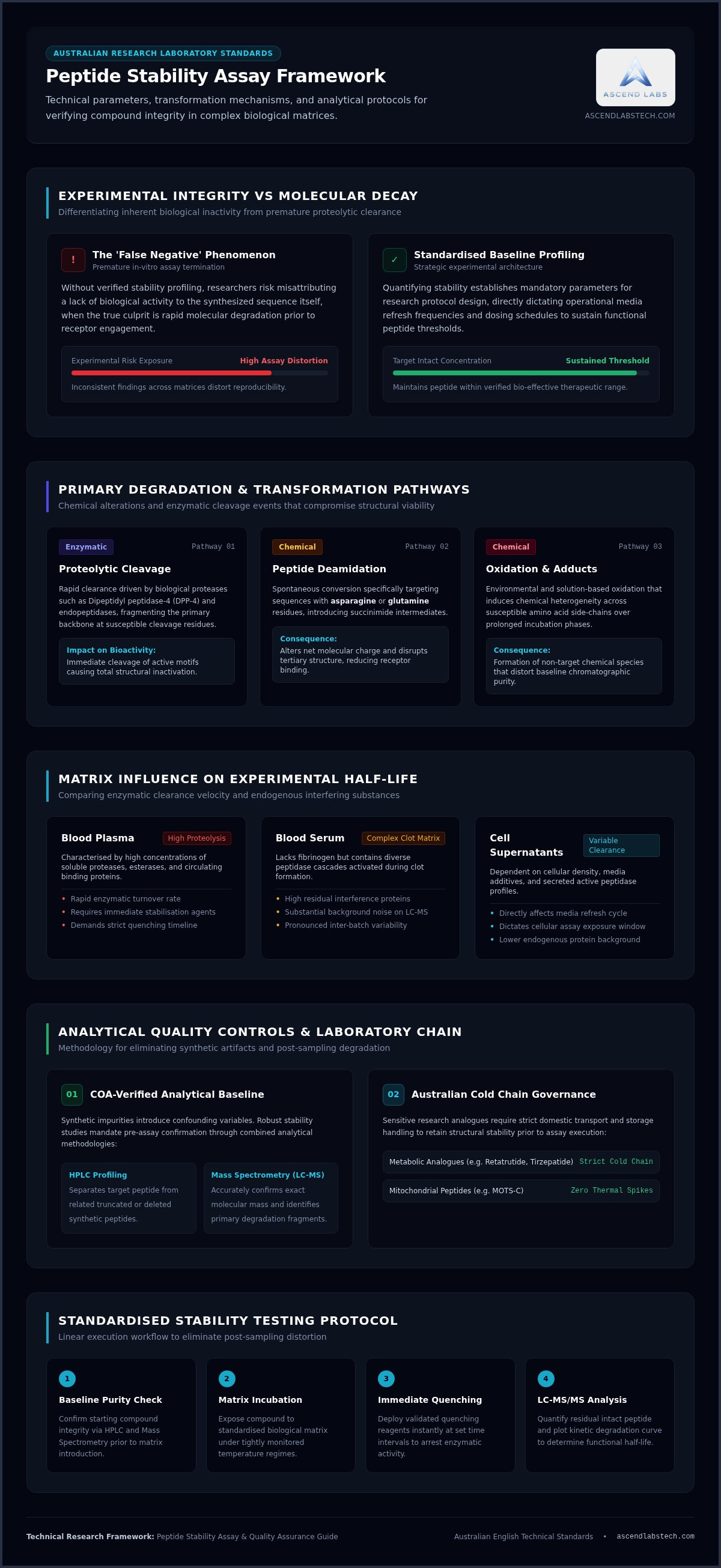
Peptide stability represents the inherent resistance of a molecular sequence to chemical or enzymatic transformation under specific environmental conditions. It's the fundamental metric that determines whether a compound remains structurally intact long enough to elicit a biological response. Within the Australian scientific landscape, this peptide stability assay guide serves as a technical benchmark for ensuring that experimental observations are the result of peptide-receptor interaction rather than the presence of degradation fragments. Without this verification, researchers risk attributing a lack of activity to the compound itself when the culprit is actually premature molecular decay.
When a peptide undergoes rapid proteolysis or chemical alteration, the resulting loss of bioactivity often leads to 'false negatives' in in-vitro assays. These errors can prematurely terminate viable research paths or lead to incorrect conclusions regarding a compound's potency. Establishing a clear stability profile is not merely a quality control step. It's a strategic requirement that dictates the design of research protocols, including media refresh rates and optimal dosing intervals. This data ensures that the concentration of the intact peptide remains within the effective range throughout the duration of the experiment.
To better understand the analytical complexities involved in quantifying these changes, watch this helpful video:
Biological Matrices and Their Challenges
The environment in which a peptide is studied significantly influences its half-life. Stability often varies dramatically between blood plasma, serum, and cell culture supernatants due to the varying concentrations of endogenous proteases and peptidases. In the context of Australian laboratory standards, a biological matrix is defined as a complex mixture of biological origin that contains the target analyte and potential interfering substances, such as proteins or lipids, which can influence assay performance.
The presence of specific enzymes can lead to rapid peptide clearance, necessitating the use of stabilisers or specific quenching agents. Chemical pathways also play a critical role. For instance, understanding peptide deamidation pathways is essential for researchers working with sequences containing asparagine or glutamine residues. These transformations can alter the peptide's net charge and tertiary structure, potentially rendering it inactive before the assay is complete.
Stability as a Prerequisite for Reproducibility
Inconsistent stability data is a primary contributor to the 'reproducibility crisis' currently facing modern biochemistry. Without a standardised baseline stability profile, researchers cannot distinguish between a compound's inherent biological inactivity and its premature degradation within the test system. This is particularly relevant when working with high-purity metabolic compounds such as Retatrutide or Tirzepatide, where structural integrity is paramount to research outcomes.
Establishing these benchmarks ensures that subsequent studies can be replicated across different laboratories with confidence. For a comprehensive overview of how initial compound quality influences these outcomes, refer to our guide on Peptide Purity Testing: A Professional Protocol for Australian Research Verification. Rigorous stability testing remains the only way to verify that your research compounds remain functional throughout the duration of your study.
Mechanisms of Peptide Degradation and Transformation
Peptide degradation is a multifaceted process governed by both the primary sequence and the surrounding environment. In this peptide stability assay guide, we categorise these transformations into enzymatic and chemical pathways. Enzymatic degradation is often the primary clearance mechanism in biological systems, where proteases like Dipeptidyl peptidase-4 (DPP-4) and Neprilysin (NEP) target specific cleavage sites. Identifying these vulnerable points is essential for researchers aiming to extend a compound's half-life within a biological matrix and ensure that the experimental results reflect the peptide's true pharmacological potential.
Chemical instability involves pathways such as deamidation, oxidation, and disulfide bond shuffling. These reactions occur independently of enzymes and are heavily influenced by the peptide's secondary structure, which can either shield or expose the amide backbone. A well-defined alpha-helix, for instance, can bury sensitive residues within a hydrophobic core, thereby reducing the rate of solvent-mediated hydrolysis. Adhering to ICH Q5C stability testing protocols allows laboratories to systematically track these changes over time. Understanding these mechanisms is particularly vital in triple agonist research, where compounds like Retatrutide must maintain structural integrity across multiple receptor-binding domains to remain effective.
Proteolytic Susceptibility in Metabolic Peptides
Modern metabolic research focuses heavily on GIP and GLP-1 analogues, which are frequently engineered to resist rapid proteolysis. For example, substituting specific amino acids at the N-terminus, such as the introduction of aminoisobutyric acid, can significantly increase resistance to DPP-4. Researchers now utilise bioinformatic tools to predict these cleavage points before commencing in-vitro studies. These modifications are critical because even a single cleavage event can completely abolish the peptide's affinity for its target receptor, leading to misleading assay results. Ensuring you start with high-purity metabolic research compounds is the first step in accurately mapping these proteolytic profiles.
Environmental and Chemical Stressors
Environmental factors such as pH and temperature act as catalysts for degradation. Buffer selection is critical for assay longevity, as pH-dependent degradation can accelerate deamidation or lead to irreversible precipitation. Temperature-induced aggregation also poses a significant risk, often manifesting as baseline drift or missing peaks during HPLC detection. Oxidation represents another major hurdle; specifically, the oxidation of the methionine residue in MOTS-C can lead to a significant loss of mitochondrial-regulatory activity and interfere with precise HPLC quantification. Maintaining a controlled environment and selecting appropriate storage conditions is essential for generating reproducible data in any professional laboratory setting.
Standard Protocols for Peptide Stability Assays
Executing a robust stability study requires a methodical approach to sample handling and analytical precision. This peptide stability assay guide outlines the core parameters necessary to generate high-fidelity data within an Australian laboratory setting. The process begins with the rigorous preparation of the biological matrix. This typically involves centrifugation at 3000 to 4000 g to remove cellular debris, followed by temperature equilibration to 37°C to simulate physiological conditions. Failure to equilibrate the matrix before spiking the peptide can lead to inaccurate initial degradation rates, as enzyme kinetics are highly temperature-dependent.
Incubation parameters must be clearly defined to capture the full degradation profile. Standard protocols involve multiple time points, often ranging from 0 to 120 minutes, with n=3 replicates at each interval to ensure statistical significance. Quenching the reaction is perhaps the most critical juncture. Researchers must select a method that provides instantaneous enzyme inactivation without compromising the analyte. While Trichloroacetic acid (TCA) offers rapid precipitation, Acetonitrile (ACN) is often preferred for its compatibility with downstream LC-MS workflows. Heat-induced precipitation is a third alternative, though it carries the risk of inducing peptide aggregation that can interfere with accurate quantification. Aligning these steps with ICH Q5C stability testing guidance ensures your research meets international benchmarks for biotechnological products.
Step-by-Step Assay Execution
Uniform peptide distribution is paramount for reproducibility. The peptide should be spiked into the pre-warmed matrix and vortexed immediately to ensure a homogenous mixture. The zero-time (T0) control serves as the non-negotiable baseline for all subsequent calculations. It accounts for any immediate non-specific binding to plasticware or instant degradation upon contact with the matrix. By optimising the quenching step, you prevent post-sampling degradation, which is a common source of error that artificially shortens the calculated half-life of specialised research compounds.
Detection and Quantification Techniques
Quantification of the remaining parent peptide is typically achieved via Reverse-Phase HPLC (RP-HPLC). This technique provides the resolution required to monitor both purity and structural stability over time. When the objective is to identify specific degradation fragments or cleavage sites, Mass Spectrometry (LC-MS) becomes essential. By plotting the natural log of the peak area against time, researchers can derive the degradation rate constant (k). This value allows for the precise calculation of the half-life (t1/2), providing a definitive metric for comparing the stability of different peptide analogues or formulations.
Optimising Laboratory Handling and Storage in Australia
Maintaining the integrity of a compound begins long before the first pipette is drawn. In the Australian context, the 'cold chain' presents a unique logistical challenge due to extreme ambient temperatures that can exceed 40°C during domestic transit. This peptide stability assay guide emphasises that domestic supply chains are superior for minimising thermal fluctuations. Upon laboratory arrival, immediate assessment of temperature indicators is critical. Lyophilised powders offer significantly higher long-term stability compared to peptides in solution, as the absence of water arrests most chemical degradation pathways.
Mitigating Thermal Degradation
Long-term storage of research compounds requires a stable -80°C environment to preserve molecular structure. In Australia's humid regions, atmospheric moisture can infiltrate vials during retrieval, leading to hydrolytic degradation. The use of desiccants within secondary storage containers is a necessary safeguard against this moisture ingress. Utilising low-protein binding tubes is essential to prevent the non-specific adsorption of peptides to the internal surface of the vial, which can lead to significant losses in concentration before an assay even begins.
Reconstitution Protocols for Maximum Stability
The choice of solvent dictates the peptide's shelf-life in its liquid state. While sterile water is standard, certain metabolic compounds require specialised buffers to maintain a specific pH and prevent aggregation. Mechanical shearing is a frequent but overlooked cause of degradation; long-chain peptides should never be vortexed during reconstitution. Instead, gentle inversion or swirling is required to achieve a homogenous solution. Understanding the stability windows for GIP receptor agonist research compounds is vital, as these sequences can be particularly sensitive to environmental stressors once reconstituted.
Freeze-thaw cycles are detrimental to peptide integrity. Each cycle promotes the formation of ice crystals that can physically disrupt the peptide's tertiary structure or induce irreversible aggregation. To mitigate this risk, laboratory practitioners should aliquot the reconstituted peptide into single-use volumes immediately after the initial preparation. This practice ensures that the bulk of the research material remains undisturbed at -80°C, preserving the accuracy of your stability assays and the reliability of your data sets.
Securing High-Purity Compounds for Reliable Assay Outcomes
The technical rigour of a peptide stability assay guide is ultimately dependent on the quality of the starting material. If a compound enters the laboratory with pre-existing degradation products or synthetic impurities, the resulting stability data will be fundamentally skewed. For researchers, assay validity starts with the Certificate of Analysis (COA). This document provides the essential baseline for structural integrity, ensuring that the observed degradation kinetics are a property of the peptide itself rather than a result of residual solvents or truncated sequences. Using unverified or sub-standard peptides introduces variables that can't be corrected through protocol alone, often leading to wasted resources and irreproducible findings.
Ascend Labs maintains a disciplined approach to quality assurance, ensuring that every compound in the Ascend Labs product catalogue meets stringent purity requirements. By utilising both High-Performance Liquid Chromatography (HPLC) and Mass Spectrometry, we verify the molecular weight and chemical purity of every batch. This dual-verification process is the only way to guarantee that compounds like Tirzepatide or Growth Factor Peptides arrive in a state that permits precise, benchmarked stability testing.
Interpreting COA and HPLC Data
A professional chromatogram is more than a simple purity percentage; it's a map of molecular consistency. When reviewing HPLC data, researchers must distinguish between baseline electronic noise and the distinct peaks that indicate impurities. For metabolic research compounds, a purity level of 99% or higher is the preferred standard. This high threshold is particularly important for longitudinal stability studies where batch-to-batch consistency is required to track subtle degradation over extended timeframes. Without this level of precision, minor impurities can act as catalysts, accelerating chemical transformations like oxidation and rendering your stability results unreliable.
The Advantage of Domestic Australian Supply
Logistical efficiency is a critical factor in maintaining the structural integrity of sensitive neuromodulators and metabolic analogues. International transit often exposes research materials to uncontrolled thermal environments and prolonged delays, which can initiate the very degradation pathways you intend to study. Ascend Labs mitigates these risks by providing a domestic Australian supply, significantly reducing transit time and ensuring compounds aren't subjected to the stressors of global shipping. Our discreet, secure shipping is tailored specifically for the Australian scientific community, providing a reliable foundation for your experimental work.
Explore our range of COA-verified research peptides for your next stability assay.
Advancing Analytical Precision in Peptide Research
Achieving reliable data requires a meticulous integration of rigorous protocols and premium materials. This peptide stability assay guide has detailed the necessity of standardising incubation parameters and selecting appropriate quenching agents to prevent post-sampling degradation. Precision is essential. Managing the environmental stressors inherent to the Australian climate is equally paramount for maintaining the structural integrity of complex neuromodulators and metabolic analogues. These foundational steps ensure that your results reflect true biological activity rather than experimental artefact.
Ascend Labs remains dedicated to supporting the Australian scientific community. We provide compounds that meet the highest clinical-grade research standards. With COA and Mass Spectrometry verification on all batches, you can proceed with your stability studies with absolute confidence in your molecular baseline. Reliable domestic Australian shipping ensures your compounds don't face the degradation risks associated with international transit.
We look forward to facilitating your next serious inquiry. High-purity, verified research compounds are the cornerstone of scientific truth.
Frequently Asked Questions
What is a peptide stability assay and why is it necessary?
A peptide stability assay is a quantitative test used to measure the rate at which a peptide degrades in a specific biological or chemical environment. It's necessary because it establishes the compound's half-life and identifies the breakdown products that may interfere with experimental data. This peptide stability assay guide highlights that without this baseline, researchers cannot distinguish between a compound's lack of biological activity and its premature degradation within the test system.
How do I calculate the half-life of a peptide in blood plasma?
To calculate the half-life (t1/2), you must first determine the degradation rate constant (k) by plotting the natural logarithm of the remaining peptide concentration against time. The slope of this linear regression represents k. The half-life is then calculated using the formula t1/2 = 0.693 / k. This quantitative approach allows for precise comparisons of stability across different biological matrices, ensuring your research into metabolic compounds like Retatrutide is grounded in robust kinetics.
Which quenching method is best for stopping enzymatic degradation?
The optimal quenching method depends on the downstream analytical requirements, but Acetonitrile (ACN) precipitation is widely regarded as the most versatile for LC-MS workflows. ACN provides immediate enzyme inactivation while maintaining the solubility of many research peptides. Alternatively, Trichloroacetic acid (TCA) offers rapid precipitation but may require additional neutralisation steps. Researchers should select a method that stops the reaction instantaneously at each time point to prevent post-sampling degradation and ensure data accuracy.
Can I use a peptide for research if it has been stored at room temperature?
Peptides stored at room temperature for extended periods typically undergo significant degradation and should be verified via HPLC before use. While lyophilised powders are more stable than solutions, exposure to ambient heat can initiate deamidation and oxidation. If a compound has been compromised, it may yield false negatives or inconsistent results. For sensitive research into neuromodulators or growth factors, using only COA-verified compounds that have been maintained within a strict cold chain is essential.
What are the most common degradation pathways for metabolic peptides?
Metabolic peptides primarily degrade through enzymatic proteolysis and chemical transformation. Proteases like DPP-4 and NEP target specific amide bonds, leading to rapid clearance in biological systems. Chemical pathways include deamidation of asparagine residues and the oxidation of sulfur-containing amino acids. Understanding these specific vulnerabilities is a core component of any peptide stability assay guide, as it allows researchers to predict the metabolic fate of compounds like Tirzepatide during in-vitro studies.
How does pH affect the stability of research compounds like MOTS-C?
The stability of MOTS-C and similar compounds is highly pH-dependent, as extreme acidity or alkalinity can catalyse hydrolytic cleavage and deamidation. Most peptides exhibit maximum stability near their isoelectric point, where the net charge is zero. Deviating from the optimal pH range can also induce irreversible aggregation or precipitation, which complicates HPLC quantification. Precise buffer selection is therefore critical to maintain the structural integrity of the compound throughout the duration of the stability assay.
Why is HPLC preferred over other methods for stability testing?
High-Performance Liquid Chromatography (HPLC) is preferred because it offers the high resolution required to separate the intact parent peptide from its various degradation products. Unlike simpler spectroscopic methods, HPLC allows for the precise quantification of the remaining analyte based on peak area. When coupled with Mass Spectrometry, it becomes an even more powerful tool, enabling the identification of specific cleavage sites and providing a comprehensive profile of the peptide's chemical and structural stability over time.
How should I store my research peptides to prevent degradation in the Australian climate?
To counter the Australian climate, store lyophilised peptides in a -80°C freezer and use desiccants to prevent moisture ingress. Aliquotting reconstituted peptides into single-use volumes is essential to avoid repeated freeze-thaw cycles, which physically disrupt molecular structure. Choosing a domestic supplier like Ascend Labs also reduces the risk of thermal degradation, as compounds are shipped via a secure Australian cold chain, ensuring they arrive with their structural integrity and purity fully intact.


