

A 95% purity rating on a certificate of analysis is often a failure in disguise for high-precision metabolic research. While that figure might satisfy basic requirements, it leaves a significant margin for unidentified impurities that can introduce uncontrollable variables into your study. You likely recognise that the integrity of your data depends entirely on the chemical consistency of your compounds. Uncertainty regarding batch-to-batch variation or the inability to accurately interpret complex HPLC graphs can lead to costly research failures that are difficult to rectify.
This professional protocol for peptide purity testing provides the technical framework you need to verify compound integrity. You'll master the process of reading a Certificate of Analysis with clinical precision, ensuring your Australian laboratory results remain both accurate and reproducible. We'll examine the critical distinctions between 95% and 99% purity levels, explain how to verify HPLC wavelengths at the 214 nm standard, and establish a rigorous verification sequence for compounds like Retatrutide and Tirzepatide. By the end of this guide, you'll have the confidence to act as an authoritative gatekeeper for your laboratory's chemical standards.
Key Takeaways
- Recognise that research-grade standards require a minimum of 98% purity to ensure data reproducibility and prevent unidentified variables in laboratory studies.
- Master the analysis of High-Performance Liquid Chromatography (HPLC) chromatograms by evaluating peak symmetry and verifying absorption at the critical 214 nm wavelength.
- Identify common synthesis errors, including deletion and truncated sequences, that can compromise the integrity of advanced compounds like Retatrutide and Tirzepatide.
- Implement a standardised intake protocol for peptide purity testing that incorporates rigorous visual inspection and batch-specific traceability for all new research materials.
- Ensure research continuity by sourcing high-purity metabolic compounds from domestic Australian suppliers committed to transparent verification and domestic stability.
The Fundamentals of Peptide Purity Standards
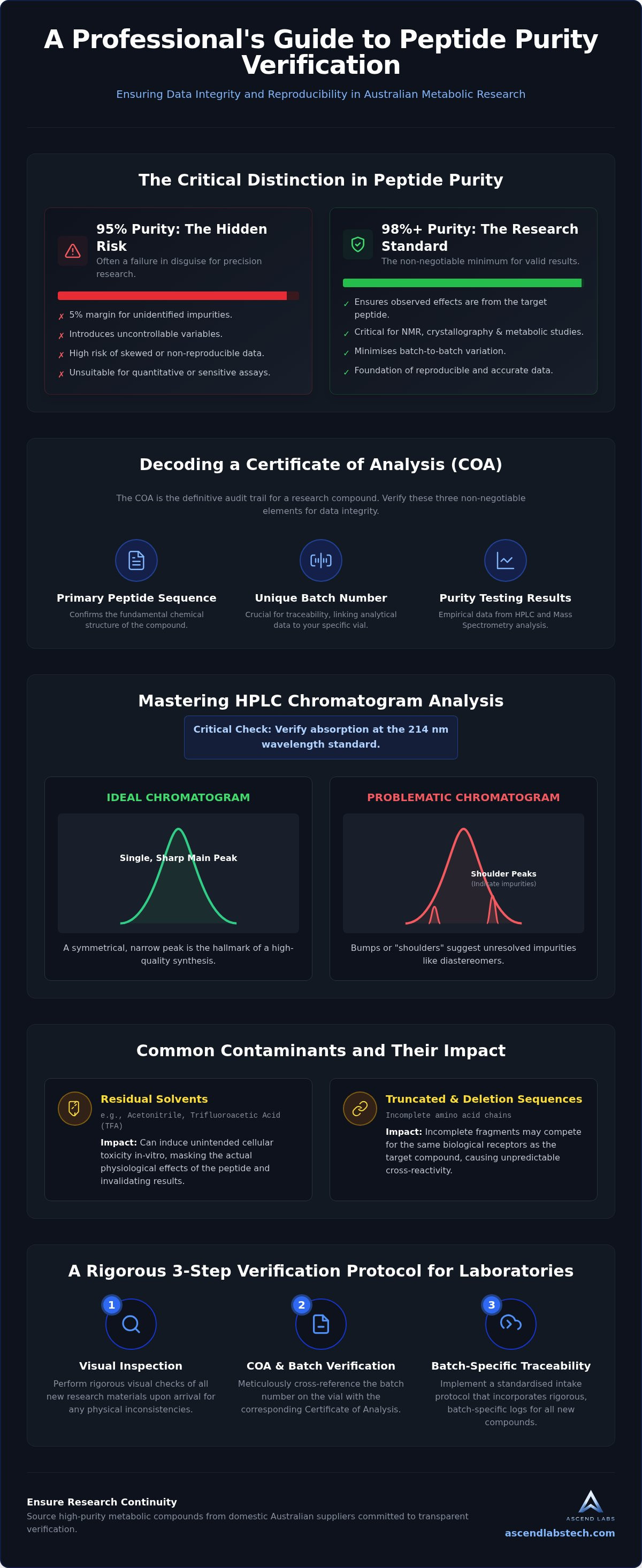
Peptide purity is defined as the mass percentage of the target peptide sequence relative to the total quantity of all related substances that absorb at the 214 nm wavelength. This metric is the cornerstone of peptide purity testing; it quantifies the presence of the desired amino acid chain against the background of synthesis-related byproducts. In a professional research environment, chemical purity must be distinguished from biological activity. While chemical purity refers to the absence of contaminants, biological activity describes the compound's capacity to elicit a specific physiological response. High chemical purity is a prerequisite for reliable activity, but it's not the sole determinant of success. In Australian laboratories, the data's precision is inextricably linked to the chemical profile of the compound. Rigorous peptide purity testing ensures that the observed effects are solely attributable to the target sequence, rather than synthesis byproducts.
Mapping Purity Levels to Research Applications
Laboratory standards are categorised by the sensitivity of the intended assay. Purity levels between 95% and 98% are typically reserved for initial screening or qualitative assays where minor variances won't compromise the primary objective. However, "Research Grade" usually demands a minimum of 98% purity. This tier is essential for quantitative studies, NMR spectroscopy, and crystallography. For advanced metabolic research compounds such as Tirzepatide or Retatrutide, the requirement for 98% or higher purity is non-negotiable. These compounds interact with intricate metabolic pathways where even minute impurities can alter ligand-receptor binding affinity, leading to skewed or non-reproducible data.
The Cost of Impurity in Scientific Inquiry
The presence of contaminants is often an unavoidable byproduct of the peptide synthesis process. If these impurities aren't meticulously removed through purification stages, they introduce significant risks to experimental reproducibility. Residual solvents like acetonitrile or trifluoroacetic acid (TFA) are particularly problematic; they can induce unintended cellular toxicity in-vitro, effectively masking the actual physiological effects of the peptide. Truncated sequences, which occur when amino acid chains fail to complete during the coupling phase, present a different danger. These incomplete fragments may compete for the same biological receptors as the target compound, causing unpredictable cross-reactivity. Maintaining the integrity of the Australian research chemical supply chain requires a disciplined approach to batch-to-batch verification. Without it, the scientific signal of your research is easily lost in the chemical noise of contamination.
How to Read a Peptide Certificate of Analysis (COA)
A Certificate of Analysis (COA) serves as the definitive audit trail for any research compound. It provides a technical snapshot of the material's chemical state at the point of synthesis and purification. For Australian researchers, this document must contain three non-negotiable elements for verification: the primary peptide sequence, a unique batch number, and the empirical results of peptide purity testing. Without a specific batch number, traceability is compromised, as the analytical data cannot be reliably linked to the specific vial in your laboratory. Meticulous review of these documents is the first step in ensuring your data remains precise and reproducible.
Step 1: Deciphering the HPLC Chromatogram
High-Performance Liquid Chromatography (HPLC) is the industry standard for determining purity by separating the target peptide from related substances. When you analyse the chromatogram, look for a single, sharp 'main peak' that dominates the x-axis. The integration area under this curve (AUC) is what determines the stated purity percentage. You should be cautious of 'shoulder peaks' or small bumps on the leading or trailing edges of the main peak. These often indicate the presence of diastereomers or closely related impurities that weren't fully resolved during the purification process. A symmetrical, narrow peak is the hallmark of a high-quality synthesis.
Step 2: Verifying Mass Spectrometry Results
While HPLC confirms the purity of the sample, Mass Spectrometry (MS) is required to confirm its identity. The MS report should list a 'Found Mass' that aligns with the 'Theoretical Mass' calculated from the amino acid sequence. In the spectrum, you'll typically observe the [M+H]+ ion for smaller peptides or the [M+2H]2+ ion for larger metabolic sequences; these represent the mass of the peptide plus one or two hydrogen protons, respectively. Mass Spectrometry confirms the identity of compounds like Retatrutide by verifying that the observed molecular weight aligns precisely with its specific triple-agonist chemical formula.
Secondary metrics in the COA summary table also warrant your attention. Moisture content and residual salt levels, particularly Trifluoroacetic acid (TFA), are critical for calculating the true peptide content of your lyophilised powder. High TFA levels can skew concentration calculations and may introduce unintended variables in sensitive in-vitro assays. Professional laboratories often prioritise compounds with low residual TFA to maintain a stable and predictable research environment. Reviewing these technical documents allows you to verify the integrity of your research materials before you commit to complex laboratory protocols.
Identifying Common Peptide Contaminants and Impurities
While the previous sections established the metrics for verification, understanding the chemical origin of impurities is essential for a complete assessment. High-standard peptide purity testing identifies more than just a percentage; it characterises the specific errors that occur during the iterative stages of solid-phase synthesis. Deletion sequences are a primary concern. These occur when an amino acid fails to couple to the growing chain, resulting in a peptide missing one or more residues. Conversely, truncated sequences arise when the reaction terminates prematurely, often due to steric hindrance or aggregation. These fragments can mimic the target peptide's binding properties while lacking its biological efficacy, potentially confounding your experimental results. Errors are inevitable without rigorous oversight.
Incomplete deprotection remains another common technical hurdle. During synthesis, protecting groups are used to prevent side-chain reactions, but if these are not entirely removed, they remain attached to the final compound. This increases the observed molecular mass and typically renders the peptide biologically inert. Beyond synthesis errors, residual solvents from the purification process, such as acetonitrile or trifluoroacetic acid (TFA), can persist in the final lyophilised cake. Professional peptide purity testing must account for these chemical artifacts to ensure the compound's safety for in-vitro applications.
The Role of TFA in Peptide Stability
Most synthetic peptides are provided as TFA salts because trifluoroacetic acid is the standard mobile phase used during reverse-phase HPLC purification. While TFA provides excellent solubility and stability for many sequences, its presence can drastically lower the pH of research solutions. This acidity may interfere with pH-sensitive assays or affect cell viability. In such instances, performing a salt exchange to an acetate or hydrochloride form is a necessary step to align the compound with specific research requirements. Recognising the salt form of your compound is a fundamental aspect of laboratory quality control.
Spotting Synthesis By-products
Diastereomers represent a subtle but significant impurity, forming when an amino acid undergoes racemisation during the coupling process. These isomers have the same mass but different spatial configurations, which can significantly alter their interaction with biological targets. Oxidative stress during synthesis or storage can also lead to the unwanted formation of disulphide bridges between cysteine residues. These structural aberrations are particularly disruptive in mitochondrial peptide research, where precise folding is required for the compound to traverse mitochondrial membranes and interact with internal proteins. Maintaining a disciplined verification protocol ensures these by-products don't compromise your scientific inquiry.
A Verification Protocol for Australian Laboratories
Establishing a standardised intake procedure is critical for maintaining research integrity. Upon arrival, every vial must undergo a visual inspection. The lyophilised powder should appear as a uniform, white or off-white "cake" or loose powder. Any discolouration, clumping, or signs of moisture suggests degradation or improper handling during transit. Before committing to high-value assays, conduct internal solubility testing using a small aliquot. If the peptide fails to dissolve in the recommended buffer despite the COA's claims, it may indicate a salt form mismatch or the presence of insoluble impurities. These initial checks act as the first line of defence against compromised data.
Rigorous peptide purity testing extends beyond the supplier's provided documentation. While a COA is essential, cross-referencing this data with independent third-party verification is the gold standard for Australian research. This involves comparing the chromatograms and mass spectra from the supplier against verified benchmarks or internal standards. If discrepancies arise in the peak symmetry or molecular weight, the batch should be quarantined immediately. A disciplined verification protocol ensures that your laboratory resources are only invested in compounds that meet the highest analytical thresholds.
Intake and Storage Procedures
Beyond the scope of laboratory research, the principles of rigorous contamination testing are essential for ensuring the safety of physical environments. For those requiring professional verification of property standards, Methamphetamine Testing Services NZ Limited offers specialised screening to detect hazardous residues in residential and commercial spaces.
Precision begins at the point of receipt. Document all batch numbers and expiry dates in a centralised laboratory information management system to ensure full traceability throughout the study's lifecycle. To preserve chemical stability, store peptides at -20°C for short-term use or -80°C for long-term archiving. It's critical to avoid frequent freeze-thaw cycles; instead, aliquot the stock into single-use quantities. This practice prevents the mechanical stress and moisture condensation that lead to rapid peptide degradation and subsequent research failure.
Evaluating Supplier Transparency
Finding a reputable peptide supplier in Australia requires an assessment of their technical transparency. A credible partner provides batch-specific HPLC and MS reports as standard, rather than generic templates. For specialised compounds like KLOW, you should be able to request additional data regarding residual solvent levels or salt content without hesitation. This level of disclosure is what separates a mere vendor from a dedicated research partner. To ensure your laboratory operates with the highest-grade compounds, you can order verified research peptides from a specialist who prioritises analytical rigor above all else.
Sourcing High-Purity Research Compounds with Confidence
The efficacy of any laboratory protocol is ultimately limited by the quality of the starting material. While the verification steps outlined in this guide provide a necessary safety net, sourcing from a specialist who prioritises peptide purity testing at the point of origin is the most effective way to ensure research continuity. Ascend Labs operates as a disciplined curator of high-purity research peptides, positioning itself as an authoritative gatekeeper for the Australian scientific community. By focusing on advanced metabolic compounds like Retatrutide and Tirzepatide, we provide researchers with access to the specific agonists required for modern metabolic and growth factor studies. Our commitment to transparency ensures that every compound is backed by the analytical rigour necessary for peer-reviewed data.
Domestic supply remains a critical factor in maintaining compound integrity. Peptides are inherently sensitive to thermal fluctuations and mechanical stress during transit. Sourcing through a domestic Australian supply chain reduces transit times significantly, ensuring that lyophilised cakes remain stable and free from the degradation risks associated with prolonged international logistics. This focus on domestic stability, combined with stringent peptide purity testing, allows Australian laboratories to maintain higher operational standards and more predictable experimental outcomes. Precision is not merely a goal; it's the standard upon which we operate.
The Ascend Labs Standard of Excellence
Our selection process is defined by a "substance over style" philosophy that values scientific truth above all else. Every compound in our inventory undergoes a meticulous verification sequence to ensure it meets the specific requirements of Australian research environments. We don't merely act as a vendor; we function as a principled institution that provides the technical documentation required for serious inquiry. This includes providing batch-specific HPLC and MS reports that allow you to verify the identity and purity of your compounds with absolute confidence. Our operation is built on professional ethics and a deep commitment to the meticulousness required by advanced practitioners.
Next Steps for Your Research Project
Integrating high-standard compounds into your next study is a straightforward process designed for efficiency and precision. By accessing our comprehensive catalogue of metabolic and growth factor peptides, you can secure the materials needed for complex quantitative assays without the uncertainty of batch-to-batch variation. Whether your study involves MOTS-C or specialised recovery peptides, our framework ensures you receive materials that have already passed through a rigorous quality assurance filter. Explore our range of high-purity research peptides today to ensure your laboratory data remains precise and reproducible.
Advancing Australian Research Through Analytical Rigour
Maintaining the integrity of laboratory data requires a disciplined commitment to chemical verification. You now possess the technical framework to interpret complex HPLC chromatograms and identify the synthesis errors that often compromise research outcomes. By implementing a standardised intake protocol and demanding batch-specific documentation, you ensure that unidentified variables don't undermine your scientific inquiry. Professional peptide purity testing isn't merely an administrative requirement; it's the essential safeguard that preserves the validity of your study.
Ascend Labs remains a principled partner for specialists who value precision and transparency. As an Australian-owned and operated institution, we provide batch-specific HPLC/MS verification for every compound, ensuring your materials meet the highest clinical-grade standards. Our discreet domestic shipping further protects the stability of your research peptides, allowing you to focus on achieving reproducible results. Secure your high-purity research compounds from Ascend Labs to establish a foundation of excellence for your next project. Your commitment to meticulous verification is the first step toward significant scientific discovery.
Frequently Asked Questions
What is the difference between 95% and 99% peptide purity for research?
The primary difference lies in the margin for unidentified chemical variables that can skew quantitative data. A 99% purity level ensures that only 1% of the material consists of synthesis by-products, whereas 95% purity allows for a significant 5% contaminant load. For high-precision studies involving metabolic agonists, this 4% variance can lead to inconsistent receptor-binding results and compromised reproducibility in the laboratory environment. Precision requires the highest possible purity standards.
How can I tell if a peptide COA is legitimate or forged?
A legitimate Certificate of Analysis must include a unique batch number that corresponds directly to your specific vial. You should scrutinise the HPLC chromatogram for unique baseline noise and specific integration data rather than a perfectly clean, generic image. If the report lacks a timestamp or the theoretical mass doesn't align with the amino acid sequence, the document's authenticity is highly questionable. Cross-referencing with third-party verification remains the most reliable safeguard.
Why is HPLC the preferred method for testing peptide purity in Australia?
High-Performance Liquid Chromatography is the preferred method because it provides the most accurate separation of the target sequence from closely related impurities. By measuring absorption at the 214 nm wavelength, it detects peptide bonds with high sensitivity. This allows researchers to quantify the exact mass percentage of the desired compound. It remains the industry benchmark for peptide purity testing due to its high resolution and reliability in complex analytical settings.
Does the appearance of the lyophilised powder indicate its purity?
The visual appearance of a lyophilised cake is an unreliable indicator of chemical purity. While a uniform white powder suggests proper freeze-drying, it cannot reveal the presence of truncated sequences or residual solvents. A compound could appear physically perfect while containing significant chemical contaminants or even consisting primarily of bulking agents. Only rigorous peptide purity testing through HPLC and Mass Spectrometry can confirm the actual chemical composition of the research material.
What are the most common impurities found in synthetic research peptides?
The most frequent impurities include:
- Deletion sequences where an amino acid failed to couple during synthesis.
- Truncated sequences caused by premature chain termination.
- Incomplete deprotection where side-chain protecting groups remain attached to the peptide.
- Residual solvents such as acetonitrile or trifluoroacetic acid from the purification phase.
These by-products are inherent risks of the synthesis process and must be meticulously removed during the purification stages to ensure research integrity.
How does residual TFA affect my in-vitro research results?
Residual trifluoroacetic acid (TFA) acts as a strong counter-ion that can significantly lower the pH of your reconstituted research solutions. In sensitive in-vitro assays, this increased acidity may induce cellular toxicity or alter the conformation of the peptide itself. If your research involves pH-sensitive biological systems, you should consider a salt exchange to acetate or hydrochloride forms to prevent these unintended experimental variables from masking your results.
Should I re-test my peptides if they have been stored for over six months?
Re-testing is highly recommended if the compounds haven't been stored under optimal conditions, such as -80°C in a desiccated environment. Peptides are susceptible to hydrolysis and oxidation over time; these processes reduce the effective concentration and introduce new degradation products. If you observe any change in solubility or if the material has undergone multiple freeze-thaw cycles, a secondary purity check ensures that your data remains grounded in stable chemical facts.
How do I interpret the mass spectrometry peak for a large peptide?
For larger metabolic peptides, you'll often see multiple charged ions rather than a single molecular peak. Instead of the standard [M+H]+ ion, you might identify the [M+2H]2+ or [M+3H]3+ peaks, which represent the molecular weight divided by the number of attached protons. To find the actual mass, multiply the observed m/z value by the charge number and subtract the mass of the protons. This verification confirms the identity of complex sequences with high precision.


