

The traditional view of mitochondria as mere cellular powerhouses is officially obsolete. Modern evidence suggests these organelles function as sophisticated signalling hubs that dictate metabolic health and cellular longevity through a hidden proteome. This paradigm shift has accelerated mitochondrial peptide research, transforming how we understand age-related physiological decline and systemic homeostasis.
You likely recognise the frustration of navigating dense academic literature only to find that sourcing high-purity compounds within Australia remains a significant hurdle. This article provides a definitive technical briefing on the mechanisms, signalling pathways, and research applications of mitochondrial-derived peptides (MDPs) for the local scientific community. We'll examine the specific roles of MOTS-c and KLOW in longevity studies, while outlining the essential protocols for verifying compound integrity via COA and HPLC. By the end of this guide, you'll have a comprehensive understanding of MDP signalling and a clear pathway to identifying reliable, domestically verified compounds for your inquiry.
Key Takeaways
- Understand the paradigm shift viewing mitochondria as sophisticated signalling hubs that regulate cellular longevity via a unique proteome.
- Identify the specific mechanisms of action, including AMPK pathway activation, that allow mitochondrial-derived peptides to modulate metabolic health.
- Compare the distinct research applications of MOTS-c and KLOW, focusing on metabolic flexibility and anti-ageing markers.
- Master the technical protocols required for mitochondrial peptide research, from precise reconstitution to specialised storage requirements.
- Evaluate the advantages of domestic Australian sourcing to maintain compound integrity through verified COA and HPLC standards.
The Evolution of Mitochondrial Peptide Research in 2026
The scientific understanding of mitochondrial function has undergone a radical transformation. For decades, academic texts described these organelles as passive energy producers. We now recognise them as active regulators of cellular fate and systemic health. This shift has placed mitochondrial peptide research at the forefront of modern longevity science. The discovery of a hidden mitochondrial proteome suggests that these organelles exert profound influence through secreted signalling molecules.
Mitochondria aren't isolated components. They act as sophisticated sensors that respond to metabolic stress by releasing specific peptides. These molecules then travel to the nucleus or across cell membranes to alter gene expression. This process is essential for maintaining physiological balance as research models age. Investigating these pathways requires an uncompromising focus on molecular precision and compound integrity.
What are Mitochondrial-Derived Peptides (MDPs)?
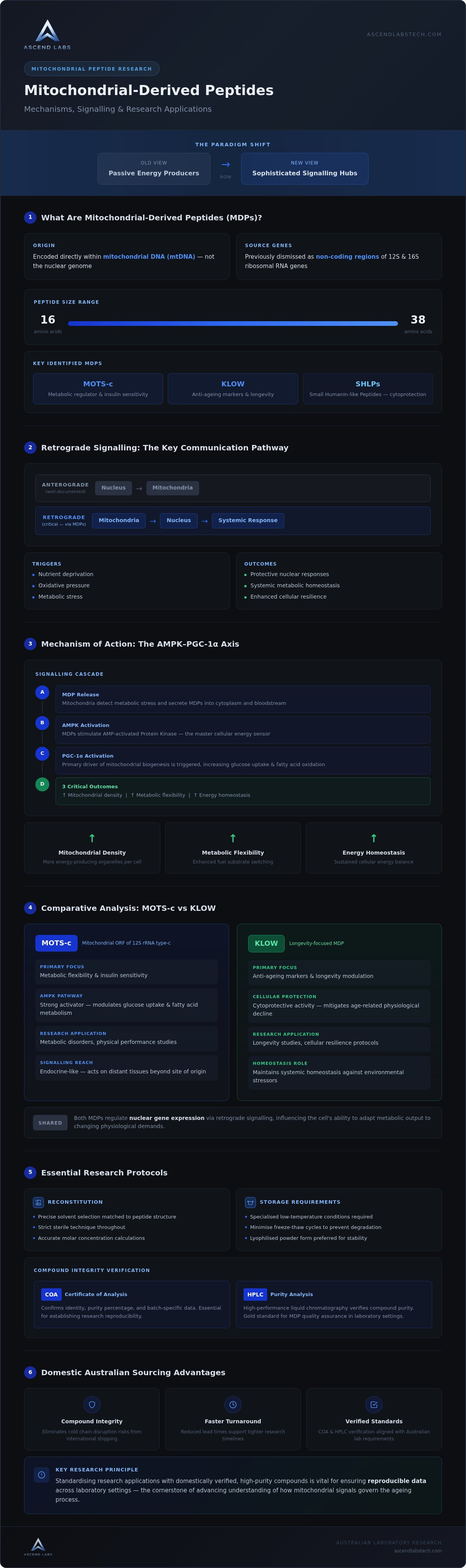
MDPs are short, bioactive peptides encoded directly within the mitochondrial DNA (mtDNA) rather than the nuclear genome. These sequences were previously dismissed as non-coding regions of the 12S and 16S ribosomal RNA genes. Current mitochondrial peptide research identifies several key peptides, including MOTS-c and the Small Humanin-like Peptides (SHLPs), which possess potent biological activity. These peptides typically consist of 16 to 38 amino acids and function as metabolic regulators. They influence critical pathways including insulin sensitivity and cellular cytoprotection. For the Australian scientific community, understanding the structural nuances of these compounds is the first step in designing robust longevity protocols.
The Significance of Retrograde Signalling
Retrograde signalling describes the communication pathway from the mitochondria back to the nucleus. While anterograde signalling (nucleus to mitochondria) is well-documented, the reverse is proving critical for cellular resilience. MDPs act as the primary messengers in this pathway. When mitochondria encounter stressors, such as nutrient deprivation or oxidative pressure, they secrete peptides to trigger protective nuclear responses. This mechanism is a central focus for investigating how to mitigate age-related physiological decline. By influencing nuclear gene expression, MDPs help maintain systemic metabolic homeostasis and enhance cellular resilience against environmental stressors. This intricate feedback loop ensures that the cell can adapt its metabolic output to meet changing physiological demands.
The shift toward viewing mitochondria as signalling hubs requires researchers to adopt more sophisticated tools. Precise molecular inquiry into these stress responses depends on the availability of high-purity metabolic research compounds. As we move further into 2026, the focus remains on standardising these research applications to ensure reproducible data across laboratory settings. This methodical approach is vital for advancing our understanding of how mitochondrial signals govern the ageing process.
Mechanisms of Action: How MDPs Regulate Cellular Function
The biological utility of mitochondrial-derived peptides extends far beyond the mitochondrial matrix. Current evidence in mitochondrial peptide research demonstrates that these molecules act as systemic regulators, influencing tissues distant from their site of origin. This endocrine-like function is mediated through specific enzymatic pathways and cellular sensors that monitor metabolic demand. By facilitating communication between the mitochondria and the rest of the cell, MDPs ensure that physiological processes remain synchronised under stress.
The AMPK-PGC-1α Axis
One of the most significant mechanisms identified is the activation of the Adenosine Monophosphate-activated Protein Kinase (AMPK) pathway. MDPs increase cellular uptake of glucose and enhance fatty acid oxidation by stimulating this energy sensor. This activation triggers the PGC-1α transcriptional coactivator, which acts as the primary driver of mitochondrial biogenesis. In laboratory models, this sequence results in three critical outcomes: increased mitochondrial density, enhanced metabolic flexibility, and improved cellular energy homeostasis. These findings are vital for studies investigating metabolic disorders and physical performance. By modulating the AMPK pathway, MDPs provide a molecular framework for understanding how cells adapt to increased physiological workloads.
MDPs and Cellular Proteostasis
Maintaining the integrity of the cellular proteome is essential for longevity science. MDPs influence proteostasis by regulating the folding, trafficking, and degradation of proteins. They interact with the heat shock response to prevent the accumulation of misfolded proteins, which is a hallmark of age-related decline. This mechanism is particularly relevant in regenerative studies, such as those involving peptides for connective tissue research, where structural protein integrity is paramount. By ensuring proteins are correctly folded and functional, MDPs support the long-term health of complex tissue systems.
Beyond proteostasis, these peptides serve a critical role in reducing oxidative stress. They modulate the production of reactive oxygen species (ROS) and enhance the expression of endogenous antioxidant enzymes. This dual action—protecting protein structure while mitigating oxidative damage—supports sustained cellular resilience. Exploring systemic inflammation is another frontier in this field. Data suggest that mitochondrial-derived signalling can suppress pro-inflammatory cytokines, potentially offering a pathway to modulate chronic, low-grade inflammation in research models.
For the Australian scientific community, investigating these complex interactions depends on access to high-purity compounds. Researchers seeking to advance their inquiry can find verified metabolic research compounds through dedicated domestic channels that prioritise analytical verification. This ensures that experimental outcomes are based on precise, uncontaminated molecular data, allowing for more accurate assessments of peptide-driven signalling pathways.
Comparative Analysis: MOTS-c vs KLOW in Longevity Research
Distinguishing between specific peptides is essential for targeted mitochondrial peptide research. While early inquiry focused on general mitochondrial function, current studies prioritise the distinct signalling architectures of MOTS-c and KLOW. These compounds operate via unique pathways, requiring researchers to select the appropriate molecule based on the specific metabolic or protective outcomes they wish to investigate. Understanding these differences is vital for designing robust experimental protocols.
MOTS-c: The Metabolic Regulator
MOTS-c is a 16-amino acid peptide encoded within the 12S rRNA region of the mitochondrial genome. It functions as a metabolic rheostat, translocating to the nucleus in response to cellular stress to regulate glucose metabolism and fatty acid oxidation. It's frequently categorised as an exercise mimetic because it replicates many of the physiological benefits of physical exertion at the cellular level. This makes it a primary tool for studies involving obesity and type 2 diabetes models. While triple-agonist molecules like retatrutide target systemic hormonal pathways, MOTS-c offers a direct mitochondrial intervention. It targets cellular energy sensors without the same systemic hormonal load, providing a more granular view of mitochondrial metabolic control.
KLOW: The Longevity Sentinel
KLOW represents a different frontier in mitochondrial peptide research, primarily investigated for its interaction with the Klotho protein. This protein is a well-established longevity marker associated with renal health and cognitive preservation. KLOW appears to modulate these pathways, positioning it as a longevity sentinel in modern research. Current inquiry within the Australian scientific community focuses on its neuroprotective and cardiovascular applications. Unlike MOTS-c, which prioritises immediate metabolic flux, KLOW is studied for its capacity to maintain structural and functional integrity over longer durations. This makes it a critical compound for investigating the fundamental drivers of age-related physiological decline.
Investigating multiple mitochondrial pathways often reveals synergistic effects. Using MOTS-c to address metabolic flexibility alongside KLOW for Klotho modulation provides a multi-faceted view of cellular health. This integrated approach allows for a more nuanced understanding of how different signalling hubs cooperate to maintain systemic homeostasis. Researchers must prioritise high-purity compounds for these comparative studies to ensure that the observed data points are genuinely compound-specific and reproducible. Selecting the right peptide requires a clear understanding of the intended research application and the specific signalling targets involved.
Establishing Rigorous Protocols for Mitochondrial Peptide Studies
Success in mitochondrial peptide research depends entirely on the precision of the experimental framework. These short-chain peptides are notoriously unstable. Even minor deviations in handling or storage can lead to rapid degradation, rendering the resulting data invalid. Standardising every step from compound arrival to cellular application is the only way to ensure scientific reproducibility and maintain the integrity of longevity studies.
Temperature regulation remains the most critical factor for maintaining peptide bioactivity. Mitochondrial peptides should be stored at -20°C or -80°C for long-term stability. Repeated freeze-thaw cycles must be avoided as they induce physical stress on the molecular structure, leading to denaturation. Lyophilised powders are significantly more stable than reconstituted solutions; therefore, aliquoting after reconstitution is a mandatory protocol. This ensures that only the required amount of the compound is exposed to room temperature during active inquiry.
Quality Assurance and Purity Standards
Researchers must meticulously scrutinise the Certificate of Analysis (COA) for every batch of peptides. A valid COA should provide clear evidence of High-Performance Liquid Chromatography (HPLC) and Mass Spectrometry (MS) verification. For reliable results, a purity threshold of >98% is the non-negotiable industry standard. Low-grade research chemicals often contain residual solvents, truncated peptide sequences, or heavy metals that can interfere with cellular assays. Identifying these contaminants before initiating a study prevents the waste of laboratory resources and ensures that observed effects are truly compound-specific.
Optimising Research Environments
Managing the half-life of compounds like MOTS-c requires careful planning in both in-vitro and in-vivo models. In aqueous solutions, these peptides can degrade rapidly, often within hours depending on the pH and ambient temperature. For in-vitro studies, using specific protease inhibitors or serum-free media can help extend stability. In-vivo models require precise dosing schedules to account for rapid systemic clearance. Australian laboratories must also ensure strict adherence to ethical guidelines and institutional biosafety protocols when conducting these inquiries. Documenting cellular uptake and stability within your specific research environment is essential for validating the final outcomes.
Achieving these standards requires a partnership with a supplier that understands the technical demands of advanced biotechnology. To secure compounds that meet these stringent verification requirements, you can source verified metabolic research compounds directly from an Australian specialist that prioritises clinical transparency.
Securing High-Purity Compounds for Australian Laboratory Inquiry
Procuring high-purity compounds for mitochondrial peptide research within Australia presents unique logistical hurdles. International supply chains often expose sensitive peptides to prolonged customs inspections and inconsistent temperature controls. These delays aren't merely administrative; they pose a genuine threat to the structural integrity of the molecules. When a peptide's bioactivity is compromised during transit, the validity of the entire research project is called into question. Ensuring a stable, cold-chain-compliant delivery path is essential for any serious scientific inquiry.
The Australian research community requires a supply chain that mirrors the precision of the laboratory environment. Meticulous logistics are just as critical as the synthesis process itself. By prioritising domestic channels, researchers can mitigate the risks of environmental exposure and ensure that the compounds they receive match the specifications listed on their analytical reports. This focus on operational integrity is what separates successful studies from those plagued by inconsistent data.
The Advantage of Domestic Australian Supply
Engaging with a domestic supplier eliminates the primary risks associated with international procurement. By reducing transit times from weeks to days, researchers can ensure that compounds like MOTS-c and KLOW arrive in optimal condition. This proximity is vital for maintaining the cold chain requirements essential for peptide stability. Domestic sourcing also removes the burden of navigating complex import regulations for restricted research chemicals. Scientists gain direct access to batch-specific verification data and technical support, allowing for immediate clarification of analytical results. This streamlined approach ensures that laboratory resources are focused on inquiry rather than logistics.
- Preservation of molecular bioactivity through rapid domestic shipping protocols.
- Elimination of customs-related temperature fluctuations and transit delays.
- Direct access to comprehensive COA and HPLC verification documents for every batch.
- Simplified procurement processes tailored to the Australian laboratory environment.
Ascend Labs: A Partner in Scientific Discovery
Ascend Labs operates as a disciplined curator for the Australian scientific community. We prioritise clinical transparency and scientific rigor, ensuring that every compound in our catalogue meets the highest standards of purity. Our selection of mitochondrial peptide research tools, including MOTS-c and KLOW, is verified through rigorous HPLC and mass spectrometry protocols. We don't act as a mere vendor; we position ourselves as a principled partner for serious researchers who value substance and precision. By providing reliable, domestically sourced metabolic research compounds, we support the advancement of longevity science across the country.
The future of peptide science in Australia depends on the availability of precise molecular tools. As we move through 2026, the demand for verified, high-purity signalling molecules will only increase. Ascend Labs remains committed to maintaining the integrity of these supply chains, providing the foundational materials necessary for groundbreaking discoveries in cellular health and metabolic homeostasis. Our focus remains on the essential facts of the operation: accuracy, exclusivity, and meticulous quality assurance.
Advancing the Frontier of Australian Mitochondrial Inquiry
The transition toward viewing mitochondria as active signalling organelles has redefined the landscape of longevity science. We've examined how the mitochondrial-derived peptide proteome serves as a critical link between metabolic stress and systemic cellular responses. By prioritising precise molecular tools like MOTS-c and KLOW, researchers can now investigate the specific pathways governing age-related physiological decline. These advancements in mitochondrial peptide research offer a structured pathway toward more accurate and reproducible scientific outcomes.
Success in this field requires more than just theoretical knowledge; it demands access to compounds of uncompromising quality. Ascend Labs supports the Australian scientific community by providing specialised metabolic research compounds that are meticulously verified through HPLC and Mass Spectrometry. Our focus on domestic Australian shipping ensures that these fragile molecules maintain their structural integrity from our laboratory to yours. It's our priority to provide the transparency and clinical rigor your inquiry deserves.
Explore the Ascend Labs catalogue of high-purity mitochondrial peptides to secure the verified materials necessary for your next phase of inquiry. The evolution of peptide science continues to reveal new layers of cellular regulation, and we look forward to supporting your contribution to this vital field of discovery.
Frequently Asked Questions
What is the primary role of MOTS-c in mitochondrial peptide research?
MOTS-c serves as a metabolic rheostat that regulates systemic homeostasis by translocating from the mitochondria to the nucleus. It primarily influences glucose metabolism and fatty acid oxidation in response to metabolic stress. In mitochondrial peptide research, it's frequently utilised as an exercise mimetic to investigate cellular energy sensors and metabolic flexibility.
How do mitochondrial-derived peptides differ from standard signalling peptides?
Mitochondrial-derived peptides are uniquely encoded within the mitochondrial DNA rather than the nuclear genome. Unlike standard signalling peptides, they facilitate retrograde communication, allowing the organelle to signal its status directly to the nucleus. This specific signalling architecture enables mitochondria to act as active regulators of cellular fate and systemic resilience.
Is KLOW peptide available for research purposes in Australia?
KLOW is available for domestic scientific inquiry through specialised Australian suppliers like Ascend Labs. Researchers can secure this compound for studies investigating longevity-associated proteins and neuroprotective markers. Sourcing domestically eliminates the complexities of international customs delays and ensures the compound's structural integrity is maintained during transit.
What purity standards are required for mitochondrial peptide studies?
Scientific reproducibility in metabolic studies requires a purity threshold of at least 98%. Every compound must undergo High-Performance Liquid Chromatography (HPLC) and Mass Spectrometry verification to confirm sequence integrity and molecular weight. Using research chemicals that fall below these standards introduces contaminants that can invalidate sensitive cellular assays.
Can MOTS-c and KLOW be used together in metabolic research models?
MOTS-c and KLOW can be utilised together to investigate synergistic effects across multiple signalling pathways. While MOTS-c targets immediate metabolic flux and energy sensing, KLOW focuses on longevity markers like the Klotho protein. This integrated approach allows for a multi-faceted analysis of cellular homeostasis and age-related physiological decline.
How should mitochondrial peptides be stored to ensure long-term stability?
Peptides must be stored as lyophilised powders at -20°C or -80°C to preserve their bioactivity. Once the compound is reconstituted, it becomes significantly more fragile and should be divided into aliquots to prevent repeated freeze-thaw cycles. Maintaining a strict cold chain is essential for preventing the rapid degradation of these sensitive short-chain sequences.
What are the common signalling pathways targeted by mitochondrial peptide research?
Mitochondrial peptide research frequently targets the AMPK-PGC-1α axis to investigate mitochondrial biogenesis and energy regulation. Other primary targets include the heat shock response for proteostasis and the retrograde signalling pathways that influence nuclear gene expression. These pathways are essential for understanding how cells adapt to environmental and metabolic stressors.
Where can I source HPLC-verified mitochondrial peptides in Australia?
Ascend Labs provides HPLC-verified mitochondrial peptides directly to the Australian laboratory community. We prioritise clinical transparency by providing batch-specific COA data and mass spectrometry verification for all research compounds. Our domestic shipping protocols are designed to maintain the structural integrity of sensitive metabolic research tools throughout the delivery process.


