

The validity of a scientific conclusion is only as robust as the purity of the compounds used to reach it. In an environment where the TGA has made unapproved peptide products a compliance priority for 2026, the margin for error in procurement has narrowed significantly. You likely recognise the frustration of managing inconsistent batch quality from overseas vendors or the disruption caused by customs seizures of vital materials. Sourcing high purity research peptides australia shouldn't be a matter of chance; it's a process of rigorous technical verification.
This procurement guide outlines the essential criteria for securing laboratory-grade peptides while ensuring the integrity of your research outcomes. You'll learn how to evaluate domestic supply chains, interpret complex HPLC and MS testing data, and demand verifiable Certificates of Analysis for every compound. We provide a structured overview of the standards required to maintain research continuity and data precision throughout 2026 and beyond.
Key Takeaways
- Understand why a 98% purity benchmark is essential for ensuring the integrity of your research data and the reproducibility of your results.
- Learn to decode a Certificate of Analysis by interpreting HPLC and Mass Spectrometry data to confirm compound identity and purity levels.
- Discover how to differentiate between professional solid-phase synthesis and generic research chemicals to maintain high stability standards.
- Secure your supply chain for high purity research peptides australia by opting for domestic logistics that eliminate the risks of international customs seizures.
- Implement a technical procurement framework for 2026 that prioritises verifiable transparency and clinical-grade materials for all laboratory protocols.
The Critical Role of Purity in Australian Peptide Research
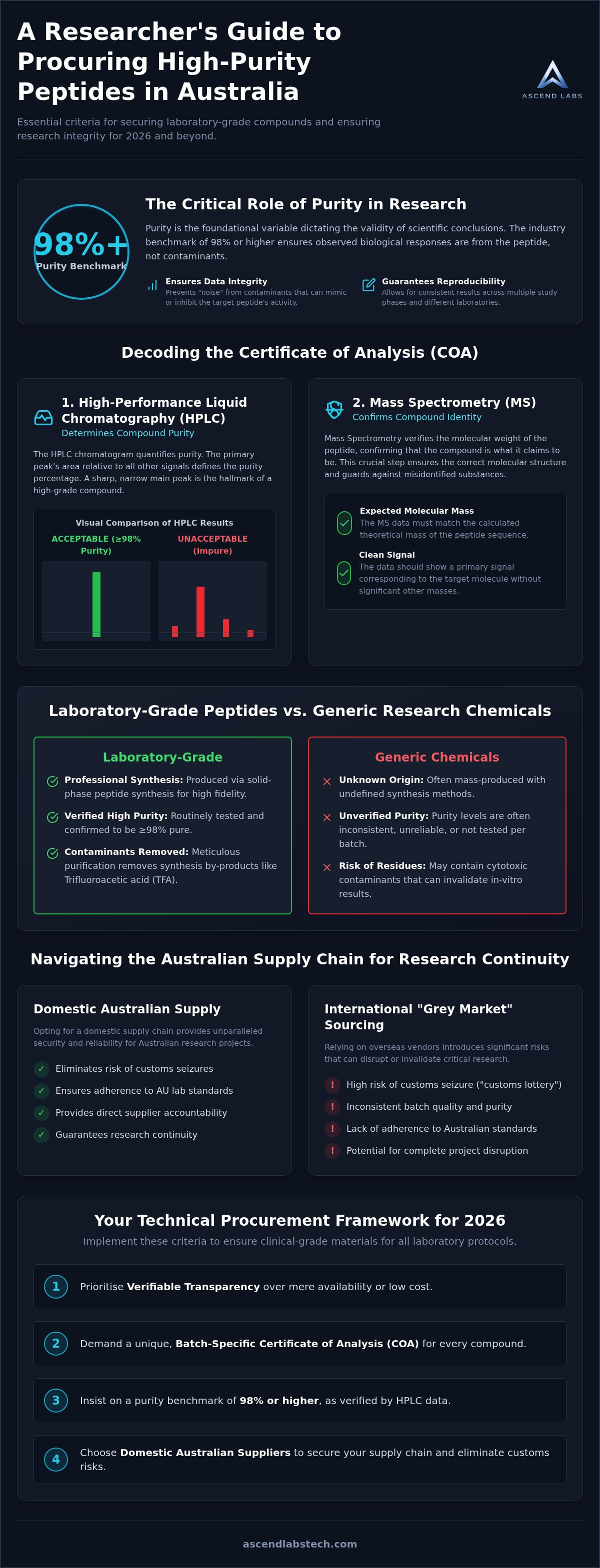
In the Australian research landscape, purity is not a luxury; it is the foundational variable that dictates the validity of every scientific conclusion. For laboratory practitioners, the industry benchmark of 98% or 99% purity isn't an arbitrary figure. It represents the threshold required to ensure that observed biological responses are the result of the peptide itself, rather than unintended contaminants. When sourcing high purity research peptides australia, researchers must prioritise compounds that meet these stringent criteria to maintain the integrity of their data and ensure reproducibility across multiple study phases.
The presence of even minute impurities can lead to catastrophic failures in data interpretation. These contaminants often mimic or inhibit the target peptide's activity, creating "noise" that obscures the true metabolic or cellular response. As the TGA scales up regulatory attention in 2026, the shift toward domestic, verified supply chains has become a necessity for those who cannot afford the risks associated with international grey-market vendors. Reliable procurement is now defined by technical transparency rather than mere availability.
Contaminants and Research Integrity
Synthesis by-products are an inherent risk in peptide production. During the solid-phase peptide synthesis process, truncated sequences or deprotected amino acid residues can remain in the final batch if purification is insufficient. A common concern in growth factor research is the presence of Trifluoroacetic acid (TFA) residues. If these salts aren't meticulously removed, they can alter the pH of the research environment and trigger cytotoxic effects that invalidate in-vitro results.
Purity levels directly influence the binding affinity of complex molecules like retatrutide. In triple-agonist receptor studies, the presence of isomeric impurities can lead to non-specific binding. This interference makes it impossible to accurately measure the compound's interaction with GLP-1, GIP, and glucagon receptors. High-purity standards ensure that the molecular structure remains precise, allowing for the clean, predictable data that advanced biotechnology requires.
The Australian Scientific Standard
The regulatory landscape for high purity research peptides australia has reached a turning point. With the TGA identifying unapproved peptides as a 2026 compliance priority, researchers are moving away from the "customs lottery" of overseas shipping. Domestic verification has become the superior choice because it allows for immediate accountability and adherence to Australian laboratory storage standards. Verification of these standards relies on High-performance liquid chromatography (HPLC) to ensure the primary peak represents the intended sequence without significant interference.
Australian researchers are increasingly gravitating toward boutique, specialist suppliers who act as disciplined curators of their catalogues. This shift reflects a broader move toward clinical rigor. By choosing domestic partners who provide individualised testing data, laboratories can bypass the inconsistencies of mass-produced international stock. This commitment to a "substance over style" approach ensures that every milligram of material used in 2026 protocols meets the highest available grade for scientific inquiry.
Decoding the Certificate of Analysis (COA): HPLC and Mass Spectrometry
A Certificate of Analysis (COA) serves as the technical mandate for any serious laboratory operation. It provides the empirical evidence required to validate the chemical integrity of high purity research peptides australia. This document relies on a two-pillar verification system where High-Performance Liquid Chromatography (HPLC) determines purity levels, while Mass Spectrometry (MS) confirms the absolute identity of the compound. Without batch-specific data, a researcher is operating on trust rather than evidence; it's a risk that 2026 standards no longer permit.
Interpreting High-Performance Liquid Chromatography (HPLC)
Reading an HPLC chromatogram requires a focus on the signal-to-noise ratio. The primary peak represents the target peptide, and its area percentage relative to the total chromatogram defines the purity. A sharp, narrow peak with a clean baseline is the hallmark of laboratory-grade material. Red flags include secondary peaks, which indicate synthesis by-products, or a broad, drifting baseline suggesting residual solvents or salts. Australian researchers should prioritise reports where the Peak Area % meets or exceeds the 98% threshold to ensure data reproducibility.
Verification via Mass Spectrometry
While HPLC confirms how much of a substance is present, Mass Spectrometry confirms exactly what that substance is. This is particularly vital for complex metabolic compounds like MOTS-C or KLOW, where structural precision is paramount. By measuring the mass-to-charge ratio (m/z), MS allows practitioners to verify that the molecular weight of the batch aligns perfectly with the target sequence's theoretical mass. Mass Spectrometry prevents the misidentification of structural analogues, ensuring the compound interacting with your research model is exactly what was intended.
Relying on outdated or generic reports is a significant vulnerability. Given the Australian Government public health warnings regarding unapproved materials, batch-specific testing is the only way to ensure 2026 research accuracy. Each procurement cycle must be accompanied by its own dedicated COA to account for synthesis variances. For those seeking absolute transparency, you can review our technical standards to see how we prioritise these verification pillars in every batch we curate.
Comparing Laboratory-Grade Peptides vs. Generic Research Chemicals
Distinguishing between laboratory-grade materials and generic research chemicals is a critical competency for any Australian investigator. While both may appear identical in a lyophilised state, their molecular biographies differ significantly. To understand Peptides: What they are, one must look at the synthesis method. High-tier procurement relies on Solid-Phase Peptide Synthesis (SPPS). This method allows for the meticulous, step-by-step assembly of amino acids, ensuring the final sequence is precise and free from the truncated chains common in cheaper, high-volume alternatives.
Stability is a primary concern given the logistical demands of the Australian climate. Laboratory-grade high purity research peptides australia undergo sophisticated lyophilisation protocols to remove moisture without compromising the peptide's structural integrity. This process creates a stable, porous "cake" that resists degradation during long-term storage. Generic suppliers often bypass these refined freeze-drying stages, leading to products that degrade rapidly once they arrive at an Australian facility. Proper lyophilisation isn't just about shelf-life; it's about ensuring the compound remains viable for the duration of a multi-month study.
Degradation often occurs in the final millimetres of the supply chain. Professional-grade vials are vacuum-sealed or flushed with inert gases like nitrogen to prevent oxidation and moisture ingress. Choosing "cheap" alternatives often results in hidden costs that far exceed any initial savings. A single failed experiment or a set of non-reproducible results can waste hundreds of laboratory hours and thousands of dollars in associated reagents. In 2026, the price of a peptide must be weighed against the cost of your time and the validity of your data.
Quality Control Benchmarks
Technical quality assurance extends beyond the COA. It involves standardised pH testing and solubility verification to ensure the compound behaves predictably in a saline or bacteriostatic medium. For instance, peptides for connective tissue research require specific trifluoroacetic acid (TFA) removal to prevent interference with delicate cellular matrices. Without these batch-specific benchmarks, research outcomes remain speculative and lack the rigor required for peer-reviewed publication.
Supplier Transparency and Ethics
A professional Australian vendor operates with clinical authority. They prioritise "substance over style," focusing on technical documentation rather than emotive marketing or retail-centric aesthetics. This includes operational discretion and a commitment to ethical sourcing. In a landscape where the TGA has increased scrutiny, a supplier's transparency regarding their synthesis and purification methods is the only reliable indicator of a clinical-grade supply chain. Trust is built through data, not claims.
Navigating the Australian Domestic Supply Chain for Research Continuity
Securing a reliable supply of high purity research peptides australia involves more than just verifying chemical data; it requires a logistical framework that protects the compound from the moment it leaves the laboratory until it reaches yours. International procurement has increasingly become a "customs lottery." With the TGA and Australian Border Force intensifying their coordination to seize unapproved peptide imports in 2026, the risk of institutional disruption is significant. Transitioning to a domestic supply chain eliminates these border risks and ensures that your research materials are already within Australian territory, adhering to local standards of handling and storage.
Peptides are inherently fragile molecules. Long-haul international transit exposes these compounds to fluctuating temperatures and mechanical stress that can lead to denaturation. Domestic logistics allow for temperature-controlled transport specifically designed for the Australian climate. By utilising professional handling and discreet packaging, researchers can maintain the structural integrity of their materials while ensuring they arrive in a condition suitable for immediate experimentation. This proximity shortens the lead time between a hypothesis and its practical investigation.
Logistical Advantages of Domestic Supply
Choosing a domestic partner reduces the window of vulnerability for sensitive compounds. When materials don't have to endure weeks in transit, the risk of peptide degradation is virtually eliminated. This is particularly vital for maintaining a consistent supply of metabolic research compounds like Tirzepatide, where batch-to-batch consistency is essential for longitudinal studies. Furthermore, having Australian-based technical support means that procurement queries are handled by experts who understand the local regulatory environment and the specific needs of Australian biotechnology facilities.
Research Continuity in 2026
Maintaining a steady laboratory inventory requires delivery timeframes that are predictable and transparent. Domestic suppliers provide the reliability needed to support urgent pilot studies or to scale up existing protocols without the fear of sudden supply chain failures. Research continuity in the context of Australian peptide logistics refers to the ability to maintain a steady, predictable flow of verified materials that prevents the suspension of experimental timelines due to external supply chain disruptions. By removing the uncertainty of international shipping, you can focus entirely on the precision of your data.
Establishing a resilient supply chain is the final step in professional peptide procurement. Secure your laboratory supply chain today by choosing to procure verified research compounds from a specialist domestic partner.
Ascend Labs: The Benchmark for High Purity Research Peptides
Ascend Labs operates as a principled institution dedicated to the integrity of Australian biotechnology. We don't view ourselves as a mere vendor, but as a disciplined curator of the materials that drive scientific progress. Our commitment to clinical rigor ensures that every compound in our inventory meets the technical criteria outlined in this guide. By providing high purity research peptides australia, we empower researchers to focus on their data without the persistent anxiety of batch variability or supply chain failure. This commitment to transparency is our foundational principle.
Verification is the cornerstone of our operational ethics. While many suppliers rely on outdated factory claims, Ascend Labs implements a rigorous verification process for every batch, every time. This level of transparency is vital for maintaining the trust of the Australian scientific community. We understand that in 2026, the validity of your inquiry rests entirely on the substance of your materials. Our role is to ensure that substance is beyond reproach, providing the security and trust required for advanced laboratory protocols.
A Disciplined Approach to Quality
Our quality assurance protocol is built on three pillars: accuracy, exclusivity, and meticulousness. We prioritise HPLC and MS verification for every research compound to confirm both purity and identity. This is particularly critical for advanced metabolic and neuromodulator peptides. By focusing on specialised compounds such as KLOW and MOTS-C, we provide access to the frontier of research while maintaining a sophisticated level of technical oversight. We don't compromise on these standards because we know your research outcomes depend on them.
The Ascend Labs philosophy is defined by a "substance over style" approach. We avoid the hyperbolic language of the retail market in favour of clinical, authoritative transparency. Our documentation provides the precise data required for institutional review and peer-reviewed publication. This focus on precision ensures that your research protocols are supported by compounds that align with the highest global standards of chemical synthesis and purification. We act as an expert guide, valuing scientific truth above all else.
Securing Your Research Future
As we move through 2026, the need for a reliable domestic supply chain has never been more apparent. Ascend Labs offers a streamlined path to high-tier procurement, allowing scientific institutions to bypass the complexities of international logistics. Our catalogue is meticulously curated to meet the evolving needs of the Australian biotech sector, ensuring you have access to the latest metabolic and recovery compounds without the risk of regulatory delays or customs seizures. We provide the stability your laboratory requires for long-term inquiry.
Accessing our 2026 peptide catalogue is a straightforward process designed for professional practitioners. We provide the technical support and operational discretion required for sensitive research environments. By choosing a partner that values scientific truth and clinical rigor, you secure the future of your inquiry and the integrity of your results. Explore the Ascend Labs research peptide catalogue today.
Advancing the Integrity of Australian Biotechnology
The shift toward clinical-grade standards in 2026 requires a departure from speculative procurement. Achieving valid research outcomes depends on the meticulous verification of compound identity and purity through batch-specific HPLC and Mass Spectrometry. By prioritising materials that meet the 98% industry benchmark, you eliminate the variables that lead to failed experiments and non-reproducible data. Transitioning to a secure, domestic supply chain ensures that your laboratory protocols remain uninterrupted by international logistical failures or regulatory seizures.
Ascend Labs remains committed to supporting the Australian scientific community with integrity and technical expertise. As a specialist, Australian-owned and operated supplier, we provide the transparency required for serious inquiry into metabolic and neuromodulator compounds. Securing high purity research peptides australia is the final step in ensuring your research future is built on a foundation of chemical accuracy and operational discretion. We act as a disciplined curator for those who value data precision above all else.
View our high-purity research peptide catalogue to access verified materials for your next study. We look forward to supporting your ongoing commitment to scientific truth and discovery.
Frequently Asked Questions
How do I verify the purity of research peptides purchased in Australia?
Verification requires a batch-specific Certificate of Analysis (COA) containing both HPLC and Mass Spectrometry data. You should examine the HPLC chromatogram for a sharp, isolated primary peak with a clean baseline, indicating minimal synthesis by-products. Confirming that the mass-to-charge ratio on the MS report aligns with the theoretical molecular weight of the target peptide is the only empirical way to ensure compound identity and purity.
What is the difference between 98% and 99% peptide purity for research?
The 1% variance represents a significant reduction in potentially reactive synthesis contaminants. In sensitive in-vitro studies, even minute impurities can interfere with receptor binding affinity or trigger unintended cytotoxic responses. While 98% is the standard industry benchmark, 99% purity is often preferred for advanced metabolic research to ensure the highest degree of data reproducibility and to minimise experimental "noise."
Can I buy high purity peptides for sale in Australia with domestic shipping?
Yes, procuring high purity research peptides australia from a domestic supplier is the most effective way to ensure research continuity. Domestic shipping bypasses the heightened 2026 TGA regulatory scrutiny and the risk of customs seizures associated with international imports. Local suppliers allow laboratories to maintain a predictable inventory while ensuring that the compounds haven't been compromised by long-haul international transit stress.
What documents should a reputable Australian peptide supplier provide?
A professional supplier must provide a comprehensive COA for every specific batch, not just a generic template. This documentation should include the High-Performance Liquid Chromatography (HPLC) report to prove purity and a Mass Spectrometry (MS) report to verify molecular identity. Technical data sheets regarding solubility, pH levels, and lyophilisation standards are also essential for maintaining clinical-grade protocols in a laboratory setting.
How should laboratory-grade peptides be stored to maintain purity?
Lyophilised peptides should be stored in a dedicated laboratory freezer at -20°C to ensure long-term stability and prevent degradation. It's vital to keep the vials vacuum-sealed and protected from light and moisture ingress. Once the compound is reconstituted, it should be refrigerated at 2°C to 8°C and used within a specific timeframe to avoid peptide denaturation, which can invalidate your research results.
What are the risks of using low-purity peptides in metabolic research?
Low-purity compounds introduce uncontrolled variables that can lead to non-reproducible data and failed experiments. In metabolic research involving complex agonists like Tirzepatide, residual salts or truncated peptide sequences can cause non-specific binding or alter cellular metabolism. These inconsistencies often result in the loss of valuable research hours and the waste of expensive laboratory reagents, making high-purity materials a more cost-effective choice long-term.
Why is HPLC verification necessary for every batch of research compounds?
Chemical synthesis is a precise but variable process where even slight environmental changes can alter the final yield. HPLC verification ensures that every unique batch meets the required purity threshold before it enters your laboratory. Relying on a supplier's historical data rather than batch-specific testing is a significant risk; it leaves your research vulnerable to inconsistencies that can compromise the integrity of your scientific conclusions.
Is it better to source peptides domestically in Australia or from overseas?
Domestic sourcing is technically superior due to the increased coordination between the TGA and Australian Border Force in 2026. Sourcing high purity research peptides australia locally eliminates the "customs lottery" and the risk of peptide denaturation during long-haul international flights. Domestic suppliers provide faster lead times and more reliable technical support, which is essential for maintaining the momentum of urgent pilot studies and institutional research projects.


