

How much of your research budget is being quietly liquidated by the invisible process of biochemical degradation? It's a persistent challenge for the Australian scientific community when a meticulously planned study yields inconsistent results because a compound lost its structural integrity faster than anticipated. You've likely felt the frustration of questioning whether a failed assay was due to your hypothesis or simply a vial of degraded material. Maintaining peptide stability after reconstitution is not a matter of guesswork; it's a technical discipline that requires precise handling and environmental control.
This guide provides the rigorous protocols needed to preserve the bioactivity of your research compounds. You'll master the transition from lyophilised powder to solution while avoiding common pitfalls like mechanical stress or thermal fluctuations. We'll outline a definitive stability timeline for reconstituted compounds, compare the shelf life of bacteriostatic versus sterile water, and establish a standardised protocol for your laboratory. By understanding the specific triggers for oxidation and hydrolysis, you can ensure your data remains accurate and your materials remain viable for the full 28-day refrigerated window.
Key Takeaways
- Understand why the transition to an aqueous state initiates the degradation clock and how to manage peptide stability after reconstitution through rigorous environmental control.
- Identify the specific biochemical triggers, including hydrolysis and oxidation, that compromise the structural integrity of sensitive Methionine and Cysteine residues.
- Evaluate the efficacy of bacteriostatic water versus sterile water in inhibiting microbial growth and maintaining long-term vial sterility during multi-use protocols.
- Master a standardised laboratory protocol for preparation and sanitisation that minimises mechanical stress and prevents thermal shock to the peptide chain.
- Recognise why 99%+ purity levels and COA verification are essential prerequisites for ensuring predictable stability and consistent experimental results.
Understanding the Transition: Why Reconstitution Triggers the Stability Clock
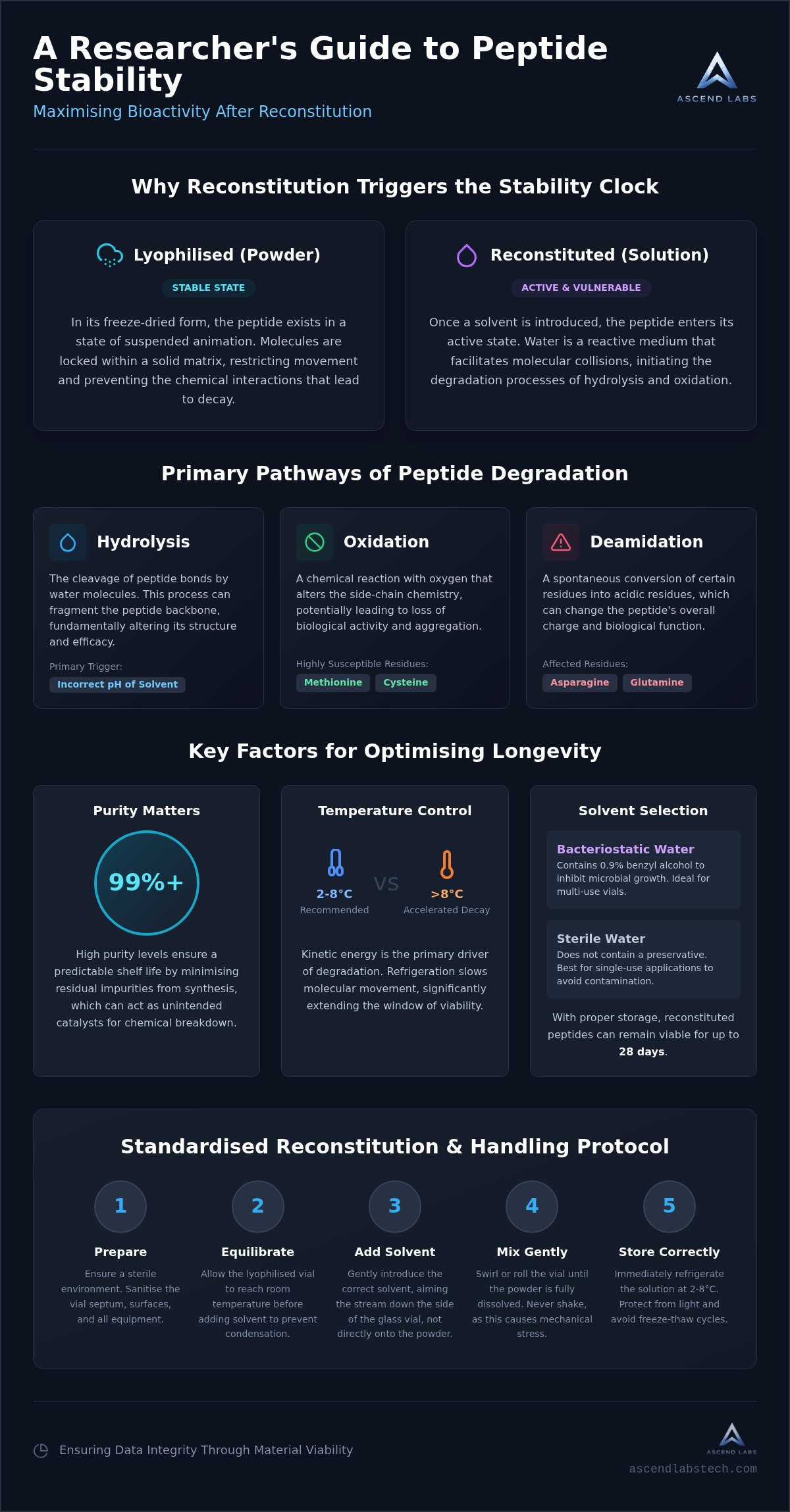
Reconstitution represents the definitive turning point in a peptide's lifecycle. It is the technical process of restoring a lyophilised peptide to its liquid state, transitioning the compound from a stable, solid matrix into a functional solution ready for experimental use. While this transition is necessary for application, it fundamentally alters the biochemical environment of the compound. In its freeze-dried form, a peptide exists in a state of suspended animation. The molecules are locked within a porous, glass-like structure that restricts movement and prevents the chemical interactions that lead to decay. Once a solvent is introduced, the compound enters its "active" research state, where the presence of water facilitates the molecular collisions required for degradation.
The vulnerability of the aqueous state stems from the fundamental peptide structure and classes which dictate how individual amino acids interact with their surroundings. Water is not merely a neutral carrier; it is a highly reactive medium. It provides the necessary environment for hydrolysis and other degradative pathways that are physically impossible in a dry powder. The structural complexity of the sequence also influences this timeline. Generally, longer amino acid chains or those with complex secondary structures present more potential sites for cleavage. Consequently, peptide stability after reconstitution becomes a manageable variable that is heavily dependent on the specific sequence length and the precision of the handling environment.
The Impact of Lyophilisation Purity
The foundation of post-solvent longevity is established during the manufacturing process. Residual impurities from the synthesis phase, such as leftover salts or organic solvents, often act as unintended catalysts for chemical breakdown once the peptide is in solution. High-purity standards, typically verified by HPLC to exceed 99%, provide a more predictable shelf life because there are fewer reactive species present to trigger premature decay. Commencing your research with verified materials from Ascend Labs ensures that your baseline is free from the contaminants that accelerate molecular fragmentation and lead to inconsistent experimental data.
Molecular Mobility and Kinetic Energy
In a liquid state, amino acid side chains gain significant freedom of movement. This increased molecular mobility allows for the intramolecular interactions that result in deamidation and aggregation. Kinetic energy is the primary driver of this process. As ambient temperatures rise, the velocity of molecular movement increases, directly correlating to a faster rate of chemical breakdown. For the researcher, room temperature is the primary enemy of structural integrity. Even brief exposure to temperatures above the standard 2-8°C refrigeration range can significantly contract the window of viability for reconstituted research compounds.
The Biochemistry of Degradation: Hydrolysis, Oxidation, and Deamidation
Maintaining peptide stability after reconstitution requires a granular understanding of the chemical pathways that lead to decay. Hydrolysis is the most prevalent threat. This process involves the cleavage of peptide bonds by water molecules; it is highly dependent on the pH of the solvent. If the solution is not correctly buffered, the peptide backbone may fragment, which fundamentally alters the compound’s efficacy. Ensuring you source compounds like Tirzepatide with verified purity levels is the first step in mitigating these biochemical risks before they manifest in your assays.
Oxidation and deamidation represent more subtle forms of degradation. Methionine and Cysteine residues are highly susceptible to oxygen exposure, leading to altered side-chain chemistry. Deamidation occurs when Asparagine or Glutamine residues spontaneously convert into acidic residues, potentially changing the peptide’s charge and biological activity. When these chemical changes accumulate, aggregation often occurs. Peptides lose their secondary structure and clump together, becoming biologically inert aggregates that skew experimental data.
Residue-Specific Vulnerabilities
Identifying high-risk sequences is a necessary skill for advanced practitioners. Compounds with specific amino acid clusters are more prone to rapid decay. For instance, metabolic research compounds like Tirzepatide possess complex structures that demand precise handling to maintain their integrity. Shifts in pH, even minor ones, can dramatically increase the rate of deamidation in these sensitive solutions. Following established peptide handling and storage guidelines helps mitigate these risks by ensuring the chemical environment remains stable throughout the life of the vial.
Mechanical Stress and Shearing
Physical handling protocols are frequently overlooked in the laboratory. Vigorous shaking is particularly damaging; it introduces air bubbles that increase the surface area for oxidation and can physically tear the molecular structure. Peptide shearing is the mechanical disruption of molecular folding through kinetic force. To preserve structural integrity, researchers should always employ a gentle swirling technique rather than aggressive agitation. This ensures the compound dissolves without compromising the delicate secondary structures required for bioactivity.
Solvent Selection and Storage Conditions: Optimising Longevity
The selection of a solvent is the primary operational decision that dictates the longevity of a research compound. While sterile water is sufficient for single-use applications, it doesn't provide the preservative capacity required for multi-dose vials. Bacteriostatic water, which contains 0.9% benzyl alcohol, serves as a robust antimicrobial agent. It inhibits the growth of bacteria that could otherwise introduce proteases, the specific enzymes responsible for dismantling peptide chains. Maintaining peptide stability after reconstitution relies on this chemical barrier to prevent microbial-induced degradation over the course of a study.
Environmental management is equally vital. The gold standard for refrigerated storage is a consistent range between 2°C and 8°C. Temperatures outside this window accelerate the kinetic energy of the solution, leading to the biochemical breakdown described in earlier sections. Light sensitivity is another factor; ultraviolet exposure can cause photolysis, where the energy from light waves physically breaks chemical bonds. Adhering to professional Peptide Handling and Storage Guidelines ensures that these external stressors are minimised through the use of light-shielded containers and calibrated refrigeration units.
Reconstituted Peptide Shelf Life Table
Researchers should adhere to the following stability benchmarks for most aqueous peptides:
- Standard Stability: 28 to 30 days when stored under optimal refrigeration (2-8°C).
- Short-term Stability: 24 to 48 hours if left at room temperature; this is generally not recommended for sensitive sequences.
- Extended Stability: While re-freezing reconstituted peptides is sometimes debated, it often introduces significant risks. Repeated freeze-thaw cycles create ice crystals that can shear the delicate molecular structure.
Solvent pH and Buffering
Solubility is not a universal constant. Certain hydrophobic peptides may require the addition of a small amount of acetic acid or a basic buffer to achieve a clear solution. The purity of these solvents directly impacts the final stability of advanced compounds like Retatrutide. If the solvent introduces ions that shift the pH away from the peptide’s isoelectric point, the compound may precipitate. You can identify this as cloudiness or visible particulates in the vial, which serves as an immediate indicator of molecular aggregation and structural failure.
A Step-by-Step Protocol for Reconstitution and Handling
Before introducing the solvent, ensure the vial has reached room temperature. This equilibration prevents the formation of internal condensation, which can introduce moisture-related degradation before the experiment begins. Once equilibrated, perform a rigorous sanitisation of the rubber stopper using a 70% isopropyl alcohol swab. This step is non-negotiable; it prevents the introduction of environmental contaminants that compromise peptide stability after reconstitution. Precision at this stage is the foundation of experimental reliability.
The actual introduction of the solvent requires a "Slow Drip" technique to preserve the compound's delicate structure. Most high-quality vials are vacuum-sealed, which can pull the solvent in with excessive force if not managed carefully. Tilt the vial and aim the needle so the solvent runs down the interior glass wall rather than impacting the lyophilised powder directly. This avoids the mechanical shock that can lead to immediate denaturation or the formation of air bubbles, which increases the surface area for oxidation. Following this, employ passive dissolution. Allow the peptide to dissolve naturally. If the compound is particularly hydrophobic, a gentle swirling motion is acceptable, but never resort to mechanical agitation.
Maintaining the Cold Chain in Australia
Australia's climate presents unique challenges for laboratory logistics. Ambient laboratory temperatures during the summer months can quickly exceed the safe range for sensitive compounds. Maintaining a strict cold chain is essential for preserving bioactivity. Domestic supply through Ascend Labs is a strategic advantage in this regard, as it reduces the initial thermal stress and transit time compared to international shipping. Once the vial is in your facility, it must be housed in a dedicated, temperature-monitored refrigeration unit to ensure the 2-8°C benchmark is never breached.
Post-Reconstitution Monitoring
Effective lab management requires precise documentation and regular oversight. Every vial should be clearly marked with the "Date of Reconstitution" and a calculated "Discard Date" based on the established 28-day stability window. Conduct a visual inspection before every use. If you notice particulate matter, cloudiness, or any change in clarity, the peptide stability after reconstitution has likely been compromised, and the material should be discarded to avoid skewed data. Always store vials in an upright orientation. This reduces the time the solution spends in contact with the rubber stopper, preventing the potential leaching of impurities or the absorption of the peptide onto the septum material.
The Ascend Labs Standard: Purity as a Predictor of Stability
Purity is the primary determinant of how a compound behaves once the solvent is introduced. While lower-grade materials may satisfy basic identification tests, they often contain residual salts or truncated sequences that don't just compromise the assay but act as catalysts for degradation. A 99%+ purity standard isn't just a metric; it's a technical necessity for predictable peptide stability after reconstitution. By minimising the presence of reactive impurities, researchers can ensure that the degradation curves observed in their assays are a result of the peptide’s inherent biochemistry rather than preventable contamination.
Certificate of Analysis (COA) verification serves as the essential audit for these purity claims. It confirms the absence of catalysts that might otherwise accelerate hydrolysis or deamidation. For advanced compounds such as Retatrutide, MOTS-C, and KLOW, this baseline of quality is non-negotiable. Mitochondrial research compounds like MOTS-C are particularly sensitive to their environment; starting with a high-purity lyophilised standard is the only way to maintain structural integrity during the 28-day refrigerated window.
Research Application: Peptides for Connective Tissue
Studies involving peptides for connective tissue research often require high-concentration solutions to mirror physiological conditions. However, increasing the concentration of a solution also increases the frequency of molecular collisions, which can lead to rapid aggregation. In these applications, the margin for error is significantly reduced. Researchers must balance the need for high-density solutions with the risk of the peptide losing its secondary structure. Using HPLC-verified standards ensures that the solution remains clear and bioactive, providing the consistency required for long-term tissue repair observations.
The Future of Australian Peptide Research
Ascend Labs remains committed to supporting the Australian scientific community by providing laboratory-grade standards with the security of domestic logistics. By eliminating the thermal stressors associated with international transit, we provide a foundation where peptide stability after reconstitution is maximised from the moment of arrival. The future of research in Australia depends on the reduction of experimental variables. Through meticulous storage education and the provision of high-integrity compounds, we enable researchers to focus entirely on their data. Ultimately, longevity is a product of three critical factors: absolute purity, appropriate solvent selection, and unwavering thermal discipline.
Advancing Experimental Rigour through Technical Discipline
Securing reliable data requires a shift from viewing peptides as static reagents to understanding them as dynamic biochemical entities. You've seen how peptide stability after reconstitution is influenced by initial purity levels, solvent pH, and the mechanical precision of your handling protocols. By prioritising 99%+ HPLC-verified standards and maintaining a strict cold chain, you eliminate the variables that lead to experimental drift and wasted material. Meticulously managing these factors ensures that your observations reflect the true bioactivity of the compound rather than the effects of premature degradation.
Ascend Labs is dedicated to supporting this level of precision within the Australian scientific community. We provide specialised metabolic and recovery compounds, including Retatrutide and MOTS-C, all verified by HPLC and Mass Spectrometry to ensure absolute structural integrity. Our discreet domestic shipping further reduces the thermal risks associated with international transit, delivering high-purity standards directly to your facility. Explore the Ascend Labs catalogue for high-purity research peptides and ensure your next study is built on a foundation of biochemical truth. Professional handling is the most effective safeguard for your research outcomes.
Frequently Asked Questions
How long do peptides last in the fridge after reconstitution?
Most research compounds remain viable for 28 to 30 days when stored at a constant temperature between 2°C and 8°C. This window is the industry standard for maintaining peptide stability after reconstitution, provided a preserved solvent like bacteriostatic water is used. Beyond this period, the risk of structural fragmentation via hydrolysis increases significantly, which can compromise the accuracy of your experimental data.
Can I freeze peptides after they have been reconstituted with bacteriostatic water?
Re-freezing peptides after they have been transitioned to a liquid state is generally discouraged due to the risk of molecular shearing. The formation of ice crystals during the freezing process can physically disrupt the delicate secondary folding of the peptide chain. It is more effective to aliquot the lyophilised powder into single-use vials before reconstitution if long-term storage of the compound is required.
What happens if a reconstituted peptide is left at room temperature for a few hours?
Brief exposure to room temperature initiates a rapid increase in kinetic energy, which accelerates biochemical decay pathways such as oxidation and deamidation. While a few hours of exposure may not render the compound entirely inert, it reduces the overall stability window and introduces unnecessary experimental variables. Consistent refrigeration is essential to ensure the integrity of the amino acid sequence remains intact throughout the study.
How can I tell if my research peptide has degraded or gone bad?
Visual indicators such as cloudiness, precipitation, or a shift in solution clarity are the primary signs that a compound has degraded. If the solution is no longer transparent or exhibits visible particulates, the peptide stability after reconstitution has been compromised. These physical changes suggest molecular aggregation, a state where the peptides have clumped together and become biologically inactive.
Does the type of water used for reconstitution affect the peptide’s shelf life?
The choice of solvent is a critical factor in determining the duration of a peptide's bioactivity in a liquid state. Bacteriostatic water contains 0.9% benzyl alcohol, which inhibits microbial growth and allows for a 28-day refrigerated shelf life in multi-use vials. Conversely, sterile water lacks preservatives and is only suitable for single-use applications, as it becomes vulnerable to bacterial contamination within 24 hours of opening.
Why do some peptides become cloudy after I add the solvent?
Cloudiness, or precipitation, occurs when the peptide fails to remain in a fully solvated state, often due to an incorrect pH or excessive concentration. This physical reaction indicates that the molecules are clumping together rather than staying dispersed in the solvent. Such aggregation is a definitive sign of structural failure and suggests that the compound will not yield reliable or accurate results in a laboratory setting.
Is it necessary to wait for the vial to reach room temperature before adding water?
Equilibrating the vial to room temperature is a mandatory step to prevent the formation of internal condensation during the reconstitution process. If cold air inside the vial meets warmer ambient air when the stopper is accessed, moisture can settle on the lyophilised cake. This unwanted moisture can trigger premature degradation before the solvent is even introduced, undermining the stability of the compound from the outset.
Can I use a vortex mixer to speed up the dissolution of a peptide?
You should never use a vortex mixer or any form of aggressive mechanical agitation to dissolve a research compound. High-kinetic force causes peptide shearing, which is the physical disruption of the molecule's delicate folded structure. Instead, allow the solvent to sit on the powder for several minutes and employ a gentle swirling motion to achieve full dissolution without compromising the peptide's structural integrity.


