

In the current scientific climate, the label "lab-grade" has become a hollow marketing term unless it is backed by batch-specific, third-party analytical verification. For Australian researchers, the frustration of inconsistent results or indecipherable HPLC reports is a significant barrier to meaningful progress. You understand that the integrity of your in-vitro studies depends entirely on the chemical precision of your compounds; however, navigating the variance between suppliers often feels like a gamble. Using degraded or impure material does not just waste time; it compromises the reproducibility of your entire data set.
This reference provides a definitive framework for mastering research peptide quality control standards in 2026. By following these protocols, you will gain the technical expertise required to verify the identity and purity of every vial before it enters your workflow. We will establish a clear checklist for evaluating domestic suppliers, examine the nuances of interpreting Mass Spec reports for compounds like Retatrutide and MOTS-C, and outline the protocols necessary to maintain a reliable, high-purity supply chain within Australia. This is the essential benchmark for laboratories that value substance over style and data over promises.
Key Takeaways
- Understand why 98% purity is the absolute minimum benchmark for credible data and how to identify the risks associated with unverified research compounds.
- Master the distinct roles of HPLC and Mass Spectrometry in verifying both the chemical purity and the exact molecular identity of your laboratory samples.
- Implement rigorous research peptide quality control standards by prioritising independent third-party verification to eliminate the inherent bias of in-house testing.
- Develop a systematic protocol for interpreting Certificates of Analysis (COA) to ensure batch-level transparency and data integrity across all studies.
- Recognise the importance of domestic Australian supply chains in maintaining the stability of sensitive compounds like Retatrutide and MOTS-C.
The Foundation of Peptide Purity in Scientific Research
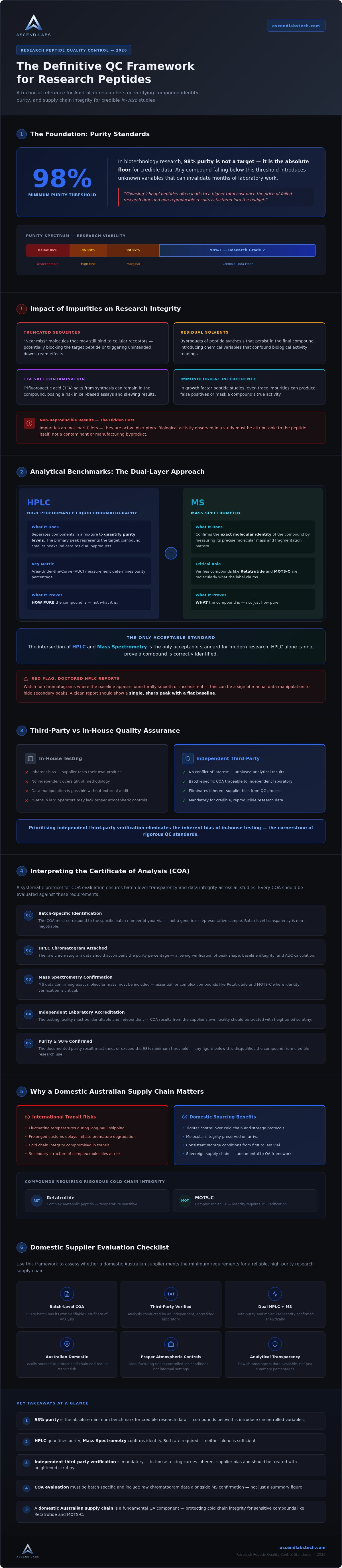
In the discipline of biotechnology, 98% purity is not a target; it's the absolute floor for credible data. Any compound falling below this threshold introduces a set of unknown variables that can invalidate months of laboratory work. Adhering to strict research peptide quality control standards ensures that the biological activity observed in a study is the result of the peptide itself, rather than a contaminant or a manufacturing byproduct. The proliferation of unverified research compounds from "bathtub labs", which often operate without proper atmospheric controls or analytical oversight, has made batch-level verification more critical than ever for the Australian scientific community.
The Impact of Impurities on Research Integrity
Chemical impurities are more than just inert fillers; they are active disruptors. During the process of peptide synthesis and purity standards, various byproducts such as residual solvents, trifluoroacetic acid (TFA) salts, and truncated sequences can emerge. Truncated sequences are particularly problematic because these "near-miss" molecules may still bind to cellular receptors, potentially blocking the target peptide or triggering an unintended downstream effect. In studies involving growth factor peptides, even trace amounts of immunological interference can produce false positives or mask a compound's true therapeutic potential. Choosing "cheap" peptides often leads to a higher total cost once the price of failed research time and non-reproducible results is factored into the budget.
Peptide Stability and Storage Standards
The journey from the laboratory to the bench is a period of significant vulnerability for lyophilised powders. International transit exposes sensitive compounds to fluctuating temperatures and prolonged customs delays, both of which can initiate premature degradation. Maintaining a rigorous cold chain is essential for preserving the secondary structure of complex molecules. This is why a domestic Australian supply chain is a fundamental component of quality assurance. By sourcing from a specialised catalogue within Australia, researchers mitigate the risks associated with long-haul shipping. Domestic logistics allow for tighter control over storage protocols, ensuring that compounds such as Retatrutide or MOTS-C arrive with their molecular integrity intact. Standardising these storage conditions across the duration of a study is the only way to ensure that metabolic research remains consistent from the first vial to the last.
Ultimately, the reproducibility of scientific results rests on the reliability of the starting material. Without a principled approach to quality control, the risk of data contamination is too high for any serious institution to ignore. Precision starts with the procurement of verified, high-purity compounds that have been handled with the same clinical rigour expected in the lab itself.
Analytical Benchmarks: HPLC and Mass Spectrometry Analysis
Establishing robust research peptide quality control standards requires more than a simple stamp of approval. It demands a dual-layered analytical approach that addresses both the quantity of the compound and its specific molecular identity. While many suppliers claim their products are "lab tested", the utility of that data depends entirely on the methodology used. HPLC is a technique that separates components in a mixture to quantify purity levels. However, purity alone doesn't prove that the substance is what the label claims it's. This is why the intersection of High-Performance Liquid Chromatography (HPLC) and Mass Spectrometry (MS) is the only acceptable standard for modern research.
HPLC: Quantifying the Purity Percentage
HPLC remains the gold standard for determining the concentration of the target peptide relative to impurities. When reviewing a chromatogram, the primary peak represents the target compound, while smaller peaks indicate residual byproducts. The purity is calculated using the area-under-the-curve (AUC) measurement. A clean report should show a single, sharp peak with a flat baseline. Researchers should remain vigilant for "doctored" reports where the baseline appears unnaturally smooth or inconsistent. This can be a sign of manual data manipulation to hide secondary peaks. These research peptide quality control standards mirror the rigour found in Good Manufacturing Practice quality control regulations, ensuring that every batch meets a specific purity threshold before it reaches the bench.
Mass Spectrometry: Confirming Molecular Identity
While HPLC tells us how much of a substance is present, Mass Spectrometry confirms exactly what that substance is. MS measures the mass-to-charge ratio of ions to determine the molecular weight of the compound. This step is vital for identifying truncated sequences. These are partial peptide chains that might have similar retention times in HPLC but possess a different molecular mass. For complex molecules like Retatrutide, MS is non-negotiable. Without it, there's no way to verify that the triple-agonist structure has been synthesised correctly. Relying on a single test is a significant risk; only by combining HPLC and MS data can a laboratory proceed with total confidence in their reagents. If you require compounds verified by this level of analytical rigour, you can explore our specialised research catalogue to find batch-verified materials.
Third-Party Verification vs In-House Quality Assurance
Research-grade is a claim often made but rarely verified with the necessary detachment. While in-house testing is a standard part of the manufacturing process, it cannot serve as the final authority for high-stakes scientific inquiry. The research peptide quality control standards required for reproducible data demand a clear separation between the producer and the analyst. Relying solely on supplier-provided data introduces an inherent bias that can compromise the integrity of an entire study. For Australian laboratories, the shift toward independent, third-party verification isn't just a preference; it's a fundamental requirement for sovereign quality and data security.
The Conflict of Interest in Self-Testing
In-house results are essentially a manufacturer's self-assessment. Even with the best intentions, there's a risk of "cherry-picking" the most favourable reports from multiple synthesis runs. A supplier might produce five batches of a compound but only publish the HPLC chromatogram for the one that reached 99% purity. This lack of transparency creates a significant gap in the record. In the Australian research market, transparency acts as a critical differentiator. Researchers shouldn't treat supplier data as the final word but rather as a starting point. True accountability requires a "Batch-Specific" mandate where old reports are discarded as soon as new stock arrives. If a report doesn't match the specific batch number on your vial, it's scientifically irrelevant.
Criteria for Independent Lab Selection
Evaluating an analytical laboratory requires looking beyond their equipment list. ISO/IEC 17025 accreditation is the primary benchmark, as it ensures the facility operates with a high degree of technical competence and produces valid results. Another essential practice is blind testing. This involves sending samples to a lab without identifying the supplier, ensuring the analysts have no preconceived bias toward the results. This level of rigour is explored further in our guide on Peptide Purity Testing, which outlines the professional protocols necessary for verification. When selecting a partner for independent analysis, laboratories should prioritise facilities that specialise in complex peptide sequences rather than general chemical testing.
As a principled institution, Ascend Labs operates on a mandate of absolute batch-level transparency. We don't rely on historical data or "typical" purity levels to justify our current inventory. By utilising independent verification for every batch in our domestic supply chain, we ensure that the compounds you receive meet the most stringent research peptide quality control standards. This commitment to third-party oversight allows researchers to focus on their data, confident that their starting material is exactly what the Mass Spec confirms it to be.
Interpreting the Certificate of Analysis (COA) for Research Compounds
A Certificate of Analysis is the definitive technical record of a compound's journey from synthesis to verification. However, the document is only as valuable as the researcher's ability to scrutinise its contents. Adhering to research peptide quality control standards requires a systematic approach to reading these reports. The first step is always a direct cross-reference: the batch number on the report must correspond exactly with the number printed on the vial. Discrepancies here are a primary indicator of administrative negligence or intentional data obfuscation. If the batch numbers don't match, the report is scientifically irrelevant to the vial in your hand.
While we previously established 98% as a minimum purity threshold, high-end research often demands a target of 99% or greater. This level of precision minimises the interference of chemical byproducts in sensitive assays. Beyond the percentage, the date of analysis is a critical variable. Peptides are susceptible to degradation over time, even when stored as lyophilised powders. A report older than 12 months may no longer reflect the current state of the compound, particularly for fragile sequences like MOTS-C. Finally, the Mass Spectrometry spectrum must be verified against the theoretical molecular weight of the peptide. If the observed mass peak deviates from the theoretical value, the identity of the compound is in question.
Key Fields Every Researcher Must Inspect
A comprehensive COA provides data beyond simple purity percentages. Physical indicators like appearance and solubility are foundational; a research peptide should typically present as a uniform, white lyophilised powder. For more complex sequences, specific rotation and amino acid analysis offer deeper insights into the structural integrity of the molecule. Always examine the "Notes" or "Comments" section at the end of the report. This is often where analytical labs disclose caveats regarding sample stability or minor deviations in the testing environment that could impact your results. It's these small details that separate a principled institution from a mere vendor.
Red Flags in Peptide Documentation
Identifying fraudulent or substandard documentation is a vital skill for maintaining laboratory integrity. Be wary of reports with heavy watermarks that obscure the name of the third-party testing laboratory. Transparency is a hallmark of quality, and hiding the source of the data is a significant red flag. Inconsistent formatting between the HPLC chromatogram and the MS report within the same batch suggests that the documents may have been spliced together from different sources. If a supplier cannot provide a clean, cohesive, and recent report, the risk of using an impure or degraded compound becomes unacceptably high. Reliable data begins with reliable documentation.
Ascend Labs: Upholding Sovereign Quality Standards in Australia
Ascend Labs operates as a principled institution dedicated to the integrity of the Australian scientific community. Our operational philosophy is built on the belief that transparency is the only viable path to scientific truth. By implementing stringent research peptide quality control standards, we eliminate the ambiguity that often plagues the procurement process. We don't rely on "typical" results or historical data; instead, we provide batch-level transparency for every compound in our inventory. This ensures that the analytical reports you review are a direct reflection of the physical material currently on your laboratory bench.
The Ascend Labs verification protocol is a rigorous, multi-stage process designed to safeguard data integrity. We understand that in modern research, a single error in reagent purity can invalidate months of work. Our commitment to clinical rigour means that every vial of Retatrutide, MOTS-C, or Tirzepatide is backed by independent HPLC and Mass Spectrometry data. This meticulous oversight allows researchers to focus on their primary inquiries, confident that their starting materials meet the highest global benchmarks for purity and identity.
Meticulous Curation of Research Compounds
Our approach to inventory is defined by a "Substance over Style" philosophy. We don't aim to offer the broadest possible catalogue, but rather the most meticulously verified one. This disciplined curation allows us to maintain exceptional oversight over advanced molecules such as KLOW and Tirzepatide. By specialising in high-complexity sequences, we provide the precision tools required for sophisticated Metabolic Research Compounds. Every addition to our selection must pass through our internal quality gate before it is released to the domestic market. You can explore our catalogue of research peptides to see the full range of verified compounds currently available.
Securing Your Research Supply Chain
The Australian research environment presents unique geographical and logistical challenges. International transit often involves prolonged exposure to uncontrolled environments and customs delays that can initiate the degradation of sensitive lyophilised powders. Ascend Labs eliminates these variables by maintaining a purely domestic supply chain. Our discreet, Australian-owned infrastructure ensures that your compounds are stored and shipped under optimal conditions. Supporting local research infrastructure is a critical step in securing the future of sovereign scientific inquiry. By choosing a domestic partner, you ensure that your research peptide quality control standards remain intact from the point of synthesis to the final assay.
Securing the Future of Australian Biotechnology
The evolution of laboratory procurement in 2026 demands a departure from unverified claims and a shift toward absolute analytical transparency. Precision is paramount. Maintaining rigorous research peptide quality control standards is the only method to preserve the integrity of your longitudinal data and ensure the reproducibility of your results. By prioritising batch-specific HPLC and Mass Spectrometry data, you eliminate the variables that often compromise sensitive in-vitro studies.
Sourcing from an Australian sovereign supply chain further mitigates the risks of compound degradation associated with international transit. This commitment to domestic reliability ensures that advanced metabolic compounds arrive with their molecular structure intact. As the Australian scientific community continues to advance, the reliance on independent third-party verification will remain the defining characteristic of a professional laboratory.
We invite you to uphold these benchmarks in your own work. Your research deserves the precision that only meticulous verification can provide.
Frequently Asked Questions
What is the standard purity level for research peptides in Australia?
The absolute minimum benchmark for credible scientific data is 98% purity. For high-end metabolic research involving compounds like Retatrutide, a target of 99% or higher is preferred to minimise the interference of chemical byproducts. Anything below 98% introduces too many unknown variables, which can easily invalidate in-vitro results and compromise the reproducibility of your study.
How often should a peptide supplier update their COA reports?
Reports should be updated with every single new batch produced, regardless of the timeframe. A Certificate of Analysis is not a static document; it's a batch-specific record. If the batch number on your vial doesn't match the report provided, the data is scientifically irrelevant. Researchers should insist on seeing the most recent analytical data for the specific stock they are purchasing.
Can I rely on HPLC data alone to verify a research compound?
No, HPLC data alone is insufficient for total verification. While HPLC is excellent for quantifying the purity percentage, it cannot confirm the molecular identity of the substance. You must combine HPLC with Mass Spectrometry (MS) to ensure the compound is exactly what the label claims. This dual-layered approach is the foundation of modern research peptide quality control standards in Australian laboratories.
Why does the molecular weight on the MS report differ slightly from the theoretical mass?
Minor variances typically occur due to the presence of different isotopes or the formation of salt adducts during the ionisation process. A difference of less than one Dalton is generally acceptable in a laboratory setting. Analysts look for the primary peak to align with the theoretical mass of the peptide sequence to confirm that the synthesis has been executed correctly.
What are the most common contaminants found in low-quality research peptides?
The most frequent impurities include residual solvents, trifluoroacetic acid (TFA) salts, and truncated sequences. Truncated sequences are partial peptide chains that failed to complete the synthesis process. These are particularly problematic because they can compete for receptor binding sites, leading to false positives or masked results in sensitive biological assays and growth factor studies.
How does international shipping affect the quality control of sensitive peptides?
International transit exposes lyophilised powders to fluctuating temperatures and prolonged customs delays, both of which can initiate premature degradation. These variables make it difficult to maintain consistent research peptide quality control standards. Sourcing from a domestic supplier ensures that the cold chain is managed effectively, preserving the molecular integrity of compounds like MOTS-C during their final delivery.
Is it necessary to re-verify peptides once they arrive at the laboratory?
Secondary verification is an excellent practice for large-scale studies, but it's often cost-prohibitive for smaller labs. The most efficient solution is to source from a principled supplier that provides transparent, third-party batch-specific data. This allows you to proceed with confidence without the need for redundant testing, provided the supplier offers full transparency regarding their own analytical protocols and verification methods.
What is the difference between research-grade and pharmaceutical-grade peptides?
The distinction lies in the regulatory oversight and the intended use of the compound. Pharmaceutical-grade peptides are manufactured under strict GMP conditions specifically for human clinical use. Research-grade peptides are intended solely for laboratory and scientific in-vitro research. Compounds supplied by Ascend Labs are strictly for research purposes and must never be used for human consumption or as prescription medications.


