

If a certificate of analysis reports 99% purity, why does your quantitative assay show a 25% discrepancy in active mass? In 2026, the reality is that chromatographic purity often masks the presence of counter-ions and residual moisture, which can systematically overstate experimental concentrations. For researchers maintaining the integrity of Australian laboratory studies, relying on surface-level data is no longer a viable strategy. Rigorous third-party testing for research peptides has transitioned from a professional courtesy to a mandatory technical requirement for valid, reproducible science.
You likely recognise the frustration of navigating inconsistent batches and the persistent risk of forged documentation that threatens to compromise your research data. This guide provides a sophisticated framework for evaluating supplier transparency and mastering the technical standards of third-party verification. By reading this briefing, you'll gain the confidence to verify the purity of compounds like Retatrutide or MOTS-C against Australian research standards. We will analyse the critical difference between HPLC and mass spectrometry, the impact of net peptide content on reconstitution, and how to identify legitimate ISO/IEC 17025 accredited laboratory reports.
Key Takeaways
- Understand the role of independent verification as a neutral scientific audit that eliminates manufacturer bias and ensures the validity of your laboratory data.
- Distinguish between HPLC for chromatographic purity and Mass Spectrometry for molecular identity to confirm you're working with the exact sequence required.
- Learn to identify the hallmarks of rigorous third-party testing for research peptides, including ISO/IEC 17025 accreditation and verifiable QR codes on Certificates of Analysis.
- Master the skill of cross-referencing batch numbers and interpreting net peptide content to avoid systematic errors in your reconstitution and concentration calculations.
- Recognise why domestic Australian sourcing is essential for maintaining the cold chain and bypassing the logistical risks associated with international customs seizures.
Defining Third-Party Testing in Peptide Research
Third-party testing for research peptides represents the most critical layer of verification in the biotechnological supply chain. Unlike internal quality control, this process involves an un-affiliated laboratory acting as a neutral scientific auditor to verify the chemical composition of a specific batch. This independence is essential for Australian researchers because it removes the commercial incentive to overlook minor synthesis failures or degradation. By providing an un-biased assessment, third-party verification ensures that the compounds used in your laboratory are exactly what the label claims.
While industrial chemicals may tolerate broader specifications, research-grade compounds require absolute precision. Even trace impurities can alter biological signalling or cause unintended cytotoxicity, which directly threatens the reproducibility of Australian scientific studies. For metabolic research, where precise quantification is paramount, an independent audit provides the necessary security to proceed with complex assays.
To better understand the selection of an independent auditor, watch this technical briefing:
The Objective Standard: Why Independence Matters
Relying solely on a manufacturer's data introduces significant risk. Internal reports often reflect "cherry-picked" samples rather than a representative cross-section of the entire production run. True batch verification requires an external party to confirm that the compound delivered matches the analysis provided. This process establishes a rigorous chain of custody; it ensures the integrity of the sample remains uncompromised from the point of synthesis to the final delivery at your facility.
Peptide Purity vs. Peptide Content
A common point of confusion in third-party testing for research peptides is the distinction between chromatographic purity and net peptide content. Purity, typically measured via high-performance liquid chromatography (HPLC), indicates the percentage of the target peptide relative to other peptidic impurities or synthesis byproducts. It's a measure of how "clean" the peptide fraction is within the sample.
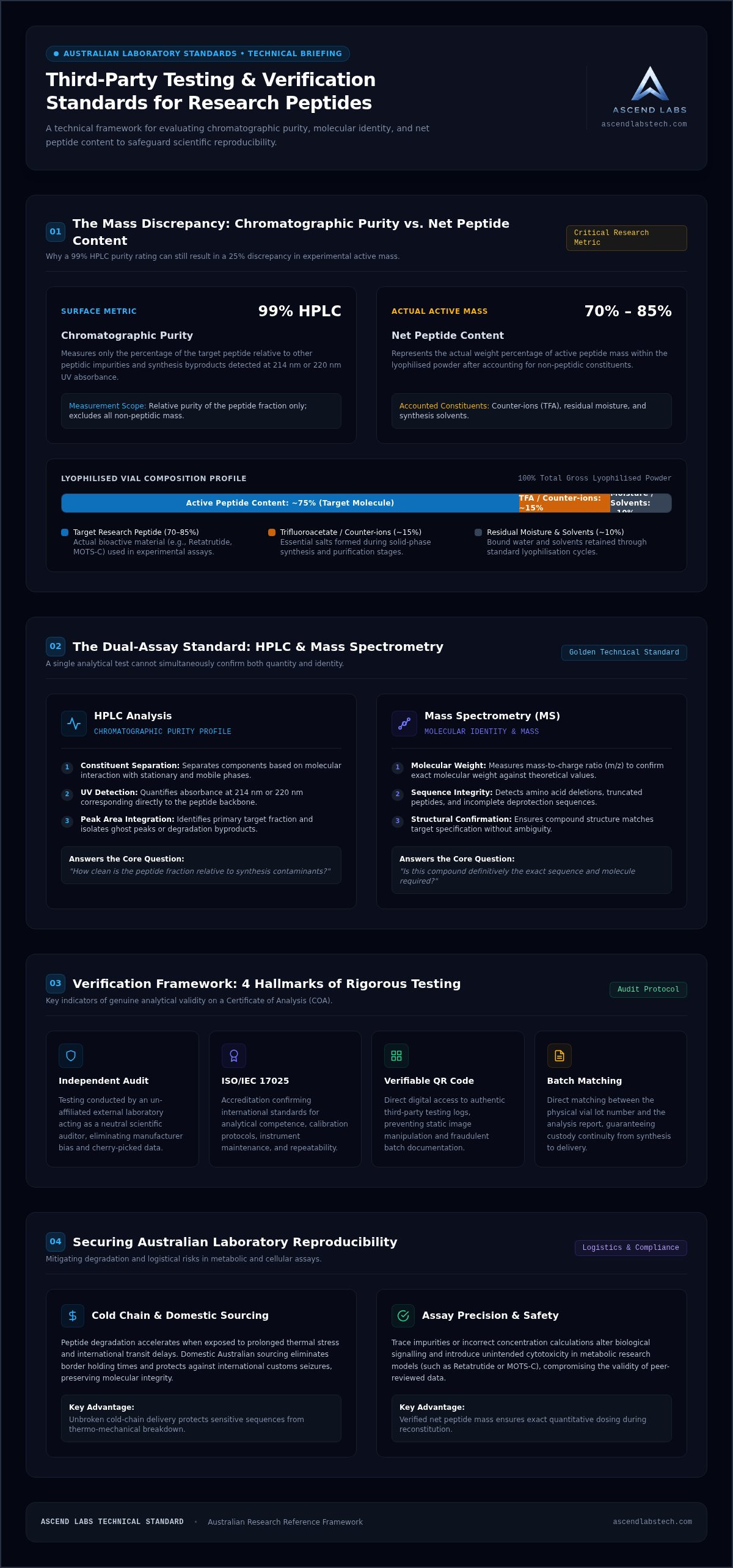
However, purity does not account for non-peptidic mass. Lyophilised powders often contain counter-ions such as trifluoroacetate (TFA), residual solvents, and moisture. A vial with 99% HPLC purity might only possess a net peptide content of 70% to 85%. For those sourcing metabolic research compounds, failing to account for this mass discrepancy can lead to systematic errors in concentration calculations. Verification must therefore address both the identity of the molecule and the actual active mass present in the vial.
The Technical Benchmarks: HPLC and Mass Spectrometry
Validating the integrity of complex compounds requires a dual-assay approach. Standalone metrics are insufficient for modern biotechnology; a single test cannot simultaneously confirm both the quantity and the identity of a substance. For Australian researchers, the gold standard involves the concurrent use of High-Performance Liquid Chromatography (HPLC) and Mass Spectrometry (MS). These technologies provide a comprehensive analytical profile that ensures your data isn't compromised by synthesis errors or batch-to-batch variability.
HPLC: Analysing the Purity Profile
High-Performance Liquid Chromatography serves as the primary instrument for assessing chromatographic purity. This process separates sample constituents based on their molecular interactions with a stationary phase. In a professional third-party report, purity is determined by the "peak area" integration. A 99% purity rating indicates that the target peptide accounts for 99% of the total UV absorbance detected, typically at the 214 nm or 220 nm wavelength corresponding to the peptide backbone.
Researchers must look beyond the primary peak. The presence of "ghost peaks" or a raised baseline indicates the existence of related substances, such as truncated sequences or salts. While 95% purity may suffice for basic screening, advanced metabolic studies demand thresholds of ≥98.0%. This level of precision is vital when working with sophisticated metabolic research compounds that require high stability and minimal interference.
Mass Spectrometry: Verifying Molecular Weight
While HPLC measures how much of the target substance is present, Mass Spectrometry confirms what that substance actually is. It measures the mass-to-charge ratio of the ionised molecule to determine its molecular weight. This step is non-negotiable for verifying the amino acid sequence of compounds like MOTS-C or Retatrutide. Without MS, a "mismatch" compound—an entirely incorrect molecule that happens to elute at the same time as the target during HPLC—could pass unnoticed and invalidate months of laboratory work.
Modern third-party testing for research peptides utilises high-resolution systems to achieve mass accuracy within <5 ppm. This precision allows for the differentiation between the target molecule and structural analogues or adducts. When these two benchmarks are used in tandem, they provide a definitive chemical fingerprint. This level of verification is the only way to guarantee that the Tirzepatide or Retatrutide in your laboratory matches the theoretical mass required for reproducible scientific inquiry. Domestic supply chains that prioritise this dual-assay validation offer the most reliable path for maintaining research integrity in the Australian market.
Evaluating Verification: Third-Party vs. In-House Testing
The distinction between internal manufacturer reports and independent verification is often the difference between successful inquiry and compromised data. While a manufacturer may provide a Certificate of Analysis (COA), this document represents a self-audit. In any high-stakes laboratory environment, the entity producing the compound shouldn't be the same entity responsible for verifying its quality. This inherent conflict of interest is the primary reason why third-party testing for research peptides is essential for scientific integrity.
The Risks of Internal Testing
Internal laboratories frequently operate without the stringent oversight required for objective results. A common issue involves the use of equipment calibrated to favour high-purity outcomes, where baseline noise is suppressed to hide synthesis byproducts. There's also the persistent problem of "cherry-picking," where a manufacturer tests the single best vial from a large run and applies that result to the entire batch, ignoring the variance inherent in mass synthesis.
- Lack of accountability: Internal labs aren't audited by neutral bodies for specific batch accuracy, meaning there's no recourse for inaccurate data.
- Template COAs: Some suppliers reuse old reports for new batches, failing to account for the unique impurities that can arise in each individual synthesis run.
- Commercial pressure: The drive to move inventory often outweighs the commitment to identifying trace impurities that could skew research results.
Third-Party Verification as a Research Pillar
Independent verification acts as a technical safety net. By employing laboratories accredited under ISO/IEC 17025, researchers ensure that the analytical methods used are standardised and internationally recognised. These facilities have no stake in the commercial success of the compound, meaning their reports are purely data-driven and focus on absolute accuracy.
Incorporating these standards into your workflow builds a reliable dataset for long-term Australian studies. The protocol for peptide purity testing involves a rigorous chain of custody that manufacturer-led reports simply can't replicate. While the initial investment in third-party testing for research peptides may seem higher, it's negligible compared to the cost of failed research, lost reagents, and the damage to institutional credibility caused by contaminated samples.
Securing compounds through a domestic supplier that prioritises these independent audits ensures that your Retatrutide or MOTS-C batches meet the precise requirements of Australian research standards. It's a disciplined approach to quality that prioritises scientific truth over marketing claims.
Interpreting the Certificate of Analysis (COA) for Research Integrity
A Certificate of Analysis (COA) serves as the primary technical record for a compound, but its presence alone doesn't guarantee quality. For Australian practitioners, the ability to critically evaluate this document is the final safeguard in third-party testing for research peptides. Forged or "template" reports have become increasingly sophisticated; consequently, a methodical approach to scrutiny is non-negotiable for maintaining research integrity. You must look beyond the headline purity percentage to the underlying data that supports it.
Step-by-Step COA Scrutiny
The first point of inspection is the analysis date. If the data is more than 12 months old, it may no longer reflect the stability or purity of the current batch. You must cross-reference the batch number printed on the report with the unique identifier on the vial. A discrepancy here renders the document useless for your records.
When analysing the chromatogram, look for a single, sharp, and symmetrical peak. Broad shoulders or secondary peaks are immediate red flags indicating synthesis byproducts or degradation. Additionally, verify the laboratory’s contact details and accreditation status. Legitimate reports must list a physical address and a valid ISO/IEC 17025 registration number. Blurred logos or generic, illegible signatures are common indicators of a doctored document.
Advanced Verification Techniques
In 2026, the standard for verification has shifted toward digital transparency. Most reputable independent labs now include dynamic QR codes that link directly to their secure database. Scanning these allows you to confirm that the chromatogram on your screen matches the one in their records. If a QR code is missing or leads to a dead link, the report's authenticity is compromised, and you should contact the third-party lab directly to confirm the accession number.
You should also pay close attention to the "Net Peptide Content" (NPC). While HPLC purity tells you the cleanliness of the peptide fraction, the NPC reveals the actual percentage of peptide by weight. This distinction is vital for accurate molar calculations in metabolic research. As explained in our professional overview of the Certificate of Analysis, failing to account for counter-ions and moisture can lead to a 15% to 20% error in your experimental concentrations. This level of transparency is exactly what sophisticated practitioners expect when conducting third-party testing for research peptides to ensure reproducible results.
Securing High-Purity Compounds for Australian Laboratories
Purity is not merely a laboratory metric; it's a logistical outcome. For Australian researchers, the transition from synthesis to the laboratory bench is fraught with variables that can compromise molecular stability. Integrating third-party testing for research peptides into a domestic supply chain provides a level of security that international procurement cannot match. By prioritising a verified domestic framework, laboratories ensure that their metabolic and mitochondrial compounds arrive with their structural integrity fully preserved.
In 2026, the baseline for third-party testing for research peptides has evolved. It's no longer sufficient to provide a static report. The modern standard requires a dynamic verification process where the supplier acts as a sophisticated curator of high-purity materials. This disciplined approach to quality management ensures that every batch of Tirzepatide or Retatrutide meets the precise benchmarks required for reproducible scientific inquiry.
The Australian Domestic Advantage
International transit presents significant risks to the stability of sensitive peptide backbones. Thermal stress during long-haul transit and unpredictable customs delays can lead to degradation, even in lyophilised powders. Sourcing through a domestic supplier bypasses these variables, ensuring that the cold chain remains intact and the compound's bio-activity is uncompromised. This is particularly critical for sensitive mitochondrial compounds like MOTS-C, which require meticulous handling to maintain their research value.
Domestic supply also facilitates direct access to technical support. When a laboratory requires clarification on a chromatogram or a mass spectrometry report, having a local partner allows for immediate, professional dialogue. This proximity strengthens the relationship between the supplier and the researcher, fostering a collaborative environment where scientific truth is the primary objective.
Procurement Framework for Researchers
Selecting a supplier requires a shift in focus from retail marketing to technical transparency. A principled institution will provide comprehensive data as a standard, not as a premium addition. When reviewing the Ascend Labs product catalogue, researchers can expect materials that have undergone rigorous independent auditing. This transparency is essential for integrating third-party data into a laboratory’s broader quality management system.
As laboratory standards continue to advance, the ability to document every stage of the procurement process becomes a mandatory requirement for publication and peer review. Future trends in 2026 point toward even greater digitisation of the verification process, where batch-specific data is instantly accessible through secure, encrypted portals. By adopting these standards now, Australian laboratories position themselves at the forefront of global biotechnological research, ensuring their data stands up to the highest levels of international scrutiny.
Advancing Australian Research Standards in 2026
Achieving scientific reproducibility requires a disciplined commitment to analytical precision. As this guide has detailed, the transition toward mandatory third-party testing for research peptides ensures that your laboratory data remains uncompromised by synthesis byproducts or batch variance. By prioritising independent verification through dual HPLC and Mass Spectrometry assays, you establish a technical foundation that stands up to the most rigorous peer review.
Securing high-purity compounds through an Australian-owned and operated institution provides a significant logistical advantage. This domestic focus maintains the cold chain and eliminates the degradation risks associated with international transit. Specialised curation of metabolic research compounds, backed by clinical-grade verification, allows you to focus entirely on your inquiry rather than the integrity of your reagents. You're now equipped to scrutinise every Certificate of Analysis with the quiet confidence of an expert curator.
Elevating your research protocols starts with a principled approach to procurement. We look forward to supporting your next breakthrough with the precision your work demands.
Frequently Asked Questions
What is the difference between a manufacturer COA and a third-party COA?
A manufacturer Certificate of Analysis is a self-audit produced by the synthesis facility, which introduces an inherent conflict of interest. In contrast, a third-party COA is an independent report from a neutral laboratory that has no commercial stake in the product. Professional third-party testing for research peptides ensures that the analytical results, including purity and identity, are verified through objective, standardised protocols that eliminate manufacturer bias.
Why is 99% purity the standard for research peptides like Retatrutide?
A threshold of 99.0% purity is the technical benchmark for advanced compounds like Retatrutide to ensure that synthesis byproducts don't interfere with receptor-binding studies. While 95% purity may suffice for basic screening, quantitative assays require the highest degree of chromatographic cleanliness. Maintaining this standard prevents unintended biological signalling caused by truncated sequences, ensuring that your Australian laboratory results are both precise and valid for peer-reviewed publication.
Can I trust a peptide supplier that does not provide HPLC data?
You shouldn't rely on any supplier that fails to provide batch-specific HPLC data. High-Performance Liquid Chromatography is the baseline metric for purity; without it, there's no evidence of chromatographic cleanliness. In 2026, third-party testing for research peptides must include both HPLC for purity and Mass Spectrometry for identity. Suppliers who omit these reports are often masking inconsistent synthesis runs or a lack of rigorous quality control.
How often should a peptide batch be re-tested for purity?
Peptide batches should be verified upon synthesis and re-tested if the compound is stored for over 12 months. Stability varies by sequence; for example, mitochondrial compounds like MOTS-C may require more frequent monitoring if storage conditions deviate from recommended temperatures. If a vial has been subjected to thermal stress during transit, a secondary verification is advisable to confirm that no significant degradation or oxidation has occurred.
What are the most common contaminants found in unverified peptides?
Unverified compounds often contain synthesis byproducts such as truncated sequences, residual solvents, and moisture. Endotoxin contamination is another significant risk; research peptides should test below 5.0 EU/mg for in vitro studies to avoid macrophage activation. Additionally, residual trifluoroacetic acid (TFA) salts can exhibit cytotoxicity in cell cultures if they exceed 10–100 nM, which is why understanding the salt content of your specific batch is vital.
How do I verify if a third-party testing laboratory is legitimate in Australia?
Legitimate laboratories must hold ISO/IEC 17025 accreditation, which is audited in Australia by the National Association of Testing Authorities (NATA). You should scan the dynamic QR code on the COA to verify the accession number against the lab's secure database. If a report lacks a verifiable digital signature or a physical lab address, it's likely a template and shouldn't be used to validate your research data.
Does third-party testing guarantee the compound is safe for human use?
Third-party testing verifies only the chemical specifications and identity of a compound for laboratory research. It isn't a safety certification for clinical use. Ascend Labs provides specialised compounds exclusively for scientific inquiry and does not supply prescription medications for human consumption. Verification ensures that your research data is accurate and reproducible within a controlled laboratory environment, maintaining the integrity of your institutional studies.
What is the role of TFA (Trifluoroacetic acid) in peptide purity reports?
Trifluoroacetic acid (TFA) is a standard counter-ion used during the HPLC purification process to stabilise the peptide. Most lyophilised research peptides are delivered as TFA salts, which typically account for 15% to 30% of the total powder weight. Understanding the role of TFA is essential for calculating the Net Peptide Content (NPC), as failing to account for these salts will lead to systematic overstatement of active peptide concentrations.


