

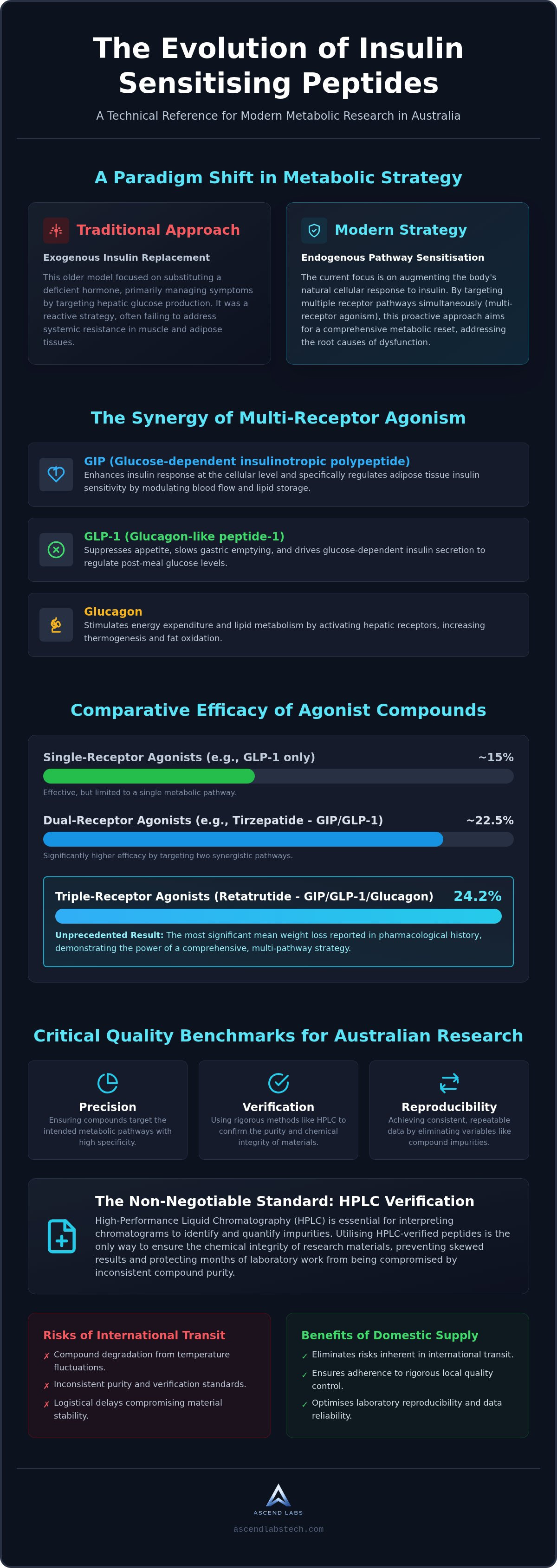
With phase 2 trials of Retatrutide reporting a 24.2% mean weight loss, the most significant result in pharmacological history, the focus of metabolic study has shifted toward complex multi-receptor agonism. This evolution creates a demanding environment for insulin sensitising peptide research, where the intricate interplay of GIP, GLP-1, and Glucagon pathways requires a higher level of analytical precision. You likely understand that while these triple-agonist compounds offer unprecedented potential, the practicalities of sourcing HPLC-verified materials within Australia often present a significant barrier to achieving consistent, reproducible data.
Inconsistent purity in imported compounds can compromise months of laboratory work, making domestic supply and rigorous verification more than just a convenience. This article serves as a comprehensive technical reference for Australian researchers, detailing the comparative efficacy of modern peptides and the specific purity standards required for 2026. We provide a clear framework for evaluating peptide integrity, ensuring your metabolic studies are built on a foundation of chemical accuracy and reliable domestic logistics. We will examine the nuances of multi-receptor pathways and the verification protocols essential for maintaining the highest standards of laboratory inquiry.
Key Takeaways
- Examine the paradigm shift from exogenous insulin replacement to advanced endogenous sensitisation strategies in contemporary metabolic study.
- Analyse the synergistic mechanisms of GIP, GLP-1, and Glucagon agonism to better understand their roles in modern insulin sensitising peptide research.
- Compare the specific binding affinities and metabolic efficacy of dual-receptor agonists against the latest triple-agonist compounds like Retatrutide.
- Establish a rigorous framework for interpreting HPLC chromatograms to identify impurities and ensure the chemical integrity of research materials.
- Optimise laboratory reproducibility by utilising domestic supply channels that eliminate the degradation risks inherent in international transit.
The Evolution of Insulin Sensitising Peptide Research
Insulin sensitising peptides represent a sophisticated class of compounds engineered to augment the cellular response to endogenous insulin. For decades, metabolic inquiry prioritised exogenous insulin replacement, a strategy that essentially provided a substitute for a deficient hormone. Modern insulin sensitising peptide research has moved beyond this reactive model. It now focuses on sensitising existing pathways, a shift that addresses the root causes of metabolic dysfunction rather than merely managing symptoms. This transition is central to the 2026 research environment, where the focus has pivoted toward multi-pathway agonism to achieve systemic metabolic stability.
Australian institutions remain at the forefront of this progression. The Florey Institute and the Garvan Institute have pioneered investigations into single-chain insulin analogues and the complex role of incretin hormones. These local efforts have defined how GIP and GLP-1 receptors modulate insulin secretion with high specificity. With the Medical Research Future Fund (MRFF) reaching its $1 billion annual capacity in 2026, the Australian scientific community is uniquely positioned to explore these advanced pathways. Precision. Verification. Reproducibility. These three pillars now define the standard for domestic metabolic studies.
Traditional Insulin Mimetics vs. Modern Sensitisers
Classical mimetics primarily targeted hepatic glucose production to maintain glycaemic control. While these older models were effective in isolated contexts, they often failed to address systemic insulin resistance across muscle and adipose tissues. We've seen the emergence of non-traditional peptides like Catestatin (CST) in recent metabolic studies to fill this gap. CST offers a broader approach by modulating catecholamine release and inflammatory responses. Unlike traditional mimetics, modern sensitisers like Tirzepatide aim for a comprehensive metabolic reset. They target multiple receptors simultaneously to achieve superior efficacy compared to single-receptor hormone replacement.
The Significance of In-Vitro Metabolic Models
High-fidelity in-vitro models are essential for evaluating peptide action before progressing to clinical stages. Researchers utilise specific hepatocyte and adipocyte cell lines to map how compounds influence cellular signalling. A critical area of 2026 research involves macrophage-mediated inflammation in the liver. Understanding how peptides mitigate this inflammation is key to reversing chronic insulin resistance. Achieving reproducible data in these sensitive models requires compounds of the highest integrity. Inconsistent purity in research materials can lead to skewed results, making HPLC-verified peptides a non-negotiable standard for serious insulin sensitising peptide research in Australian laboratories.
Mechanisms of Action: GIP, GLP-1, and Glucagon Agonism
The core of modern insulin sensitising peptide research lies in the orchestration of the incretin effect. GIP and GLP-1 receptors act as primary drivers of glucose-dependent insulin secretion, working in tandem to regulate postprandial glucose levels. While GLP-1 focuses on slowing gastric emptying and suppressing appetite, GIP enhances insulin response more directly at the cellular level. The GIP receptor specifically regulates adipose tissue insulin sensitivity by modulating blood flow and lipid storage in white adipose tissue. This dual-action approach prevents the glycaemic volatility often seen in single-receptor studies, providing a more stable environment for longitudinal metabolic analysis.
Integrating glucagon receptor agonism represents a major advancement in 2026 metabolic research. Traditionally viewed solely as a counter-regulatory hormone to insulin, glucagon's now utilised in multi-agonists to stimulate energy expenditure and lipid metabolism. By activating hepatic glucagon receptors, these compounds increase thermogenesis and fat oxidation. The synergy achieved by combining these three pathways—GIP, GLP-1, and Glucagon—surpasses the efficacy of single-receptor ligands by addressing both energy intake and energy output simultaneously. It's a comprehensive strategy that targets the multi-faceted nature of metabolic syndrome.
Catestatin (CST) and Liver Inflammation Research
Catestatin functions as a potent endogenous regulator of glucose and insulin tolerance. Research from UC San Diego has demonstrated that this peptide improves glucose and insulin sensitivity by suppressing excessive hepatic glucose production. CST also plays a vital role in reducing macrophage recruitment in the liver, effectively dampening the chronic inflammation that often precedes systemic insulin resistance. Current 2026 findings in obese mouse models indicate that CST significantly restores metabolic flexibility, making it a key focus for laboratories studying non-traditional sensitisation pathways and hepatic health.
The Incretin Pathway in Neuromodulator Research
There's an increasing crossover between metabolic studies and neuroscience. The same incretin pathways that regulate peripheral insulin sensitivity are also active within the central nervous system. Research into neuromodulator peptides australia suggests that these compounds influence central insulin signalling, potentially protecting against neurodegeneration. This has profound implications for longevity and cognitive function studies, as central insulin resistance is increasingly linked to age-related decline. Laboratories focusing on these complex interactions can source high-purity metabolic research compounds to ensure the accuracy and reproducibility of their neurological data.
Comparative Analysis of Modern Sensitising Agents
The landscape of insulin sensitising peptide research is currently defined by the transition from dual to triple-receptor agonism. While dual agonists like Tirzepatide have established a high benchmark for metabolic regulation, triple agonists like Retatrutide introduce a third pathway: the glucagon receptor. This addition significantly alters the metabolic profile of the compound. Dual agonists primarily focus on the synergy between GIP and GLP-1 to enhance insulin secretion and suppress appetite. Triple agonists, however, leverage glucagon agonism to increase energy expenditure and directly target hepatic lipid accumulation. This comparative analysis is vital for laboratories deciding which ligand best suits their specific metabolic models.
Evaluating the potency of GLP-1 versus GIP receptor binding affinities reveals distinct pharmacological signatures. Tirzepatide exhibits a "GIP-favoured" profile, which is thought to provide superior weight loss and glycaemic control compared to traditional GLP-1 analogues. In contrast, triple agonists maintain this GIP potency while adding the thermogenic benefits of glucagon activation. This results in more aggressive suppression of hepatocyte glucose production and a marked reduction in intracellular lipid stores. For researchers, the choice between these agents often depends on whether the study focuses on insulin secretion alone or broader energy homeostasis.
Purity remains the ultimate deciding factor in research outcomes. There's a significant distinction between standard research-grade materials and high-purity, HPLC-verified compounds. Impurities or peptide degradation can lead to off-target effects or inconsistent receptor binding, particularly in sensitive in-vitro models. Achieving reproducible data in 2026 requires meticulous attention to the chemical integrity of the peptides used, ensuring that the observed effects are truly representative of the compound's mechanism of action.
Retatrutide in Advanced Metabolic Studies
The mechanism of triple agonism in retatrutide research offers a more comprehensive approach to metabolic syndrome. By targeting GIP, GLP-1, and Glucagon receptors simultaneously, it achieves weight loss results that were previously unattainable with dual agonists. This compound represents the current frontier for Australian metabolic labs investigating the limits of pharmacological weight management. Maintaining Retatrutide stability in laboratory settings is paramount; its complex structure requires precise storage conditions and domestic sourcing to avoid the degradation risks of long-haul transit.
Tirzepatide: The Dual Agonist Standard
Tirzepatide remains the dual agonist standard due to its well-documented efficacy and predictable receptor binding profile. When compared to traditional GLP-1 analogues like Semaglutide, Tirzepatide consistently demonstrates superior glycaemic control due to its GIP component. In many Australian laboratories, it's utilised as a reliable control in multi-agonist research. This allows scientists to isolate the specific contributions of the glucagon receptor in newer triple-agonist compounds, providing a clear baseline for comparative metabolic studies.
Critical Quality Benchmarks for Australian Peptide Research
Precision is the non-negotiable foundation of metabolic science. In the context of insulin sensitising peptide research, the chemical integrity of a compound determines the validity of the entire study. High-Performance Liquid Chromatography (HPLC) remains the gold standard for assessing purity. A clean chromatogram shows a single, sharp peak; any secondary peaks indicate the presence of impurities or peptide degradation. These contaminants can introduce variables that obscure the compound's true metabolic effects, leading to data that is difficult to replicate across different laboratory settings.
Mass Spectrometry complements HPLC by confirming the molecular weight and sequence identity of the peptide. While HPLC tells you how pure the sample is, Mass Spectrometry confirms that the sample is exactly what it claims to be. For 2026 research standards, relying on a generic Certificate of Analysis (COA) is no longer sufficient. Laboratories must demand batch-specific COAs that provide a transparent record of the specific vial's verification. This ensures that every milligram used in an experiment meets the rigorous requirements of modern biotechnology and yields reliable data.
The Risk of Impurities in Insulin Research
Residual Trifluoroacetic acid (TFA) is a common byproduct of peptide synthesis that can significantly alter in-vitro cell viability. Even trace amounts of TFA can be toxic to sensitive hepatocyte or adipocyte cell lines, skewing results in insulin sensitising peptide research. Truncated sequences, which are peptides missing one or more amino acids, can also interfere with receptor binding affinity. The difference in data reliability between 95% and 99% purity is substantial. At 95% purity, the unknown impurities can create significant biological noise, whereas 99% purity provides the clarity needed for definitive conclusions and high-fidelity modelling.
Australian Standards for Laboratory Verification
Aligning with Australian laboratory grade standards is essential for maintaining the international standing of domestic research. Domestic verification through peptide purity testing allows researchers to bypass the quality variances often found in international supply chains. This local oversight ensures that compounds remain stable and potent upon arrival. Integrating these protocols with mitochondrial peptide research enables a more comprehensive understanding of metabolic longevity and cellular health. To maintain these high standards, researchers should source HPLC-verified research compounds from trusted domestic providers who prioritise transparency and chemical accuracy.
Sourcing High-Purity Research Compounds in Australia
Securing reliable materials for insulin sensitising peptide research requires a strategic balance between chemical verification and logistical precision. For Australian laboratories, the traditional reliance on international suppliers often introduces unacceptable variables into the experimental framework. Customs delays, fluctuating temperatures during long-haul transit, and inconsistent purity standards can compromise sensitive metabolic experiments. By choosing a domestic supply chain, researchers eliminate these external risks. This ensures that the compounds arriving at the bench are as stable and potent as the day they were synthesised, allowing for greater confidence in longitudinal data.
Ethical procurement in 2026 demands a higher level of transparency than previous years. With the TGA making unapproved peptides a compliance priority, it's essential for laboratories to source through professional, domestic channels that understand the local regulatory environment. This approach ensures that all materials are strictly for laboratory research purposes and meet the rigorous standards of the Australian scientific community. A domestic supply chain doesn't just offer convenience; it provides a layer of accountability and quality assurance that international vendors cannot replicate.
Domestic Logistics and Peptide Stability
Ascend Labs operates as an authoritative gatekeeper for the Australian scientific community. We maintain a curated catalogue of high-purity metabolic agents, including Retatrutide and Tirzepatide, specifically for laboratory research purposes. Every compound is backed by transparent, batch-specific COA documentation, providing researchers with the HPLC and Mass Spectrometry data required for rigorous verification. We don't act as a mere vendor; we position ourselves as a disciplined partner dedicated to the integrity of Australian biotechnology. Our focus remains on providing verified compounds that meet the exacting standards of 2026 research protocols, ensuring that your laboratory work is built on a foundation of chemical accuracy.
Advancing Metabolic Inquiry with Precision Verification
It's clear that the paradigm shift toward triple-receptor agonism has fundamentally redefined the parameters of insulin sensitising peptide research in 2026. This increasing complexity necessitates a more rigorous approach to chemical verification; HPLC and Mass Spectrometry standards are now the only reliable metrics for ensuring laboratory success. By prioritising these verified benchmarks and eliminating the degradation risks inherent in international transit, Australian researchers can ensure their data remains both robust and reproducible. Consistency in metabolic modelling requires more than just advanced ligands. It demands a supply chain built on transparency and technical precision.
As an Australian-owned and operated institution, Ascend Labs provides batch-specific, verified standards for serious metabolic inquiry. Our exclusive focus on laboratory-grade compounds ensures your studies are built on a foundation of absolute chemical integrity. We invite you to explore the Ascend Labs research peptide catalogue to secure high-purity materials with the benefit of reliable domestic shipping. Precision at the bench begins with purity in the vial. We look forward to supporting your next metabolic breakthrough.
Frequently Asked Questions
What is the primary role of an insulin sensitising peptide in research?
The primary role of an insulin sensitising peptide is to enhance cellular sensitivity to endogenous insulin rather than acting as a direct hormone replacement. In insulin sensitising peptide research, these compounds are utilised to map signalling pathways in hepatocytes and adipocytes. Researchers use them to study the reversal of systemic insulin resistance and investigate the modulation of inflammatory markers. This enables a deeper understanding of metabolic flexibility within complex in-vitro and in-vivo models.
How does Retatrutide differ from Tirzepatide in metabolic studies?
Retatrutide functions as a triple-receptor agonist, targeting GIP, GLP-1, and glucagon receptors, whereas Tirzepatide is a dual agonist focusing only on GIP and GLP-1. The inclusion of glucagon receptor agonism in Retatrutide research allows for the study of increased energy expenditure and hepatic lipid oxidation. This third pathway distinguishes Retatrutide as a more comprehensive agent for investigating metabolic syndrome compared to the dual-action mechanism of Tirzepatide.
Are these insulin sensitising peptides available for human consumption in Australia?
No, these peptides are strictly for laboratory research purposes and are not for human consumption. In Australia, unapproved peptides are a high compliance priority for the TGA in 2026. Possession or supply without a valid prescription for therapeutic use is illegal and carries significant penalties. Research-grade compounds are intended solely for scientific inquiry within a controlled laboratory environment to ensure safety and regulatory adherence.
What is the minimum purity required for reliable in-vitro peptide research?
Reliable in-vitro results generally require a minimum purity of 98% to 99% to ensure data integrity. Lower purity levels often introduce biological noise through residual trifluoroacetic acid (TFA) or truncated sequences, which can skew receptor binding affinities. High-purity standards are essential for insulin sensitising peptide research to ensure that observed cellular responses are attributable solely to the peptide itself rather than unknown contaminants or synthesis byproducts.
How does Catestatin (CST) improve insulin sensitivity in mouse models?
Catestatin improves insulin sensitivity by suppressing excessive hepatic glucose production and reducing macrophage-mediated inflammation in the liver. In obese mouse models, CST has been shown to restore metabolic flexibility and enhance glucose tolerance. Researchers utilise this peptide to study non-traditional sensitisation pathways that differ from the incretin-based mechanisms seen in GLP-1 and GIP agonists, providing a broader perspective on metabolic health and systemic inflammation.
Why is domestic Australian shipping preferred for research peptides?
Domestic shipping is preferred to eliminate the risks of peptide degradation associated with international transit and customs delays. Sensitive metabolic compounds can lose structural integrity if they're exposed to fluctuating temperatures during long-haul freight. Australian-based supply ensures a shorter, temperature-controlled logistics chain, maintaining the chemical potency of the peptides. This reliable domestic delivery is critical for laboratories requiring consistent, high-fidelity materials for sensitive experiments.
Can I buy MOTS-C and KLOW alongside insulin sensitising agents?
Yes, metabolic research compounds such as MOTS-C and KLOW are available for procurement alongside insulin sensitising agents. These peptides are often studied in conjunction with incretin mimetics to explore mitochondrial function and metabolic longevity. Ascend Labs maintains a curated catalogue of these high-purity agents, ensuring that all compounds meet the same rigorous HPLC and Mass Spectrometry verification standards required for advanced scientific inquiry within Australian laboratories.
What documentation should accompany a research-grade peptide purchase?
Every research-grade peptide purchase should be accompanied by a batch-specific Certificate of Analysis (COA). This documentation must include HPLC chromatograms to verify purity and Mass Spectrometry data to confirm the molecular weight and sequence identity. Relying on generic or outdated COAs is insufficient for 2026 standards. Batch-specific verification provides the transparency needed to ensure that the material used in your research meets the exact chemical specifications required.


