

The era of mono-receptor metabolic research is rapidly concluding, replaced by a sophisticated landscape of multi-receptor synergy that demands absolute chemical precision. As Australian laboratories transition toward more complex models, the requirement for a high-purity gip receptor agonist research compound has never been more critical for establishing valid baseline data. You've likely encountered the frustration of international procurement, where inconsistent purity and opaque mass spectrometry reports stall your progress for weeks. In a field where a fraction of a percentage in variance can compromise an entire study, relying on unverified international sources represents an unacceptable risk to your project timelines.
We understand that your research relies on materials that match their theoretical profiles without exception. This technical briefing provides a comprehensive analysis of GIP receptor agonist mechanisms, focusing on the shift from dual to triple agonism and the rigorous verification standards required in 2026. We'll examine the domestic supply chain's role in maintaining compound integrity and offer a clear framework for interpreting complex HPLC data. This overview ensures your laboratory operates with total confidence in its primary materials, allowing you to focus on high-level inquiry rather than supply chain logistics or purity concerns.
Key Takeaways
- Understand the clinical evolution from mono-agonism to multi-receptor synergy and how GIP integration enhances metabolic research outcomes.
- Learn to interpret complex HPLC and Mass Spectrometry reports to ensure your gip receptor agonist research compound meets the mandatory ≥99% purity threshold.
- Master technical protocols for the reconstitution and storage of lyophilised peptides to prevent degradation and maintain chemical stability in laboratory environments.
- Discover the advantages of a secure domestic supply chain in Australia, eliminating international lead times and temperature-related transit risks.
- Analyse the specific synergistic profiles of dual and triple agonist models to optimise experimental design for metabolic studies.
Understanding GIP Receptor Agonism in Metabolic Research
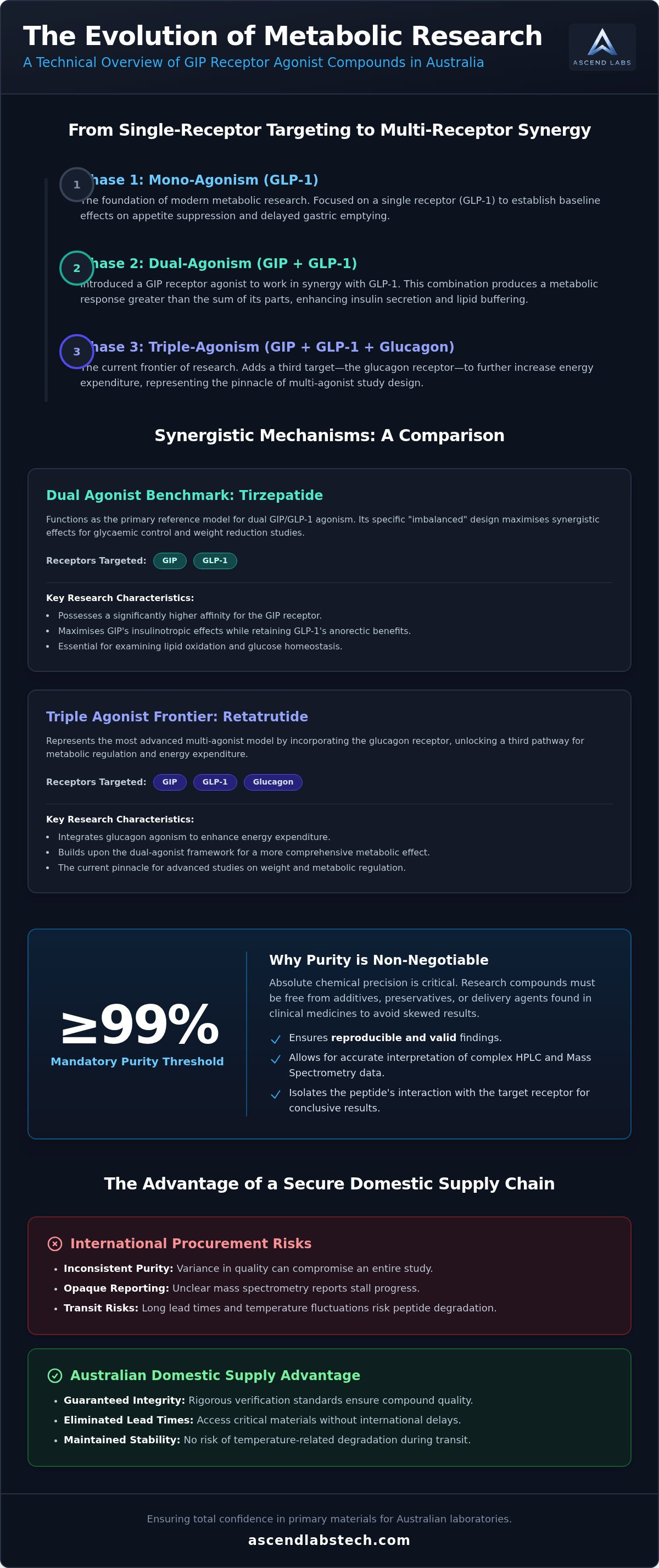
Gastric Inhibitory Polypeptide, or GIP, is a 42-amino acid peptide that serves as a cornerstone of metabolic endocrinology. Historically, research focused on its ability to inhibit gastric acid secretion, but modern inquiry has shifted entirely toward its potent incretin properties. In 2026, the Australian research community has moved beyond GLP-1 mono-agonism, recognising that GIP-inclusive multi-agonism offers a more effective pathway for metabolic regulation. This evolution is driven by clinical evidence that dual and triple agonists achieve superior results in weight reduction and glycaemic control compared to single-receptor targets.
GIP receptors are distributed across critical tissues, including the pancreas, adipose tissue, and the central nervous system. This widespread expression means a gip receptor agonist research compound is essential for studying holistic energy balance. By targeting GIP receptors in adipose tissue, researchers can observe changes in lipid buffering and insulin-mediated glucose uptake. In the brain, these compounds help illuminate the pathways governing appetite suppression and energy expenditure, making them indispensable for modern obesity studies.
The Biological Mechanism of GIP Signalling
Binding to the GIP receptor (GIP-R) initiates a G-protein coupled cascade, specifically stimulating the adenylate cyclase pathway. This process elevates intracellular cAMP levels, which in turn enhances glucose-dependent insulin secretion from pancreatic beta cells. In a laboratory setting, this "incretin effect" is meticulously measured to understand how GIP modulates glucagon. Unlike GLP-1, GIP's effect on glucagon is bifunctional; it can stimulate secretion during low blood sugar while suppressing it when levels are high. Such complexity is why GIP remains a primary subject for 2026 diabetes research.
Distinguishing Research Compounds from Clinical Medications
Scientific integrity depends on the use of high-purity materials that remain free from the additives found in TGA-approved medicines. Clinical formulations are designed for patient stability, not experimental flexibility. They often contain preservatives or delivery agents that can skew results in cell culture or sensitive assays. Precise chemical profiles are non-negotiable for insulin sensitising peptide research in Australian laboratories. Utilising a verified gip receptor agonist research compound ensures that your findings are reproducible and based solely on the peptide’s interaction with the target receptor. It's the difference between a successful study and an inconclusive data set.
Synergistic Mechanisms: Comparing Dual and Triple Agonist Models
The integration of multiple receptor pathways marks a fundamental shift in metabolic study design. While GLP-1 mono-agonists established the foundation, the introduction of a gip receptor agonist research compound as part of a multi-agonist framework has unlocked significantly higher efficacy in weight loss and glycaemic regulation. This synergy occurs because GIP and GLP-1 target complementary pathways. GIP primarily modulates insulin secretion and lipid buffering in adipose tissue, while GLP-1 focuses on appetite suppression and delayed gastric emptying. Combined, they produce a metabolic response that exceeds the sum of their individual parts.
Tirzepatide: The Dual Agonist Benchmark
Tirzepatide serves as the primary reference model for dual agonism in Australian laboratories. It functions as an "imbalanced" agonist, possessing a significantly higher affinity for the GIP receptor than the GLP-1 receptor. This specific ratio is designed to maximise the insulinotropic effects of GIP while maintaining the anorectic benefits of GLP-1. Current research protocols in Australia frequently utilise Tirzepatide to examine lipid oxidation and glucose homeostasis. By using high-purity metabolic research compounds, scientists can isolate these synergistic effects without the interference of clinical excipients.
Retatrutide and the Triple Agonist Frontier
The current pinnacle of multi-receptor study is the triple agonist model, exemplified by Retatrutide. This compound adds glucagon receptor (GCGR) agonism to the existing GIP/GLP-1 framework. It's a strategic addition; glucagon directly stimulates hepatic glucose production and, more importantly, increases energy expenditure through thermogenesis. This triple receptor interaction addresses metabolic dysfunction from three distinct angles simultaneously.
Recent Phase 2 data illustrates the impact of this triple synergy. Participants in these trials achieved up to 24.2% body weight reduction over 48 weeks, surpassing the 20-22% typically observed with dual agonists. For Australian researchers, this gip receptor agonist research compound provides a vital tool for investigating complex pathologies. Specifically, it's used in non-alcoholic fatty liver disease (NAFLD) models, where glucagon-mediated lipid clearance in the liver is a primary area of interest. The ability to observe these interactions in a controlled setting is essential for advancing our understanding of metabolic rate and thermogenesis in 2026.
Technical Specifications and Purity Verification for Research Compounds
Establishing scientific validity requires more than just an active compound; it necessitates a standard of chemical excellence that eliminates confounding variables. In the context of metabolic endocrinology, a gip receptor agonist research compound must consistently achieve a purity threshold of ≥99%. This benchmark isn't arbitrary. Even a 1% variance in purity can introduce significant concentrations of residual reagents or truncated peptide sequences. These impurities can trigger unintended cellular responses, effectively rendering your experimental data unreliable. For Australian laboratories, the primary tools for ensuring this standard are High-Performance Liquid Chromatography (HPLC) and Mass Spectrometry (MS).
HPLC Analysis: Ensuring Chemical Integrity
HPLC serves as the definitive method for quantifying peptide purity. By separating the sample components based on their chemical properties, an HPLC chromatogram provides a visual representation of the compound's cleanliness. A high-purity GIP agonist will display a single, sharp peak with a minimal baseline drift. Any secondary peaks indicate the presence of degradation products or synthesis by-products. Identifying these impurities early is essential, as they directly impact experimental reproducibility. Laboratories that fail to implement rigorous peptide purity testing protocols risk publishing findings that cannot be replicated by the wider scientific community. A Certificate of Analysis (COA) must accompany every batch, providing a transparent record of the integration values from the HPLC process.
Mass Spectrometry and Sequence Verification
While HPLC confirms the quantity of the primary substance, Mass Spectrometry verifies its identity. It's the only reliable way to confirm that the gip receptor agonist research compound possesses the correct molecular weight and amino acid sequence. MS analysis detects even subtle errors, such as single amino acid substitutions or truncated sequences that might otherwise pass a standard purity test. These "off-target" molecules can bind to non-target receptors, creating "noise" in your metabolic assays. By meticulously verifying the molecular mass against the theoretical profile, researchers safeguard their protocols against sequence-level anomalies. This level of verification is especially critical when studying complex multi-agonists, where the interplay between GIP, GLP-1, and glucagon receptors requires absolute sequence fidelity to produce accurate results.
Implementation Protocols in Australian Laboratory Settings
Maintaining the structural integrity of a gip receptor agonist research compound requires strict adherence to biochemical handling standards. Even the highest purity peptides are susceptible to denaturation if subjected to improper environmental conditions or mechanical stress. Australian researchers must implement standardised protocols to ensure that the chemical profile verified at the point of synthesis remains intact throughout the experimental lifecycle. Precision in handling is just as vital as the initial purity of the compound for achieving reproducible results.
Reconstitution and Solvent Selection
Choosing the appropriate solvent is the first step in successful implementation. For most in-vitro applications, bacteriostatic water or sterile phosphate-buffered saline (PBS) serves as a reliable medium. Your choice depends entirely on specific research aims and the pH sensitivity of the assay. Mechanical degradation is a common but avoidable error. You shouldn't shake the vial. Instead, allow the solvent to run down the side of the glass and gently swirl until the lyophilised powder is completely dissolved. Precise calculations are paramount; determining the exact concentration for your assays ensures that dosing remains consistent across all replicates.
Storage and Stability Logistics
Stability is heavily influenced by temperature and light exposure. Lyophilised peptides are generally stable at room temperature for short periods, but long-term storage requires a controlled environment at -20°C or, ideally, -80°C. Once reconstituted, the peptide's shelf life diminishes significantly. It's best to maintain liquid solutions at 2-8°C and use them within a narrow window to prevent significant degradation. Freeze-thaw cycles present a major risk to peptide bioactivity. Repeated ice crystal formation can shear the delicate molecular bonds of a gip receptor agonist research compound.
To mitigate this risk, researchers should aliquot the reconstituted solution into single-use volumes before freezing. This practice ensures that each sample is only thawed once, preserving the integrity of the remaining stock. Given the harsh Australian climate, ensuring that your climate-controlled inventory is backed by redundant power systems is a necessary safeguard for high-value metabolic research. Access verified metabolic research compounds to ensure your laboratory starts with the highest quality materials and a reliable domestic supply chain.
Safety protocols must remain a priority. While these compounds are designated for research purposes only, they should be handled with the same rigour as any bioactive agent. Utilise appropriate personal protective equipment and ensure all waste is disposed of according to Australian laboratory safety standards. Maintaining a meticulous log of batch numbers and storage durations will further support the reproducibility of your data and the long-term validity of your findings.
Procuring Verified GIP Agonists from Ascend Labs
Ascend Labs operates as a specialised partner for the Australian scientific community, providing high-purity metabolic compounds tailored for domestic research requirements. Procuring a gip receptor agonist research compound through a domestic channel is no longer just a convenience; it's a methodological necessity for 2026. We understand that the integrity of your data depends entirely on the quality of your primary materials. By positioning ourselves as an authoritative scientific gatekeeper, we ensure that Australian laboratories have access to verified peptides without the logistical compromises inherent in international sourcing.
The Domestic Supply Advantage
International procurement carries inherent risks that can compromise the validity of sensitive metabolic research. Customs delays are often unpredictable, and prolonged exposure to fluctuating temperatures during global transit frequently leads to peptide degradation. By maintaining a robust domestic inventory, we eliminate these variables. Our shipping protocols are rapid and discreet, ensuring that every gip receptor agonist research compound arrives at your facility with its bioactivity intact. This domestic focus directly supports the Australian biotechnology ecosystem, allowing researchers to maintain project momentum without the administrative hurdles or degradation risks of cross-border supply chains.
Quality Assurance and Expert Support
Our commitment to scientific truth is reflected in our rigorous verification processes. Every batch we distribute undergoes comprehensive HPLC and Mass Spectrometry testing to confirm both purity levels and sequence identity. We don't just provide chemicals; we provide transparency. Researchers can access a detailed Certificate of Analysis (COA) for every compound, ensuring that the materials used in their assays meet the mandatory ≥99% purity threshold. This meticulous approach is central to the Ascend Labs philosophy of substance and precision.
You can explore our full research peptide catalogue to identify compounds specifically synthesised for metabolic and neuromodulatory studies. Initiating a professional inquiry with our team is a straightforward process designed for institutional efficiency. We operate with a high degree of operational discretion, understanding the ethical and technical requirements of advanced research. By choosing a domestic, verified supplier, you secure a reliable foundation for your inquiry, ensuring your findings are based on materials of the highest chemical integrity. All compounds are strictly for laboratory research purposes only and are not for human consumption.
Advancing Metabolic Inquiry with Chemical Precision
The evolution of metabolic study design in 2026 necessitates a departure from mono-agonism toward the sophisticated synergy of dual and triple receptor models. Achieving reproducible data in these complex frameworks depends entirely on the chemical integrity of your primary materials. By utilising a domestic supply chain, Australian researchers can effectively eliminate the degradation risks associated with international transit while ensuring absolute sequence fidelity through rigorous batch testing. This disciplined approach to procurement allows you to focus on high-level inquiry rather than supply chain volatility.
Ensuring every gip receptor agonist research compound meets mandatory clinical-grade purity standards is the cornerstone of valid experimental design. Ascend Labs remains committed to supporting the Australian biotechnology sector by providing meticulous quality assurance through HPLC and Mass Spectrometry verification for every batch. Our focus on domestic logistics ensures that temperature-sensitive metabolic compounds arrive with their bioactivity fully intact. We provide the transparency and technical precision required for the most demanding laboratory protocols.
We look forward to facilitating your next breakthrough in metabolic science.
Frequently Asked Questions
What is the primary difference between a GIP receptor agonist and a GLP-1 agonist?
GIP and GLP-1 are both incretin hormones but they target distinct receptors with different physiological outcomes. GLP-1 primarily stimulates insulin secretion and promotes satiety through central nervous system pathways. GIP has more complex roles, particularly in adipose tissue where it facilitates lipid buffering and improves insulin sensitivity. While GLP-1 mono-agonists are well-documented for appetite suppression, GIP agonists are researched for their ability to complement these effects, potentially leading to more robust metabolic regulation in multi-agonist models.
Are GIP receptor agonist research compounds available for human use in Australia?
No, these compounds are strictly for laboratory research and are not approved for human consumption in Australia. The Therapeutic Goods Administration (TGA) maintains rigorous standards for prescription medicines, which research-grade chemicals don't meet. It's critical to distinguish between regulated pharmaceutical products and a gip receptor agonist research compound intended for in-vitro or pre-clinical inquiry. For those seeking clinical weight management under medical supervision, Medi Slim provides a professional pathway using approved treatments. All research materials must be handled within a controlled laboratory setting by qualified professionals and are never for clinical use.
Lyophilised Tirzepatide should be stored in a climate-controlled environment at -20°C for long-term stability. Once you reconstitute the peptide, it becomes significantly more sensitive to degradation. Reconstituted solutions must be kept refrigerated at 2-8°C and used within a short timeframe. To prevent molecular shearing caused by repeated freeze-thaw cycles, we recommend aliquoting the solution into single-use vials. This practice preserves the structural integrity and bioactivity of the compound throughout the duration of your study.
What purity level is required for published metabolic research?
Peer-reviewed journals and institutional boards generally require a purity threshold of ≥99% for valid metabolic research. Lower purity levels introduce synthesis by-products that can trigger off-target effects, effectively compromising the integrity of your experimental data. Utilising a high-purity gip receptor agonist research compound ensures that any observed physiological changes are the direct result of the peptide itself. This level of precision is essential for maintaining the reproducibility and scientific standing of your published findings in the biotechnology field.
Can GIP receptor agonists be used in triple agonist research models?
Yes, GIP receptor agonists are fundamental components of triple agonist models, such as Retatrutide. These models combine GIP, GLP-1, and glucagon receptor agonism to target multiple metabolic pathways simultaneously. Research indicates that this triple synergy can produce superior outcomes in weight reduction and glucose homeostasis compared to mono or dual agonists. Incorporating GIP agonism into these complex models allows researchers to observe the intricate interplay between incretin signalling and hepatic glucose production in controlled environments.
Why is domestic Australian shipping important for peptide integrity?
Peptides are delicate molecules that are highly susceptible to denaturation when exposed to temperature fluctuations or prolonged transit times. International shipping often involves unpredictable customs holds and uncontrolled storage conditions, which can significantly compromise peptide bioactivity. Domestic Australian shipping ensures a rapid, temperature-stable delivery process that protects the structural integrity of the compound. By sourcing materials domestically, laboratories can maintain a secure supply chain and ensure that their research materials arrive in optimal condition for immediate experimental use.
How do I interpret the HPLC report for a GIP agonist research compound?
An HPLC report provides a chromatogram that displays the purity of the compound based on its elution time. You should look for a single, sharp peak that represents the primary peptide. The area under this peak, relative to the total area of all detected peaks, determines the purity percentage. Secondary peaks indicate the presence of impurities or degradation products. A professional report will also include integration data to confirm that the compound meets the required purity standards for high-level metabolic research.
Does Ascend Labs provide a Certificate of Analysis (COA) with every order?
Yes, Ascend Labs provides a comprehensive Certificate of Analysis (COA) for every batch of research peptides. This document includes both HPLC and Mass Spectrometry data to verify the purity and molecular identity of the compound. Transparency is central to our operational philosophy, ensuring that researchers have full confidence in the materials they utilise. Accessing this data allows you to confirm that the batch meets our rigorous internal standards before commencing any sensitive laboratory protocols or assays.


