

The integrity of a neurological study is only as robust as the molecular purity of its catalysts. For many specialists, the decision to buy neuromodulator peptides australia is often clouded by the opaque nature of global supply chains and the persistent risk of international customs intervention. You've likely encountered the frustration of inconsistent batch quality or the absence of rigorous verification data when sourcing critical compounds for your laboratory. In a field where a single impurity can skew an entire data set, the reliance on unverified e-commerce vendors is a variable most researchers can't afford.
We agree that in a high-stakes research environment, precision is the only acceptable standard. This guide provides a definitive framework for identifying domestic procurement strategies that align with Australian research standards and TGA compliance priorities. You'll gain a technical understanding of HPLC and Mass Spectrometry protocols required for absolute purity verification. We'll also examine the logistical advantages of domestic supply to ensure your research remains compliant, secure, and entirely uninterrupted by regulatory friction or border seizures.
Key Takeaways
- Establish a rigorous verification framework using HPLC and Mass Spectrometry to confirm the molecular weight and absolute purity of every research compound.
- Navigate the logistical complexities of domestic procurement to buy neuromodulator peptides australia while eliminating the variables of international customs and transit degradation.
- Examine the in-vitro functional impact of neuromodulators on GABAergic systems and the upregulation of Brain-Derived Neurotrophic Factor (BDNF) in laboratory models.
- Transition from speculative e-commerce sources to a disciplined, domestic supply chain that prioritises transparency, integrity, and scientific accuracy.
- Optimise laboratory workflows by understanding the critical role of domestic distribution in maintaining the stability of sensitive biotechnological reagents.
The Landscape of Neuromodulator Peptides in Australian Research
Neuromodulator peptides represent a sophisticated class of compounds designed to influence synaptic transmission and neural plasticity within controlled laboratory models. Unlike traditional neurotransmitters that facilitate direct, point-to-point signalling, these peptides act as subtle regulators of neural circuitry. Neuropeptides are chemical messengers that adjust the excitability of neurons, effectively modulating the "gain" of specific brain regions. In the context of Australian neuroscience, there's a distinct shift toward peptide-based research as laboratories seek to understand the mechanisms behind cognitive enhancement and neuroprotection.
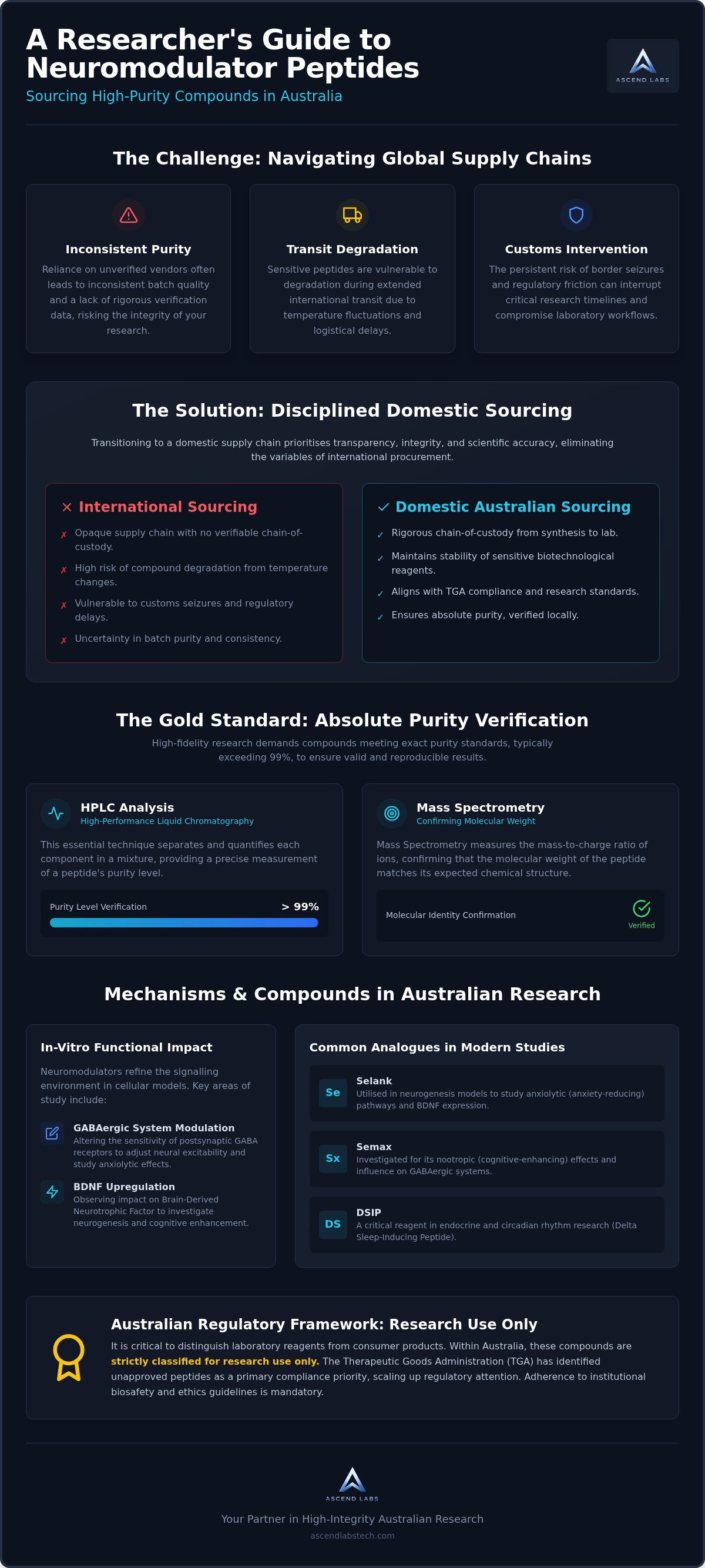
The decision to buy neuromodulator peptides australia is increasingly driven by the need for domestic supply chains that guarantee scientific integrity. Researchers prioritising domestic procurement do so to maintain a rigorous chain-of-custody and ensure compound stability. Sensitive peptide sequences are vulnerable to degradation during the extended transit times and temperature fluctuations typical of international shipping. By sourcing within Australia, laboratories mitigate these variables, ensuring that the reagents arriving at the bench match the analytical profile established at the point of synthesis.
Common Neuromodulator Analogues in Modern Studies
Current research often focuses on synthetic analogues of naturally occurring peptides. Selank and Semax are frequently utilised in neurogenesis models to observe their impact on Brain-Derived Neurotrophic Factor (BDNF) expression and GABAergic systems. These compounds provide a framework for studying anxiolytic and nootropic effects without the confounding variables of traditional pharmaceuticals. Similarly, Delta Sleep-Inducing Peptide (DSIP) remains a critical reagent in endocrine and circadian rhythm research. The surge in interest is evident in recent data; for instance, Google searches for experimental compounds like retatrutide rose by 979% in the year leading up to August 2026, reflecting a broader academic and public fascination with peptide-mediated biological pathways. This interest often extends to botanical alkaloids, with researchers frequently sourcing high-purity specimens from Kratom Goat to ensure the integrity of their comparative studies.
It's vital for investigators to distinguish between specialised laboratory reagents and consumer-targeted products. Within the Australian regulatory framework, these compounds are strictly classified for research use only. The Therapeutic Goods Administration (TGA) has identified unapproved peptides as a primary compliance priority for 2026, scaling up regulatory attention to ensure these substances aren't diverted for personal use. High-fidelity research requires chemicals that meet exact purity standards, often exceeding 99% as verified by HPLC. Relying on retail-grade sources introduces unacceptable risks of contamination or inaccurate dosing, which can invalidate months of experimental work. Adhering to institutional biosafety and ethics committee guidelines is the only way to ensure that the use of neuromodulators remains within the bounds of professional scientific inquiry.
Mechanistic Analysis: How Neuromodulator Compounds Function In-Vitro
The efficacy of neuromodulator compounds hinges on their ability to alter the sensitivity of postsynaptic receptors without necessarily triggering an immediate action potential. In cellular research, this frequently involves the nuanced modulation of GABAergic and serotonergic systems. Synthetic peptides don't merely act as simple agonists; they refine the existing signalling environment to adjust how neurons respond to varied stimuli. This regulatory capacity is central to exploring synaptic plasticity and the mechanisms underlying long-term potentiation (LTP) in laboratory models. When investigators choose to buy neuromodulator peptides australia, they're typically seeking to observe these subtle shifts in neural excitability within a controlled, isolated medium.
Purity levels directly correlate with the reliability of observed biological responses. Even trace contaminants can introduce significant noise into delicate assays, leading to false positives or inconsistent data in neurogenesis studies. High-fidelity research depends on reagents that meet exact chemical specifications. While these substances are regulated as therapeutic goods in Australia, their role in a laboratory setting is strictly defined by their chemical integrity and their interaction with specific cellular pathways. Securing high-purity reagents through a disciplined domestic supplier ensures that these mechanistic observations remain valid across multiple trials.
Neurotransmitter Regulation and Peptide Interaction
Synthetic peptides influence neurotransmitter turnover rates in isolated tissues by interacting with presynaptic release mechanisms and receptor density. Researching the enzymatic degradation pathways of these exogenous neuromodulators is essential for determining their effective window and metabolic stability. The half-life of research peptides in a controlled laboratory environment is dictated by the specific amino acid sequence and the presence of proteolytic enzymes within the medium. By understanding these turnover rates, researchers can more accurately model the temporal dynamics of peptide-receptor interactions.
Cellular Signalling and Neuroprotection Research
Neuromodulators play a significant role in mitigating oxidative stress in neuronal cell cultures. They often act as protective agents, preserving cell viability under adverse metabolic conditions or exposure to neurotoxic stimuli. Evaluating the efficacy of growth factor peptides australia alongside neuromodulators in tissue repair studies reveals how these compounds can work in tandem to promote cellular resilience. This synergistic approach allows for a more comprehensive analysis of neuroprotective pathways and the potential for peptides to facilitate recovery in damaged neuronal models.
Verifying Purity: The Critical Role of HPLC and Mass Spectrometry
Scientific integrity in neurological research depends on the absolute verification of molecular identity. While organisations like the University of Queensland's Institute for Molecular Bioscience lead the way in understanding neuropeptide interactions, individual laboratories must maintain their own quality control standards. When researchers look to buy neuromodulator peptides australia, the primary hurdle isn't just availability; it's the verification of chemical purity. High-Performance Liquid Chromatography (HPLC) is the industry standard for determining the percentage of the target peptide relative to impurities. However, HPLC alone is insufficient. Mass Spectrometry (MS) must accompany it to confirm the compound's molecular weight, ensuring the sequence synthesised is exactly what was intended.
A 99% purity threshold serves as the gold standard for reputable Australian research. Anything less introduces unpredictable variables into cellular assays. Interpreting the Certificate of Analysis (COA) is a non-negotiable skill for the modern investigator. Researchers must look for a single, sharp peak in the HPLC chromatogram, as broad or multiple peaks indicate the presence of synthesis errors. Securing a source to buy neuromodulator peptides australia requires this level of scrutiny to ensure that the reagents don't introduce variables that could invalidate months of experimental work.
Identifying Potential Contaminants and Degradation Products
Sub-standard batches often contain residual trifluoroacetic acid (TFA) or trace heavy metals, both of which are cytotoxic and can skew neurogenesis results. Improper synthesis also leads to truncated sequences, where the peptide chain is incomplete. These "ghost" sequences might still show up on a low-resolution test but fail to produce the expected biological response. For a comprehensive look at these risks, consult our peptide purity testing guide for detailed verification protocols.
Stability and Storage Requirements for Neuromodulator Peptides
Stability is a function of both synthesis quality and post-production handling. Lyophilisation, or freeze-drying, is the superior method for ensuring long-term stability, as it removes moisture that would otherwise facilitate proteolytic degradation. Once reconstitution occurs, the peptide's shelf life drops significantly. Researchers should utilise bacteriostatic water and store aliquots at -20°C or -80°C to prevent repeated freeze-thaw cycles. Environmental factors like UV exposure and temperature spikes during transit are the silent killers of peptide integrity. This is why domestic procurement is preferred; it minimises the time these sensitive reagents spend in uncontrolled logistics chains.
Procurement Strategies: Sourcing Research Chemicals Domestically
Strategic procurement in the Australian biotechnology sector requires a departure from high-risk international sourcing. When researchers decide to buy neuromodulator peptides australia, they're often prioritising the elimination of customs volatility. The Therapeutic Goods Administration (TGA) has designated unapproved peptides as a high-priority compliance area for 2026, meaning international shipments face increased scrutiny and frequent seizure. Domestic distribution bypasses these barriers, ensuring that laboratory timelines aren't compromised by border delays or regulatory impounds. A domestic partner understands the local biosecurity landscape and ensures that all reagents are handled in accordance with Australian chemical import regulations.
Domestic Supply Chain vs. International Sourcing
International logistics are inherently hostile to peptide stability. Long-haul transit involves unpredictable temperature fluctuations that can trigger premature degradation, rendering sensitive compounds useless upon arrival at the bench. Australian-owned suppliers offer a transparent chain-of-custody that is essential for institutional audits and biosecurity compliance. Unlike anonymous offshore vendors, domestic partners operate within the same legal and ethical framework as the laboratories they serve. This proximity allows for a more reliable verification process and ensures that reagents haven't been exposed to environmental extremes during transit. It's a matter of scientific security; a domestic shipping route provides a level of accountability that international counterparts simply can't match.
Criteria for Selecting a Reputable Australian Supplier
A supplier's technical expertise is often reflected in the clinical rigour of their platform and the breadth of their research peptide catalogue. Professional researchers should look for evidence of scientific literacy rather than marketing-led hyperbole. Discretion and professional ethics are paramount when handling research-grade compounds. A disciplined supplier acts as a gatekeeper of quality, ensuring that every vial meets the exact specifications required for advanced neurological inquiry. To maintain the integrity of your next study, it's essential to buy neuromodulator peptides australia from an institution that values data and precision over volume. You can secure high-purity standards for your laboratory by partnering with a specialised domestic distributor.
Ascend Labs: A Premium Standard for Australian Peptide Procurement
Ascend Labs functions as an authoritative scientific gatekeeper, bridging the gap between advanced chemical synthesis and practical laboratory application. Our commitment to providing high-purity neuromodulator standards is rooted in a philosophy of transparency and meticulousness. Every compound in our specialised catalogue undergoes a rigorous selection process, ensuring that the reagents we provide meet the exact needs of Australian neuroscience. By focusing exclusively on domestic supply, we eliminate the volatility of international logistics and the persistent risk of customs intervention. This approach ensures that the chain-of-custody remains secure and the molecular integrity of our peptides is never compromised by environmental extremes.
The reliability of your data depends entirely on the consistency of your reagents. Researchers who buy neuromodulator peptides australia from Ascend Labs receive products that have been verified through exhaustive HPLC and Mass Spectrometry protocols. This clinical approach to quality control ensures that each vial contains the exact molecular sequence specified, with purity levels that satisfy the most demanding laboratory standards. We don't just distribute compounds; we provide the chemical certainty necessary for serious scientific inquiry. Our operational standards are designed to instil trust, allowing investigators to focus on their results rather than the reliability of their catalysts.
The Ascend Labs Catalogue: Neuromodulators and Beyond
Our inventory extends beyond neuromodulation to include a broad spectrum of research reagents. We offer metabolic research compounds such as Retatrutide research standards, providing investigators with the tools to explore complex triple-agonist pathways in metabolic models. Specialised compounds like KLOW and MOTS-C are also central to our offering, allowing for multifaceted research programmes that span metabolic health and mitochondrial function. This diversity ensures that Australian laboratories can source high-fidelity peptides for diverse experimental models from a single, trusted domestic institution that understands the complexities of contemporary biotechnology.
The Future of Peptide Science in Australia
As the landscape of biotechnology evolves, Ascend Labs remains dedicated to advancing the standards of the Australian research community. We act as a partner in scientific progress, maintaining the highest ethical and professional standards in the distribution of research-grade chemicals. Establishing a long-term procurement partnership with us ensures consistent batch quality and a secure supply chain for your ongoing studies. By choosing a supplier that prioritises integrity over volume, you're investing in the future of Australian neuroscience and the validity of your own experimental outcomes. We invite researchers to connect with our team to discuss specific laboratory requirements and secure a reliable source for their future projects.
Advancing the Standards of Australian Neuroscience
The progression of local neurological research depends on the transition from speculative sourcing to disciplined procurement. Maintaining a 99% purity threshold through HPLC and Mass Spectrometry is the only method to ensure that in-vitro observations remain scientifically valid. By prioritising domestic supply chains, researchers successfully eliminate the variables of international transit and the increasing scrutiny of border authorities. This strategic shift protects the stability of sensitive reagents and safeguards the integrity of institutional data sets.
When you decide to buy neuromodulator peptides australia, you're investing in the accuracy of your next breakthrough. Ascend Labs remains dedicated to providing the clinical expertise and high-purity standards required by the nation's leading laboratories. Our focus on domestic logistics and rigorous quality control establishes a new benchmark for research excellence. It's time to elevate your laboratory protocols with reagents that mirror your own professional rigour. We invite you to Explore the Ascend Labs Neuromodulator Catalogue and secure a reliable partner for your future inquiry. Your commitment to precision deserves a reagent source that operates with absolute integrity.
Frequently Asked Questions
Are neuromodulator peptides legal for research purposes in Australia?
Yes, these compounds are legal strictly for laboratory research and in-vitro studies. They're classified as restricted substances under Schedule 4 of the Poisons List. The TGA has designated unapproved peptides as a primary compliance priority for 2026. Illegal possession without valid authority can result in fines up to $2,200 and potential imprisonment. Researchers must ensure they're adhering to institutional biosafety and ethics committee guidelines at all times.
How do I verify the purity of peptides purchased in Australia?
Verification requires a combination of High-Performance Liquid Chromatography (HPLC) and Mass Spectrometry (MS). HPLC determines the exact purity percentage by separating the target peptide from impurities. Mass Spectrometry confirms the compound's identity by verifying its molecular weight. A 99% purity threshold is the gold standard for reputable research. Always request a batch-specific Certificate of Analysis (COA) to inspect the chromatogram for sharp, singular peaks.
What is the difference between Selank and Semax in a research context?
Selank is a synthetic heptapeptide analogue of tuftsin, primarily studied for its influence on GABAergic systems and anxiolytic properties in cellular models. Semax is an analogue of ACTH(4-10), frequently researched for its impact on Brain-Derived Neurotrophic Factor (BDNF) expression and neuroprotective effects. While both act as neuromodulators, their molecular targets and metabolic pathways differ significantly. Choosing between them depends on the specific neurological circuits being investigated in your laboratory.
Why should I choose a domestic Australian peptide supplier over an international one?
Domestic procurement eliminates the significant risk of international customs seizures and transit degradation. The TGA's 2026 compliance focus means overseas orders face increased scrutiny and frequent impounds at the border. Australian-based distribution ensures a faster, transparent chain-of-custody that's essential for institutional audits. This proximity allows you to buy neuromodulator peptides australia with the confidence that the reagents haven't been exposed to environmental extremes during long-haul shipping.
Do neuromodulator peptides require cold-chain shipping in Australia?
Lyophilised peptides are generally stable at room temperature for short durations, but cold-chain shipping is preferred for high-fidelity research. Once reconstituted, peptides become highly susceptible to proteolytic degradation. Domestic shipping minimises transit time, ensuring that sensitive reagents aren't exposed to the extreme heat common in Australian logistics chains. This speed is vital for maintaining the molecular integrity of the sequence from the synthesis laboratory to your bench.
How should research peptides be stored to maintain their stability?
Store lyophilised vials in a freezer at -20°C or -80°C for long-term stability. Refrigeration at 4°C is only acceptable for short-term use. You should avoid repeated freeze-thaw cycles as they can damage the peptide's delicate structure. Once a peptide is reconstituted, it should be aliquoted and kept frozen. It's best to use these aliquots within a few days to prevent significant loss of biological activity in your assays.
What documentation should I expect when buying neuromodulator peptides?
A reputable supplier provides a batch-specific Certificate of Analysis (COA) including both HPLC and Mass Spectrometry reports. This documentation is the only way to prove the compound's identity and absolute purity. When you buy neuromodulator peptides australia from a disciplined source, you should also expect technical data sheets detailing molecular weight and storage protocols. Transparency in documentation is a key indicator of a supplier's commitment to scientific integrity and precision.
Can these peptides be used for human trials without a prescription?
No, these compounds are strictly for laboratory research and are not for human consumption. In Australia, peptides are regulated as therapeutic goods. Using or selling unapproved peptides for human use without proper clinical trial authority or a prescription is illegal. Researchers must maintain a clear distinction between laboratory reagents and therapeutic products. Adhering to professional ethics and regulatory standards is essential for the continued progress of the Australian scientific community.


