

With the TGA designating unapproved peptides as a primary compliance priority for 2026, the margin for error in sourcing growth factor peptides australia has effectively vanished. For the serious researcher, the challenge isn't just locating these compounds; it's ensuring that the material in the vial matches the digital data provided. It's a reality where inconsistent purity from international suppliers and the heightened risk of customs seizures can compromise years of meticulous laboratory work.
You recognise that valid scientific inquiry requires absolute transparency and domestic reliability to maintain research integrity. This guide provides an authoritative exploration of the biological mechanisms, research applications, and purity standards essential for high-level study. We'll outline a reliable protocol for verifying peptide standards and explain how domestic sourcing protects the continuity of your research timeline. We also examine the technical nuances of HPLC and mass spectrometry data to ensure your laboratory-grade compounds meet the most stringent Australian specifications.
Key Takeaways
- Analyse the precise mechanisms of cellular signalling and how synthetic growth factor analogues interact with receptors to initiate tissue repair protocols.
- Master the verification process for growth factor peptides australia by utilising HPLC and Mass Spectrometry to ensure laboratory-grade purity and identity.
- Evaluate the specific roles of recovery and neuromodulator peptides within the contemporary research landscape and their implications for metabolic studies.
- Optimise research timelines by prioritising domestic procurement to mitigate customs delays and preserve peptide structural integrity.
Defining Growth Factor Peptides in a Research Context
Growth factor peptides are short chains of amino acids that function as biological signalling molecules. These compounds coordinate complex cellular responses by binding to specific receptors on the cell surface. When investigating growth factor peptides australia, it's vital to distinguish between endogenous substances produced by living organisms and the synthetic analogues used in laboratory settings. These research-grade materials are precision-engineered tools designed to probe specific biological pathways. In Australia, these compounds are exclusively intended for laboratory and scientific research purposes, necessitating a high degree of operational discretion and technical oversight.
The integrity of any scientific inquiry depends on the chemical consistency of the reagents used. For growth factor peptides, purity isn't merely a quality metric. It's a prerequisite for reproducible research outcomes. Inconsistent batches or the presence of contaminants can lead to aberrant signalling, masking the true biological effects of the compound. Researchers must prioritise compounds that have undergone rigorous verification to ensure that experimental data remains valid and untainted by impurities.
The Biological Architecture of Peptides
Peptides are defined by their sequence of amino acids, joined by covalent peptide bonds. While proteins are complex, three-dimensional structures, peptides are typically shorter and more agile in their signalling capacity. High-purity research compounds are created through solid-phase peptide synthesis (SPPS). This process allows for the meticulous assembly of specific sequences to ensure high target affinity. Growth factors differ from standard metabolic peptides in their primary function. While metabolic variants often regulate energy homeostasis or hormonal balance, growth factors are specifically geared towards stimulating cellular maturation and tissue repair.
Growth Factors vs. Cytokines: A Technical Distinction
The distinction between growth factors and cytokines is often nuanced, as both categories act as signalling molecules. A growth factor is a naturally occurring substance that influences cell maturation and survival. Cytokines are traditionally associated with immune responses, yet the two categories frequently overlap in their roles regarding cellular proliferation. For Australian scientific protocols, precise classification is essential. Researchers must understand these overlapping roles to accurately interpret data from pathways such as MAPK or PI3K/Akt. Using the correct terminology ensures that research findings are aligned with global biotechnological standards and can be verified by peers within the scientific community. Accurate classification allows for more precise targeting within the growth factor peptides australia research landscape.
Mechanisms of Cellular Signalling and Tissue Repair
Signal transduction represents the fundamental process by which growth factor peptides translate extracellular information into specific intracellular actions. In the context of growth factor peptides australia, research typically centres on how these molecules bind to transmembrane receptors to trigger a cascade of biochemical events. This sequence is not a simple linear reaction. It is a complex network of branching pathways that determine the fate of the cell, influencing everything from survival to programmed death. By studying these mechanisms, researchers can map the precise molecular triggers required for cellular maturation.
Activation of the Mitogen-Activated Protein Kinase (MAPK) or Phosphoinositide 3-kinase (PI3K)/Akt pathways is a primary outcome of these interactions. These cascades are critical for regulating gene expression and metabolism in-vitro. PI3K/Akt, in particular, is often studied for its role in cell cycle progression and anti-apoptotic signalling. Researchers also examine how these compounds modulate the extracellular matrix (ECM). By influencing the synthesis and degradation of ECM components like laminin and fibronectin, growth factor peptides provide deep insights into the structural dynamics of cellular environments. This modulation is vital for understanding how cells navigate and interact with their physical surroundings during repair processes.
Receptor-Ligand Interactions in Research
The interaction between a peptide and its receptor follows a rigorous lock-and-key mechanism. The peptide's amino acid sequence must precisely match the spatial configuration of the receptor's binding site to initiate a signal. Synthetic research compounds often function as agonists, mimicking endogenous signals to elicit a maximal biological response for observation. Receptor affinity is a critical determinant of experimental success; it is directly influenced by the structural stability of the peptide during the binding phase. High affinity ensures that the signal is sustained long enough to be measured and analysed within a controlled laboratory setting.
Modulating Cellular Proliferation and Differentiation
Growth factors are central to the cell cycle, governing the transitions between phases to facilitate proliferation or specialised differentiation. Recovery peptides are frequently studied within tissue repair models to observe their impact on fibroblast activity and collagen deposition. This research is particularly relevant for peptides for connective tissue research, where the objective is to understand the molecular triggers for structural regeneration. As the TGA has marked unapproved peptides as a 2026 compliance priority, and considering they are illegal for non-medical personnel to import, domestic verification protocols are the only viable path for maintaining scientific integrity. High-fidelity research depends on these precise interactions, making it imperative to source from a disciplined curator of laboratory-grade compounds that understands the necessity of purity in signal transduction studies.
Key Growth Factor Peptides in Contemporary Australian Studies
The landscape for growth factor peptides australia is currently defined by a move toward specialised application in chronic disease models. Australian laboratories are increasingly focused on the nuanced application of specific growth factor analogues that move beyond basic cell signalling to explore complex systemic responses. In this context, sourcing through domestic channels is essential for maintaining research timelines. International logistics often introduce variables, such as temperature fluctuations or customs delays, that can compromise the structural integrity of these sensitive research tools. Local supply ensures that the cold chain remains intact and that the material arrives in a state suitable for immediate laboratory use.
Research integrity relies on the elimination of external variables. When scientists investigate the regenerative potential of these compounds, they require reagents that behave predictably under controlled conditions. This predictability is only possible through rigorous batch-to-batch consistency. By utilising domestic sources, researchers can bypass the logistical friction that often plagues international procurement, allowing for a more streamlined and reliable inquiry process.
Metabolic and Recovery Research Compounds
Contemporary research into metabolic regulation prioritises compounds that influence tissue homeostasis and energy balance. These studies often involve recovery peptides designed to observe the acceleration of physiological repair mechanisms in-vitro. A significant area of interest is the study of triple-agonist compounds. For instance, the research landscape surrounding advanced compounds like Retatrutide explores how multi-pathway activation can influence metabolic outcomes.
- Analysis of insulin-like growth factor (IGF) analogues in muscle tissue homeostasis.
- Observation of fibroblast activation in chronic wound healing models.
- Investigation of metabolic rate modulation via mitochondrial signalling.
Researchers prioritise compounds with verified purity profiles because even trace contaminants can trigger off-target effects. This is particularly vital in metabolic studies where precise hormonal mimicry is required to produce valid data. High-fidelity research depends on these precise interactions, making it imperative to use compounds that have been verified through domestic laboratory standards.
Neuromodulator Peptides in Neuroscience
The study of neuromodulator peptides represents a sophisticated frontier in Australian neuroscience. These growth factor analogues are used to investigate synaptic plasticity and neuronal health in-vitro. Research focuses on neuroprotective mechanisms, specifically how peptides can influence the survival of neurons under various stress models. Given the sensitivity of neuronal cultures, the requirement for sterile, laboratory-grade materials is absolute. Any deviation from high-purity standards can result in the failure of the experiment or the generation of unreliable data. This demand for precision reinforces the need for a disciplined curator who ensures that every batch of growth factor peptides australia meets rigorous HPLC and mass spectrometry standards before it enters the laboratory environment.
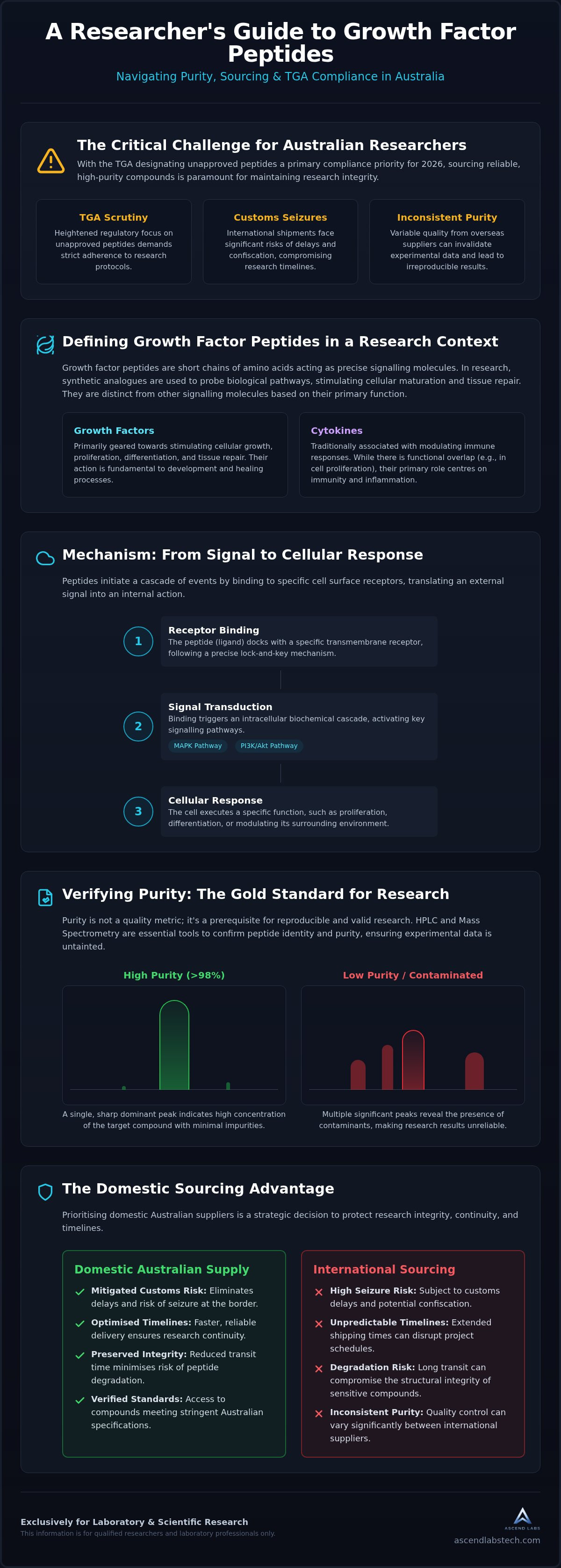
Verifying Purity: The Role of HPLC and Mass Spectrometry
Scientific inquiry into growth factor peptides australia requires empirical proof of chemical composition. High-Performance Liquid Chromatography (HPLC) remains the gold standard for assessing the purity of these compounds. This analytical technique separates the components of a mixture, allowing researchers to determine the concentration of the target peptide relative to any impurities. Without this data, a laboratory cannot guarantee that the biological responses observed are the result of the peptide itself rather than synthesis by-products. For Australian researchers, relying on unverified or grey market chemicals introduces unacceptable variables that can compromise years of data collection.
A Certificate of Analysis (COA) is the essential document that bridges the gap between a manufacturer's claims and laboratory reality. It provides a transparent record of the batch's performance against established benchmarks. In the disciplined environment of Australian biotechnology, a COA isn't optional; it's a foundational requirement for research integrity. It ensures that the material meets the specific standards for sterility and concentration required for sensitive in-vitro models. Using compounds without this verification risks producing data that is both irreproducible and scientifically invalid.
Interpreting HPLC Chromatograms
Identifying the primary peptide peak is the first step in assessing a chromatogram. This peak represents the target molecule, while smaller, secondary peaks indicate the presence of impurities or truncated sequences. Valid scientific research typically necessitates a purity level of >98% to ensure that signalling pathways are not skewed by contaminants. The area under the curve in HPLC analysis provides a quantitative measurement of the total amount of the target peptide present in the sample relative to the total detected material. This ratio is the definitive metric for establishing batch-to-batch consistency and ensuring that the reagent meets the required specifications.
The Necessity of Mass Spectrometry
Mass Spectrometry (MS) serves as the definitive tool for identity verification. While HPLC assesses purity, MS confirms that the researcher is working with the correct amino acid sequence by measuring the molecular weight of the compound. This precision is vital for detecting residual solvents or synthesis by-products that could interfere with cellular assays. The increasing complexity of mitochondrial peptide research has driven higher purity standards across the industry, as these sensitive pathways require absolute molecular accuracy. To ensure your research meets these rigorous benchmarks, you must source verified, laboratory-grade compounds from a supplier that prioritises technical transparency and provides comprehensive analytical data.
Securing Laboratory-Grade Compounds via Domestic Australian Supply
The efficacy of growth factor peptides australia relies heavily on the stability of the supply chain. When researchers source compounds from international vendors, they expose their projects to variables that are often beyond their control. Prolonged transit times, fluctuating temperatures during customs inspections, and the risk of regulatory seizure can all compromise the integrity of a study. Domestic procurement eliminates these logistical hurdles, providing a streamlined pathway for acquiring high-purity reagents. By sourcing within Australia, laboratories ensure that their materials are not subject to the degradation that frequently occurs during long-haul international shipping.
Regulatory friction is a significant concern for modern scientific inquiry. As the TGA continues to increase its oversight of peptide imports, the risk of customs delays for non-domestic research compounds has reached a critical point. Sourcing domestically allows researchers to bypass these complications, ensuring that projects remain on schedule and within budget. This proximity also facilitates a more direct line of communication regarding batch-specific data, allowing for a level of technical transparency that international suppliers rarely provide.
Domestic Logistics and Research Integrity
Rapid domestic shipping is the most effective way to prevent peptide degradation. Compounds like growth factors are highly sensitive to environmental stressors, particularly heat and UV light. Exposure to these elements can trigger denaturation, altering the peptide's primary structure and rendering it ineffective for receptor-ligand studies. Local supply chains are optimised for speed and temperature control, ensuring that the cold chain remains intact from the point of verification to the laboratory bench. Furthermore, professional handling of these materials is essential. Discreet, laboratory-grade packaging protects the compounds from physical damage and light exposure, maintaining the high fidelity required for sensitive in-vitro models.
Ascend Labs: A Partner in Australian Scientific Inquiry
Ascend Labs acts as an authoritative gatekeeper and a disciplined curator of growth factor peptides australia. Our commitment to research integrity is reflected in our rigorous verification protocols. Every batch of material undergoes comprehensive HPLC and mass spectrometry analysis to ensure it meets the >98% purity standard required for valid scientific inquiry. We don't just provide compounds; we provide the technical assurance that your reagents are sterile, accurate, and consistently produced.
Researchers are invited to explore our specialised catalogue, which includes high-purity metabolic research compounds, recovery peptides, and neuromodulator analogues. The procurement process is designed for professional efficiency, allowing scientists to focus on their data rather than their logistics. To secure laboratory-grade materials for your next study, you can access our primary procurement platform and consult with a partner who understands the specific demands of the Australian research landscape.
Advancing Australian Biotechnological Inquiry
The pursuit of rigorous scientific data requires an unwavering commitment to chemical precision. Validating the biological mechanisms of growth factor peptides australia depends entirely on the exclusion of impurities that might otherwise skew experimental results. By prioritising COA-verified purity for every batch, researchers ensure that their findings are grounded in empirical truth rather than analytical noise. This technical transparency is the foundation of any reproducible study within the laboratory environment.
Domestic procurement remains the most reliable strategy for maintaining research continuity. It bypasses the volatility of international logistics and the increasing scrutiny of customs protocols; ensuring that sensitive compounds arrive without structural degradation. Ascend Labs operates as a disciplined curator of these essential materials, providing the specialised laboratory-grade research standards necessary for high-fidelity study. Secure domestic Australian shipping ensures your timeline remains intact and your reagents remain stable throughout the transit process.
We invite you to Explore the Ascend Labs Research Catalogue to secure the precision tools required for your next phase of inquiry. Scientific excellence begins with the integrity of your reagents and the reliability of your supply partner.
Frequently Asked Questions
What are growth factor peptides and how are they used in research?
Growth factor peptides are short chains of amino acids that function as biological signalling molecules to coordinate cellular responses. In a laboratory context, they are utilised to investigate mechanisms of cellular proliferation, maturation, and tissue repair. These compounds allow researchers to probe specific intracellular pathways, such as MAPK or PI3K/Akt, providing deep insights into how cells respond to external stimuli under controlled conditions.
Are growth factor peptides legal for research purposes in Australia?
Growth factor peptides are legal in Australia when intended strictly for laboratory and scientific research purposes. However, many of these compounds are classified as Schedule 4 substances by the TGA, meaning they are restricted for human use without a valid prescription. Researchers must ensure they are sourcing growth factor peptides australia through professional channels that adhere to domestic regulations and provide materials exclusively for in-vitro or animal study models.
How do I verify the purity of a peptide compound for laboratory use?
Verification requires a combination of High-Performance Liquid Chromatography (HPLC) and Mass Spectrometry (MS). HPLC determines the purity level by separating the target peptide from synthesis by-products, while MS confirms the molecular identity by verifying the amino acid sequence. A purity of >98% is the standard benchmark for valid scientific inquiry. Researchers should always request batch-specific chromatograms to ensure the material matches the required technical specifications.
What is the difference between research-grade and cosmetic-grade peptides?
The primary distinction lies in the level of analytical verification and chemical purity. Research-grade peptides are high-purity compounds, typically >98%, designed for precise signalling studies and verified through HPLC and MS. Cosmetic-grade peptides are often lower in concentration and formulated for topical application in skincare products. Research-grade materials are far more concentrated and must be handled with the technical precision required for sensitive laboratory assays.
Why is domestic shipping important for peptide stability in Australia?
Domestic shipping is critical for maintaining the cold chain and protecting peptides from environmental degradation. International transit often involves prolonged exposure to heat, light, and customs delays, all of which can denature the peptide's primary structure. Sourcing growth factor peptides australia via domestic channels ensures rapid delivery and professional handling, which preserves the structural integrity of the compound and maintains the validity of the research timeline.
Can growth factor peptides be used for human consumption?
No, growth factor peptides provided for research are strictly not for human consumption or therapeutic use. These compounds are laboratory-grade reagents intended only for scientific inquiry, such as in-vitro cell culture or animal research models. The TGA and Australian health authorities have issued clear warnings regarding the use of unapproved peptides for human use due to potential risks of adverse effects and lack of clinical evaluation.
What should I look for in a Certificate of Analysis (COA)?
A comprehensive COA should include the batch number, the date of analysis, and the specific results of HPLC and Mass Spectrometry tests. You should verify that the primary peak on the HPLC chromatogram represents a purity of at least 98%. Additionally, the MS data must confirm the target molecular weight. The COA serves as the definitive record of the material's chemical identity and sterility, ensuring it meets laboratory standards.
How should research peptides be stored to maintain their integrity?
Research peptides should be stored in a lyophilised state in a secure, climate-controlled environment. For short-term use, refrigeration at 4°C is usually sufficient; however, long-term storage requires freezing at -20°C or -80°C to prevent degradation. It's also vital to protect the vials from light exposure and moisture. Once reconstituted, peptides are significantly less stable and should be used promptly or aliquoted to avoid repeated freeze-thaw cycles.


