

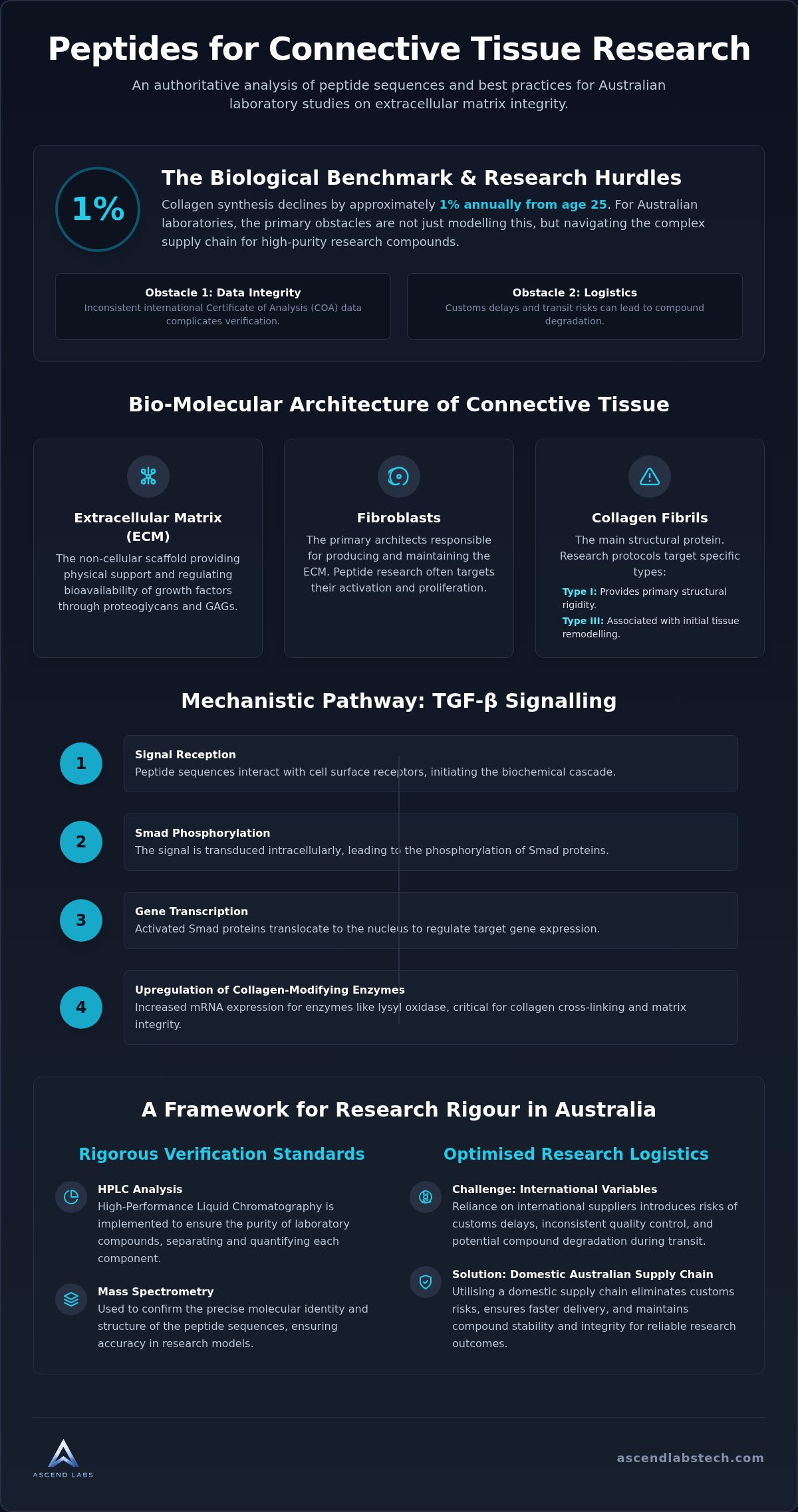
While the biological benchmark for collagen synthesis decline is established at approximately 1 per cent annually from age 25, the primary obstacle for Australian laboratories remains identifying the precise biochemical triggers to model this degradation effectively. Sourcing high-purity peptides for connective tissue research often involves managing the complexities of inconsistent international COA data and logistical delays. You likely recognise that the gap between medical marketing and legitimate research data has never been wider, particularly as the TGA scales up regulatory oversight in 2026.
This technical roundup provides an authoritative analysis of the primary peptide sequences currently utilised in Australian laboratory studies focused on extracellular matrix integrity. We'll examine the biochemical pathways of growth factor peptides and identify specific candidates for in-vitro or in-vivo connective tissue models. By focusing on verified HPLC standards and domestic supply chains, this briefing ensures your inquiry remains grounded in scientific rigour rather than retail hyperbole. We'll conclude by establishing a framework for sourcing research-grade compounds that meet the meticulous requirements of advanced biotechnology.
Key Takeaways
- Analyse the bio-molecular architecture of the extracellular matrix and the specific role of signalling sequences in modulating fibroblast activity.
- Identify the primary sequences utilised in peptides for connective tissue research to effectively model collagen synthesis and cellular proliferation.
- Evaluate the mechanistic pathways of growth factor peptides, including TGF-β and IGF-1 receptor interactions, within the cellular microenvironment.
- Implement rigorous verification standards using HPLC and Mass Spectrometry to ensure the purity and molecular identity of laboratory compounds.
- Optimise research logistics by utilising a domestic Australian supply chain to eliminate customs-related transit risks and compound degradation.
The Bio-Molecular Architecture of Connective Tissue Research
Connective tissue research focuses on the intricate interplay between the extracellular matrix (ECM), specialised fibroblasts, and the hierarchical organisation of collagen fibrils. While traditional methodologies often relied on systemic protein administration, contemporary Australian laboratory models prioritising precision are increasingly utilising targeted peptides for connective tissue research. This shift allows for the modulation of specific cellular microenvironments without the confounding variables associated with larger, less stable proteins. By isolating specific amino acid sequences, researchers can observe discrete biochemical responses within the tissue scaffold with a level of accuracy that was previously unattainable.
Central to these studies is the synthesis and cross-linking of collagen, the main structural protein in the extracellular matrix. Research protocols typically target Type I and Type III collagen synthesis to evaluate tissue tensile strength and elasticity. Type I collagen provides the primary structural rigidity, while Type III is often associated with the initial stages of tissue remodelling and repair. By employing short-chain signalling sequences, it's possible to observe how specific motifs influence the spatial arrangement of these fibrils. This focus on molecular architecture ensures that laboratory findings translate into a deeper understanding of tissue integrity and structural resilience.
Extracellular Matrix (ECM) Dynamics
The ECM is the non-cellular component providing essential physical scaffolding for cellular constituents. In advanced research models, the focus extends beyond simple structural support to the active modulation of proteoglycans and glycosaminoglycans (GAGs). These molecules regulate hydration and the bioavailability of growth factors within the matrix. Laboratory analysis often measures how specific research compounds influence ECM density and the subsequent resistance to enzymatic degradation. Accurate modelling requires a stable environment where these biochemical interactions can be quantified without interference from degraded or impure reagents.
Fibroblast Activation and Proliferation
Fibroblasts serve as the primary architects of connective tissue, responsible for the production and maintenance of the ECM. Research often explores the transition from quiescent fibroblasts to active myofibroblasts, a critical phase in tissue repair and remodelling studies. Certain peptide sequences trigger the endogenous release of growth factors in-vitro, facilitating an environment conducive to cellular migration. Evaluating how these sequences impact the velocity and directionality of fibroblast movement provides vital data for developing effective connective tissue models. This cellular migration is a key metric in determining the efficacy of a research compound in promoting structural regeneration within a controlled environment.
Mechanistic Pathways: Growth Factors and Cellular Signalling
The regulation of connective tissue repair relies on a series of complex biochemical cascades. In Australian laboratory settings, the TGF-β (Transforming Growth Factor beta) signalling pathway is often the primary focus for researchers investigating fibrotic responses and collagen deposition. Signal reception, Smad phosphorylation, and gene transcription represent the fundamental axis of TGF-β activity. By utilising peptides for connective tissue research, scientists can observe how specific sequences modulate these pathways to regulate gene expression. This process is critical for the upregulation of mRNA expression for collagen-modifying enzymes, such as lysyl oxidase. A recent systematic review on collagen peptide supplementation highlights the efficacy of these short-chain sequences in influencing matrix integrity and structural resilience.
While TGF-β remains a central pillar, modern inquiries are expanding to include systemic metabolic modulators. Compounds like Retatrutide are being studied for their secondary effects on systemic tissue health, providing a more comprehensive view of the cellular microenvironment. Researchers seeking to expand their 2026 laboratory protocols can view the current catalogue of recovery peptides to ensure their models reflect these multifaceted interactions. This approach allows for a more nuanced understanding of how metabolic health influences the rate of extracellular matrix turnover.
The Role of IGF-1 Pathways in Research
Insulin-like Growth Factor 1 (IGF-1) serves as a potent mitogen in connective tissue models. It promotes cell-cycle progression in fibroblasts by activating the PI3K/Akt pathway, leading to increased cellular proliferation and survival. When combined with other growth factor sequences, IGF-1 often demonstrates synergistic effects that accelerate the modelling of tissue repair. Current laboratory protocols focus on measuring IGF-1 receptor affinity and the subsequent downstream signalling intensity. Quantifying these interactions is essential for researchers evaluating peptides for connective tissue research, as it provides a benchmark for the metabolic demands of regenerating scaffolds.
Angiogenic Modulation and Tissue Perfusion
Efficient tissue repair requires more than just structural proteins; it necessitates a functional vascular supply. Peptides that function as vascular endothelial growth factor (VEGF) mimics are vital for modelling angiogenesis within damaged connective tissue. These sequences facilitate the development of new blood vessel networks, ensuring adequate nutrient delivery to the repair site. Researchers often analyse the cross-talk between these angiogenic factors and collagen deposition to understand how perfusion influences structural density. This interaction is a critical determinant in the success of large-scale tissue engineering projects, where perfusion limits the viable thickness of the engineered construct. Without sufficient angiogenic signalling, the core of the scaffold often becomes necrotic, which can invalidate the research model.
Roundup: Essential Peptides for Extracellular Matrix Studies
The 2026 technical landscape for peptides for connective tissue research is defined by a shift toward highly specific amino acid sequences that isolate discrete biochemical responses. Australian researchers are increasingly moving away from broad-spectrum proteins in favour of isolated fragments that target specific cellular receptors. This systematic roundup examines the primary categories currently utilised in domestic laboratory models, focusing on their capacity to facilitate extracellular matrix (ECM) turnover and structural repair. These sequences are selected for their ability to interact with the signalling pathways discussed previously, ensuring a cohesive approach to tissue modelling.
Growth Factor Peptides for Structural Integrity
Growth Factor Peptides are engineered to mimic the bioactivity of endogenous proteins responsible for cellular proliferation and matrix synthesis. These mimics typically feature a molecular weight ranging from 1,200 to 4,500 Daltons and sequence lengths spanning 12 to 40 amino acid residues. Their stability in common laboratory media, such as DMEM or RPMI 1640, remains a critical variable for longitudinal studies. Researchers utilise these sequences to observe the acceleration of cellular proliferation within synthetic scaffolds, providing data on how effectively a compound can stimulate structural regeneration. The focus is often on sequences that demonstrate high resistance to proteolysis, ensuring prolonged activity in-vitro.
Recovery Peptides: Mechanistic Breakdown
Recovery Peptides represent a specialised research category prioritising high affinity for tissue-resident stem cells and the modulation of the inflammatory environment. In Australian research models, these sequences are evaluated for their dual capacity to dampen pro-inflammatory cytokines while simultaneously activating pro-regenerative signalling pathways. This balance is essential for accurately modelling the transition from the inflammatory phase to the proliferative phase of tissue repair.
- Ligament Models: Research often focuses on sequences that promote elastic fibre integration and recoil capacity.
- Tendon Models: Studies prioritise uniaxial tensile strength and the alignment of Type I collagen fibrils.
- Stem Cell Affinity: Sequences are screened for their ability to recruit mesenchymal stem cells to the site of modelled injury.
Metabolic Research Compounds, including MOTS-C, are also gaining prominence for their role in mitochondrial efficiency. This efficiency is a prerequisite for the energy-dependent process of collagen cross-linking and matrix stabilisation. Similarly, Neuromodulator Peptides are being used to investigate the emerging brain-connective tissue axis. These studies explore how neural signalling molecules influence matrix homeostasis and cellular stress responses within connective tissue scaffolds. By integrating these diverse categories, researchers can develop more holistic models that account for systemic metabolic and neural influences on local tissue health.
Methodologies for Verifying Peptide Purity in Australian Labs
Precision in peptides for connective tissue research is contingent upon absolute chemical verification. High-Performance Liquid Chromatography (HPLC) remains the primary analytical tool for determining peptide purity within the Australian biotechnology sector. In an environment where the TGA has prioritised compliance for unapproved peptides throughout 2026, researchers must distinguish between peptide purity and peptide content. While purity refers to the percentage of the target sequence relative to impurities, content accounts for the actual mass of the peptide including counter-ions and water. Australian laboratories typically require purity levels exceeding 99 per cent to ensure that experimental outcomes aren't skewed by contaminants or residual reagents.
Identifying red flags in a Certificate of Analysis (COA) is a vital skill for maintaining laboratory standards. Inconsistent data from international vendors often manifests as missing peak integration or outdated testing dates. A legitimate COA must include both the HPLC chromatogram and a Mass Spectrometry report to confirm both the purity and the molecular identity of the compound. To ensure your laboratory models are built on verified foundations, you can access HPLC and Mass Spec verified research compounds through our domestic supply chain, which eliminates the variables associated with international transit.
Interpreting HPLC Chromatograms
HPLC chromatograms provide visual evidence of a compound's integrity. Researchers must focus on peak integration, where the area under the primary peak represents the target peptide. Red flags include broad, tailing peaks or multiple significant secondary peaks, which suggest degradation or incomplete synthesis. Differentiating between the active peptide peak and residual solvent peaks is vital for accurate dosing in-vitro. Standardised reporting in Australian institutions typically requires that integration data be clearly presented alongside the chromatogram to allow for independent peer review and verification of the purity percentage.
Mass Spectrometry and Molecular Weight Verification
While HPLC confirms purity, Mass Spectrometry (MS) confirms identity. Electrospray Ionisation (ESI) is the preferred method for identifying the molecular weight of peptides for connective tissue research. Reputable suppliers provide data comparing the observed mass against the theoretical mass calculated from the amino acid sequence. Any variance exceeding a narrow tolerance indicates a synthesis error or an incorrect sequence. Third-party verification has become the benchmark for reputable Australian suppliers. It provides an unbiased layer of quality assurance that internal documentation cannot match, ensuring the compound's molecular identity is indisputable.
Maintaining integrity within the laboratory environment requires strict adherence to storage and reconstitution protocols. Reconstituted stability varies significantly between sequences; some growth factor mimics require immediate use or specialised buffering to prevent deamidation. Lyophilised peptides should be stored at sub-zero temperatures to mitigate oxidation. Following these meticulous handling procedures ensures that the high-purity compound verified in the lab remains stable throughout the duration of the study.
Sourcing High-Purity Research Compounds in the Australian Market
Navigating the Australian regulatory landscape in 2026 requires a strategic approach to procurement that prioritises domestic security over international convenience. The TGA's increased scrutiny on unapproved peptides has rendered international importation a high-risk venture, with recent compliance actions including significant fines for unauthorised supply. Beyond legal considerations, the physical integrity of peptides for connective tissue research is frequently compromised during long-haul transit. Exposure to fluctuating temperatures and extended customs delays can lead to peptide deamidation or oxidation, effectively invalidating the precision of your laboratory models before they begin.
By utilising a domestic Australian supply chain, researchers eliminate these variables. Ascend Labs operates as a disciplined curator, offering a specialised catalogue that bypasses the inconsistencies of global marketplaces. Our focus is on providing a secure, professional logistics framework that respects the operational discretion required for scientific inquiry. This meticulous approach ensures that the molecular identity verified in our laboratory remains intact upon arrival at yours, allowing for seamless integration into 2026 research protocols.
The Ascend Labs Standard of Excellence
Our commitment to scientific truth is reflected in a curated selection of high-end research chemicals designed for advanced practitioners. This exclusivity allows us to maintain rigorous quality assurance standards that larger, mass-market vendors cannot replicate. Our catalogue includes advanced metabolic and longevity-related sequences such as KLOW and MOTS-C, which are essential for contemporary studies on mitochondrial efficiency and extracellular matrix turnover. Direct access to domestic stock facilitates rapid project iteration, ensuring that your research timeline isn't dictated by international shipping schedules or customs backlogs.
Establishing a Reliable Research Partnership
Securing laboratory-grade compounds involves more than a simple transaction; it requires a partnership built on transparency and integrity. In long-term connective tissue studies, batch-to-batch reliability is the most critical metric for success. Any variance in peptide content or purity between batches can introduce systemic errors into longitudinal data. We provide the analytical documentation necessary to establish this consistency, allowing researchers to focus on data acquisition rather than reagent verification. Establishing a reliable supply chain is the final step in ensuring your peptides for connective tissue research meet the exacting standards of the Australian biotechnology sector.
To view our current technical specifications and verified sequences, researchers are invited to Explore the Ascend Labs Peptide Catalogue and integrate our high-purity compounds into their next phase of structural modelling.
Advancing Connective Tissue Modelling in 2026
The evolution of connective tissue research in 2026 hinges on the integration of precise signalling sequences and rigorous analytical standards. Effective modelling requires a sophisticated understanding of both the structural architecture of the extracellular matrix and the complex biochemical pathways of growth factor peptides. The selection of high-purity peptides for connective tissue research is the foundational step in ensuring that laboratory observations translate into replicable scientific truth. By prioritising sequences with confirmed molecular identities, researchers can eliminate the variables that often compromise longitudinal data.
Establishing a reliable domestic supply chain remains the most effective strategy for mitigating customs risks and transit-related degradation. Ascend Labs provides an exclusive catalogue of advanced growth factors and neuromodulators; each batch is backed by independent HPLC and Mass Spectrometry verification. As an Australian-owned and operated institution, we provide discreet national shipping to ensure your laboratory receives compounds of the highest integrity. You can secure high-purity research compounds from Ascend Labs to advance your structural modelling with confidence. We look forward to supporting your next phase of scientific inquiry.
Frequently Asked Questions
What are the primary peptides used for collagen research?
Primary sequences utilised in this field include those targeting the TGF-β and IGF-1 receptors to model the synthesis of Type I and Type III collagen. These peptides for connective tissue research allow scientists to observe discrete biochemical responses, such as the spatial arrangement of collagen fibrils and the rate of matrix stabilisation, with higher precision than systemic proteins. Using isolated fragments ensures that laboratory findings remain focused on specific structural outcomes.
How do growth factor peptides influence fibroblast activity in-vitro?
Growth factor peptides function as high-affinity ligands that bind to cellular receptors, initiating intracellular signalling cascades like the PI3K/Akt or Smad pathways. This interaction triggers the transition of quiescent fibroblasts into active myofibroblasts, which are responsible for producing the extracellular matrix. In a controlled environment, these sequences accelerate cell-cycle progression and promote the migration of fibroblasts across synthetic scaffolds, providing vital data on tissue repair velocity.
Is HPLC verification necessary for all research-grade peptides?
HPLC verification is essential for all laboratory compounds to confirm a purity threshold typically exceeding 99 per cent. Without this analysis, researchers risk introducing contaminants that can skew experimental data or cause unexpected cellular toxicity. Given the TGA's 2026 focus on peptide compliance, using verified compounds isn't just a matter of scientific rigour; it's a necessary step to ensure the legitimacy and safety of the research protocol.
What is the difference between growth factor and recovery peptides in a research context?
Growth factor peptides are designed to mimic endogenous proteins that stimulate cellular proliferation and structural synthesis. Recovery peptides, while often overlapping in function, are specifically categorised by their capacity to modulate inflammatory signalling and recruit tissue-resident stem cells. While growth factors focus on building the matrix, recovery sequences are often used to model the transition from the inflammatory phase to the proliferative phase of tissue repair.
How should research peptides be stored to maintain their structural integrity?
Lyophilised research peptides should be stored in a sub-zero environment, ideally between -20°C and -80°C, to prevent deamidation and oxidation. Maintaining these compounds in a desiccated state within a temperature-controlled centre is vital for long-term stability. Once you've reconstituted the compound, its half-life decreases significantly, often requiring immediate use or specialised buffering to maintain the secondary structure of the amino acid sequence.
Can metabolic compounds like Retatrutide be used in connective tissue studies?
Metabolic research compounds, including Retatrutide, are increasingly being utilised to study the systemic influences on tissue health. Researchers use these triple-agonist sequences to investigate how metabolic efficiency and mitochondrial function impact the energy-dependent processes of collagen cross-linking. These studies provide a more holistic view of how systemic health influences local extracellular matrix integrity and overall structural resilience in peptides for connective tissue research.
Why is domestic Australian shipping preferred for research compounds?
Domestic shipping is preferred to eliminate the significant risks of customs intervention and the structural degradation caused by international transit. Long-haul journeys often expose sensitive peptides to fluctuating temperatures and moisture, which can compromise the purity of the compound. Sourcing from within Australia ensures a secure, rapid logistics chain that maintains the meticulous quality standards required for advanced laboratory inquiry and scientific verification.
What should I look for in a Certificate of Analysis (COA) for research peptides?
A legitimate COA must feature an HPLC chromatogram showing clear peak integration and a Mass Spectrometry report that confirms the molecular identity. You should verify that the observed mass matches the theoretical mass of the sequence and check that the testing date is current. Red flags in documentation include missing integration data, outdated reports, or a lack of third-party verification, all of which suggest a compromise in quality assurance protocols.


