

A single microgram of deviation in a laboratory setting isn't just a mathematical oversight; it's the difference between reproducible discovery and compromised data. For many researchers, the transition from a lyophilised powder to a stable, accurately diluted solution represents a critical point of vulnerability where errors in arithmetic can lead to significant experimental drift. Utilising a precise peptide reconstitution calculator Australia is essential for maintaining the clinical rigour required in modern biotechnology, especially when dealing with high-purity compounds that demand exact concentration ratios.
You likely understand that the integrity of your research depends on the absolute precision of your starting material. This guide provides you with a foolproof framework to master these meticulous calculations, helping you avoid common pitfalls like the confusion between milligrams and micrograms. We'll outline standardised protocols tailored for Australian research environments, addressing everything from solvent selection to the stability of reconstituted peptides in our unique climate. By the end of this briefing, you'll possess the confidence to execute every reconstitution with the mathematical certainty your scientific inquiries deserve.
Key Takeaways
- Understand the clinical rationale for lyophilisation and the standardised protocols required to return solid research compounds to a stable liquid state.
- Master the three-variable mathematical framework—Total Mass, Diluent Volume, and Target Dose—by integrating a peptide reconstitution calculator Australia into your laboratory workflow.
- Establish a meticulous sanitisation routine for your workspace and equipment to eliminate the risk of cross-contamination or compromised research data.
- Learn to adjust your calculations based on HPLC and Mass Spectrometry verification to ensure the final solution concentration reflects the true purity of the starting material.
- Recognise how domestic Australian sourcing preserves the molecular integrity of sensitive compounds like Retatrutide and MOTS-C by reducing environmental exposure during transit.
Understanding Peptide Reconstitution in Australian Research
Reconstitution is the meticulous process of restoring a lyophilised peptide to its liquid state for laboratory application. Because Peptides are short chains of amino acids, their structural stability is highly dependent on their environment. To ensure molecular integrity during domestic transit across Australia, these compounds are processed into a solid, freeze-dried form. This state minimises the risk of thermal degradation and mechanical agitation that could otherwise compromise the research material. For researchers, the transition from powder to solution is a critical phase where precision is non-negotiable.
The clinical importance of precise concentration cannot be overstated. In metabolic studies, even a minor deviation in the dilution ratio can lead to significant experimental drift, rendering data sets non-reproducible. This is why relying on a peptide reconstitution calculator Australia provides a safeguard against the manual arithmetic errors that often plague laboratory settings. By establishing a standardised protocol from the outset, you ensure that every microgram of the compound is accounted for and correctly distributed within the diluent.
The Science of Lyophilisation
Lyophilisation involves removing water from a frozen product through sublimation. This preservation method protects the delicate bonds in advanced compounds like Retatrutide or MOTS-C from hydrolytic cleavage. Every vial is vacuum-sealed to prevent oxidation and moisture ingress. Once you introduce a diluent, the chemical clock starts ticking. Reconstituted solutions are significantly more susceptible to degradation than their solid counterparts, requiring strict adherence to cold-chain storage protocols to maintain their bioactivity for the duration of the study.
Diluent Selection: Bacteriostatic vs. Sterile Water
Choosing the correct solvent is a foundational step in any research protocol. Bacteriostatic water is the standard in many Australian settings because it contains 0.9% benzyl alcohol. This additive acts as a preservative to inhibit bacterial proliferation, allowing for multi-use applications over a set period. In contrast, sterile water lacks this preservative and is strictly for single-use scenarios where the presence of alcohol might interfere with specific cellular assays. Proper storage of these diluents in temperature-controlled environments is essential for maintaining purity. Using a peptide reconstitution calculator Australia helps determine the exact volume of these diluents required to reach your target concentration, ensuring consistency across multiple vials and research phases.
The Mathematical Architecture of Peptide Dosage
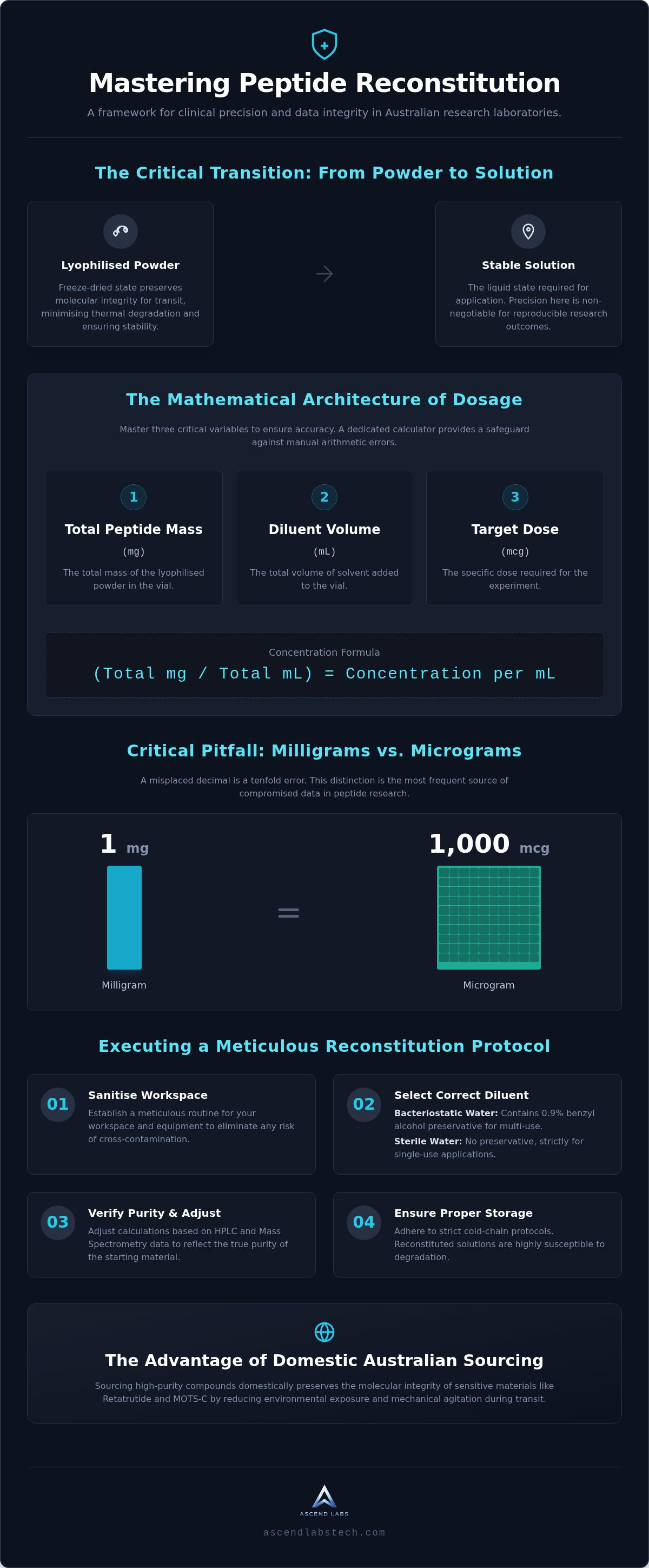
Precision in the laboratory isn't just a goal; it's the baseline. To achieve it, you must navigate three critical variables: Total Peptide Mass (mg), Diluent Volume (mL), and Target Dose (mcg). These components form the mathematical architecture of every successful reconstitution protocol. If you miscalculate even one, the entire data set becomes unreliable. The foundational formula is straightforward: (Total mg / Total mL) = Concentration per mL. While the math seems simple on paper, the complexity increases when you consider the high-potency nature of modern compounds. For instance, advanced research involving triple agonists requires a level of detail that generic guides often overlook. Using a dedicated peptide reconstitution calculator Australia ensures these variables are synchronised before you ever touch a vial.
The distinction between milligrams and micrograms is the most frequent source of error in peptide research. Milligrams (mg) typically define the total mass of the lyophilised powder within the vial, whereas micrograms (mcg) define the specific dose required for the study. A single milligram contains 1,000 micrograms. This three-order-of-magnitude difference means a misplaced decimal point results in a tenfold error in concentration. Syringe volume also plays a pivotal role in the visual measurement of a dose. Whether you're using a 0.3mL, 0.5mL, or 1.0mL barrel, the physical space occupied by the solution changes. A smaller barrel provides higher resolution for micro-doses, making it easier to draw an accurate volume without the risk of parallax error.
Achieving this level of precision requires starting with verified materials. You can explore a range of high-purity Metabolic Research Compounds to ensure your baseline data remains untainted by impurities or inaccurate mass declarations.
Standardising the Microgram Conversion
Converting mg to mcg is a non-negotiable skill for any researcher. For high-potency compounds like Tirzepatide, where the effective dose is measured in minute increments, absolute accuracy is vital. Always double-check your calculations by working backwards from the final concentration. If a 5mg vial is reconstituted with 2mL of diluent, the concentration is 2.5mg/mL, or 2,500mcg/mL. Decimal point errors are best mitigated by using a structured worksheet or a digital calculator to verify the math before the diluent is introduced to the vial.
Calculating Concentration per Syringe Unit
Most Australian laboratories utilise standard insulin syringes, which are graduated into 100 units per 1mL. To determine the microgram value of a single "tick mark", you must divide the concentration per mL by 100. If your concentration is 2,000mcg/mL, each unit represents 20mcg. Adjusting these calculations for non-standard syringe sizes is essential. A 50-unit syringe (0.5mL) still follows the same concentration logic, but the visual scale is doubled, providing better clarity for the researcher. Always confirm the syringe capacity and graduation scale to ensure the drawn volume matches the calculated requirement.
Executing a Meticulous Reconstitution Protocol
Proper execution of a laboratory protocol is as vital as the initial calculations. While a peptide reconstitution calculator Australia ensures mathematical accuracy, the physical handling of the vial determines the final solution's integrity. To maintain the highest standards of research, you must operate within a sterile, draught-free workspace. This environment minimises the risk of airborne contaminants entering the vial during the procedure. Wearing appropriate Personal Protective Equipment (PPE), including gloves and a lab coat, is a fundamental requirement to protect both the researcher and the purity of the compound.
The transition from a lyophilised cake to a liquid solution requires a delicate touch. Peptides are structurally sensitive; aggressive handling can lead to the shearing of molecular bonds, effectively denaturing the compound. This is why the "slow-drip" method is the industry standard. By introducing the diluent gradually, you allow the powder to hydrate without the mechanical stress associated with rapid liquid injection. This process ensures that the biochemical properties of the peptide remain intact for subsequent metabolic or recovery studies.
Step-by-Step Laboratory Procedure
Begin by sanitising the rubber stoppers of both the peptide vial and the diluent container using 70% isopropyl alcohol wipes. Allow the alcohol to air-dry completely to ensure a sterile entry point. Before extracting the solvent, draw a volume of air into the syringe equal to the amount of liquid you intend to withdraw. Injecting this air into the diluent vial equalises the internal pressure, making the extraction process smooth and controlled. When transferring the diluent to the peptide vial, angle the needle so the liquid hits the glass wall rather than the peptide cake itself. This prevents "spraying," a common error that can damage the delicate lyophilised structure. Once the solvent is added, you should cross-reference your final volume with your peptide reconstitution calculator Australia results to confirm the intended concentration.
Visual Verification of the Solution
A successful reconstitution results in a perfectly clear, particle-free solution. After adding the diluent, use a gentle swirling motion to encourage dissolution; never shake the vial, as this introduces air bubbles and mechanical stress. Some high-quality vials exhibit a "vacuum pull" that may draw the diluent in rapidly. You must maintain a firm grip on the syringe plunger to resist this pull and control the flow rate. If the solution remains cloudy or contains visible "floaters" after several minutes of gentle swirling, it may indicate an issue with the peptide's purity or a problem with the diluent's pH balance. In such cases, the integrity of the sample may be compromised, and the solution should be evaluated against the original HPLC reports before proceeding with any research applications.
Mitigating Calculation Errors and Ensuring Purity
Many researchers mistakenly assume that a vial labelled as 5mg contains exactly 5mg of the active compound. In reality, the net peptide content is influenced by the purity percentage and the presence of counter-ions or residual moisture. If a batch is verified at 98% purity versus 99.5%, the actual mass of the active molecule varies. Failing to account for this variance can lead to sub-therapeutic or inconsistent dosing in sensitive metabolic studies. Before inputting data into a peptide reconstitution calculator australia, it's imperative to consult the HPLC and Mass Spectrometry reports to determine the precise analytical mass of your sample.
Some high-end manufacturers include a slight "overfill" in each vial. This surplus compensates for the minute amount of material lost during the lyophilisation process or when withdrawing the final solution. If your analytical report indicates a total mass of 5.2mg in a 5mg vial, your dilution volume must be adjusted accordingly to maintain the target concentration. While manual verification is a useful skill, utilising digital tools helps eliminate the risk of human error, particularly when managing complex calculations for triple-agonist compounds. To ensure your research begins with the most accurate baseline, you can secure COA-verified research peptides that provide the transparency needed for rigorous scientific inquiry.
Interpreting the Certificate of Analysis (COA)
A Certificate of Analysis is the definitive record of a compound's identity and quality. You should prioritise two metrics: the Purity percentage and the Net Peptide Content. The "Mass" stated on the vial's label is often a nominal value, whereas the COA reveals the actual weight of the peptide chain itself. High-Performance Liquid Chromatography (HPLC) is the gold standard for verifying peptide concentration accuracy. By cross-referencing these figures, you ensure that your starting material meets the stringent requirements of your research protocol before the first drop of diluent is added.
Common Reconstitution Pitfalls
"Math Blindness" is a documented phenomenon where repetitive laboratory tasks lead to overlooked decimal errors. It's best practice to have a second researcher verify every calculation before the diluent is introduced. In small-batch studies, even a 0.1mL error in diluent volume can skew results significantly. Additionally, the Australian climate presents unique challenges for solution stability. Post-reconstitution, peptides are highly sensitive to thermal fluctuations; maintaining a consistent cold-chain at 2-8 degrees Celsius is essential to prevent the degradation of the solution in varied laboratory environments across the country. Using a peptide reconstitution calculator australia allows you to standardise these variables, but physical environmental control remains your responsibility.
Securing High-Purity Compounds for Accurate Results
The most sophisticated peptide reconstitution calculator Australia is only as effective as the purity of the compound being measured. If the starting material contains impurities or has degraded during transit, the mathematical precision of your protocol becomes irrelevant to the final outcome. Sourcing from a reputable Australian supplier is a strategic decision that directly impacts the validity of your experimental data. By choosing domestic procurement, you bypass the unpredictable environmental stressors associated with international freight. This ensures that the molecular structure of your research material remains intact from the point of manufacture to the laboratory bench.
International logistics often involve prolonged exposure to extreme temperatures and customs delays that can compromise sensitive peptide bonds. In contrast, domestic shipping across Australia allows for tighter control over the cold-chain and significantly shorter transit times. This reliability is essential when handling advanced compounds such as Retatrutide or various recovery peptides, where structural integrity is the primary determinant of research success. A commitment to scientific integrity requires rigorous quality assurance processes, providing researchers with the certainty required for high-stakes metabolic studies.
The Ascend Labs Standard
Ascend Labs specialises in providing high-purity metabolic research compounds and growth factor peptides to the Australian scientific community. Our catalogue features advanced molecules like KLOW and MOTS-C, all of which undergo HPLC and Mass Spectrometry verification to ensure they meet uncompromising standards. Australian researchers prefer our discreet, domestic shipping model because it eliminates the regulatory hurdles and potential for degradation inherent in overseas sourcing. Beyond providing premium materials, we offer technical support for compound-specific inquiries, helping you refine your protocols for maximum reproducibility and data accuracy.
Next Steps for Your Research
Integrating this guide into your standard operating procedures is a critical step toward standardising your laboratory workflows. By combining meticulous physical protocols with the mathematical accuracy of a peptide reconstitution calculator Australia, you create a foolproof framework for your inquiry. To deepen your understanding of these advanced molecules, you should explore the latest findings in triple agonist research. Once your protocol is established and your calculations are verified, you can View the Ascend Labs Research Catalogue to secure the high-purity compounds necessary for your next phase of discovery.
Advancing Analytical Precision in Australian Laboratories
The transition from a lyophilised solid to a precisely diluted solution is a defining moment in laboratory research. As established throughout this briefing, achieving reproducible results requires a synthesis of mathematical rigour and meticulous physical handling. By integrating a peptide reconstitution calculator australia into your standard operating procedures, you eliminate the risks of manual arithmetic errors and decimal misplacements. This digital precision, when paired with the slow-drip method and temperature-controlled storage, ensures that the molecular structure of your compounds remains uncompromised for the duration of your study.
Scientific truth depends on the transparency of your starting materials. Every analytical breakthrough begins with a verified baseline, making the interpretation of HPLC and Mass Spectrometry reports as critical as the dilution itself. To ensure your inquiries are supported by the highest purity standards, Explore our HPLC-verified research peptide range at Ascend Labs. We provide specialised metabolic compounds, including Retatrutide and Tirzepatide, each accompanied by comprehensive COA verification and delivered via discreet domestic shipping. Maintaining these standards allows you to focus on the essential facts of your discovery with absolute confidence in your final data.
Frequently Asked Questions
How much bacteriostatic water should I add to a 5mg peptide vial?
The volume of bacteriostatic water depends entirely on your target concentration for the study. Adding 1mL to a 5mg vial yields a concentration of 5,000mcg/mL, while 2mL results in 2,500mcg/mL. Utilising a peptide reconstitution calculator australia helps you determine the exact volume required to match your specific research protocol and syringe capacity.
Can I use normal tap water or bottled water for peptide reconstitution?
You must never use tap or bottled water for this process. These sources contain minerals, chlorine, and microorganisms that compromise the purity of the compound and lead to rapid molecular degradation. Only clinical-grade bacteriostatic water or sterile saline should be utilised to maintain the structural integrity of the peptide chain during the research period.
What happens if I accidentally shake the peptide vial after adding the water?
Shaking a vial causes significant mechanical stress that can lead to the denaturation of the peptide molecules. These short chains of amino acids are fragile; vigorous movement can break the delicate bonds that define their biological activity. If you've shaken the vial, the structural integrity of the compound is likely compromised, potentially rendering your research data invalid.
How long do reconstituted peptides remain stable in an Australian refrigerator?
Reconstituted peptides typically remain stable for 21 to 28 days when stored in a dedicated laboratory refrigerator between 2 and 8 degrees Celsius. Stability varies by specific compound, with some growth factors degrading faster than metabolic research compounds. Maintaining a consistent cold chain is essential given the thermal volatility of the Australian climate and its impact on solution longevity.
Why does my peptide solution look cloudy after I mixed it?
A cloudy solution often indicates that the peptide hasn't fully dissolved or that the diluent's pH level is incompatible with the compound. It can also suggest the presence of impurities or that the solution was mixed too rapidly, causing air entrapment. A successful reconstitution should always result in a transparent, particle-free liquid; cloudiness is generally a sign of a compromised sample.
How do I calculate the dosage if my syringe is measured in units instead of mL?
Standard insulin syringes are graduated into 100 units per 1mL, meaning each unit represents 0.01mL. To find the dosage per unit, divide the total micrograms in the vial by the total units of diluent added. For example, if a 5mg vial is mixed with 200 units (2mL) of water, each unit on the syringe contains exactly 25mcg of the active compound.
Is a peptide reconstitution calculator accurate for all types of research compounds?
A peptide reconstitution calculator australia is accurate for all research compounds, provided you input the verified mass from the HPLC report rather than the nominal value on the label. The mathematical principles of concentration remain constant regardless of the compound's specific molecular weight. Accuracy depends on the precision of your initial measurements and the verified purity of the starting material.
Should I let the peptide vial reach room temperature before adding the diluent?
Allowing the lyophilised vial to reach room temperature for several minutes before adding the diluent is a recommended practice. This step prevents thermal shock to the peptide bonds and reduces the risk of condensation forming inside the vial, which can introduce moisture-related instability. Once the solution is clear, it should be returned to refrigerated storage immediately to preserve its bioactivity.


