

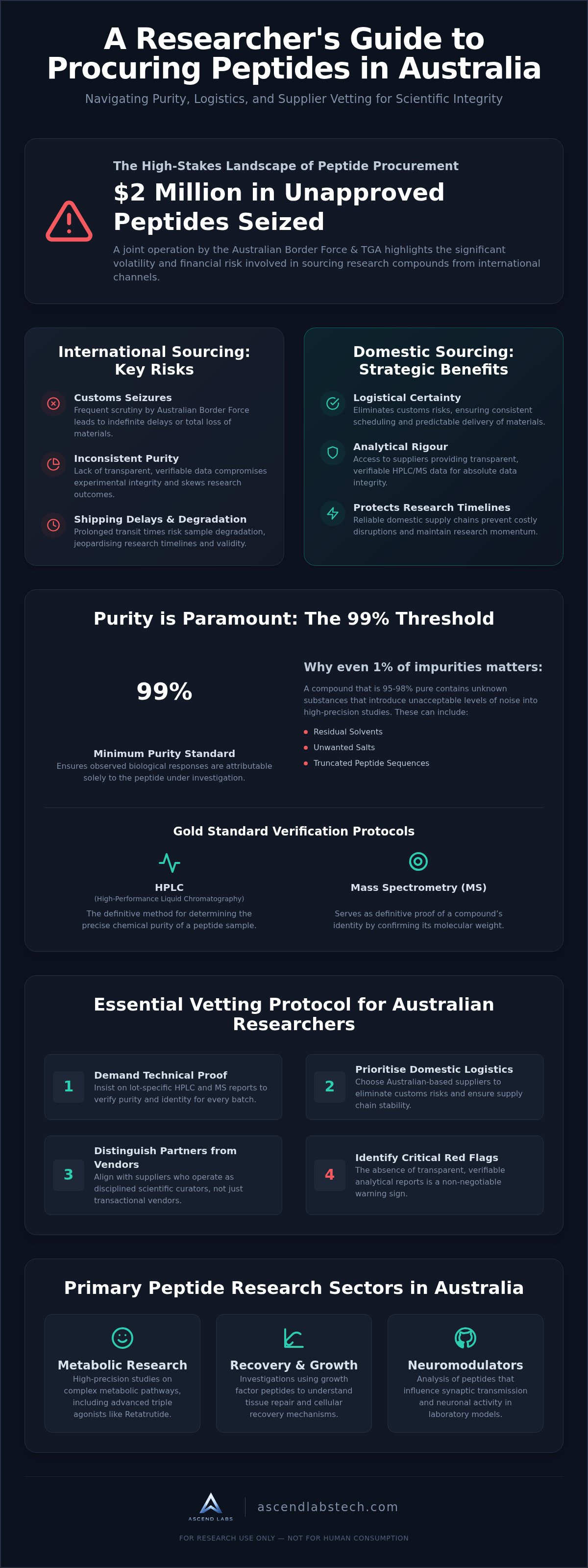
A recent joint eight-month operation between the Australian Border Force and the TGA culminated in the seizure of $2 million worth of unapproved peptides and performance compounds. For serious researchers, this statistic underscores the immense volatility and risk involved in procuring research peptides australia through international channels. It is a landscape where customs seizures and inconsistent purity levels are not merely inconveniences; they are significant barriers to scientific progress.
You likely recognise that the integrity of your data depends entirely on the quality of your compounds, yet finding a source that provides transparent HPLC/MS verification remains a persistent challenge. This article provides a comprehensive framework for navigating these complexities, ensuring your laboratory maintains domestic reliability and analytical rigour. We will examine the technical requirements for verifying compound quality, the logistical advantages of Australian-based sourcing, and the protocols for securing advanced research materials such as Retatrutide and Tirzepatide. By prioritising substance over marketing, you can establish a secure pipeline for your metabolic and recovery research needs.
Key Takeaways
- Establish a technical foundation for verifying compound purity through HPLC and mass spectrometry to ensure the absolute integrity of your research data.
- Evaluate the strategic benefits of domestic-only logistics to eliminate the significant risks of customs seizures and international shipping delays.
- Implement a professional vetting protocol for procuring research peptides australia to distinguish authoritative scientific partners from unreliable vendors.
- Master the identification of critical red flags in supplier documentation, such as the absence of transparent, lot-specific analytical reports or verifiable purity data.
- Secure consistent access to advanced metabolic research compounds, including Retatrutide and Tirzepatide, by aligning with a disciplined domestic curator.
Navigating the Landscape of Procuring Research Peptides in Australia
The current state of peptide science in Australian institutions is marked by a shift toward high-precision metabolic and neuromodulator studies. Peptides, which are short chains of amino acids linked by peptide bonds, serve as the foundational architecture for these investigations. Unlike therapeutic goods intended for clinical use, research-grade compounds are synthesised specifically for in vitro or laboratory-based in vivo analysis. This distinction is critical. It defines the analytical rigour required for verification and the legal framework within which laboratories must operate. For many institutions, the process of procuring research peptides australia has become a strategic priority to avoid the instability of international supply chains.
The Scope of Australian Laboratory Research
Australian laboratories are increasingly focused on the complex interplay of metabolic pathways. Advanced triple agonist studies, particularly those involving retatrutide, represent the current frontier of this research. These studies require compounds with a high degree of structural integrity to ensure that experimental variables remain controlled. Standard operating procedures dictate that every chemical must be accompanied by batch-specific data to ensure researchers observe biological responses with materials of known molecular weight and purity.
Demand is currently concentrated in three primary sectors: metabolic research compounds, growth factor peptides for recovery studies, and neuromodulators. Domestic sourcing is the most effective way to protect research timelines. International shipments are frequently subject to Australian Border Force scrutiny, often resulting in indefinite delays or total loss of materials. A domestic supply chain provides a level of logistical certainty that international vendors cannot match, allowing for consistent scheduling of experiments and reducing the risk of sample degradation during prolonged transit.
Regulatory Awareness for Research Procurement
The 'research only' designation isn't a mere label; it's a legal boundary that restricts these substances from human consumption. When procuring research peptides australia, researchers assume an ethical responsibility to maintain strict laboratory protocols. Compliance isn't optional. It requires a meticulous approach to technical documentation, including High-Performance Liquid Chromatography (HPLC) and Mass Spectrometry (MS) reports. These documents serve as definitive proof of a compound’s identity. Without them, laboratory results lack the necessary validation for peer-reviewed publication or subsequent phase development.
Benchmarks for Research Peptide Quality and Purity
In the discipline of laboratory research, purity is the single most significant variable affecting experimental outcomes. When procuring research peptides australia, the presence of even minor contaminants can lead to off-target effects, skewed data, or the complete failure of a study. A compound that is only 95% pure contains 5% unknown substances; these could be residual solvents, salts, or truncated peptide sequences. For metabolic research, where precise agonist-receptor interactions are the focus, such impurities introduce unacceptable levels of noise. Maintaining a 99% purity threshold ensures that the biological responses observed are attributable solely to the peptide under investigation.
Verification requires a two-pronged analytical approach. While many suppliers claim high quality, only those providing verifiable data from High-Performance Liquid Chromatography (HPLC) and Mass Spectrometry (MS) meet professional standards. This level of transparency is essential, particularly given the TGA joint statement regarding the risks associated with unverified compounds. Analytical rigour is the only safeguard against substandard materials. The process of procuring research peptides australia requires a commitment to these verification protocols to protect the integrity of the scientific record.
Interpreting HPLC and MS Reports
HPLC stands as the definitive gold standard for determining the chemical purity of a peptide sample. A chromatogram displays a series of peaks; in a high-purity sample, the primary peak should represent at least 99% of the total area. Baseline noise or secondary peaks indicate the presence of impurities that may interfere with assay results. Mass Spectrometry complements this by confirming the identity of the substance. It measures the mass-to-charge ratio of the ions, allowing researchers to verify that the molecular weight of the synthesised peptide matches its theoretical value exactly. This ensures the compound is not only pure but also correctly identified.
The Role of the Certificate of Analysis (COA)
A comprehensive Certificate of Analysis (COA) is the cornerstone of laboratory compliance. It must be batch-specific rather than a generic template. A valid COA includes the peptide’s sequence, molecular weight, HPLC purity percentage, and the MS identification results. Relying on suppliers who withhold this data introduces significant risk. Third-party verification acts as an additional layer of security, providing an unbiased audit of the synthesis quality. For labs that prioritise data integrity, using a disciplined domestic source that provides transparent analytical reports is the most effective way to secure high-purity research materials.
Domestic Supply vs International Procurement Risks
Logistical volatility represents one of the most significant threats to research continuity. While international vendors often promise global reach, the reality of procuring research peptides australia from overseas is fraught with systemic friction. International procurement introduces variables that are often outside the researcher’s control, including unpredictable customs intervention and environmental exposure during long-haul transit. For institutions focused on high-precision outcomes, the reliability of domestic supply is not just a convenience; it's a fundamental requirement for maintaining analytical rigour.
Mitigating Customs and Regulatory Friction
International shipments of research compounds are frequently flagged by the Australian Border Force (ABF) for intensive screening. This scrutiny has intensified recently. A joint operation in mid-2026 involving the TGA and ABF resulted in the seizure of $2 million worth of unapproved peptide products. When a shipment is seized, the loss isn't merely financial. It represents a total reset of research timelines, often delaying studies by months. Domestic procurement eliminates these regulatory hurdles by keeping the entire supply chain within Australian jurisdiction. This ensures that materials arrive without the risk of indefinite detention at the border.
Ensuring Cold-Chain Integrity and Handling
Peptides are inherently fragile molecules. Compounds such as MOTS-C and various Growth Factor Peptides are particularly sensitive to temperature fluctuations and mechanical stress. During a 10-day international transit period, packages are often exposed to uncontrolled warehouse environments and the extreme temperatures of cargo holds. This exposure can lead to peptide denaturation or degradation, rendering the compound useless for precise metabolic research. Leading domestic facilities, such as those discussed by the University of Queensland's Rosengren Group, emphasise the importance of structural biology and stability in peptide science.
Shorter domestic transit times, typically 24 to 48 hours, significantly reduce the window for environmental degradation. Domestic shipping allows for a more controlled cold-chain process, utilising discreet and secure packaging designed to maintain thermal stability. By procuring research peptides australia through a domestic-only provider, researchers ensure that the chemical integrity of the compound at the point of synthesis is preserved through to the point of delivery.
Criteria for Selecting a Reputable Australian Supplier
Selecting a synthesis partner is a high-stakes decision for any laboratory. When procuring research peptides australia, the objective is to identify a curator who operates with the same level of rigour as the research institution itself. A reputable supplier does not simply act as a vendor; they serve as a scientific gatekeeper. This means providing absolute clarity on synthesis protocols and batch-specific verification. A partner who prioritises substance over marketing will always lead with data rather than hyperbolic claims.
Identifying red flags is essential for maintaining laboratory standards. Professional researchers should be wary of suppliers who utilise retail-oriented language or those who cannot provide immediate technical specifications for their catalogue. Common indicators of an unreliable source include the absence of lot-specific HPLC/MS data, anonymised contact details, and a lack of transparency regarding domestic inventory. In contrast, a sophisticated supplier will demonstrate a deep immersion in biotechnology and a clear understanding of the chemical categories they curate.
Specialisation in advanced metabolic research compounds, such as Retatrutide or Tirzepatide, indicates a supplier’s alignment with current scientific frontiers. These compounds require sophisticated synthesis techniques and meticulous quality assurance. A partner with genuine scientific knowledge can provide technical support regarding molecular weight and structural integrity, which is invaluable when working with sensitive neuromodulator peptides. This level of expertise ensures that the compounds you receive are fit for purpose and capable of producing reliable, reproducible data.
Transparency in Sourcing and Synthesis
Researchers must demand clear information regarding the synthesis environment and the origin of raw materials. Consistent batch-to-batch quality is only possible through meticulous oversight and disciplined quality control. A professional communication style, devoid of retail jargon, reflects a supplier's commitment to scientific integrity. Professionalism in documentation is the first indicator of a disciplined operation that values accuracy above all else.
Accountability and Technical Support
A domestic presence provides a level of accountability that international entities cannot replicate. If technical questions arise regarding a compound’s specifications, a domestic partner is reachable and legally accountable within the Australian framework. This proximity allows for a more responsive technical support structure, ensuring that your research timelines are protected. The cheapest option is rarely the most scientifically sound.
Secure high-purity compounds through a disciplined domestic curator committed to analytical transparency and scientific rigour.
Securing High-Purity Compounds Through Ascend Labs
Ascend Labs operates as a principled institution dedicated to the provision of high-purity research materials. When procuring research peptides australia, the primary objective is the elimination of analytical uncertainty. We address this by acting as a disciplined curator; we don't just supply compounds, we verify their chemical identity with clinical precision. Our operation is built on the belief that scientific truth is paramount. This philosophy informs every aspect of our synthesis and distribution protocols, ensuring that your laboratory results are built on a foundation of absolute integrity.
The Ascend Labs Analytical Standard
Our analytical standard is defined by absolute transparency and a refusal to accept the industry status quo. Every compound in our catalogue, including advanced metabolic research compounds like Tirzepatide and specialised peptides like KLOW, is subject to rigorous verification. We provide batch-specific HPLC and MS data to ensure that researchers receive materials with a confirmed purity of 99% or higher. This meticulousness allows for the high-end aesthetic of a premium boutique while maintaining the uncompromising standards of a clinical laboratory. By focusing on a specific range of advanced peptides, we ensure that our expertise remains deep and our quality remains consistent across every vial. We don't rely on generic templates; we provide the raw data necessary for professional compliance.
Streamlined Domestic Logistics
Reliability in research is often a function of logistical stability. Ascend Labs operates an Australian-only supply chain to ensure that your materials are never subject to the unpredictability of international borders. This domestic focus allows for a streamlined delivery process that minimises transit time and protects the structural integrity of temperature-sensitive compounds. When procuring research peptides australia, the risk of degradation during long-haul transit is a significant concern. Our domestic logistics are handled with the same level of discretion and professionalism as our laboratory synthesis. This ensures that your research timelines remain intact and your compounds arrive in optimal condition, ready for immediate analytical use.
For researchers who value data over marketing, Ascend Labs provides a secure and authoritative source for high-purity materials. We invite you to review our current research peptide catalogue to secure the compounds necessary for your next metabolic or neuromodulator study.
Advancing the Integrity of Australian Laboratory Standards
Achieving precise experimental outcomes requires a fundamental shift from retail-style procurement to clinical-grade curation. You've established that analytical transparency, specifically through lot-specific HPLC and MS data, remains the only definitive safeguard against substandard materials. By prioritising domestic logistics, researchers effectively bypass the volatility of international borders and ensure that sensitive molecules maintain their structural integrity throughout the entire transit process. This methodical approach protects both your research timelines and the long-term validity of your data.
The process of procuring research peptides australia is most successful when you align with a partner who values scientific truth over marketing convenience. Ascend Labs supports this mission by providing a comprehensive Certificate of Analysis for every batch and maintaining a discreet, domestic-only supply chain. Our focus on specialised metabolic and recovery research compounds ensures that your laboratory has reliable access to the highest-purity materials available. We invite you to Explore the Ascend Labs Research Catalogue and secure the compounds necessary for your next phase of inquiry. Elevating the standard of your materials is the most direct path to advancing the quality of your scientific discoveries.
Frequently Asked Questions
Is procuring research peptides in Australia legal for laboratory use?
Yes, the process of procuring research peptides australia is legal when the compounds are intended for laboratory analysis. While many peptides are listed under Schedule 4 of the Poisons Standard, research-grade materials are designated specifically for non-human applications. This allows institutions to conduct legitimate scientific inquiry provided they adhere to strict laboratory protocols and safety data sheet requirements.
Can I use research peptides for human clinical trials without a licence?
No, research-grade peptides cannot be used for human clinical trials without appropriate TGA authorisation and clinical trial notification. These compounds are synthesised for laboratory research and lack the specific GMP certifications required for human administration. Using research chemicals in human subjects outside of a regulated clinical trial framework is a violation of Australian therapeutic goods regulations.
How do I verify the purity of a research peptide batch?
Batch purity is verified through High-Performance Liquid Chromatography (HPLC) and Mass Spectrometry (MS). HPLC determines the purity percentage by separating the chemical components, while MS confirms the molecular identity by measuring mass-to-charge ratios. When procuring research peptides australia, you should always demand batch-specific analytical reports that confirm a purity threshold of at least 99% to ensure experimental consistency.
What is the difference between research-grade and pharmaceutical-grade peptides?
The primary difference lies in the synthesis environment and intended application. Pharmaceutical-grade peptides are manufactured under Good Manufacturing Practice (GMP) conditions for human therapy. Research-grade peptides are curated for laboratory use, focusing on high chemical purity for analytical rigour rather than clinical administration standards. Both require high purity, but pharmaceutical compounds undergo additional regulatory vetting.
How long does domestic shipping for research peptides usually take in Australia?
Domestic shipping for research materials typically takes between 24 and 48 hours within Australia. This efficiency is a primary benefit of using a local supplier, as it significantly reduces the window for environmental exposure. Rapid transit ensures that fragile compounds remain stable and arrive at your laboratory without the degradative risks associated with international logistics.
What happens if a research peptide shipment is delayed in transit?
Prolonged delays in transit can lead to peptide degradation, particularly for temperature-sensitive molecules. If a shipment is delayed, the structural integrity of the compound may be compromised by environmental fluctuations. Domestic supply chains mitigate this risk by providing predictable delivery windows and specialised packaging designed to maintain stability during the short transit period.
Are HPLC and Mass Spectrometry reports provided with every order?
Yes, professional synthesis partners provide comprehensive HPLC and MS reports with every batch. These documents, often consolidated into a Certificate of Analysis (COA), are essential for laboratory compliance and data validation. At Ascend Labs, we provide these reports to ensure researchers have absolute transparency regarding the molecular weight and purity of their compounds.
What are the storage requirements for metabolic research compounds like MOTS-C?
Metabolic research compounds like MOTS-C are most stable when stored in a lyophilised state. For long-term preservation, these vials should be kept at -20°C in a moisture-controlled environment. Once reconstituted for laboratory analysis, the peptide should be stored at 2-8°C and used within a specific timeframe to prevent denaturation or loss of biological activity.


