

In 2026, the tirzepatide research compound has transcended its initial clinical reputation to become the definitive benchmark for dual-agonist metabolic studies. While the pharmaceutical application of this peptide is well-documented, its role as a precise tool for investigating incretin synergy requires a more disciplined, technical approach. You've likely encountered the significant challenges of sourcing high-purity compounds within Australia, where the line between retail-grade products and true laboratory-standard reagents is often blurred.
We understand that for serious practitioners, data integrity is non-negotiable. This briefing provides a comprehensive technical overview of the dual GIP and GLP-1 mechanism, designed to move your inquiry beyond surface-level observations. You'll gain a clear understanding of the metabolic pathways involved, alongside a framework for identifying domestic supply standards that meet rigorous HPLC and CoA verification requirements. We'll explore the specific protocols that differentiate clinical results from laboratory-controlled metabolic research, ensuring your study maintains the highest level of scientific rigour.
Key Takeaways
- Gain a technical understanding of the dual GIP and GLP-1 receptor synergism that distinguishes this peptide from traditional mono-agonist research models.
- Evaluate the specific applications of the tirzepatide research compound within adipose tissue studies and in-vitro glycaemic control simulations.
- Master the verification process for peptide purity by learning to analyse HPLC reports and Certificates of Analysis for laboratory-grade reagents.
- Recognise the operational advantages of domestic Australian supply chains for maintaining the biochemical stability of sensitive metabolic compounds.
Understanding the Tirzepatide Research Compound: The Dual-Agonist Paradigm
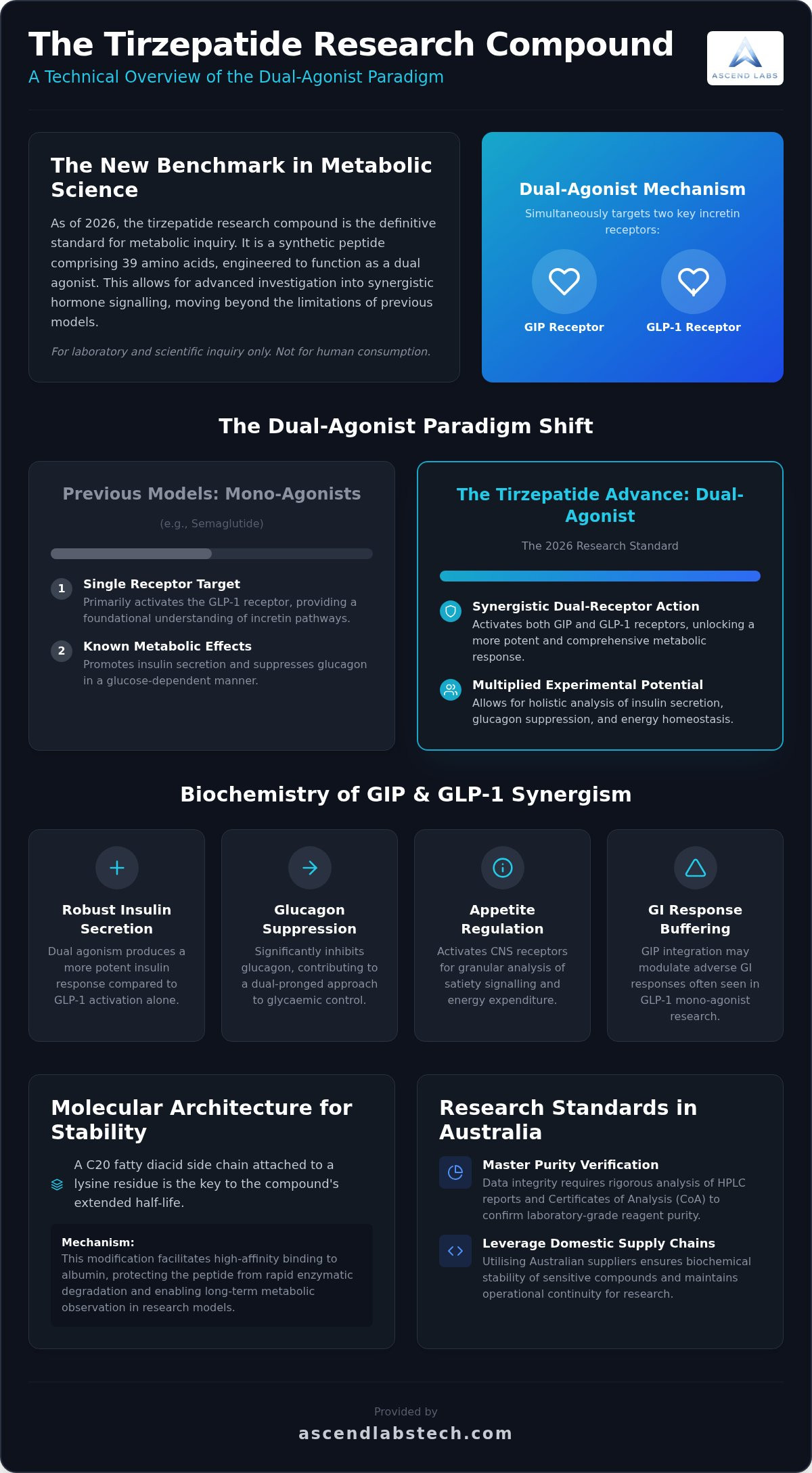
Tirzepatide is a synthetic peptide comprising a precise sequence of 39 amino acids. It represents a sophisticated evolution in metabolic research, functioning as a dual agonist of both the glucose-dependent insulinotropic polypeptide (GIP) and glucagon-like peptide-1 (GLP-1) receptors. This dual-action mechanism marks a significant departure from previous research models that relied solely on GLP-1 mono-agonists, such as semaglutide. While mono-agonists provided a foundational understanding of incretin pathways, the tirzepatide research compound allows for the investigation of synergistic hormone signalling. This synergy is critical for researchers examining the complex interplay of insulin secretion, glucagon suppression, and energy homeostasis.
In the current 2026 landscape, this compound is recognised as the definitive benchmark for metabolic inquiry. It acts as the standard against which all emerging multi-agonist peptides are measured. The transition from single to dual-receptor targeting has redefined laboratory protocols, moving beyond simple glycaemic monitoring toward a more holistic analysis of metabolic flux. It's essential to maintain a strict boundary regarding the application of this material. The compound is classified exclusively for laboratory and scientific inquiry. It's not intended for human consumption or clinical use, and its value lies entirely in its capacity to provide high-resolution data in controlled research environments.
The Molecular Structure of Tirzepatide
The architectural integrity of the peptide is defined by its specific amino acid sequence and a C20 fatty diacid side chain. This side chain, attached to the lysine residue at position 20, is a critical modification. It facilitates a high affinity for albumin binding, which effectively extends the compound's half-life. This structural stability is vital for extended study protocols, as it prevents the rapid enzymatic degradation typical of endogenous incretins. By ensuring a sustained presence in laboratory models, the peptide allows for the observation of long-term metabolic adaptations that shorter-lived analogues cannot capture.
Historical Context in Australian Research
The Australian scientific community has seen a rapid evolution in metabolic research over the last decade. Early studies focused on simple GLP-1 analogues, but the publication of the SURMOUNT trial data catalysed a shift toward dual-agonist models. These trials highlighted the profound influence of GIP receptor activation when paired with GLP-1, sparking a surge of interest in domestic laboratories. Today, Australian researchers utilise the peptide to explore advanced concepts in adipose tissue biology and neuro-metabolic signalling. The compound's reliability and well-documented mechanism make it the primary choice for institutions seeking to push the boundaries of metabolic science in 2026.
The Biochemistry of GIP and GLP-1 Receptor Synergism
The biochemical profile of the tirzepatide research compound is defined by its simultaneous activation of two distinct incretin pathways. By targeting both the GIP and GLP-1 receptors, researchers can observe a physiological response that is qualitatively different from single-receptor stimulation. In-vitro studies demonstrate that this dual agonism leads to a more robust insulin secretion profile compared to GLP-1 activation alone. This is complemented by a significant suppression of glucagon, creating a dual-pronged approach to glycaemic regulation that remains a primary focus for metabolic laboratories in 2026.
One of the most compelling aspects of GIP integration is its potential to modulate the adverse gastrointestinal responses often observed in GLP-1 mono-research. In laboratory models, GIP appears to act as a physiological buffer, potentially reducing the intensity of nausea-like signals. This makes the compound a versatile tool for studying appetite regulation via the central nervous system (CNS). By activating receptors in the hypothalamus and hindbrain, the peptide allows for a granular analysis of satiety signalling and energy expenditure. The synergy between these two pathways doesn't just add their effects together; it multiplies the experimental possibilities for understanding metabolic homeostasis.
GLP-1 Receptor Activation Mechanisms
GLP-1 receptor agonism remains a cornerstone of metabolic inquiry, primarily through its modulation of gastric emptying and satiety pathways. Researchers focus on how these signals delay nutrient absorption and promote a sustained feeling of fullness in animal models. Beyond digestion, there is significant interest in pancreatic beta-cell preservation. Studies investigate whether sustained activation can mitigate apoptosis and enhance functional cell mass. For those exploring even more complex interactions, a comparative analysis with Retatrutide: The Frontier of Triple Agonist Research in Australia provides insight into the evolution from dual to triple agonism.
GIP Receptor Activation and Fat Metabolism
GIP is often the critical differentiator in research involving the tirzepatide research compound. Unlike GLP-1, GIP receptors are highly expressed in adipose tissue. This allows researchers to study direct improvements in insulin sensitivity within fat cells. GIP acts as a lipid buffer, promoting the efficient storage of fats in subcutaneous depots while potentially reducing ectopic fat deposition. This mechanism is central to understanding why dual agonists often outperform mono-agonists in fat-mass reduction studies. Practitioners seeking to establish these frameworks in their own laboratories can source high-purity metabolic compounds to ensure consistent data collection across all study phases.
Primary Research Applications in Metabolic Science
The tirzepatide research compound facilitates an expansive range of inquiries into multi-systemic metabolic dysfunction. In current research cycles, its utility has moved far beyond simple weight metrics. Laboratory protocols now prioritise the investigation of preferential fat-mass reduction. Researchers utilise this peptide to observe how dual agonism targets visceral adipose tissue while maintaining the structural integrity of other organ systems. This specificity is a primary driver for its adoption in high-resolution metabolic studies. It's a tool that allows for a more granular understanding of energy balance and lipid distribution in vivo.
For models investigating Type 2 Diabetes, the peptide provides a technical framework for understanding glucose disposal. Research focuses on the suppression of HbA1c levels and the enhancement of insulin sensitivity in peripheral tissues. These studies are often paired with an analysis of hepatic health. Researchers track liver markers, such as ALT and AST, to evaluate the compound's influence on hepatic steatosis and liver-specific inflammatory cytokines. This multi-pronged approach is essential for understanding the link between systemic insulin resistance and organ-specific metabolic failure. It helps clarify how dual incretin activation alters the progression of fatty liver conditions.
Investigations into cardiometabolic health focus on the compound's influence on lipid profiles and vascular markers. Researchers monitor changes in LDL and HDL cholesterol alongside arterial pressure markers to assess overall metabolic stability. These data points provide a comprehensive map of how dual agonism influences the cardiovascular system under metabolic strain. By tracking these variables, laboratories can establish more precise benchmarks for how the peptide modulates the systemic environment beyond simple glycaemic control.
Body Composition and Lean Mass Retention
A critical focus in 2026 is the ratio of fat loss to lean muscle mass preservation. Metabolic studies often struggle with the unintended degradation of muscle tissue during rapid weight changes. Researchers are increasingly combining their protocols with peptides for connective tissue research to ensure structural stability is maintained. This allows for a more accurate simulation of healthy metabolic aging. It's a method that provides a more nuanced view of tissue preservation during experimental weight flux, ensuring that the data reflects a healthy metabolic transition rather than simple starvation-like responses.
Neuroprotective and Inflammatory Research
The anti-inflammatory pathways triggered by dual GIP and GLP-1 activation represent a significant frontier. Current inquiry is moving toward understanding how these incretin mimetics influence neuro-inflammation within the central nervous system. Preliminary data indicates that the compound may offer neuroprotective benefits, potentially mitigating the damage caused by chronic metabolic stress. These findings suggest the peptide's utility will continue to grow as research expands into multi-systemic inquiries. It's no longer just a metabolic tool; it's a candidate for studying the intersection of neurology and endocrinology.
Laboratory Standards: Verifying Purity and Stability in Australia
Securing a high-purity tirzepatide research compound is the first step in any credible laboratory study. However, the technical verification of that purity is where the scientific standard is truly established. High-Performance Liquid Chromatography (HPLC) remains the gold standard for this process. It allows researchers to quantify the exact concentration of the primary peptide against any residual impurities. When you review a Certificate of Analysis (CoA), the chromatogram should display a single, sharp peak. This indicates a high degree of purity, ideally exceeding 99%. Broad or multiple peaks suggest degradation or contamination, which can compromise the integrity of your metabolic data.
Identity verification is equally critical. Mass Spectrometry is utilised to confirm that the molecular weight of the compound aligns with the established sequence for tirzepatide. For a compound with 39 amino acids and a C20 fatty diacid side chain, the molecular identity must be precise. Stability is further enhanced through lyophilisation. This freeze-drying process removes moisture, resulting in a stable powder that resists enzymatic breakdown. Without this step, the peptide would be far too sensitive for transport or long-term storage in the varied Australian climate.
Storage and Reconstitution Protocols
Peptide integrity is highly sensitive to environmental factors. For long-term preservation, the lyophilised powder should be stored at -20°C in a moisture-controlled environment. Once you're ready to begin your study, reconstitution must be handled with care. Bacteriostatic water is the preferred solvent, as it contains 0.9% benzyl alcohol to inhibit microbial growth. Researchers should avoid mechanical stress during the mixing process. Shaking the vial can shear the delicate peptide bonds; instead, a gentle swirling motion is required to achieve a clear, homogenous solution.
Identifying High-Quality Australian Suppliers
The 2026 research landscape in Australia is often complicated by the risks of international logistics. Sourcing from overseas frequently leads to customs delays, temperature excursions, and a complete lack of accountability if the batch is compromised. Domestic Australian supply ensures a controlled chain of custody from the laboratory to your facility. This proximity allows for more rigorous quality control and immediate verification of batch-specific data. For institutions requiring consistent results, you can verify batch purity and source laboratory-grade peptides through domestic channels that prioritise technical transparency over retail convenience.
Procuring High-Purity Tirzepatide for Australian Research
Sourcing the tirzepatide research compound within the Australian landscape necessitates a move away from high-volume retail models toward a more disciplined, laboratory-focused approach. Ascend Labs operates as a dedicated gatekeeper for high-purity metabolic reagents. We recognise that the validity of your research hinges entirely on the chemical precision of your compounds. By maintaining a specialised focus on metabolic science, we provide the Australian scientific community with a reliable framework for serious inquiry. Every vial we provide is a testament to our commitment to scientific truth and operational transparency.
The transition from theoretical models to practical laboratory application requires a partner that understands the nuances of peptide stability. We don't merely act as a vendor; we function as a principled institution that prioritises data integrity above all else. This means ensuring that every research project has access to the same high-standard reagents, regardless of the study's scale. Our role is to remove the uncertainty surrounding peptide sourcing, allowing you to focus on the technical aspects of your metabolic research without concern for batch-to-batch variability.
Meticulous Quality Assurance
Our quality control protocols are designed to eliminate the variables that often compromise study reproducibility. Each batch of the tirzepatide research compound is subjected to rigorous identity verification and purity analysis. We utilise HPLC and mass spectrometry to ensure every vial meets a minimum 99% purity threshold. This Ascend Labs standard for laboratory-grade metabolic compounds is non-negotiable. Every shipment is accompanied by transparent verification data, providing researchers with the batch-specific documentation required for institutional-grade reporting and analysis.
Domestic Logistics and Professional Service
International logistics present significant risks to peptide stability, often involving temperature excursions and prolonged customs delays that can degrade sensitive biochemical structures. Ascend Labs mitigates these risks through domestic Australian dispatch. Our logistics chain is meticulously organised to maintain the structural integrity of lyophilised peptides during transit. We provide a discreet, secure, and professional service that ensures your time-sensitive laboratory projects remain on schedule. If you're ready to advance your inquiry, you can view the Ascend Labs research catalogue for your next study and secure the high-purity reagents required for definitive metabolic modelling.
Advancing Metabolic Inquiry with Precision Reagents
The transition toward dual-agonist models represents a significant evolution in endocrine research. By targeting the synergistic pathways of GIP and GLP-1, you can achieve a more comprehensive understanding of metabolic flux than single-receptor studies allow. Maintaining this level of scientific rigour requires a commitment to meticulous laboratory standards, specifically regarding the verification of chemical identity and purity. Utilising a tirzepatide research compound that meets 99%+ HPLC standards is the only way to ensure your data remains reproducible and credible.
Consistency in your results is directly linked to the stability of your supply chain. Domestic Australian dispatch provides a secure chain of custody that protects the structural integrity of your peptides from environmental degradation. As you refine your research protocols, choosing laboratory-grade standards will ensure your inquiry stays at the forefront of metabolic science. Secure high-purity Tirzepatide for your Australian research project at Ascend Labs. We're here to provide the technical foundation your study requires to succeed.
Frequently Asked Questions
Is the tirzepatide research compound intended for human use?
The tirzepatide research compound is strictly intended for laboratory and scientific inquiry and is not for human consumption. Its classification as a research chemical ensures it's utilised solely in controlled environments to investigate metabolic pathways. Any application outside of established laboratory protocols or in-vivo animal models is strictly prohibited. This distinction maintains the integrity of the scientific process and adheres to the ethical standards of the Australian research community.
What is the purity standard for Ascend Labs research peptides?
Ascend Labs maintains a non-negotiable purity standard of 99% or higher for all research peptides. We utilise High-Performance Liquid Chromatography (HPLC) to verify the concentration of the primary peptide and ensure the absence of significant impurities. This rigorous verification process is essential for providing researchers with consistent reagents. By adhering to these laboratory-grade standards, we ensure that your experimental results are reproducible and free from the variables introduced by lower-quality compounds.
How should tirzepatide be stored to ensure long-term stability in the lab?
Tirzepatide must be stored in its lyophilised state at a temperature of -20°C to ensure long-term stability. While the freeze-dried powder is relatively stable at room temperature for short periods during transit, sustained cold storage is required to prevent enzymatic degradation. Once the peptide is reconstituted, it should be kept refrigerated at 2°C to 8°C and utilised within a specific timeframe to maintain its biochemical potency throughout the study duration.
What is the difference between tirzepatide and semaglutide in a research context?
The primary technical difference lies in the receptor targeting; tirzepatide is a dual GIP and GLP-1 agonist, while semaglutide is a GLP-1 mono-agonist. In a research context, the tirzepatide research compound allows for the investigation of synergistic effects on insulin sensitivity and lipid metabolism that aren't observable with single-receptor agonists. This makes it a more complex tool for studying multi-systemic metabolic dysfunction and adipose tissue biology in advanced laboratory models.
Does Ascend Labs provide a Certificate of Analysis (CoA) with every order?
Yes, Ascend Labs provides a batch-specific Certificate of Analysis (CoA) with every order to ensure full technical transparency. The CoA includes both HPLC and Mass Spectrometry data, confirming the purity level and the molecular identity of the peptide. We believe that access to this verification data is a fundamental requirement for serious researchers. It allows you to document the quality of your reagents and maintain a high standard of data integrity in your publications.
What are the common reconstitution volumes for a 20mg or 40mg research vial?
Common reconstitution volumes typically range from 1ml to 2ml of bacteriostatic water per vial, depending on the desired concentration for the protocol. For a 20mg or 40mg vial, researchers must calculate the volume precisely to ensure accurate dosage delivery in their models. It's essential to use a solvent that inhibits microbial growth; bacteriostatic water is the standard choice for maintaining the sterile integrity of the solution over the course of an extended study.
How does domestic Australian shipping improve research outcomes?
Domestic Australian shipping significantly improves research outcomes by minimising the risk of temperature excursions and customs-related delays. International transit often exposes sensitive peptides to fluctuating environments that can compromise their structural integrity. By utilising a domestic supply chain, researchers benefit from a controlled chain of custody and faster dispatch times. This ensures that the compounds arrive in optimal condition, ready for immediate use in time-sensitive laboratory projects.
Can tirzepatide be used in combination with other metabolic peptides for study?
Yes, tirzepatide is frequently studied in combination with other metabolic or recovery peptides to observe potential synergistic interactions. Researchers often pair it with growth factor peptides or compounds like MOTS-C to investigate multi-pathway approaches to metabolic health and tissue preservation. These combination studies are vital for mapping the complex biochemical networks involved in energy homeostasis. Every combination protocol must be carefully designed to monitor for unexpected cross-reactions within the research model.


