

Peptide stability is not a passive state of storage; it is a calculated result of rigorous environmental management designed to counter hydrolysis and oxidation. For the serious researcher, understanding how to store lyophilized peptides is the critical difference between a successful outcome and a degraded, inert compound. You likely recognise that even minor fluctuations in temperature can compromise the bioactivity of high-purity materials like Retatrutide or MOTS-C. Stability requires vigilance.
This technical guide provides the precise environmental protocols required to eliminate the risk of degradation and preserve the structural integrity of your research assets. We'll establish a clear protocol for transitioning materials from the freezer to the lab bench while addressing the specific risks posed by moisture contamination and frost-free freezer cycles. By following these disciplined standards, you can maximise the shelf life of your compounds. Every milligram will remain viable and potent for its intended purpose.
Key Takeaways
- Identify why the sublimation process is the definitive standard for stabilising molecular structures and ensuring compound longevity.
- Implement precise thermal protocols, including -20°C or -80°C for long-term storage, to prevent the degradation of sensitive research assets.
- Neutralise environmental hazards such as UV light and high humidity by utilising amber vials and moisture-reduction techniques.
- Learn how to store lyophilized peptides effectively by mastering the equilibration protocol, which prevents moisture contamination during thawing.
- Recognise the role of climate-controlled domestic shipping and HPLC verification in maintaining the integrity of high-purity Australian research compounds.
The Science of Lyophilisation and Peptide Integrity
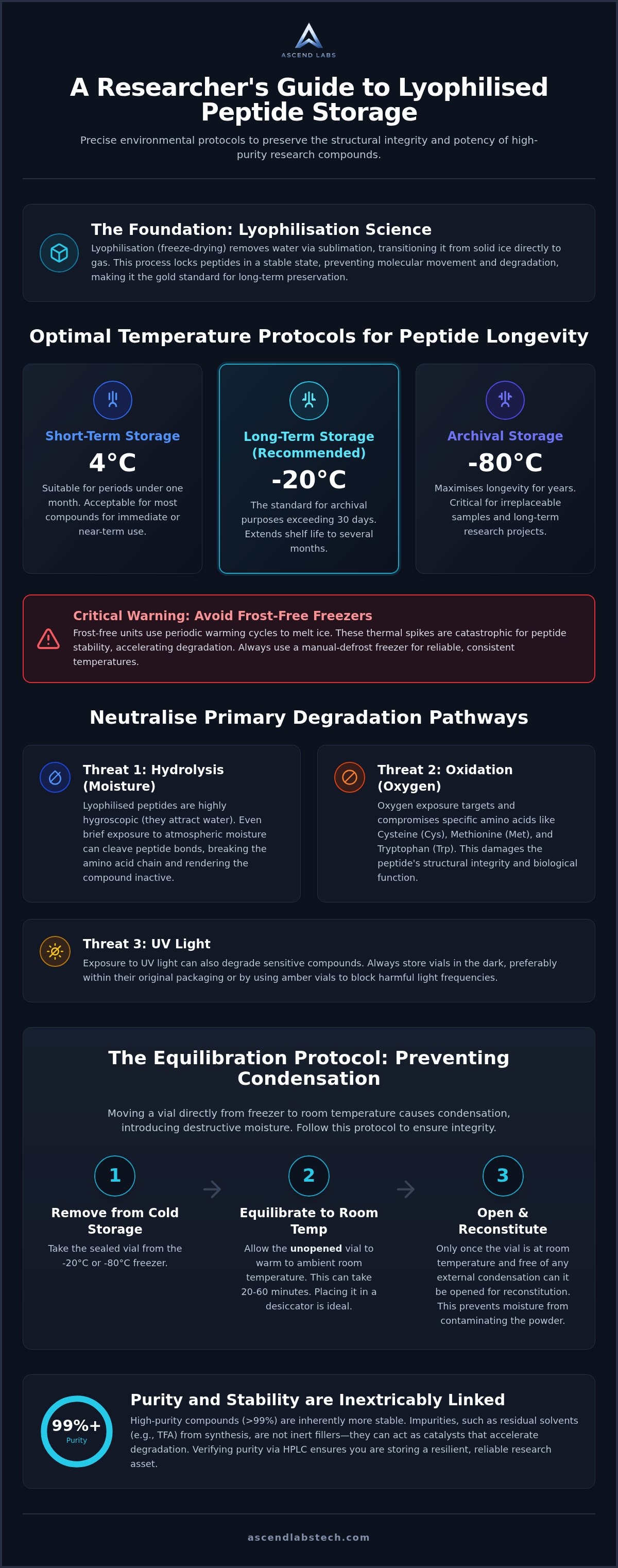
Lyophilisation, or freeze-drying, is a dehydration process that relies on the physical principle of sublimation. By transitioning water directly from a solid ice state to a gaseous state under vacuum, the process removes moisture without subjecting the compound to excessive heat. The Science of Lyophilisation is fundamental to maintaining the primary and secondary structures of delicate amino acid chains. It's the gold standard for long-term preservation because it effectively locks the peptide in a stable vitreous state, preventing the molecular movement that leads to degradation. Stability requires vigilance.
Not all peptides share the same inherent stability. Factors such as sequence length and the specific amino acid composition dictate how a compound responds to its environment. Longer, more complex chains often present more opportunities for structural folding or misfolding. Additionally, lyophilised powders are inherently hygroscopic. They act as magnets for atmospheric moisture. Mastery of how to store lyophilized peptides requires acknowledging that even a brief exposure to the humid Australian climate can initiate the "wetting" of the cake. This leads to rapid potency loss. Precision is paramount.
Primary Degradation Pathways: Hydrolysis and Oxidation
Residual moisture is the primary catalyst for hydrolysis. This chemical reaction results in the cleavage of peptide bonds, effectively breaking the chain and rendering the compound biologically inactive. Beyond moisture, oxygen exposure targets specific amino acids. Cysteine (Cys), Methionine (Met), and Tryptophan (Trp) are particularly vulnerable to oxidation. When these residues are compromised, the structural integrity of the entire compound fails. This isn't just a matter of shelf life; it's a matter of research reproducibility. If your starting material is degraded, your data is fundamentally flawed. Reliability starts in the vial.
The Relationship Between Purity and Stability
The stability of a compound is inextricably linked to its initial purity. High-purity standards, typically exceeding 99%, provide a predictable baseline for long-term storage. Impurities are not just inert fillers; they can act as potent catalysts for unwanted chemical reactions. Residual TFA (trifluoroacetic acid) or leftover solvents from the synthesis process can accelerate degradation pathways over time. Adhering to peptide purity testing standards ensures that the compound you are storing is exactly what the certificate of analysis claims. This level of precision is non-negotiable for advanced research. High-purity material is naturally more resilient.
Optimal Temperature Parameters for Peptide Longevity
The preservation of molecular integrity is fundamentally dependent on thermal stability. While lyophilisation provides a robust baseline, the specific environmental temperature determines the rate of inevitable, albeit slow, degradation. For short-term storage, typically defined as periods under one month, refrigeration at 4°C is acceptable for most compounds. However, for long-term archival purposes exceeding thirty days, temperatures of -20°C or -80°C are non-negotiable. Adhering to these Optimal Temperature Parameters ensures that the kinetic energy within the vial remains insufficient to drive chemical reactions. Stability is a function of consistency.
A critical, often overlooked risk in Australian laboratories and private research facilities is the use of "frost-free" freezers. These units operate on a cycle that periodically raises the internal temperature to melt ice build-up. While convenient for domestic use, these thermal spikes are catastrophic for peptide secondary structures. The repeated warming and cooling can cause the lyophilised cake to contract and expand, introducing micro-moisture and accelerating degradation. When considering how to store lyophilized peptides, you must ensure the use of a manual-defrost freezer. If a frost-free unit is unavoidable, vials should be placed in the centre of the unit, ideally within a secondary insulating container to buffer these fluctuations. Internal consistency cannot be assumed based on the freezer's digital display alone. External secondary thermometers, calibrated to Australian standards, should be placed within the storage environment to provide a redundant verification layer.
Refrigeration vs. Freezing: A Comparison
Expected shelf lives vary significantly across thermal ranges. At 4°C, most peptides remain stable for several weeks. At -20°C, this extends to several months, while -80°C allows for preservation spanning years. It's essential to designate specific units for active research phases versus long-term storage. Once a vial is transitioned to refrigeration for active use, it should not be returned to the freezer. Repeated freeze-thaw cycles, even for powders, can lead to physical stress on the peptide molecules and potential structural compromise. Precision doesn't allow for shortcuts.
Organising Your Research Archive
Systematic inventory management is the hallmark of a disciplined laboratory. Every vial must be clearly labelled with the compound name, batch number, and date of receipt. Utilising secondary containment, such as sealed polycarbonate boxes, provides an additional layer of protection against micro-climates and accidental exposure during freezer access. For those managing a diverse catalogue of high-purity research compounds, establishing an emergency protocol for equipment failure is vital. This should include access to backup power or temporary dry-ice storage to maintain thermal continuity during unexpected outages.
Mitigating Environmental Hazards: Light and Humidity
Temperature management is only the first pillar of compound preservation. Light, moisture, and oxygen represent a triad of environmental hazards that can silently compromise your research. Photolytic degradation occurs when high-energy photons interact with peptide bonds, leading to side-chain modifications and irreversible potency loss. Beyond light, oxygen exclusion remains a critical factor. Ensure that vial caps are torqued precisely to the manufacturer’s specification before storage. This prevents the ingress of atmospheric oxygen, which can trigger oxidative pathways in sensitive residues like methionine. Precision is the only antidote to degradation.
When researchers consider how to store lyophilized peptides, they must account for the unique challenges of the Australian climate. High ambient humidity, particularly in northern or coastal regions, can compromise a compound the moment a vial is removed from cold storage. It's a mistake to underestimate the speed of moisture absorption. Protecting your research assets requires a disciplined approach to secondary containment and the use of active desiccation. Every external variable must be controlled with clinical rigor.
Photostability and Light Sensitivity
Light exposure is a silent catalyst for molecular breakdown. UV radiation can induce the formation of free radicals that subsequently attack the peptide backbone. Transparent refrigerator doors are a common risk factor in laboratory settings, as they expose vials to constant ambient light. To mitigate this, compounds should always be housed in amber glass vials or stored within opaque secondary containers. If your research involves highly sensitive molecules, don't ignore the benefits of blackout storage boxes. Opaque barriers are essential for maintaining long-term bioactivity. Reliability isn't accidental.
Moisture Management and Desiccation
Condensation is the primary enemy of the lyophilised cake. When a cold vial meets warm, humid air, moisture rapidly accumulates on the exterior and the interior of the seal. This "sweating" causes the hygroscopic powder to absorb water, which initiates hydrolysis. To prevent this, always include desiccant packs, such as silica gel or molecular sieves, within secondary storage containers. Molecular sieves are often preferred for their higher adsorption capacity at low temperatures. Inspect your vials regularly for signs of clumping or "shrinking" of the cake. These changes indicate moisture ingress and potential loss of integrity. Vigilance ensures data accuracy.
Best Practices for Handling and Reconstitution
The transition from deep-freeze storage to the laboratory bench represents the most vulnerable phase in a compound's lifecycle. While previous sections detailed long-term environmental management, the physical act of unsealing a vial requires its own set of technical protocols. Condensation is the primary risk here. If a vial is opened while still below the dew point of the laboratory, atmospheric moisture will instantly crystallise on the hygroscopic powder. This induces rapid hydrolysis and immediate degradation. Mastering the protocol for how to store lyophilized peptides necessarily includes a precise sequence for bringing them back to room temperature. Precision is the only safeguard against contamination.
Speed is equally critical. Minimising "bench time" ensures that the compound spends as little time as possible in an uncontrolled environment. Once a vial is removed from its secondary containment, it is exposed to light and fluctuating temperatures. To maintain the structural integrity of your research, you must work with efficiency and purpose. Sanitise all surfaces and use aseptic techniques during every transition. This includes wiping the vial stopper with 70% isopropyl alcohol before any needle penetration or unsealing. Consistency in handling is as vital as the purity of the material itself. High-quality research depends on these repetitive, disciplined actions.
The Step-by-Step Equilibration Process
Gradual thermal transition is essential for preventing structural shock and moisture ingress. Follow this three-part sequence:
- Step 1: Transfer the vial from the deep freeze (-20°C or -80°C) to a standard refrigerator (4°C). Allow it to sit for at least four hours to ensure a gradual warming phase that prevents thermal stress.
- Step 2: Move the vial to the laboratory bench, ideally within a desiccated environment or a sealed container with silica gel. It must reach a room temperature of 20-25°C before the seal is broken.
- Step 3: Perform a visual inspection. The lyophilised "cake" should appear as a solid, uniform mass. Any signs of clumping or "melting" suggest that moisture has already compromised the seal.
Aliquoting for Efficiency
For large-scale research, aliquoting is the most effective strategy for reducing handling risks. By dividing a large batch into smaller, single-use quantities, you avoid the need for repeated vial openings and subsequent air exposure. Calculate your aliquot sizes based on your weekly research requirements to ensure that each working stock vial is consumed within a single experimental phase. This preserves the master stock in its original, pristine state. For those seeking to maintain these high standards, sourcing high-purity research peptides from a reliable Australian supplier is the first step toward experimental success. Minimal handling remains the gold standard for long-term viability.
Ensuring Integrity with High-Purity Australian Standards
The efficacy of any research project is predicated on the stability of the starting material. While mastering how to store lyophilized peptides within your own facility is essential, the integrity of the compound is often determined before it ever reaches your bench. The storage journey begins at the point of synthesis. If a supplier fails to maintain climate-controlled environments during the final stages of production or during transit, the structural integrity of the peptide is already compromised. Stability is a continuous chain of custody. It doesn't allow for gaps in environmental management.
For researchers in Australia, the logistical advantages of domestic sourcing cannot be overstated. International shipping often subjects delicate compounds to uncontrolled thermal stress while they sit in customs warehouses or on heated airport tarmacs for extended periods. By choosing a domestic supply chain, you significantly reduce the time these materials spend in transit-related environmental hazards. Ascend Labs prioritises this continuity. We utilise discreet, domestic shipping methods specifically designed to minimise thermal fluctuations. This ensures that the high-purity material we provide arrives in its optimal state, ready for immediate archival or active use. Reliability is a local commitment.
Sourcing Verified Research Compounds
A Certificate of Analysis (COA) is not just a formality; it's a blueprint of the compound's stability. When reviewing a COA, pay close attention to the purity levels and the verification methods used. High-purity standards, typically verified through High-Performance Liquid Chromatography (HPLC) and Mass Spectrometry (MS), are more predictable during long-term storage. Cheap, unverified sources often suffer from pre-delivery degradation because they lack the rigorous quality assurance required for scientific inquiry. Starting with laboratory-grade standards is the only way to ensure that your storage protocols will be effective. Stability requires a pure foundation.
The Ascend Labs Advantage
Our commitment to scientific truth is reflected in our catalogue of high-purity research compounds, including Retatrutide and MOTS-C. We operate as a disciplined curator of biotechnology, ensuring every batch meets stringent Australian standards for purity and bioactivity. By providing HPLC-verified materials, we offer researchers the security of knowing their compounds are resilient enough to withstand long-term archival storage. If you are seeking to maintain the highest levels of accuracy in your studies, we invite you to review our catalogue for your high-purity research needs. Precision starts at the source.
Final Storage Checklist
- Verify the initial purity and COA of every batch before intake.
- Ensure all vials are stored in a manual-defrost freezer at -20°C or -80°C.
- Utilise amber vials and secondary containment to block UV light and moisture.
- Follow the equilibration protocol for at least four hours before unsealing.
- Maintain a redundant temperature monitoring system for all cold-storage units.
Advancing the Integrity of Your Research
Maintaining the kinetic stability of your research compounds is a continuous commitment to environmental management. By implementing rigorous thermal protocols and mitigating the risks of UV exposure and humidity, you preserve the structural fidelity of your assets. Mastering how to store lyophilized peptides ensures that the bioactivity of your compounds remains unchanged from the moment of receipt to the final analysis. Success in the laboratory is built upon these precise, repeatable standards. Every milligram must be handled with clinical rigor to ensure data accuracy.
Ascend Labs supports your inquiry by providing HPLC and MS verified purity for every batch, with a comprehensive COA available for every individual vial. Our discreet Australian domestic shipping minimises transit-related thermal stress, ensuring your material arrives in its optimal state for long-term archival. We invite you to explore our catalogue of HPLC-verified research peptides to source the high-purity materials your research deserves. Your commitment to precision is the foundation of scientific discovery.
Frequently Asked Questions
Can I store lyophilised peptides in a standard domestic freezer?
Avoid using standard domestic "frost-free" units for long-term storage if possible. These units employ automatic thaw cycles that periodically raise the internal temperature to melt ice build-up, which causes thermal fluctuations that compromise peptide secondary structures. If a laboratory-grade manual-defrost unit isn't available, place your vials in the centre of the freezer within an insulated secondary container to buffer these spikes.
How long do lyophilised peptides stay stable at room temperature?
Lyophilised peptides can remain stable at room temperature (20-25°C) for several days to two weeks depending on the specific amino acid sequence. However, this environment is not optimal for preserving long-term bioactivity. Immediate refrigeration or freezing upon receipt is the only way to ensure the structural integrity of your research compounds over an extended period. Stability is a result of consistent thermal management.
What is the best way to transport peptides across Australia without degradation?
The most effective way to transport peptides across Australia is via discreet domestic shipping that minimises transit time and exposure to uncontrolled environments. Utilising insulated packaging with cold packs reduces the risk of thermal stress during the journey. This is particularly vital during the summer months when ambient temperatures in transit hubs can exceed 40°C, potentially initiating degradation before the compound reaches its destination.
Does light exposure actually damage freeze-dried peptides?
Light exposure, specifically UV radiation, induces photolytic degradation of peptide bonds by creating free radicals. This leads to side-chain modifications and a measurable loss of compound potency even in a lyophilised state. Always utilise amber glass vials or opaque secondary containers to block light, especially if your storage area is subject to constant ambient light from transparent-door refrigeration units.
Should I store peptides in the fridge or the freezer for the best results?
Use a freezer at -20°C or -80°C for any storage exceeding one month to ensure maximum longevity. For active research phases under thirty days, refrigeration at 4°C is acceptable and often more convenient for daily access. Understanding how to store lyophilized peptides correctly involves matching the storage temperature to your intended research timeline to prevent unnecessary chemical kinetic energy from driving degradation.
What are the signs that a lyophilised peptide has degraded?
Visible signs of degradation include the "shrinking" or clumping of the lyophilised cake within the vial. If the powder appears discoloured or has lost its uniform, solid structure, moisture ingress has likely occurred, leading to hydrolysis. While some molecular degradation is invisible to the naked eye, these physical changes are definitive indicators of compromised integrity and potential loss of bioactivity.
How many times can I freeze and thaw a lyophilised peptide vial?
You should avoid repeated freeze-thaw cycles entirely to maintain the purity of your research material. Every time a vial transitions between temperatures, the physical stress on the molecular structure increases and the risk of condensation rises. To maintain precision, aliquot your master stock into single-use vials so that each portion is only brought to room temperature once before its intended use.
Is it necessary to use a desiccant when storing peptides in a freezer?
It's necessary to use a desiccant pack within your secondary storage container to manage the hygroscopic nature of the powder. Even in a freezer, micro-moisture can accumulate and trigger hydrolysis if the vial seal is not perfectly hermetic. Silica gel or molecular sieves provide an essential redundant layer of protection, ensuring the environment remains dry even during brief periods when the freezer door is open.


