

The most sophisticated experimental design is rendered obsolete if the underlying compound has succumbed to degradation before it ever reaches the assay. In the rigorous environment of 2026 Australian biotechnology, adhering to peptide aliquoting best practices is the primary safeguard for scientific integrity. You recognise that experimental variability is often a direct result of sub-optimal handling rather than a flaw in the hypothesis, particularly when managing sensitive compounds like Retatrutide or MOTS-C. Losing high-value research assets to improper reconstitution or thermal instability is a setback that modern laboratories cannot afford.
This protocol provides the technical precision required to preserve peptide bioactivity and ensure reproducible data across your research cycles. By implementing these standards, you'll maximise the shelf-life of your inventory and eliminate the contamination risks that compromise your findings. This briefing examines the essential requirements for solvent selection, single-use volume calculations, and the precise thermal management necessary to protect your laboratory’s most critical assets. We move from foundational stability principles to the practicalities of maintaining a disciplined chain of custody for every sample.
Key Takeaways
- Maintain the chain of integrity from procurement to study by transitioning from bulk storage to systematic, single-use aliquoting.
- Optimise reconstitution outcomes by allowing vials to equilibrate to room temperature and employing peptide aliquoting best practices for solvent selection.
- Mitigate molecular adsorption to labware surfaces and prevent cumulative concentration loss through strategic material selection and reduced transfer cycles.
- Secure long-term stability using a tiered thermal storage hierarchy and secondary containment systems designed to combat moisture ingress.
- Ensure data reproducibility by applying specialised handling protocols to high-purity compounds, including triple agonists like Retatrutide.
The Critical Role of Precision Aliquoting in Peptide Research
Precision is the hallmark of credible biotechnology. In this context, to aliquot a substance means to divide a bulk compound into precise, predetermined volumes that represent the whole. For researchers handling high-purity metabolic compounds, this isn't merely a logistical step; it's a fundamental preservation protocol. Successful peptide aliquoting best practices ensure that the "chain of integrity" remains unbroken from the moment a vial arrives from the supplier until the final assay is completed. By partitioning compounds into single-use units, you isolate variables and protect the structural fidelity of the molecule.
Research reproducibility depends entirely on the stability of the reagent. If a compound degrades between the first and tenth day of a study, the resulting data is compromised. This variability often stems from the degradation of premium compounds through improper storage or repeated exposure to the atmosphere. Beyond the scientific implications, the economic cost of losing sensitive assets like Retatrutide or KLOW to degradation is significant. Precision in the aliquoting phase is the most cost-effective method for maximising the utility of your laboratory's inventory.
Why Freeze-Thaw Cycles are the Enemy of Bioactivity
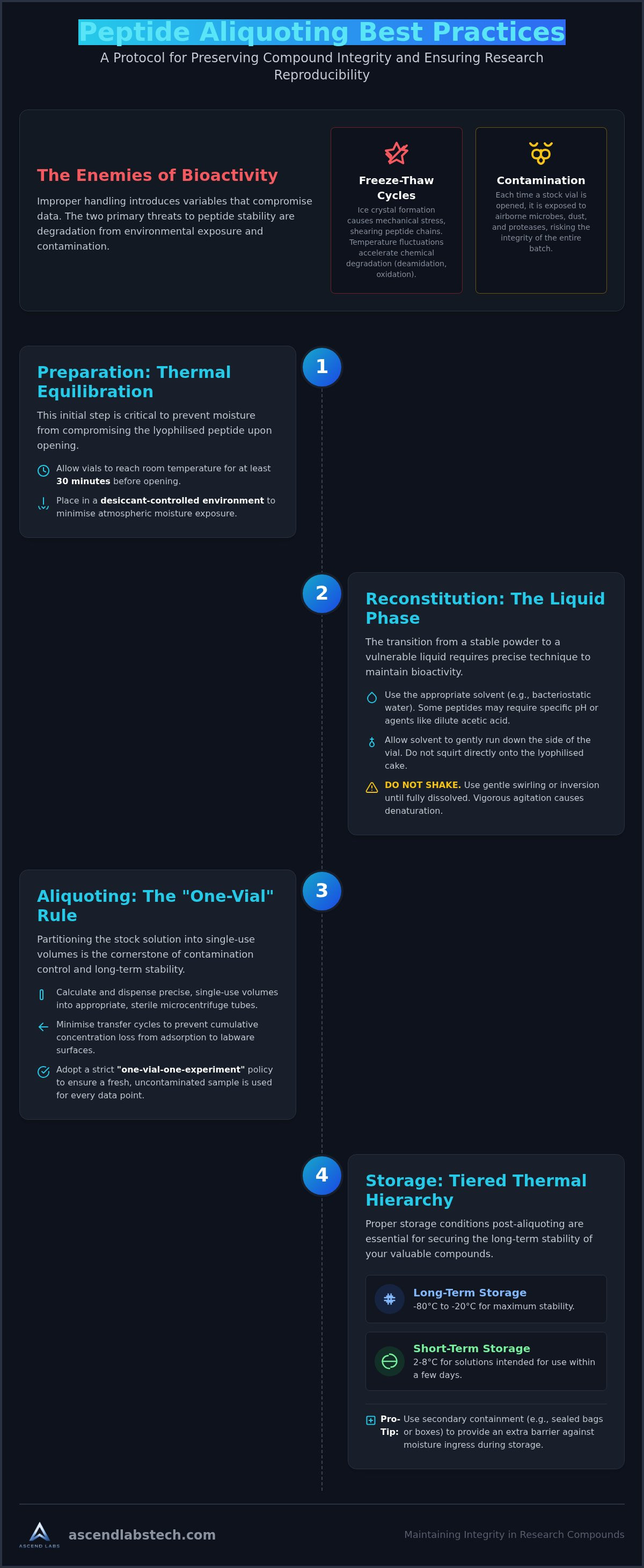
Peptides are delicate chains of amino acids held together by fragile bonds. When a reconstituted solution is frozen, the formation of ice crystals creates mechanical stress that can physically shear these chains. Repeated temperature fluctuations accelerate chemical degradation through deamidation and oxidation. These processes alter the peptide's primary and secondary structures, often rendering the compound biologically inactive. Even minor shifts in temperature during a standard freezer defrost cycle can trigger these changes; making single-use aliquots the only viable solution for long-term stability.
Aliquoting as a Strategy for Contamination Control
Contamination is often an invisible thief of research accuracy. Every time a stock vial is opened, it's exposed to airborne microbes, dust, and exogenous enzymes like proteases. Implementing a "one-vial-one-experiment" rule is a cornerstone of peptide aliquoting best practices in high-stakes metabolic research. This approach ensures that a fresh, uncontaminated sample is used for every data point. The most critical risk occurs during the initial opening of a lyophilised vial. If the seal is breached before the vial reaches room temperature, atmospheric moisture can condense inside, leading to immediate hydrolytic degradation.
Preparation and Reconstitution Protocols for Lyophilised Peptides
Reconstitution represents the transition from a stable, lyophilised state to a vulnerable liquid phase. It's a critical juncture where adherence to peptide aliquoting best practices determines the compound’s eventual bioactivity. The process must begin with thermal equilibration. Removing a vial from sub-zero storage and immediately breaching the seal allows atmospheric moisture to condense on the cold lyophilised cake. This moisture initiates hydrolytic degradation before the compound is even fully dissolved. Allow the vial to reach room temperature in a desiccant-controlled environment for at least 30 minutes before proceeding.
Solvent selection depends on the peptide's primary sequence and intended application. While bacteriostatic water is standard for many metabolic research compounds, certain sequences require specific pH adjustments. Once the solvent is introduced, the physical handling of the vial is paramount. Vigorous agitation or "shaking" must be avoided. It introduces air bubbles, creating an air-liquid interface that can lead to protein denaturation and foaming. Instead, employ a gentle swirling motion until the solution is clear. Precise concentration calculations are the bedrock of reproducible data. If a 10mg vial is reconstituted with 2ml of solvent, the resulting 5mg/ml stock must be aliquoted with absolute volumetric accuracy; errors at this stage propagate through every subsequent experiment.
Solubility Considerations for Metabolic and Mitochondrial Peptides
Advanced compounds such as MOTS-C and KLOW often possess unique solubility profiles compared to standard growth factors. Hydrophobic sequences may not dissolve readily in aqueous solutions alone. In these instances, a small volume of dilute acetic acid or DMSO may be required as a primary solvent before further dilution. Precise guidance on these requirements is found in the Certificate of Analysis (COA) provided with the compound. Reviewing the COA ensures the correct pH environment is established to maintain molecular stability throughout the aliquoting process.
Sterile Technique in the Reconstitution Phase
Maintaining a sterile environment is non-negotiable to prevent the introduction of proteases or microbial contaminants. All work should be conducted within a laminar flow hood or a sanitised, draught-free workspace. Surfaces and vial stoppers must be thoroughly decontaminated with 70% isopropyl alcohol. For accurate aliquoting, use only calibrated air-displacement pipettes equipped with aerosol-resistant, sterile tips. This prevents cross-contamination between vials and ensures the precise delivery of volumes. For laboratories seeking verified, high-purity compounds for these protocols, sourcing from specialised Australian suppliers ensures a foundation of scientific integrity.
Mitigating Adsorption and Contamination During the Aliquoting Phase
Peptide adsorption represents one of the most persistent challenges in maintaining compound concentration. It's defined as the non-specific binding of peptide molecules to the internal surfaces of laboratory vessels and pipette tips. This "sticking" effect isn't a minor inconvenience; it's a primary source of experimental error. Every time a solution is transferred between containers, a fraction of the peptide population is lost to the surface interface. Over multiple transfer steps, this cumulative loss significantly reduces the final concentration of the aliquot, potentially skewing research outcomes before the study begins.
The impact of adsorption is disproportionately severe in low-concentration samples. In a dilute solution, the ratio of available peptide molecules to the surface area of the vessel is low. This means a higher percentage of the total compound is sequestered by the container walls compared to more concentrated stocks. To combat this, peptide aliquoting best practices recommend pre-rinsing pipette tips with the peptide solution or using specialised "low-protein binding" labware. These materials are engineered with modified surfaces that minimise hydrophobic and ionic interactions, ensuring the mass of the compound you pipetted is the same mass that reaches the final vial.
Selecting the Correct Labware for Australian Research
Material selection is a critical variable in the aliquoting protocol. Polypropylene is often preferred over standard glass because it exhibits lower binding affinity for many peptide sequences. However, for compounds that interact with plasticisers, high-quality borosilicate glass remains the standard. Siliconised vials offer an advanced alternative; they feature a chemically bonded hydrophobic layer that prevents aqueous solutions from wetting the surface. Additionally, for light-sensitive research compounds, amber vials are essential to prevent photo-degradation during the aliquoting and storage phases. Selecting the appropriate vessel is the first line of defence against sample loss.
Environmental Controls and Aseptic Handling
The Australian climate, characterised by significant fluctuations in ambient humidity, requires strict environmental management within the laboratory. Many research peptides are highly hygroscopic, meaning they rapidly absorb moisture from the atmosphere. During the aliquoting process, even brief exposure to humid air can increase the weight of a lyophilised powder or dilute a reconstituted solution, leading to inaccurate concentration measurements. Aseptic transfer is the method of moving liquids between sterile containers without introducing exogenous contaminants. Maintaining a climate-controlled, draught-free environment is essential to preserve the integrity of these sensitive metabolic assets.
Optimising Storage Conditions for Long-Term Peptide Stability
Stability is a direct function of thermal and environmental control. Following peptide aliquoting best practices, a strict storage hierarchy must be maintained to prevent molecular degradation. For archival storage exceeding one year, ultra-low temperature freezers at -80°C are mandatory to arrest all molecular movement. Standard long-term storage for several months typically occurs at -20°C. For short-term use, reconstituted aliquots can be held at 4°C for up to two weeks, though this window varies depending on the specific sequence stability and the presence of bacteriostatic agents.
Moisture and light are silent catalysts for peptide breakdown. In the Australian climate, high ambient humidity poses a constant threat of moisture ingress during freezer access. Secondary containers should always include desiccant packs to maintain a dry micro-environment and prevent the formation of frost on vial surfaces. Additionally, dark storage is essential. UV exposure can trigger photo-oxidation, particularly in peptides containing sensitive residues like tryptophan or tyrosine. A dedicated research freezer, equipped with independent alarm monitoring for temperature excursions, ensures the integrity of your entire inventory. These systems provide the necessary security to protect high-value assets from power failures or equipment malfunctions.
Labelling and Data Tracking for Aliquot Management
Every aliquot must be identifiable through a precise and durable labelling system. Labels should include the compound name, concentration, reconstitution date, lot number, and the specific solvent used. It's critical to use specialised cryogenic-stable labels designed to withstand sub-zero temperatures without peeling or fading. Maintaining a digital inventory allows researchers to track the age of specific batches, ensuring that the oldest aliquots are prioritised for use before their stability window closes. This level of organisation prevents the accidental use of expired compounds and ensures data consistency across long-term studies.
Transport and Domestic Shipping Considerations
Maintaining the cold chain during internal transport or external logistics is a logistical challenge in high-heat regions. Aliquots should be moved using dry ice or high-capacity cold-packs within insulated secondary containers to prevent thermal spikes. Ascend Labs maintains these rigorous standards during domestic shipping across Australia, ensuring that every compound arrives with its bioactivity intact. For laboratories requiring a reliable supply of verified metabolic compounds, you can source high-purity research peptides through our secure domestic portal. This ensures that the chain of custody remains professional from the point of manufacture to the final laboratory bench.
Maintaining Integrity: The Ascend Labs Approach to Research Compounds
The efficacy of any laboratory protocol is fundamentally limited by the purity of the starting material. Ascend Labs provides the high-purity foundation necessary for the successful implementation of peptide aliquoting best practices. When working with advanced triple agonists like Retatrutide, the structural complexity of the molecule demands a supplier that prioritises scientific integrity over retail volume. High-purity compounds are more sensitive to environmental stressors, which means the precision of your aliquoting process must match the quality of the compound itself. Sourcing from a supplier that understands the specific challenges of the Australian research landscape ensures that the chain of custody remains uncompromised from synthesis to the final research application.
Expertise in domestic logistics is a critical component of research success. We provide researchers with comprehensive technical catalogues that include compound-specific stability data to guide your internal protocols. This transparency allows for a more disciplined approach to sample management. It's not enough to simply follow a general guide; your laboratory must adapt its methods to the specific chemical properties of the compound in question. Our operational standards are designed to support the sophisticated requirements of advanced practitioners who value data over marketing claims.
Handling Advanced Metabolic and Longevity Peptides
Unique structural considerations are required for mitochondrial peptides like MOTS-C, which exhibit distinct solubility and stability profiles compared to traditional ligands. Similarly, preserving the specific receptor agonism of Tirzepatide research compounds depends on maintaining molecular conformation through precise pH control and thermal stability during the aliquoting phase. Use this final checklist to ensure your preparation meets our standards:
- Verify the batch-specific solubility requirements in the provided documentation.
- Ensure all labware is certified low-protein binding to prevent concentration drift.
- Execute transfers in a single session to minimise atmospheric exposure.
- Confirm that storage temperatures are monitored by an independent, alarmed system.
The Ascend Labs Commitment to Scientific Rigour
Our commitment to clinical authority is reflected in the rigorous verification processes we employ. Every compound is backed by HPLC and Mass Spectrometry data, providing the empirical evidence required to validate your laboratory protocols. These verification documents are essential for researchers who must account for every variable in their study design. For more detailed application data, researchers should consult our primary Growth Factor Peptides Australia guide. This resource provides a deeper technical framework for integrating these high-purity compounds into complex research models while maintaining the highest standards of peptide aliquoting best practices.
Establishing a Standard of Excellence in Sample Management
The transition from procurement to application requires a disciplined adherence to peptide aliquoting best practices. By mastering thermal equilibration, solvent selection, and the use of low-binding labware, you eliminate the variables that compromise research reproducibility. These protocols serve as the final safeguard for your compound's structural integrity, ensuring that every data point reflects the true potential of the molecule rather than the effects of degradation. Precision is not merely a preference; it's the foundation of credible scientific inquiry.
Ascend Labs supports this pursuit of excellence as an Australian-owned and operated institution. We specialise in high-purity metabolic and recovery compounds, providing HPLC and Mass Spectrometry verification for every batch to ensure absolute transparency. Secure the integrity of your next study by selecting compounds that meet the highest international standards of purity and verification. Explore the Ascend Labs Research Peptide Catalogue to find the verified assets your research demands. We look forward to supporting your next breakthrough in metabolic science.
Frequently Asked Questions
What is the best solvent for aliquoting research peptides?
The choice of solvent depends primarily on the peptide's amino acid sequence and its specific hydrophobicity. Bacteriostatic water containing 0.9% benzyl alcohol is the standard for most metabolic research compounds because it effectively inhibits microbial growth. However, hydrophobic peptides like MOTS-C may require initial dissolution in dilute acetic acid or DMSO. Always consult the batch-specific Certificate of Analysis to determine if a specialised buffer is necessary to maintain molecular stability during the aliquoting process.
Can I store reconstituted peptides in a standard laboratory fridge?
Reconstituted peptides can be stored at 4°C, but this is only suitable for short-term use, typically not exceeding 14 days. Standard laboratory fridges are prone to temperature fluctuations that can accelerate chemical degradation. For any duration beyond two weeks, you must aliquot the solution and store it at -20°C or -80°C. Ensure the fridge is dedicated to research reagents and is equipped with a calibrated thermometer to monitor for temperature excursions that could compromise your findings.
How many times can I freeze and thaw a peptide aliquot?
You should aim for zero freeze-thaw cycles after the initial aliquoting session. Repeated cycles introduce significant mechanical stress through ice crystal formation, which physically shears the delicate peptide chains. This process leads to irreversible denaturation and deamidation of the compound. Adhering to peptide aliquoting best practices involves partitioning the stock into exact, single-use volumes so that each vial is thawed only once immediately before the experiment is performed, ensuring maximum data reproducibility.
Does aliquoting really prevent peptide adsorption to plastic vials?
Aliquoting itself doesn't stop adsorption, but it reduces the number of transfer steps where molecular loss occurs. Peptide molecules naturally adhere to the internal surfaces of plastic and glass vessels through non-specific binding. To mitigate this effect, you must use certified low-protein binding polypropylene vials. These specialised containers are engineered to minimise hydrophobic interactions, which is especially critical for maintaining the concentration of dilute samples where adsorption can disproportionately skew your experimental results and skew research data.
What should I do if my peptide doesn't fully dissolve during reconstitution?
If a compound fails to dissolve, don't use vigorous agitation or shaking, as this causes denaturation and foaming. Instead, try gentle swirling or brief, chilled sonication to encourage dissolution. If the solution remains cloudy, the peptide may require a pH adjustment. Adding a small volume of dilute acetic acid for basic peptides or ammonium hydroxide for acidic ones often resolves solubility issues. Always refer to the batch documentation for the recommended solubility protocol before adding additional solvents.
Are all research peptides equally sensitive to light and heat?
Sensitivity is highly sequence-dependent. Peptides containing residues like tryptophan, tyrosine, or cysteine are particularly vulnerable to UV-induced oxidation and require dark storage in amber vials. More complex molecules, such as the triple agonist Retatrutide, possess intricate secondary structures that are more susceptible to thermal degradation than simpler, linear sequences. Understanding these specific vulnerabilities is a core component of peptide aliquoting best practices, allowing you to tailor your storage and handling protocols to the individual compound.
How long can I store lyophilised peptides before they need to be aliquoted?
Lyophilised peptides are remarkably stable and can be stored for several years if kept in a freezer at -20°C or -80°C. However, they must remain hermetically sealed and protected from moisture. Once you breach the vial’s seal for the first time, you should proceed with reconstitution and aliquoting immediately. Moisture ingress is the primary catalyst for degradation in powder form, so it's essential to include desiccant packs in the secondary storage container to maintain a low-humidity environment.
Is it necessary to use a laminar flow hood for aliquoting research compounds?
Using a laminar flow hood is the most effective way to ensure aseptic transfer during the aliquoting process. This controlled environment prevents the introduction of airborne microbes and proteases that can rapidly degrade your samples. If a hood isn't available, you must work in a sanitised, draught-free area and use meticulous sterile techniques. This includes decontaminating all surfaces with 70% isopropyl alcohol and using aerosol-resistant pipette tips to maintain the high-purity standards required for reliable research results.


