

A high purity percentage on a peptide label is functionally meaningless if the underlying raw data cannot withstand rigorous technical scrutiny. You've likely experienced the frustration of a failed experiment or an inconsistent batch that doesn't align with your previous findings. In this guide to a certificate of analysis explained peptides, we treat the document as a definitive chemical fingerprint rather than a mere marketing claim. Relying on a supplier's summary without reviewing the primary chromatograms risks the integrity of your entire research programme.
It's a common struggle to distinguish between a genuine compound peak and baseline noise on a complex chromatogram. This guide provides a clear framework for reading HPLC and mass spectrometry data to ensure the reproducibility of your results. You'll learn how to spot red flags in documentation immediately and gain absolute certainty in the chemical identity of research compounds like Retatrutide or MOTS-C. We'll examine the essential metrics of purity, identity, and stability to transform how you verify your laboratory materials.
Key Takeaways
- Learn how a certificate of analysis explained peptides serves as the definitive chemical fingerprint for maintaining batch-to-batch consistency in your laboratory.
- Understand why HPLC is the gold standard for purity assessment and how mass spectrometry confirms the precise amino acid sequence of your research compounds.
- Master the ability to scrutinise chromatographic peaks for symmetry and baseline stability to distinguish between target peptides and unwanted impurities.
- Identify immediate documentation red flags, such as missing batch numbers or inconsistent testing dates, to protect the integrity of your research programme.
- Establish a rigorous protocol for third-party verification that prioritises empirical data and scientific truth over standard vendor marketing claims.
The Critical Role of a Certificate of Analysis in Research Integrity
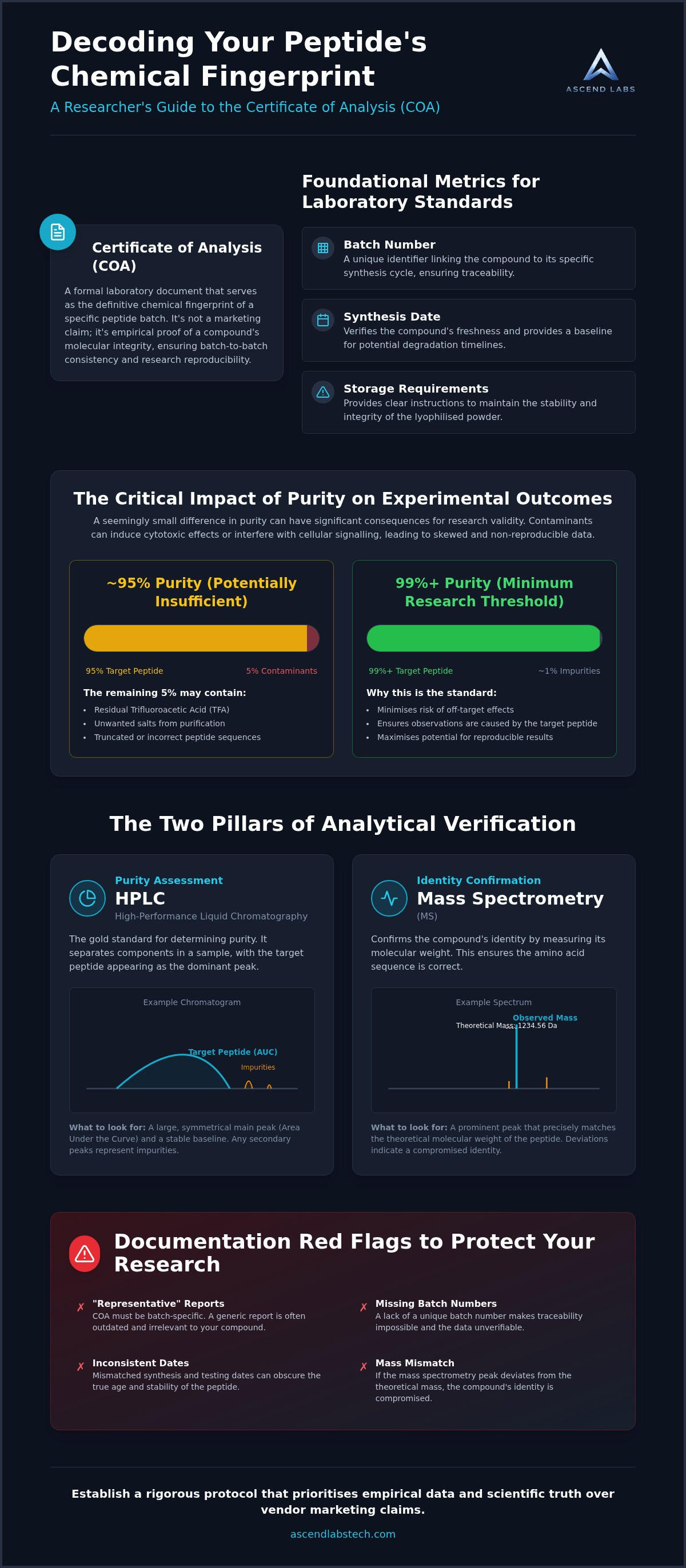
A Certificate of Analysis (COA) is a formalised laboratory document that confirms a specific batch of material meets its predetermined chemical specifications. Within the Australian research sector, this document serves as the primary safeguard against batch-to-batch variability, which can otherwise compromise months of laboratory work. For any scientific enquiry to yield credible results, the data must be underpinned by a verified chemical identity, high purity levels, and an accurate quantity of the research compound. Quite simply, the COA is the chemical fingerprint of a specific batch of synthesised peptide. Mastering how a certificate of analysis explained peptides provides a technical map for researchers ensures that the compound's molecular integrity is never assumed, but empirically proven.
Foundational Metrics for Australian Laboratory Standards
Experimental reproducibility is the cornerstone of professional research, yet it's often threatened by inadequate documentation. Establishing a baseline for your results requires moving beyond generic "representative" reports that some vendors circulate. These documents are often outdated and don't reflect the specific synthesis run of the compound you're using. To maintain rigorous standards, researchers must insist on batch-specific data that provides a transparent history of the compound's journey from synthesis to verification.
This level of detail is what facilitates a professional peptide purity testing protocol. When the documentation is batch-specific, you can cross-reference the following metrics:
- Batch Number: Unique identification that links the compound to its specific synthesis cycle.
- Synthesis Date: Verification of the compound's freshness and potential degradation timelines.
- Storage Requirements: Clear instructions to maintain the stability of the lyophilised powder.
The Relationship Between Purity and Experimental Outcomes
In the context of sensitive in-vitro studies, a purity grade of 99% is frequently the minimum threshold for viable research. While a 95% purity might seem sufficient, the remaining 5% often contains residual trifluoroacetic acid (TFA), salts, or truncated peptide sequences. These contaminants can induce cytotoxic effects or interfere with cellular signalling pathways, leading to skewed data that can't be replicated in subsequent trials. Identifying the molecular formula and theoretical weight serves as your first line of verification. If the mass spectrometry data shows a peak that deviates from the theoretical mass, the compound's identity is compromised. For high-end research compounds like Retatrutide or Tirzepatide, even minor impurities can alter metabolic responses, making the COA an indispensable tool for ensuring that your observations are caused solely by the target peptide.
Deciphering HPLC and Mass Spectrometry Data
Analytical verification of research compounds involves a dual-process approach to confirm both purity and identity. High-Performance Liquid Chromatography (HPLC) is the gold standard for determining the purity of a peptide compound, while Mass Spectrometry (MS) confirms the molecular weight to ensure the amino acid sequence is correct. In simple terms, HPLC measures the "what else" while MS measures the "what is." For the professional researcher, having a certificate of analysis explained peptides through these two lenses provides a technical map that moves beyond vendor trust and into the realm of empirical certainty. Analytical data must always be batch-specific to account for the inherent variations that occur during the complex synthesis process.
High-Performance Liquid Chromatography (HPLC) Breakdown
HPLC functions by separating the components of a sample based on their chemical interactions with a stationary phase. The primary metric for purity is the Area Under the Curve (AUC). In a clean sample, the primary peak should dominate the chromatogram, representing the target peptide. Any secondary peaks indicate the presence of impurities, such as truncated sequences or residual solvents. While a purity of 99% is the ideal, researchers must also account for counter-ions like trifluoroacetic acid (TFA). TFA is frequently used during the purification process to maintain peptide stability, yet its presence as a salt can influence the final weight of the compound. A transparent report will clearly distinguish between the target peptide peak and these necessary baseline components, ensuring that the researcher can accurately calculate molar concentrations for their assays.
Mass Spectrometry (MS) and Sequence Verification
While HPLC confirms that the sample is "clean," Mass Spectrometry confirms that the sample is actually the intended compound. This is achieved by comparing the observed mass-to-charge (m/z) ratio against the theoretical molecular weight of the peptide. Aligning with current US Pharmacopeia guidelines ensures that mass spectrometry protocols effectively identify biologics impurities and confirm structural integrity. This is particularly vital for verifying the identity of complex triple-agonists such as Retatrutide, where even a single amino acid substitution would render the research data invalid. By analysing fragmentation patterns, laboratories can confirm that the peptide's structural skeleton matches the required specifications exactly. Researchers who require compounds verified through these rigorous analytical standards can view our verified research compounds to ensure the stability of their laboratory data.
Interpreting Purity Grades and Chromatographic Peaks
Purity in peptide synthesis is expressed as a percentage of the target compound relative to all other UV-absorbing components detected during the analytical run. When a certificate of analysis explained peptides is presented with technical precision, the researcher should observe a single, sharp, and symmetrical peak on the HPLC chromatogram. A stable baseline indicates that the sample is free from significant degradation or contamination. Conversely, a "noisy" chromatogram with broad shoulders or tailing peaks suggests the presence of truncated sequences or isomers. These structural variations often arise from incomplete coupling during the solid-phase peptide synthesis process, potentially compromising the specificity of your laboratory results.
Tailing peaks are particularly problematic as they often mask closely related impurities that have similar retention times to the target peptide. If a peak isn't perfectly symmetrical, it indicates that the purification process hasn't achieved total separation. For the disciplined researcher, these visual cues are just as important as the final percentage figure. Scrutinising the shape of the primary peak allows you to verify that the synthesised compound is a homogenous substance rather than a mixture of closely related analogues.
Analysing the Chromatogram Baseline
The baseline of an HPLC report provides critical insights into the compound's stability and the precision of the laboratory's equipment. High levels of "noise" or a drifting baseline can mask minor impurities, leading to an overestimation of the final purity percentage. Researchers should pay close attention to the detection wavelength used by the laboratory. Most peptides are monitored at 214nm or 220nm, as these wavelengths correspond to the absorption of the peptide bond. Reports using non-standard wavelengths may inadvertently omit impurities that don't absorb at those specific points, resulting in a false sense of security regarding the compound's integrity.
Purity vs. Peptide Content: A Critical Distinction
A common point of confusion in analytical documentation is the distinction between peptide purity and peptide content. Purity refers to the ratio of the target peptide against other peptide-based impurities. However, it doesn't account for non-peptide substances such as residual water, acetate, or trifluoroacetate salts. Peptide content measures the actual weight of the peptide within the lyophilised powder. This distinction is vital in mitochondrial peptide research, where precise dosing is required to observe metabolic changes accurately.
For example, a vial with 99% purity might only have 80% peptide content, with the remainder being counter-ions. This aligns with the FDA guidance on Certificates of Analysis, which emphasises the necessity of understanding exactly what constitutes the final product mass. Recognising that the total mass includes these non-peptide elements is essential for calculating exact molar concentrations in your assays.
Identifying Red Flags and Verifying Third-Party Documentation
Identifying fraudulent or inaccurate documentation is a critical skill for the modern researcher. A certificate of analysis explained peptides acts as the final word on compound integrity, yet its validity depends entirely on its provenance. Inconsistent dates or missing batch numbers are immediate indicators of unreliable documentation. Beyond simple typographical errors, you should scrutinise the document for "copy-paste" artifacts. Mismatched headers, pixelated laboratory logos, or subtle font changes often suggest a report has been altered to reflect higher purity levels than were actually achieved during synthesis. If the documentation doesn't look professional, it's unlikely the compound inside the vial will meet your standards.
Verification must extend to the raw data. The observed molecular weight on the Mass Spectrometry (MS) report must align precisely with the theoretical weight of the compound. If the report displays a mass-to-charge ratio that deviates from the known amino acid sequence, it's a clear sign the compound's identity is compromised. These discrepancies are often the first indicator of a mismatched batch or a failed synthesis cycle that wasn't properly discarded by the manufacturer. Understanding a certificate of analysis explained peptides allows you to spot these discrepancies before they impact your laboratory budget.
The 60-Second COA Vetting Protocol
Efficiency in the laboratory is paramount, but speed shouldn't come at the cost of accuracy. Use this three-step protocol to verify every new batch before it enters your research programme:
- Step 1: Cross-reference the batch number on the documentation with the physical vial to ensure a direct chain of custody.
- Step 2: Confirm that the HPLC purity percentage matches the advertised grade and that the chromatogram peak is sharp and symmetrical.
- Step 3: Validate the MS peak against the known molecular weight of the peptide to confirm the chemical identity is correct.
The Importance of Independent Third-Party Testing
In-house testing by a supplier presents an inherent conflict of interest that can lead to biased results. Scientific truth is best served by independent, accredited laboratories that operate without commercial pressure to approve a batch. These facilities provide an objective layer of verification that is essential for maintaining the integrity of your data. When a supplier relies solely on their own internal reports, they're essentially asking you to trust their word over empirical data.
Transparency is the foundation of a reliable partnership with an Australian peptide supplier. You should always verify the credentials of the testing facility, ensuring they have the specialised equipment and expertise required for high-resolution peptide analysis. At Ascend Labs, we act as a disciplined curator of compounds, ensuring every batch meets the highest analytical standards. You can review our current batch verification reports to ensure your research is built on a foundation of empirical certainty.
Ascend Labs’ Protocol for Analytical Verification and Purity
Every batch of material we offer undergoes rigorous independent analysis to confirm its molecular identity and purity grade. We strictly avoid the use of "representative" reports, ensuring that the HPLC and MS data you receive is specific to the exact vial in your possession. This commitment to transparency allows Australian researchers to proceed with absolute confidence, knowing their compounds haven't been compromised by inconsistent manufacturing or poor handling. Our domestic presence is a critical component of this verification process. By maintaining a local supply chain, we ensure a secure and verifiable chain of custody that minimises the risk of compound degradation often associated with long-distance transit.
Our laboratory-grade standards are designed to instil a sense of security and trust. We don't shout to be heard; instead, we rely on the precision of our data to speak for itself. This "substance over style" approach ensures that the compounds we provide, from Growth Factor Peptides to Neuromodulator Peptides, are stable, homogenous, and ready for precise analytical application. We act as a reliable partner for serious enquiry, providing the technical weight necessary to support the integrity of your research programme.
Next Steps for Research Procurement
Securing high-purity compounds for your laboratory begins with a review of the primary analytical data. We encourage researchers to access our batch-specific COAs directly through our digital portal to verify current HPLC purity standards for active batches. If your project requires specific fragmentation patterns or detailed stability data, our technical team is available to provide specialised compound information and consultation. For those comparing global benchmarks, you may explore Per-Unit Product Sales via E-commerce from Bio Plus Peptides to see how international high-purity suppliers present their verification data. Reviewing our catalogue of HPLC-verified research peptides ensures that your procurement process aligns with the highest standards of scientific rigour. By choosing compounds that have been curated through our disciplined verification protocol, you safeguard the reproducibility and accuracy of your future results.
Advancing Research with Empirical Certainty
The integrity of laboratory research rests on the ability to verify the chemical fingerprint of every compound. As this guide to a certificate of analysis explained peptides has demonstrated, relying on surface-level purity claims is insufficient for rigorous scientific enquiry. True reproducibility requires a meticulous examination of HPLC chromatograms and mass spectrometry data to confirm both purity and identity. By identifying red flags such as mismatched batch numbers or inconsistent testing dates, you protect your research from the risks of experimental failure and baseline noise.
Ascend Labs serves as a disciplined curator for the Australian scientific community, providing compounds that meet a premium, clinical standard. Our commitment to scientific truth is backed by independent third-party HPLC/MS verification and full batch-specific transparency for all research compounds. As an Australian owned and operated supplier, we ensure a secure chain of custody that maintains compound stability and verification integrity. This focus on data over marketing ensures that your laboratory results are built on a foundation of absolute chemical certainty.
Explore the Ascend Labs catalogue of verified research peptides to secure the high-purity compounds your laboratory deserves. We look forward to supporting your next breakthrough with the precision and integrity your work demands.
Frequently Asked Questions
What is the difference between peptide purity and peptide content on a COA?
Peptide purity measures the ratio of the target sequence against related peptide impurities, such as truncated sequences or isomers. Conversely, peptide content accounts for the total weight of the peptide within the lyophilised powder relative to non-peptide components like water and counter-ion salts. For accurate molar calculations, researchers must recognise that a 99% purity grade might only reflect an 80% peptide content due to these essential stabilising elements.
How can I verify that a Certificate of Analysis is batch-specific?
Verification begins by cross-referencing the unique batch number printed on the document with the physical identifier on the vial. A batch-specific report will include a unique synthesis date and a high-resolution chromatogram that reflects that specific production cycle. Generic reports often lack these identifiers or display "representative" data that doesn't account for the subtle variations inherent in modern solid-phase peptide synthesis and purification.
Why is Mass Spectrometry essential for peptide sequence confirmation?
While HPLC confirms that a compound is clean, Mass Spectrometry is the only method that confirms the chemical identity of the compound. By measuring the mass-to-charge ratio, MS ensures the amino acid sequence aligns with the theoretical molecular weight. This is vital for complex research compounds where a single amino acid substitution would otherwise go undetected, potentially compromising the integrity and reproducibility of your laboratory results.
What does a purity level of 99% actually mean for my research?
A 99% purity grade indicates that 99% of the UV-absorbing material in the sample is the target peptide. In the context of a certificate of analysis explained peptides, this high threshold is often the minimum requirement for sensitive in-vitro studies to avoid cytotoxic interference. The remaining 1% typically consists of related peptide impurities that could otherwise skew cellular assays or lead to inconsistent observations across different research batches.
Are third-party COAs more reliable than manufacturer-issued reports?
Independent third-party verification provides an objective layer of scrutiny that removes the inherent conflict of interest found in manufacturer-issued reports. An accredited, external laboratory operates without the commercial pressure to approve a suboptimal batch, ensuring that the analytical data is rooted in scientific truth. This disciplined approach to verification is essential for Australian researchers who require absolute certainty in the chemical integrity of their metabolic or recovery compounds.
What are the most common red flags to look for on a peptide COA?
Immediate red flags include mismatched headers, pixelated laboratory logos, and inconsistent synthesis dates. A technically sound report should display a sharp, symmetrical HPLC peak with a stable baseline rather than a "noisy" chromatogram with broad shoulders. Missing batch numbers or theoretical weights that don't align with the observed mass are also critical indicators that the documentation may have been altered or represents a different synthesis run entirely.
How does HPLC determine the purity of a research compound?
High-Performance Liquid Chromatography separates the components of a sample based on their unique chemical interactions with a stationary phase. As the compound passes through the detector, it generates a peak on the chromatogram. Purity is determined by calculating the Area Under the Curve for the primary peak relative to the total area of all detected peaks. This method provides a quantitative assessment of how much target peptide is present compared to impurities.
Why do molecular weights sometimes vary slightly between MS reports?
Minor variances in molecular weight often stem from the presence of different isotopes or the specific calibration of the mass spectrometer used. Additionally, the presence of counter-ions like trifluoroacetate can influence the observed mass depending on whether the laboratory reports the free base or the salt form of the peptide. Provided the variance falls within the standard tolerance of the equipment, it usually doesn't indicate a failure in the compound's structural integrity.


