

A 99% purity claim on a certificate of analysis is often a superficial metric that masks underlying chemical inconsistencies. If you've ever questioned whether a supplier's chromatogram was selectively integrated to hide impurities, your scepticism is a vital scientific asset. You know that the validity of your metabolic or longevity research hinges on the absolute precision of your materials. It's difficult to distinguish between the target peptide and subtle synthesis by-products without a disciplined approach to data verification.
This guide provides the framework you need to master how to read peptide hplc report documents with clinical authority. You'll learn to interpret chromatograms beyond the summary table, identifying "noise" versus legitimate impurity peaks to ensure your compounds meet the highest Australian standards. We'll outline a rigorous verification protocol for all incoming research materials, from Tirzepatide to growth factor peptides, allowing you to establish a definitive chain of quality for your laboratory. By the end of this briefing, you'll possess the technical literacy to verify peptide purity percentages and safeguard your study results from contaminated materials.
Key Takeaways
- Understand the fundamental role of HPLC in separating target peptides from synthesis by-products to ensure chemical precision.
- Learn exactly how to read peptide hplc report data by identifying sharp, symmetrical main peaks and distinguishing them from baseline noise.
- Recognise secondary peaks that indicate oxidation or truncated sequences, preventing the use of compromised compounds in your research.
- Establish a verification protocol to match batch numbers and analysis dates, ensuring your laboratory materials are current and valid.
- Discover why domestic chain-of-custody is critical for maintaining the integrity of metabolic and growth factor peptides.
The Role of HPLC in Peptide Verification and Quality Control
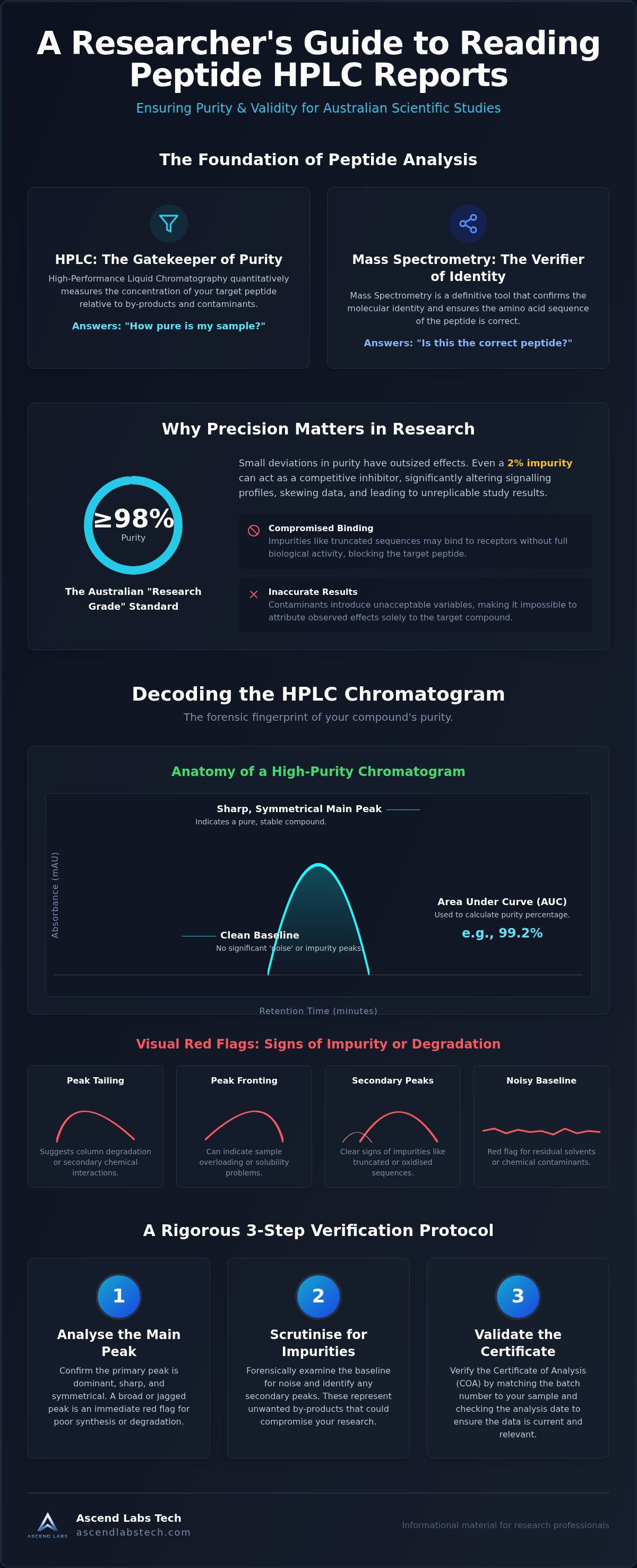
High-Performance Liquid Chromatography (HPLC) represents the gold standard for purity assessment in Australian biotechnology laboratories. It's a sophisticated separation technique that allows for the quantitative analysis of a peptide sample. While Mass Spectrometry serves as the definitive tool for molecular identity, HPLC is the gatekeeper of purity. Understanding the distinction between these two metrics is vital for any disciplined researcher. Identity confirms the sequence is correct; purity determines the concentration of that specific sequence relative to synthesis by-products and contaminants.
Small deviations in purity can have outsized effects on experimental outcomes. In the context of metabolic research, even a 2% impurity can significantly alter the signalling profile of compounds like retatrutide. These impurities often consist of truncated sequences or deletion peptides that may still bind to receptors but lack full biological activity. This can effectively turn a contaminant into a competitive inhibitor, leading to skewed data and unreplicable study results.
The Mechanism of Reverse-Phase HPLC
Reverse-phase HPLC (RP-HPLC) is the preferred analytical method for synthetic research peptides due to its high resolution. It employs a hydrophobic stationary phase, typically a C18 column, to interact with the peptide molecules. A mobile phase, usually a gradient of acetonitrile and water, facilitates the separation. As the organic solvent concentration increases, the peptide's affinity for the column changes, causing it to elute at a specific "Retention Time." This controlled separation is the foundation of how to read peptide hplc report data, as it physically isolates the target compound from its impurities based on molecular affinity.
Purity Requirements for Modern Research
In 2026, the baseline for "research grade" peptides in Australia is ≥98% purity. Anything less introduces unacceptable variables into in-vitro and in-vivo studies. Establishing a disciplined peptide purity testing protocol involves more than just checking a percentage on a summary sheet. It requires a forensic look at the chromatogram to ensure the baseline is clean and the main peak is sharp. Learning how to read peptide hplc report graphs allows researchers to verify that the purity matches the high-end standards required for metabolic and longevity research, ensuring that the biological activity observed is purely a result of the target compound.
Deconstructing the HPLC Chromatogram: A Step-by-Step Analysis
A chromatogram is more than a simple graph; it's a forensic fingerprint of your compound's purity. Understanding how to read peptide hplc report data begins with a clear grasp of the axes. The X-axis represents Retention Time, while the Y-axis measures Absorbance in milli-Absorbance Units (mAU). Retention Time is the specific duration a compound takes to pass through the column under standardised conditions. This value is unique to the molecular structure of the peptide and the specific solvent gradient used during the run.
The most prominent feature of the report should be the main peak. For a high-quality research compound, this peak must be sharp, dominant, and symmetrical. A broad or jagged peak often suggests poor synthesis or significant degradation. Analytical software calculates purity using the Area Under the Curve (AUC) method. It integrates the total area of every detected peak and determines what percentage of that total belongs to the target peptide. If the main peak accounts for 99.2% of the total integrated area, the peptide is reported as 99.2% pure.
Analysing Peak Morphology
Peak morphology offers critical clues about the sample's integrity. Peak "tailing," where the back of the peak leans or stretches, often indicates column degradation or secondary interactions. Conversely, "fronting" can suggest sample overloading or solubility issues. A clean baseline is essential for accurate reporting. Excessive "noise" or small, erratic peaks at the bottom of the graph are red flags for residual solvents or chemical contaminants. Co-elution is a more technical risk where two distinct compounds exit the column simultaneously, appearing as a single, slightly distorted peak that can artificially inflate purity readings.
Retention Time Consistency
Consistency across different batches is a hallmark of disciplined manufacturing and quality control. When you review reports for tirzepatide research compounds, the retention time should align closely with established laboratory standards. Minor shifts of a few seconds are common due to slight temperature or pressure fluctuations, but significant deviations require investigation. Comparing retention times alongside Mass Spectrometry data allows you to confirm identity with absolute certainty. For researchers who require uncompromising data, sourcing from a transparent Australian supplier ensures every chromatogram is provided in full for your internal audit and verification protocols.
By mastering how to read peptide hplc report visuals, you move beyond trusting a single percentage. You gain the ability to spot subtle anomalies that could otherwise compromise the validity of your metabolic or longevity research.
Beyond the Main Peak: Identifying Impurities and Salts
While the primary peak defines the target compound, the secondary peaks reveal the synthesis history. Identifying these peaks is a critical part of how to read peptide hplc report documentation. Synthesis by-products, such as truncated or deletion sequences, often appear as small "shoulders" or adjacent peaks. These occur when an amino acid fails to couple during a specific cycle. Oxidation products are also common, particularly in peptides containing Methionine or Cysteine. These residues are highly susceptible to oxygen exposure, resulting in secondary peaks that can degrade the biological activity of the compound. If these peaks exceed 1% of the total area, the integrity of the research material is compromised.
One must understand that HPLC has specific blind spots. It typically detects organic molecules with chromophores that absorb UV light. Salts, residual solvents, and water do not absorb UV light at the standard 214nm or 220nm wavelengths used in peptide analysis. Consequently, these components are "invisible" on the chromatogram. Differentiating between a related impurity and baseline electronic noise is essential. A legitimate impurity peak will have a clear start, apex, and return to the baseline, whereas electronic noise appears as erratic, non-reproducible fluctuations that lack a defined peak structure.
The Role of Counter-Ions (TFA vs Acetate)
Trifluoroacetic acid (TFA) is the standard ion-pairing agent used in solid-phase peptide synthesis. While it ensures high resolution during HPLC, residual TFA is often present as a counter-ion in the final lyophilised product. In many Australian research settings, particularly those involving cell culture, residual TFA can compromise cell viability due to its acidity. Researchers focusing on sensitive mitochondrial peptide research should consider requesting Acetate or HCl salt versions to avoid these cytotoxic effects. This distinction isn't always visible on a standard HPLC report but is vital for experimental success.
Quantifying Total Purity vs Peptide Content
A common misconception is that a 99% HPLC purity report indicates that 99% of the vial's weight is the peptide. This is incorrect. HPLC measures relative organic purity, not absolute weight. The "Net Peptide Content" (NPC) accounts for the moisture and counter-ions that inevitably remain after lyophilisation. Typically, the NPC of a research peptide ranges from 70% to 85%. When you learn how to read peptide hplc report data alongside a Net Peptide Content analysis, you can accurately adjust your research dosages. This ensures the actual concentration in your study is precise and reproducible, rather than being skewed by the weight of invisible salts and water.
Validating an Australian Certificate of Analysis (COA)
The Certificate of Analysis (COA) is the definitive link between a supplier's quality control laboratory and your research bench. Validating this document is as critical as the analysis itself. You must first verify that the batch number on the report matches the specific vial in your laboratory. Discrepancies here render the data irrelevant to your current study. You should also check the analysis date; reports older than 6 to 12 months often indicate stale stock that may have undergone degradation through improper storage or multiple freeze-thaw cycles. You must cross-reference the COA batch number with the supplier’s online verification database where available.
A legitimate COA must carry a signature of authority. Look for the certifying chemist's credentials and the official laboratory stamp. In a professional Australian laboratory setting, an anonymous or unsigned report is a significant breach of protocol. Understanding how to read peptide hplc report documentation requires an eye for these administrative details as much as the chemical data. The presence of a verifiable batch record ensures that the compound you're using is the exact material that passed through the HPLC column.
Spotting Generic or Fraudulent Reports
Forgery in the research chemical industry often leaves digital footprints. A major red flag is a chromatogram with a perfectly straight baseline and zero electronic noise. In a real-world HPLC run, the baseline always exhibits minor fluctuations. A perfectly flat line suggests the graph has been digitally reconstructed or "cleaned" to hide impurities. You should also be wary of "template" COAs where the layout and data remain identical across different products, with only the peptide name changed. Ascend Labs prioritises batch-specific, high-resolution HPLC data for every compound, ensuring the report you receive is a unique record of that specific synthesis run.
Third-Party Verification in Australia
Independent laboratory testing adds a layer of security for high-stakes insulin sensitising peptide research. Interpreting "blind" test results from third-party analytical services requires you to match retention times and peak morphology against the supplier's original COA. Domestic Australian suppliers offer a higher level of accountability for data accuracy compared to international vendors. If you require absolute certainty for your longitudinal studies, you can source verified research compounds that have undergone rigorous domestic auditing. Mastering how to read peptide hplc report documents from both primary and third-party sources allows you to establish an unassailable data trail for your research.
Sourcing HPLC-Verified Peptides for Australian Studies
Selecting a supplier that prioritises analytical transparency is the final step in securing your study's integrity. For Australian researchers, this means moving beyond a simple purchase and establishing a partnership with a provider that treats data as an essential component of the compound. Integrating COA data into your laboratory’s standard operating procedures (SOPs) ensures that every vial is accounted for and verified before use. This disciplined approach eliminates variables that could otherwise compromise months of metabolic or longevity research. When you've mastered how to read peptide hplc report data, you can confidently reject any batch that does not align with your internal quality thresholds.
Domestic supply offers significant advantages for maintaining the stability of sensitive research materials. International shipping often exposes peptides to extreme temperature fluctuations and customs delays that can cause molecular degradation. By choosing an Australian-owned and operated supplier, you ensure that your materials are delivered via secure, discreet domestic shipping. This maintains a consistent thermal environment and a clear chain of custody from our facility to your bench. This proximity also allows for a higher level of accountability and faster resolution for technical enquiries regarding batch consistency.
The Ascend Labs Standard of Purity
We maintain a rigorous chain of custody for all growth factor peptides in Australia. Our commitment involves providing comprehensive HPLC and Mass Spectrometry reports for every single batch produced. When you acquire advanced compounds like MOTS-C, you receive verified purity data that has been analysed for both identity and concentration. We understand that knowing how to read peptide hplc report documentation is only half the battle; the other half is having access to high-resolution, untampered data from a source you trust. Our technical team provides professional support for researchers who need assistance interpreting complex analytical results or verifying specific peak morphology.
Streamlining Your Research Procurement
Consistency is the hallmark of professional science. Accessing our full research peptide catalogue with integrated quality documentation allows you to cross-reference batch results over time. This ensures that your longitudinal data isn't skewed by subtle synthesis variations or "drift" in purity standards. Our procurement process is designed to be as methodical as your research, providing all necessary verification documents at the point of acquisition. If you require a deeper dive into a specific batch analysis or a detailed verification of a chromatogram, our technical team is available for consultation. This level of transparency is designed to meet the highest Australian laboratory standards, providing the certainty required for serious scientific inquiry.
Advancing Research Integrity Through Analytical Precision
The validity of your metabolic and longevity studies depends entirely on the chemical fidelity of your materials. By mastering how to read peptide hplc report data, you transform a simple certificate of analysis into a forensic map of your compound’s synthesis history. You've learned to identify peak symmetry, baseline noise, and the critical role of counter-ions. This technical literacy ensures your research protocols are built on a foundation of absolute precision rather than supplier assumptions.
Maintaining this standard requires a disciplined approach to procurement. Choosing a domestic partner that prioritises transparency allows you to safeguard your results from the risks of customs-related degradation and unverified data. Ascend Labs remains committed to this philosophy of quality, providing HPLC and Mass Spectrometry verified batches with secure domestic delivery for all specialised research compounds.
Explore the Ascend Labs Catalogue for HPLC-Verified Research Peptides
We look forward to supporting your next breakthrough with the analytical rigour your research deserves.
Frequently Asked Questions
What is the difference between HPLC and Mass Spectrometry in peptide testing?
HPLC measures purity by separating components based on molecular affinity, while Mass Spectrometry identifies the molecular mass to confirm identity. You need both for full verification. HPLC tells you the percentage of the target peptide relative to other organic molecules in the sample. Mass Spectrometry ensures that the main peak you see on the chromatogram is actually the compound you intended to synthesise, rather than a high-purity error.
Can a peptide be 100% pure according to an HPLC report?
No, a 100% purity reading is practically impossible in modern biotechnology. Synthesis always results in trace by-products, and baseline electronic noise is present in every genuine run. If you are learning how to read peptide hplc report data and encounter a 100% claim, it often indicates that the analytical software was set to ignore smaller peaks. A credible report for high-grade research peptides will typically show a value between 98.0% and 99.5%.
Why does my HPLC report show multiple small peaks if the purity is 98%?
Those secondary peaks account for the 2% of impurities mentioned in the summary. They represent truncated sequences, deletion peptides, or oxidation products formed during the synthesis process. While the main peak is dominant, these smaller peaks are integrated by the software to calculate the total area under the curve. Seeing these peaks is actually a sign of a transparent, high-resolution report that hasn't been digitally altered to hide synthesis imperfections.
How do I verify if an HPLC report from an Australian supplier is authentic?
Start by matching the batch number on the vial to the report. Authentic documents from a disciplined Australian supplier include a certifying chemist's signature and a specific analysis date. You should also look for a natural baseline with minor electronic fluctuations. If the baseline is a perfectly straight line with no noise, it's likely a digital forgery rather than a raw data export from a legitimate HPLC system.
Does the retention time change if the laboratory uses a different solvent?
Yes, retention time is not an absolute constant. It shifts significantly if the mobile phase composition, solvent gradient, or flow rate changes. For example, switching from an acetonitrile gradient to a methanol-based mobile phase will alter the molecular interactions within the C18 column. This is why researchers must consider the specific chromatographic conditions listed on the report when comparing different batches or validating results against external scientific literature.
What is a "blank" run in an HPLC report and why is it important?
A blank run is a chromatographic analysis performed using only the mobile phase without any peptide sample. It’s essential for identifying "ghost peaks" or background noise caused by contaminated solvents or column residue. By comparing the sample run to the blank run, you ensure that every peak in your how to read peptide hplc report reflects the actual sample composition rather than equipment interference or systemic impurities that might skew your research data.
How much TFA is typically found in research-grade peptides?
Trifluoroacetic acid (TFA) typically constitutes 10% to 30% of the total weight of a lyophilised research peptide. While HPLC reports measure organic purity, they don't account for this salt content. TFA is used as an ion-pairing agent during the purification process and remains as a counter-ion. Researchers must account for this weight when calculating precise dosages, as the actual peptide concentration is always lower than the total powder mass in the vial.
Is an HPLC report necessary for every single batch of peptides I purchase?
Yes, batch-specific testing is mandatory for credible research. Peptide synthesis is a complex chemical process where small variations in coupling efficiency or reagent quality can alter the final purity. A report from a previous batch cannot guarantee the integrity of a new one. Reliable Australian suppliers provide unique HPLC and Mass Spectrometry data for every batch to maintain a rigorous chain of custody and ensure experimental reproducibility in your laboratory.


