

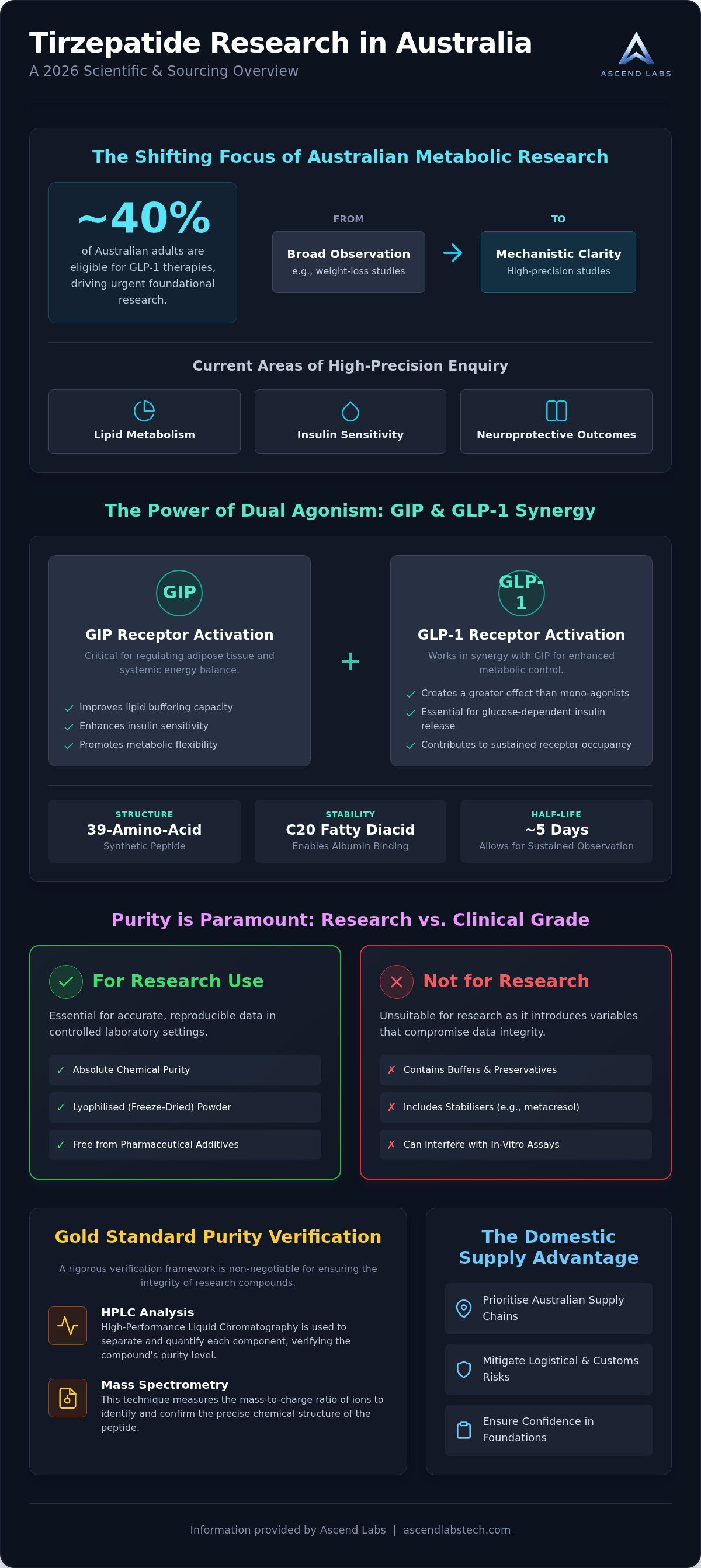
Nearly 40 per cent of Australian adults are now eligible for GLP-1 receptor agonist medications, yet the most significant advancements are happening behind laboratory doors rather than on pharmacy shelves. As we move through 2026, the focus of tirzepatide research australia has transitioned from broad clinical observation to high-precision mechanistic studies that demand absolute chemical purity. You're likely aware that the surge in public interest has complicated the procurement process, often blurring the lines between clinical-grade pharmaceuticals and the high-purity compounds required for rigorous scientific inquiry.
We'll provide an authoritative analysis of the current Australian research landscape, including the specific dual-agonist mechanisms of GIP and GLP-1. You'll gain a reliable framework for verifying peptide purity through HPLC and Mass Spectrometry data, ensuring your results remain untainted by sub-standard materials. This briefing concludes by identifying the benchmarks of a reputable domestic supplier, allowing you to focus on data collection with total confidence in your chemical foundations.
Key Takeaways
- Understand the synergistic effects of dual GIP and GLP-1 receptor activation within synthetic peptide research models.
- Identify the 2026 trends currently shaping tirzepatide research australia, specifically the transition toward high-precision mechanistic studies.
- Evaluate the functional distinctions between dual-agonist and triple-agonist compounds, such as Retatrutide, for metabolic enquiry protocols.
- Establish a rigorous verification framework using HPLC and Mass Spectrometry data to ensure the absolute purity of laboratory compounds.
- Mitigate logistical risks and customs complications by prioritising domestic Australian supply chains for metabolic research materials.
The Landscape of Tirzepatide Research in Australia for 2026
In 2026, the Australian scientific community has moved past the initial novelty of incretin mimetics. Tirzepatide represents a sophisticated 39-amino-acid synthetic peptide that targets both glucose-dependent insulinotropic polypeptide (GIP) and glucagon-like peptide-1 (GLP-1) receptors. This dual-agonism creates a synergistic effect that mono-agonists cannot replicate. The current climate for tirzepatide research australia is defined by a pursuit of mechanistic clarity rather than simple weight-loss observation. Scientists are now investigating how these pathways influence lipid metabolism, insulin sensitivity, and potential neuroprotective outcomes within the central nervous system. With almost 40 per cent of the adult population meeting eligibility criteria for clinical GLP-1 therapies, the demand for foundational research has never been more urgent.
Evolution of Metabolic Research in Australia
Precision, mechanism, and synergy. Australian research institutions have pivoted significantly toward multi-agonist studies over the last 24 months. While earlier work focused on single-pathway GLP-1 activation, the 2026 landscape for tirzepatide research australia prioritises the complex interplay between GIP and GLP-1 signalling. This shift allows for a deeper understanding of how incretin mimetics alter metabolic setpoints. Researchers must operate within a strict regulatory framework, ensuring that all laboratory-grade compounds adhere to the National Statement on Ethical Conduct in Human Research (2025). The TGA's Black Triangle Scheme for clinical tirzepatide highlights the need for ongoing monitoring, further incentivising independent laboratory studies to map long-term physiological interactions.
Research-Grade vs. Clinical Grade: A Critical Distinction
Integrity, verification, and purity. A fundamental requirement for accurate data is the use of high-purity, research-grade chemicals. Clinical pharmaceutical products are formulated with specific buffers, preservatives, and stabilisers like metacresol or sodium phosphate. These additives are essential for patient safety but are detrimental to controlled laboratory environments. They can introduce unwanted variables into in-vitro assays or cellular signalling studies. Ascend Labs addresses this need by providing strictly research-only materials. Our compounds are delivered as additive-free, lyophilised powders, ensuring that researchers can control every variable within their experimental protocols without interference from pharmaceutical excipients. It's this commitment to purity that remains essential for maintaining the integrity of Australian biotechnology enquiries.
Dual Agonism: Investigating the GIP and GLP-1 Mechanism
The biochemical profile of tirzepatide represents a departure from traditional mono-agonist research models. While earlier metabolic studies focused exclusively on the glucagon-like peptide-1 (GLP-1) pathway, tirzepatide research australia in 2026 prioritises the dual activation of both GLP-1 and glucose-dependent insulinotropic polypeptide (GIP) receptors. This 39-amino acid synthetic peptide is engineered to mimic the native GIP sequence while incorporating structural modifications that facilitate GLP-1 receptor binding. The integration of a C20 fatty diacid moiety is particularly significant, as it enables albumin binding and extends the compound's half-life to approximately five days. This stability allows for sustained receptor occupancy, providing researchers with a reliable window for observing metabolic fluctuations without the rapid degradation typical of endogenous incretins.
GIP Receptor Pathways in Metabolic Studies
GIP receptor activation is no longer viewed as a secondary metabolic function. In contemporary research, GIP is recognised for its critical role in adipose tissue regulation and systemic energy balance. Studies often examine how GIP signalling improves lipid buffering capacity and insulin sensitivity within white adipose tissue. This nutrient-stimulated response is a cornerstone of current enquiry, as it suggests a mechanism for metabolic flexibility that GLP-1 alone cannot achieve. For a deeper dive into these molecular interactions, researchers may reference our Tirzepatide Research Compound: A Technical Overview of Dual Agonism in 2026. Understanding these pathways is essential for standardising protocols in non-clinical models.
GLP-1 Synergism and Research Outcomes
The GLP-1 component of the dual-agonist mechanism remains a vital benchmark for appetite suppression and gastric emptying studies. By stimulating the GLP-1 receptor, the compound influences central satiety signals and slows the transit of nutrients, which are essential variables in metabolic rate calculations. The TGA AusPAR for Mounjaro provides extensive data on how these receptors respond in clinical settings, offering a valuable reference point for laboratory-grade comparative studies. Tirzepatide functions as an imbalanced dual agonist, exhibiting a potency at the GIP receptor that is significantly higher than its activity at the GLP-1 receptor. This specific ratio is designed to maximise metabolic synergy while potentially mitigating the gastrointestinal sensitivities often associated with high-dose GLP-1 mono-agonism. If your current laboratory protocol requires high-purity materials to test these synergistic effects, you might consider the metabolic research compounds available for domestic Australian dispatch.
Comparative Analysis: Tirzepatide vs. Retatrutide in Metabolic Studies
Researchers investigating metabolic pathways in 2026 must choose between established dual-agonist models and the emerging triple-agonist frontier. While tirzepatide focuses on the synergistic activation of GIP and GLP-1 receptors, retatrutide introduces a third pathway: glucagon receptor agonism. This additional mechanism increases energy expenditure and targets hepatic lipid metabolism more directly. However, the complexity of a triple-agonist model requires a more sophisticated experimental design to isolate the specific contributions of each receptor. For many practitioners of tirzepatide research australia, the dual-agonist model remains the preferred framework for studies where the primary objective is the interplay between insulinotropic effects and satiety signalling.
The TGA information on GLP-1 and dual GIP/GLP-1 receptor agonists highlights the regulatory scrutiny applied to these compounds, reinforcing the need for precise laboratory standards. Retatrutide’s triple-agonist profile offers higher potency in certain obesity-related models, but the glucagon component can introduce variables in glucose homeostasis that might complicate certain metabolic enquiries. Efficiency in the lab is often determined by receptor affinity. Tirzepatide exhibits a potent GIP-forward bias, whereas retatrutide seeks a balanced tri-affinity that prioritises thermogenesis.
Dual vs. Triple Agonist Research Frameworks
Tirzepatide maintains its position as the gold standard for GIP/GLP-1 focused studies because its receptor affinity is well-documented and predictable. Adding glucagon agonism, as seen in Retatrutide: The Frontier of Triple Agonist Research in Australia, creates a tri-agonist effect that significantly alters the metabolic baseline. This complexity is beneficial for studies on non-alcoholic fatty liver disease (NAFLD) or extreme metabolic resistance, but it may prove excessive for fundamental incretin research. Practitioners must decide if the third pathway adds value or merely introduces noise to their data set.
Selecting the Right Compound for Your Laboratory
Choosing between these peptides depends on the specific duration and objective of the study. Tirzepatide is often selected for its established profile in research models and its clear GIP-dominant activation ratio. Conversely, retatrutide is utilised when maximal weight reduction or thermogenesis is the primary variable. Regardless of the choice, the integrity of the data hinges on compound verification. Mass spectrometry results for both compounds must confirm that the molecular mass aligns with the theoretical sequence, ensuring that no truncated or misfolded peptides compromise the study outcomes. High-resolution mass spectrometry remains the only definitive way to verify that a batch of tirzepatide or retatrutide meets the exacting standards required for tirzepatide research australia in 2026.
Sourcing Protocols for Australian Research Institutions
Sourcing high-purity metabolic peptides requires a meticulous approach to logistics that prioritises chemical stability. For Australian institutions, the primary barrier to data integrity is often the volatility of international shipping and the unpredictability of customs clearance. Importing research chemicals from overseas frequently leads to prolonged transit times; these delays expose temperature-sensitive peptides to thermal fluctuations that can compromise molecular stability before they even reach the laboratory bench. Establishing rigorous sourcing protocols is the first step for any institution conducting tirzepatide research australia in 2026.
Reliability is paramount. Engaging in tirzepatide research australia requires a supply chain that bypasses the risks of seizure or degradation associated with cross-border transport. Domestic sourcing ensures that materials remain within a controlled environment, adhering to Australian transport standards. This proximity allows for rapid dispatch and receipt, which is essential for maintaining the integrity of lyophilised compounds. When the distance between the supplier and the laboratory is minimised, the risk of environmental interference is significantly reduced.
The Critical Role of COA and HPLC Verification
A legitimate Certificate of Analysis (COA) is not a mere formality; it is a definitive proof of chemical identity and purity. High-Performance Liquid Chromatography (HPLC) results should demonstrate a purity level of at least 98 per cent for serious scientific inquiry. Low-quality supplies often contain residual solvents, TFA (trifluoroacetic acid), or heavy metals that can skew experimental data. HPLC peaks confirm compound identity by measuring the precise retention time of the peptide against a known standard. Identifying these common contaminants or filler agents is vital for ensuring that research outcomes are not the result of chemical impurities.
Ensuring Domestic Supply Chain Integrity
Australian-owned and operated research suppliers provide a level of accountability that international vendors cannot match. By utilising specialised domestic shipping, researchers can significantly reduce the risk of transit-related degradation. This logistical precision is as critical as the chemical purity itself. While this article focuses on metabolic compounds, similar standards apply across other fields, such as those discussed in our Peptides for Connective Tissue: 2026 Technical Roundup. To ensure your laboratory meets these benchmarks, you can source verified metabolic research compounds through our secure domestic portal.
Ascend Labs: Meticulous Standards for Australian Science
Ascend Labs operates as a principled institution rather than a mere vendor, acting as a disciplined curator for the scientific community. We understand that the validity of tirzepatide research australia depends entirely on the chemical foundations provided to the laboratory. In an environment where retail-focused suppliers often prioritises marketing over molecular integrity, our operation remains committed to a "substance over style" philosophy. This approach ensures that advanced practitioners receive compounds that meet the exacting requirements of 2026 metabolic enquiry protocols without the interference of unnecessary additives or pharmaceutical excipients.
Our role as an authoritative scientific gatekeeper is defined by a refusal to compromise on verification. Every batch of tirzepatide research australia institutions receive from us has undergone a rigorous internal audit. We provide the transparency required for serious inquiry, ensuring that the data generated in your lab is a true reflection of the peptide's mechanism rather than a result of compound degradation or impurity. Secure, discreet, and efficient domestic logistics further support this mission, delivering materials within a controlled Australian supply chain that maintains peptide stability from our facility to your bench.
The Ascend Labs Quality Assurance Framework
Accuracy. Integrity. Verification. Our quality assurance framework is built upon meticulous batch testing that targets a purity threshold of >99 per cent. While industry standards often settle for lower benchmarks, we utilise both High-Performance Liquid Chromatography (HPLC) and Mass Spectrometry to confirm both the purity and the precise molecular mass of every peptide. This dual-verification process ensures that the 39-amino acid sequence of tirzepatide is intact and correctly folded. By providing researchers with comprehensive data transparency, we empower labs to maintain the highest levels of experimental rigor and reproducibility.
Partnering with Ascend Labs for Future Studies
Reliability. Discretion. Innovation. Choosing a domestic partner in biotechnology is a strategic decision that impacts the long-term viability of your research objectives. Our catalogue is curated to support diverse metabolic studies, offering high-purity compounds that allow for precise mapping of GIP and GLP-1 pathways. We operate with high professional ethics and operational discretion, ensuring that your institution's requirements are met with total reliability. As the Australian research landscape continues to evolve toward more complex multi-agonist models, Ascend Labs remains your principled partner in scientific discovery. We invite you to explore our technical standards and verify the availability of our metabolic research compounds for your next study.
Advancing Metabolic Enquiry with Precision Standards
The transition toward high-precision mechanistic studies in 2026 requires a rigorous approach to compound selection. We've analysed the synergistic potential of GIP and GLP-1 pathways and the critical need for additive-free, research-grade materials. Success in tirzepatide research australia depends on removing the variables introduced by clinical formulations and international logistical delays. Data must be absolute. It's the only way to ensure reproducibility in an increasingly complex biotechnological landscape.
Maintaining scientific integrity requires a partner that prioritises verification over marketing. Ascend Labs provides specialised research-grade standards through HPLC verified batches and secure domestic Australian logistics. By eliminating the risks of degradation and contamination, your institution can focus entirely on uncovering the next frontier of metabolic science. Secure high-purity Tirzepatide for your Australian research project at Ascend Labs. We look forward to supporting your scientific contributions with the accuracy and discretion your work demands.
Frequently Asked Questions
Is tirzepatide available for research purposes in Australia?
High-purity tirzepatide is available for laboratory use through specialised domestic suppliers. These compounds are intended strictly for in-vitro and non-human studies to observe metabolic receptor interactions. Researchers must ensure they source from providers that specialise in tirzepatide research australia rather than retail-focused outlets to maintain scientific integrity.
What is the difference between research-grade tirzepatide and Mounjaro?
Clinical Mounjaro is a finished pharmaceutical product containing preservatives such as metacresol and various buffering agents for human safety. Research-grade tirzepatide is provided as a pure, lyophilised powder without these excipients. This level of purity is essential for preventing unwanted variables in cellular assays or metabolic signalling studies where additives could interfere with data.
How do I verify the purity of tirzepatide for my laboratory study?
Verification requires batch-specific High-Performance Liquid Chromatography (HPLC) and Mass Spectrometry. HPLC confirms the purity percentage by identifying the presence of any secondary peaks. Mass Spectrometry verifies the molecular mass against the theoretical sequence. These tests ensure the compound is free from truncated peptides or chemical contaminants that might skew results.
What are the advantages of sourcing tirzepatide from a domestic Australian supplier?
Sourcing tirzepatide research australia domestically eliminates the risks of thermal degradation and customs interference common with international imports. Specialised domestic shipping maintains a controlled environment, ensuring the peptide's molecular integrity remains intact. This proximity allows for rapid receipt and immediate laboratory application, which is vital for time-sensitive metabolic enquiries.
Can tirzepatide be used in combination with other peptides in a research setting?
Tirzepatide is frequently studied in combination with other metabolic research compounds to observe synergistic effects on energy homeostasis. Common research protocols explore its interaction with triple-agonists like Retatrutide or mitochondrial-derived peptides. Such studies help map the complex interplay of various receptor pathways and their influence on systemic lipid metabolism.
What storage conditions are required for tirzepatide research compounds?
For long-term stability, lyophilised peptides must be stored at -20°C in a moisture-free environment to prevent hydrolysis. After reconstitution, the solution should be kept between 2°C and 8°C and used within a strictly defined experimental window. Exposure to light and room temperature should be minimised to prevent peptide cleavage and maintain compound potency.
Does Ascend Labs provide a Certificate of Analysis (COA) with tirzepatide?
Every batch of tirzepatide supplied by Ascend Labs is accompanied by a comprehensive Certificate of Analysis. This document provides researchers with verified HPLC and Mass Spectrometry data for the specific batch in use. We maintain a >99% purity threshold to ensure the highest standards of laboratory reproducibility and data accuracy.
What is the typical lead time for domestic shipping of research peptides in Australia?
Domestic lead times for research peptides usually range between 1 and 3 business days depending on the laboratory's location. This rapid turnaround is a significant advantage of Australian-owned suppliers like Ascend Labs. It ensures that the time between procurement and experimental commencement is as short as possible, preserving the stability of the compound.


