

A single drop of the wrong solvent can instantly render a high-purity peptide sequence useless, turning a sophisticated research compound into an unrecoverable precipitate. You've likely felt the frustration of watching a meticulously synthesised vial cloud over or fail to dissolve, knowing that experimental accuracy is slipping away with every failed attempt. In the high-stakes environment of biotechnology, these technical hurdles don't just waste time; they compromise the very data you rely on for breakthrough insights.
This research peptide solubility guide provides the clinical framework needed to navigate these chemical complexities with absolute precision. We'll help you master the precise protocols required to solubilise complex sequences while maintaining maximum stability and protecting the integrity of your high-purity compounds. Our analysis moves from foundational sequence evaluation to advanced solvent selection and systematic escalation techniques. By the end of this briefing, you'll have a repeatable strategy to ensure clear, homogeneous solutions and reliable experimental reproducibility across your entire catalogue.
Key Takeaways
- Understand how the ratio of charged to uncharged residues dictates aqueous solubility to avoid premature precipitation during reconstitution.
- Implement a systematic protocol that includes thermal equilibration and centrifugation to protect the integrity of high-purity research compounds.
- Utilise this research peptide solubility guide to master the "Minimal Organic" technique for hydrophobic sequences, ensuring a clear and homogeneous solution.
- Identify the specific solvent requirements for acidic and basic peptides to maintain maximum stability and ensure experimental reproducibility.
- Establish precise storage parameters to prevent peptide degradation, comparing the efficacy of sterile water against buffered solutions like PBS or Tris.
The Critical Role of Peptide Solubilisation in Research
Peptide reconstitution is the precise biochemical process of returning a lyophilised powder to a stable liquid state. It is a critical gateway in laboratory research, representing the transition from a preserved, inert compound to an active experimental reagent. This research peptide solubility guide emphasises that reconstitution is not a generic administrative task. It is a sequence-specific diagnostic procedure that requires meticulous attention to chemical properties. High-purity compounds, such as those verified by HPLC and Mass Spectrometry, require handling that matches their technical calibre to ensure that the resulting solution is both homogeneous and stable.
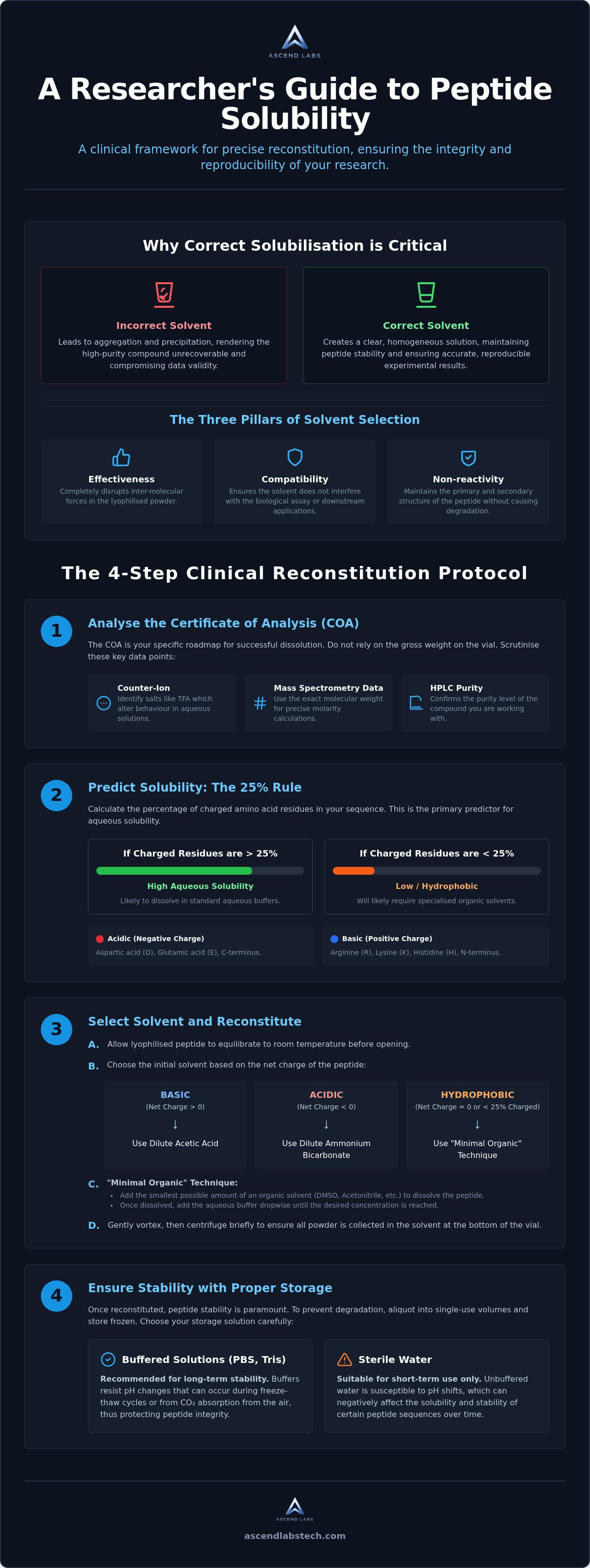
Adopting a "one-size-fits-all" approach to solubilisation often leads to catastrophic experimental variance. When a researcher assumes that sterile water is universally applicable, they risk peptide aggregation, where the compound fails to dissolve properly or precipitates out of the solution. Successful solvent selection rests upon three fundamental pillars:
- Effectiveness: The ability of the solvent to completely disrupt inter-molecular forces within the lyophilised cake.
- Compatibility: Ensuring the solvent does not interfere with the biological assay or downstream applications.
- Non-reactivity: Maintaining the primary and secondary structure of the peptide without inducing side reactions or degradation.
Why Solubility Dictates Experimental Integrity
Inaccurate solubilisation directly undermines the validity of research data. Undissolved micro-particles, often invisible to the naked eye, skew concentration and dosage accuracy, leading to inconsistent results across different trials. If the pH of the chosen solvent is poorly matched to the peptide's isoelectric point, the compound may undergo conformational changes that eliminate its bioactivity. Peptide aggregation is the irreversible clustering of hydrophobic residues. Once this clustering occurs, the peptide is typically lost to the researcher, as the aggregate cannot be easily dissociated without damaging the compound's integrity.
Consulting the Certificate of Analysis (COA)
The first step in any reconstitution protocol should be a rigorous review of the Certificate of Analysis. Many researchers overlook the COA, yet it contains the specific roadmap for successful dissolution. It identifies the counter-ion used during synthesis, such as Trifluoroacetic acid (TFA). Understanding Peptide Solubility Fundamentals is essential when dealing with these ionic interactions, as the presence of specific salts can significantly alter how a compound behaves in aqueous environments.
The COA also provides Mass Spectrometry data, which confirms the exact molecular weight required for precise molarity calculations. Relying on the gross weight provided on a vial label is insufficient for high-precision work. For a deeper understanding of how these analytical results inform your laboratory workflow, refer to our technical briefing on Interpreting HPLC and COA in Peptide Verification. By integrating these data points into your research peptide solubility guide, you ensure that every microlitre of your solution is accounted for and chemically viable.
Predicting Solubility: The Amino Acid Charge Calculation
Success in peptide reconstitution begins with a quantitative assessment of the amino acid sequence. The ratio of charged to uncharged residues acts as the primary predictor for aqueous solubility. This research peptide solubility guide relies on the '25% Rule': sequences where charged residues comprise more than 25% of the total length generally exhibit high solubility in standard aqueous buffers. Conversely, sequences below this threshold often require specialised solvent strategies to overcome hydrophobic interactions. By applying this research peptide solubility guide to your initial sequence analysis, you can pre-emptively identify potential aggregation risks.
Amino acids are classified into two critical categories for charge calculation. Acidic residues include Aspartic acid (D) and Glutamic acid (E), alongside the free C-terminus. Basic residues include Lysine (K), Arginine (R), and Histidine (H), alongside the free N-terminus. The ionisation state of specific residues, particularly Histidine and Cysteine, is heavily influenced by the surrounding pH. Histidine, with a pKa of approximately 6.0, remains largely neutral at physiological pH but carries a positive charge in more acidic environments, a nuance that can be leveraged during the dissolution process.
Calculating Net Charge at Physiological pH
To determine the overall polarity, assign a value of -1 to each acidic residue and +1 to each basic residue. The free N-terminus and C-terminus also contribute +1 and -1 respectively. Calculate the total. By establishing this net charge, you can identify if a peptide is overall acidic, basic, or neutral. It's vital to account for synthetic modifications; N-terminal acetylation or C-terminal amidation effectively neutralises those specific termini, altering the net charge and subsequent solubility profile. When working with complex Metabolic Research Compounds, these precise calculations prevent the loss of material through avoidable precipitation.
Solvent Selection Based on Peptide Polarity
Once the net charge is established, the researcher can select the optimal initial solvent to facilitate dissolution. These guidelines ensure the peptide remains stable while achieving a homogeneous solution:
- Acidic Peptides (Net Charge < 0): These sequences often require a slightly basic environment. Utilising 0.1M Ammonium Bicarbonate effectively raises the pH to encourage dissolution without compromising stability.
- Basic Peptides (Net Charge > 0): These compounds are typically more soluble in acidic conditions. Adding 0.1% Acetic Acid lowers the pH, providing the necessary environment for the peptide to enter the liquid state.
- Neutral or Hydrophobic Peptides (Net Charge = 0): Sequences with a high proportion of uncharged or hydrophobic residues often resist aqueous solvents. In these instances, organic solvents such as DMSO or DMF are required to disrupt the strong inter-molecular forces before any aqueous buffer is introduced.
Clinical Reconstitution Protocol: A Step-by-Step How-to
Executing a precise reconstitution protocol is the final technical hurdle before experimental application. This phase requires a controlled environment to mitigate the risks of contamination and physical degradation. As outlined in this research peptide solubility guide, the physical state of the lyophilised powder is highly sensitive to environmental shifts. Before opening the vial, allow it to reach room temperature within a desiccator. This step is vital to prevent atmospheric moisture from condensing on the cold powder, which can lead to premature hydration and potential hydrolytic degradation of the peptide bonds.
Once equilibrated, the vial should undergo centrifugation at approximately 10,000 x g for several minutes. This ensures that any lyophilised material adhering to the cap or sides of the container is concentrated at the base, preventing loss of material during the initial solvent addition. For peptides containing oxidation-prone residues such as Methionine or Cysteine, using degassed, oxygen-free water or buffers is a non-negotiable standard. Dissolving these compounds in oxygenated solvents can lead to the formation of sulfoxides or disulfide bridges, fundamentally altering the peptide's chemical profile.
The initial dissolution should involve adding a minimal volume of the primary solvent directly to the pellet. It's often more effective to achieve a high-concentration stock solution first, as the higher local concentration of solvent can more easily disrupt the inter-molecular forces of the lyophilised cake. Only after the solution is visibly clear and homogeneous should you proceed with dilution to the final working concentration using the secondary buffer. This research peptide solubility guide prioritises this staged approach to ensure maximum compound stability throughout the process.
Mechanical Aids: Sonication and Vortexing
While gentle agitation is often sufficient, some sequences require mechanical assistance to enter the liquid phase. Sonication should only be used after initial solvent wetting fails to achieve a clear solution. When employing this method, use short bursts of no more than 10 seconds while keeping the vial on ice to prevent thermal degradation. Avoid vortexing for larger or more fragile peptides, as the resulting shear stress can disrupt the delicate secondary structures essential for bioactivity.
Final Dilution and Aliquoting
Calculating the final concentration (mg/mL) must account for the purity factor found on the COA, rather than just the gross weight of the powder. This ensures that your molarity calculations reflect the actual peptide content rather than including residual salts or water. Once the solution is prepared, aliquot the material into single-use volumes to avoid the destructive impact of repeated freeze-thaw cycles. For researchers requiring high-purity metabolic standards for these protocols, the Ascend Labs Peptide Catalogue offers HPLC-verified compounds designed for rigorous clinical applications. Maintaining this level of technical discipline ensures that the integrity of the compound is preserved from the moment of reconstitution through to the final experimental observation.
Troubleshooting Hydrophobic Sequences and Aggregation
Hydrophobic peptides represent the most significant challenge in the laboratory, often resisting standard aqueous reconstitution. Sequences like MOTS-C and KLOW are characterised by "danger zones" where high concentrations of non-polar residues aggregate almost instantly upon contact with water. This research peptide solubility guide identifies these domains as primary risks for experimental failure. Successful dissolution requires a departure from standard water-based protocols to manage these hydrophobic interactions effectively.
The 'Minimal Organic' strategy is the preferred technical response to these sequences. By first dissolving the lyophilised powder in a minimal volume of 100% DMSO, the researcher disrupts the inter-molecular forces that lead to clustering. Once a clear solution is achieved, the aqueous buffer is added drop-wise with consistent, gentle agitation. This methodical transition prevents the "crashing" effect often seen when hydrophobic compounds are introduced to polar environments too rapidly.
Researchers must be vigilant for visual markers of failure. Aggregation typically manifests as persistent turbidity or a distinct 'gelling' of the solution. These physical shifts indicate that the peptide has reached its solubility limit or has been subjected to the 'Salting Out' effect. This occurs when high-molarity buffers are introduced too quickly, causing ions to sequester water molecules and forcing the peptide to precipitate. To maintain the highest standards of precision, you can source verified metabolic research compounds that come with detailed sequence data to inform these solvent choices.
Handling Metabolic Compounds like Retatrutide
Modern metabolic research involves increasingly complex triple agonist peptides with multiple hydrophobic domains. Retatrutide, for instance, possesses a sophisticated solubility profile that requires careful management of its receptor-binding domains. Similar care is required for Tirzepatide research compounds, where maintaining receptor binding integrity is paramount. For a detailed analysis of these complex sequences, refer to our technical overview of Retatrutide: The Frontier of Triple Agonist Research in Australia.
Recovery Protocols for Precipitated Peptides
If a peptide 'crashes' out of solution during dilution, immediate intervention is required. The 'pH Swing' technique involves temporarily shifting the pH away from the peptide’s isoelectric point to restore solubility. For an acidic peptide that has precipitated, a small addition of basic buffer may encourage redissolution. If these recovery mechanisms fail to yield a clear, homogeneous solution, the researcher must lyophilise the material to return it to a powder state before attempting a revised reconstitution path with a more robust primary solvent.
Stability and Storage Post-Reconstitution
Stability is the final pillar of this research peptide solubility guide. Once a compound has been successfully solubilised, the focus shifts to preserving its chemical integrity until the moment of assay. While sterile water is often used for initial dissolution, it rarely provides the long-term stability offered by buffered solutions like Phosphate Buffered Saline (PBS) or Tris. Buffers maintain the solution at a controlled pH, preventing the spontaneous shifts that lead to peptide degradation. In contrast, unbuffered solutions are susceptible to pH drifts that can trigger aggregation or hydrolysis over time.
Temperature management follows a strict hierarchy to ensure experimental reproducibility. For immediate use within 24 to 48 hours, 4°C is generally sufficient. However, long-term storage requires a minimum of -20°C, with -80°C being the preferred standard for sensitive sequences. Environmental factors like light and oxygen also pose significant risks. Oxidation of residues such as Methionine can occur rapidly in the presence of atmospheric oxygen. Researchers should utilise amber vials or foil wrapping to shield compounds from light-induced cleavage. Precise labelling is essential for laboratory organisation. Every vial must clearly state the reconstitution date, the exact solvent used, and the final concentration to prevent errors during subsequent aliquoting.
Preventing Chemical Degradation
Reconstituted peptides are vulnerable to three primary chemical threats: deamidation, oxidation, and hydrolysis. Deamidation frequently affects Asparagine and Glutamine residues, particularly in basic environments. Certain solvents, specifically DMSO, are highly hygroscopic. This means they actively absorb moisture from the atmosphere, which can introduce water into the system and lead to unintended hydrolysis even in frozen storage. Airtight sealing and desiccation are vital. When working with complex biological media, the addition of protease inhibitors can prevent enzymatic degradation that might otherwise compromise the peptide before the research objective is met.
Logistics of High-Purity Research in Australia
The integrity of a research project often depends on the quality of the starting material and the speed with which it is handled. Ascend Labs' domestic supply chain is designed to reduce the 'stress time' on peptides before they reach your laboratory. By avoiding the prolonged temperature fluctuations associated with international transit, we ensure that your compounds arrive in peak condition for reconstitution. Sourcing from a reliable Australian peptide supplier allows for consistent results and a higher degree of technical confidence in your data. To secure the foundation of your next study, Explore the full range of HPLC-verified compounds at Ascend Labs. This research peptide solubility guide, combined with clinical-grade materials, provides the precision required for advanced biotechnological inquiry.
Advancing Precision in Reconstitution Protocols
Mastering the technical nuances of peptide solubilisation is a prerequisite for high-calibre laboratory research. By integrating sequence-specific charge calculations with methodical mechanical handling, you eliminate the variables that lead to aggregation and experimental failure. This research peptide solubility guide serves as a framework for maintaining the integrity of complex compounds, ensuring that your data remains accurate and reproducible across every trial. Precision in the liquid phase is the only way to safeguard the investment made in high-purity lyophilised materials.
Success in the lab begins with the quality of your starting material. Ascend Labs is a proudly Australian-owned and operated institution dedicated to clinical-grade standards. We provide the domestic scientific community with HPLC and Mass Spectrometry verified batches to ensure absolute transparency and reliability. Our discreet domestic shipping across Australia ensures that your compounds arrive with minimal environmental stress, ready for immediate application. Secure your high-purity research compounds from Ascend Labs and establish a new standard of accuracy in your laboratory workflows. We look forward to supporting your next breakthrough.
Frequently Asked Questions
Can I use bacteriostatic water for all research peptide reconstitution?
No, bacteriostatic water is not universally applicable for all sequences. While the 0.9% benzyl alcohol acts as an effective preservative, this additive can destabilise certain sensitive peptides or interfere with specific cell-based assays. Researchers should prioritise sterile, deionised water or specialised buffers for initial dissolution to ensure compound integrity isn't compromised by the preservative's chemical properties.
What should I do if my peptide forms a gel instead of dissolving?
Gelling indicates that the peptide is aggregating rather than entering a true solution. This physical state often occurs when the compound is at its isoelectric point or when hydrophobic interactions dominate. You should immediately attempt to shift the pH or introduce a minimal volume of an organic solvent like DMSO to disrupt these inter-molecular forces and restore a homogeneous liquid state.
How does the net charge of a peptide affect its solubility in water?
The net charge determines how the molecule interacts with polar water molecules. Peptides with a high net positive or negative charge are generally more soluble in aqueous environments. As highlighted in this research peptide solubility guide, sequences where charged residues exceed 25% of the total length typically exhibit the highest degree of aqueous solubility without requiring organic modifiers.
Is sonication safe for all types of growth factor or recovery peptides?
Sonication is not safe for all compounds and should be used as a last resort. High-frequency sound waves generate localised heat and mechanical shear stress that can denature the delicate secondary structures of large growth factor peptides. If you must use sonication, ensure the vial remains on ice and limit exposure to short, 10-second bursts to prevent thermal degradation.
Why is it necessary to centrifuge the peptide vial before adding a solvent?
Centrifugation ensures that the entire lyophilised cake is concentrated at the base of the container. During domestic or international transit, fine particles of the powder often adhere to the vial walls or the underside of the cap. Spinning the vial at 10,000 x g prevents the loss of expensive research material when the seal is eventually broken for solvent addition.
How long can a reconstituted peptide remain stable at room temperature?
Stability at room temperature is extremely limited and varies significantly by sequence. Most peptides begin to undergo hydrolysis or enzymatic degradation within hours if left at ambient temperatures. To maintain maximum stability, keep all solutions on ice during active laboratory work and return them to regulated storage at 4°C or -20°C as soon as the procedure is complete.
What is the maximum concentration I should aim for when dissolving peptides?
Researchers should generally aim for a stock concentration between 1 mg/mL and 10 mg/mL. Exceeding this range significantly increases the risk of the peptide "crashing out" or forming aggregates, particularly with hydrophobic sequences. This research peptide solubility guide recommends starting with a concentrated stock before performing a final dilution to the required working concentration for your specific assay.
Does the presence of TFA salts in the lyophilised powder affect the final pH?
Yes, residual Trifluoroacetic acid (TFA) salts from the synthesis process can significantly lower the pH of your final solution. This increased acidity can alter the peptide's ionisation state and potentially interfere with pH-sensitive biological systems. Utilising a robustly buffered solvent, such as PBS or Tris, is often necessary to neutralise these residual acids and maintain a stable physiological environment.


