

In the rigorous field of Australian biotechnology, a Certificate of Analysis is not a courtesy; it is the only barrier between scientific discovery and laboratory failure. You understand that the integrity of your metabolic or recovery research depends entirely on the precision of your compounds. However, the prevalence of under-dosed chemicals and opaque supply chains often leads to the frustration of batch-to-batch inconsistency. When sourcing third-party tested peptides Australia, the distinction between a retail vendor and a disciplined curator of research compounds becomes a matter of analytical necessity.
It is a challenge shared by many in the specialist community who value data and precision over marketing hype. This guide will provide you with the technical framework to master peptide verification, ensuring your Australian research is backed by definitive HPLC and Mass Spectrometry data. We will examine the critical benchmarks for high-purity standards, the laboratory protocols that define quality assurance, and the logistical advantages of domestic supply. By the end of this briefing, you will possess the criteria needed to secure compounds that meet the most meticulous scientific requirements.
Key Takeaways
- Identify the critical necessity of independent analytical validation to mitigate the risks of under-dosed or impure compounds in the global market.
- Master the technical benchmarks of HPLC and Mass Spectrometry to verify the exact molecular weight and purity profile of your research materials.
- Recognise the logistical security of sourcing third-party tested peptides Australia to prevent international customs interference and maintain compound stability.
- Establish a rigorous selection process for suppliers by validating the transparency of batch numbers and the authenticity of Certificates of Analysis.
- Align your laboratory protocols with the high-purity standards required for sophisticated metabolic and recovery research.
The Imperative for Independent Third-Party Verification in Australia
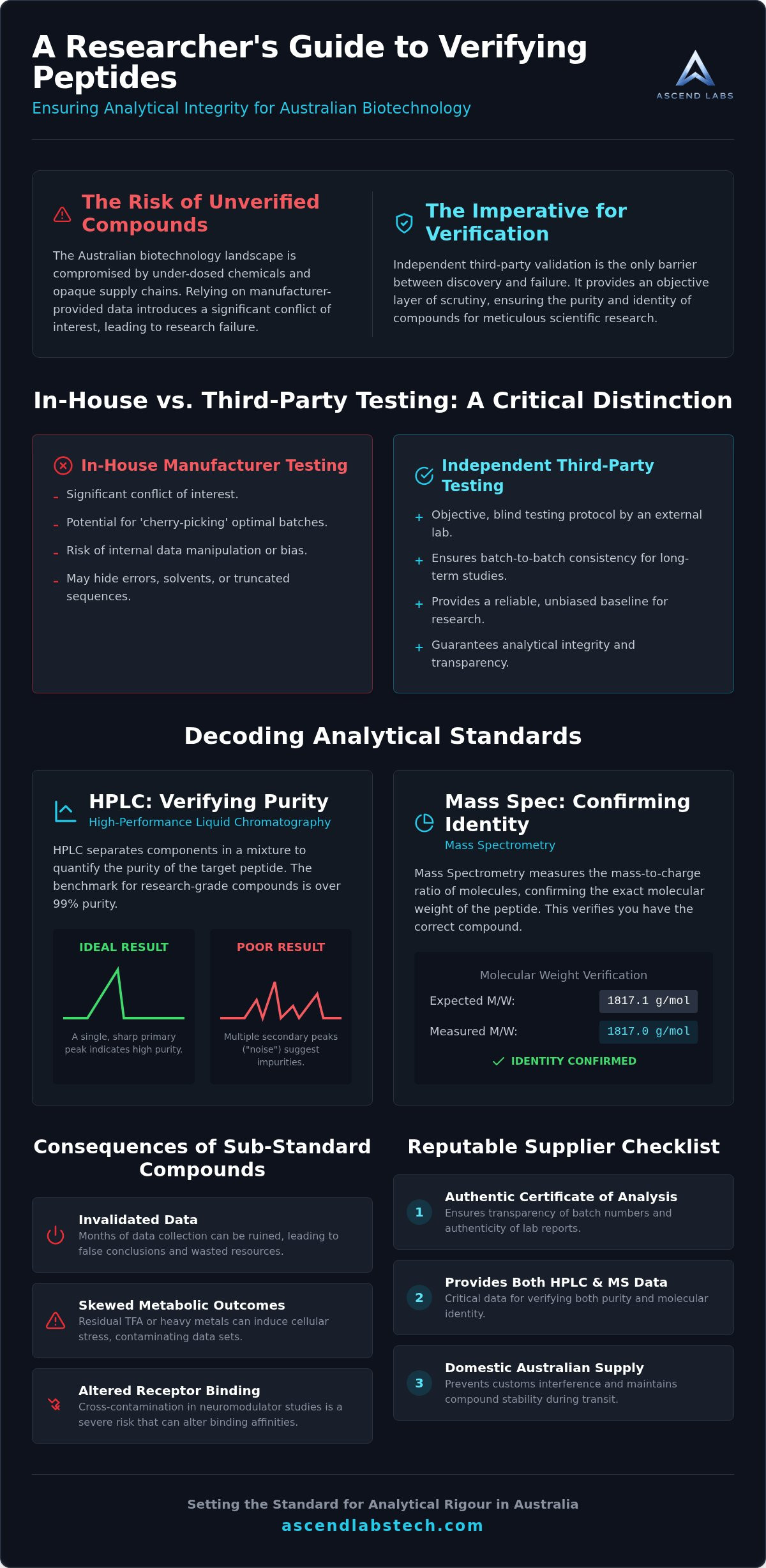
The acquisition of research compounds in Australia requires more than a simple transaction. It demands a rigorous verification process to bridge the gap between raw manufacturing output and laboratory-grade standards. Independent third-party verification is the process where a sample is sent to an external, accredited facility that has no financial interest in the sale of the product. This creates an objective layer of scrutiny that manufacturer-provided data simply cannot replicate. For those seeking third-party tested peptides australia, understanding this distinction is the first step toward ensuring analytical integrity.
Many global manufacturers produce peptides in high volumes, often providing their own internal reports. However, relying on these documents introduces a significant conflict of interest. A manufacturer's primary objective is throughput; a researcher's primary objective is truth. Errors in synthesis, residual solvents, or the presence of truncated peptide sequences can remain hidden in self-reported data. The availability of third-party tested peptides australia serves as a vital safeguard for the domestic scientific community, ensuring that the "research chemical" label doesn't become a mask for substandard quality.
Australian researchers operating in the fields of in-vitro metabolic studies or recovery pathways require a level of transparency that goes beyond a standard invoice. When a compound is introduced to a cellular environment, any deviation from the expected molecular structure can lead to confounding variables. These variables don't just ruin a single experiment; they can invalidate months of data collection and lead to false conclusions. Independent testing acts as the final gatekeeper, filtering out compounds that fail to meet the exacting requirements of modern biotechnology.
In-House vs. Third-Party Testing: A Critical Distinction
The fundamental difference lies in the protocol of blind testing. While in-house testing allows for the potential cherry-picking of optimal batches, independent validation requires a supplier to submit samples to a separate entity for High-Performance Liquid Chromatography (HPLC) analysis. This external oversight ensures that batch-to-batch consistency is maintained over long-term studies. It provides a reliable baseline for longitudinal research without the risk of supplier bias or internal data manipulation.
The Consequences of Sub-Standard Research Compounds
In mitochondrial and metabolic research, even minute impurities can lead to skewed outcomes. Residual TFA (trifluoroacetic acid) or heavy metals can induce cellular stress responses that contaminate data sets. In neuromodulator studies, cross-contamination is a severe risk that can alter receptor binding affinities. Achieving a 99% purity benchmark isn't an arbitrary goal. It's a technical requirement to ensure that observed biological effects are solely attributable to the peptide under investigation, preserving the calibre of Australian scientific inquiry.
Decoding Analytical Standards: HPLC and Mass Spectrometry
Analytical integrity in biotechnology is established through two primary pillars: purity and identity. While many vendors claim high quality, the absence of granular data makes these assertions impossible to verify. For those sourcing third-party tested peptides australia, the technical documentation must include both High-Performance Liquid Chromatography (HPLC) and Mass Spectrometry (MS) results. These methods provide a transparent view into the chemical composition of a compound, ensuring that the material delivered matches the molecular structure required for precise research outcomes.
The Therapeutic Goods Administration (TGA) warning regarding unapproved peptide products underscores the inherent risks of using unverified substances. Without independent analytical validation, researchers may inadvertently introduce contaminants such as heavy metals or residual solvents into their studies. Interpreting a chromatogram requires looking beyond the stated purity percentage. Any "noise" or secondary peaks at the baseline of an HPLC report suggests the presence of truncated sequences or manufacturing by-products. These impurities, even in small concentrations, can significantly alter the biological activity of the peptide.
The Role of HPLC in Peptide Purity Testing
HPLC functions by separating compounds based on their polarity and interaction with a stationary phase. As the peptide moves through the column, its retention time is measured against known standards. A single, sharp peak on the resulting chromatogram is the definitive goal. It indicates that the sample is homogenous and free from significant degradation. In Australian laboratories, purity is calculated by the area under this peak relative to any other detectable signals, with 99% serving as the benchmark for high-calibre research standards.
Identity Verification via Mass Spectrometry
Purity alone does not guarantee that the compound is actually the intended peptide. Mass Spectrometry provides the necessary identity verification by measuring the exact molecular mass of the sample. For complex compounds like Retatrutide, researchers must compare the experimental mass found in the report to the theoretical mass of the sequence. Mass Spectrometry is the essential tool for detecting structural analogues that might otherwise bypass a standard purity check. Researchers requiring these rigorous standards can explore the verified catalogue at Ascend Labs to ensure their data is built on a foundation of analytical truth.
The Australian Supply Landscape: Domestic Security and Quality
The stability of a research compound is frequently compromised long before it reaches the laboratory bench. For researchers sourcing third-party tested peptides australia, the geographical origin of the supply is as critical as the analytical data itself. International procurement introduces a series of variables that can degrade the structural integrity of sensitive metabolic compounds. By choosing a domestic supply chain, researchers eliminate the unpredictability of global transit and ensure that the high-purity standards verified in the lab are preserved until the point of use.
Domestic logistics offer a level of oversight that international air freight cannot match. When compounds like MOTS-C or growth factor peptides are shipped from overseas, they often endure extreme temperature fluctuations in unpressurised cargo holds or on sun-exposed tarmacs. These environmental stressors can lead to peptide denaturation or accelerated degradation. A local supply network allows for more controlled transit times and specialised handling, maintaining the cold-chain requirements essential for delicate research standards.
Mitigating Transit Degradation for High-Sensitivity Peptides
Peptide stability is highly dependent on temperature control. Prolonged exposure to heat during international transit can result in the breakdown of amino acid chains, rendering the compound ineffective for precise metabolic research. Domestic shipping centres within Australia provide a more controlled environment, significantly reducing the duration of transit and the risk of environmental exposure. This is particularly vital for recovery peptides and growth factors, where structural stability is paramount for reproducible results. Ensuring that your materials haven't spent days in a customs warehouse is a fundamental requirement for maintaining analytical integrity.
Navigating Customs and Regulatory Compliance
The complexities of importing research chemicals into Australia are significant. Border Force frequently intercepts packages that lack the necessary documentation or fail to meet strict Australian regulatory requirements regarding unapproved substances. These seizures don't just result in financial loss; they cause critical delays in research timelines. Domestic suppliers like Ascend Labs streamline this procurement process by managing the regulatory burden and ensuring that all compounds are already within the country. This allows laboratories to focus on their primary inquiry while remaining compliant with domestic standards for third-party tested peptides australia. Access to Australian-based support also ensures that technical laboratory inquiries are handled by experts who understand the local research landscape and its specific challenges.
Selection Criteria for Reputable Australian Peptide Suppliers
Identifying a reliable source for third-party tested peptides australia requires a systematic evaluation of a supplier’s analytical transparency. It is not enough for a vendor to claim high purity; they must provide the raw data that supports these assertions. A professional supplier acts as a disciplined curator, ensuring that every batch is accompanied by documentation that can be independently verified. This level of rigour is essential for maintaining the validity of your research outcomes and protecting the integrity of your laboratory environment.
Transparency begins with the batch number. Each vial in your possession should correspond to a specific, unique identifier found on the accompanying Certificate of Analysis (CoA). If a supplier cannot provide a clear link between the physical product and the laboratory report, the analytical integrity of the compound is compromised. Testing dates must also be current. Peptides are sensitive to degradation over time; therefore, a report that is several years old does not accurately reflect the current state of the material. A reputable supplier will always ensure that their inventory is backed by recent, relevant data.
How to Spot a Genuine Certificate of Analysis
A legitimate CoA must contain the specific contact details of the third-party laboratory. You should be able to contact the testing facility to verify that the report is authentic and has not been altered. Redacted information or obscured data fields are significant red flags that suggest a lack of transparency. Pay close attention to the baseline of the HPLC chromatogram. As discussed in previous sections, any excessive noise can indicate the presence of manufacturing by-products. A genuine report will provide a clear, high-resolution view of the analytical results without any missing segments.
Evaluating the Breadth of a Research Catalogue
The sophistication of a supplier’s catalogue often reflects their technical immersion in the field. Offering advanced compounds like retatrutide demonstrates a commitment to the latest frontiers of triple-agonist inquiry. Similarly, a diverse selection of peptides for connective tissue research indicates a deeper understanding of specific physiological pathways. When reviewing a catalogue, look for clinical, accurate descriptions rather than marketing-driven hyperbole. The availability of specialised standards like KLOW and MOTS-C further distinguishes an expert gatekeeper from a generic vendor. To ensure your laboratory is equipped with compounds that meet these exacting standards, you can browse the verified Ascend Labs collection today.
Ascend Labs: Setting the Standard for Analytical Rigour
Ascend Labs operates as a disciplined curator within the Australian biotechnology sector. Our objective is not to lead the market in volume, but to set the benchmark for scientific truth. We understand that for advanced practitioners, the validity of a study rests entirely on the purity of the starting material. By specialising in third-party tested peptides australia, we provide a secure bridge between complex chemical synthesis and laboratory application. Our Australian-owned operation prioritises meticulous verification, ensuring that every compound in our catalogue serves as a reliable standard for serious inquiry.
The Ascend Labs selection is deliberately curated and highly specialised. We don't offer an exhaustive list of every available chemical; instead, we focus on high-purity research standards such as Retatrutide, Tirzepatide, KLOW, and MOTS-C. This focused approach allows us to maintain an uncompromising level of oversight over every batch. Each compound is treated as a critical component of a larger scientific narrative, where accuracy, exclusivity, and precision are the primary metrics of success. This commitment ensures that your research is built on a foundation of analytical certainty.
Meticulous Quality Control Protocols
Our verification process begins with the rigorous selection of independent analytical laboratories. We partner only with facilities that demonstrate a history of precision and a commitment to unbiased data reporting. Whether you're investigating metabolic pathways with Tirzepatide or cellular energetics with MOTS-C, every vial must meet the exacting benchmarks of laboratory-grade purity. Ascend Labs pledges to provide absolute analytical transparency by ensuring that every research compound is backed by verifiable HPLC and Mass Spectrometry data. This protocol eliminates the ambiguity often associated with international supply chains and the unverified data provided by global manufacturers.
The Ascend Labs Professional Experience
We provide a clinical, authoritative, and sophisticated support structure designed for practitioners who value professional ethics and operational discretion. Based in the Whitsundays, Queensland, our operation is uniquely positioned to manage the nuances of the Australian domestic landscape. We've refined our logistics to ensure that shipping is both discreet and secure, reaching every corner of the continent without the risks of international customs interference or transit-related degradation. Researchers can access our comprehensive catalogue with the confidence that they're partnering with a principled institution. By removing the variables of opaque sourcing, we allow you to focus entirely on the essential facts of your research operation.
Advancing Australian Research through Analytical Certainty
The integrity of your research is only as robust as the compounds you utilise. Transitioning from unverified global supply chains to a domestic, data-driven framework is a necessary evolution for advanced practitioners. By mastering the technical benchmarks of HPLC and Mass Spectrometry, you ensure that every cellular response observed is a direct result of the peptide sequence, not a confounding impurity. Sourcing third-party tested peptides australia provides the essential transparency required to uphold the calibre of your scientific inquiry.
Ascend Labs stands as a reliable partner in this pursuit of truth. We provide clinical-grade research compounds backed by meticulous laboratory verification and the security of exclusive domestic supply. Our commitment to substance over style ensures that your laboratory is equipped with the precise tools needed for breakthrough metabolic and recovery research. We invite you to Explore the Ascend Labs Research Catalogue and align your operation with the highest standards of analytical rigour. Your dedication to discovery deserves nothing less than total certainty.
Frequently Asked Questions
What does third-party tested mean for peptides in Australia?
Third-party testing refers to the independent analytical validation of a compound by an external laboratory that has no financial interest in the supplier's operations. This process ensures an objective assessment of the material's purity and molecular identity. For those seeking third-party tested peptides australia, this verification serves as the primary safeguard against the risks of under-dosed or impure research chemicals.
How can I verify the purity of a research peptide batch?
You can verify batch purity by cross-referencing the unique batch number on your vial with the corresponding Certificate of Analysis (CoA). A legitimate report will include a high-resolution HPLC chromatogram where the primary peak represents the target peptide. The purity is calculated by the area under this peak relative to any detectable impurities, with a 99% benchmark being the standard for high-calibre research.
Why is HPLC testing essential for metabolic research compounds?
HPLC testing is essential because it separates the target peptide from manufacturing by-products, residual solvents, and truncated sequences. In metabolic research, even minute contaminants can induce unintended cellular stress responses or confound receptor binding data. This analytical method ensures that the biological effects observed during your study are solely attributable to the peptide sequence under investigation.
Can I trust a CoA that does not include a chromatogram?
You shouldn't rely on a Certificate of Analysis that lacks a visual chromatogram. A text-based summary of purity is insufficient because it obscures the "noise" or secondary peaks that reveal the presence of impurities. A transparent supplier of third-party tested peptides australia will always provide the full graphical data to allow researchers to conduct their own independent assessment of the compound's homogeneity.
Are lab-tested peptides in Australia different from international imports?
The distinction lies in the security of the domestic supply chain and the mitigation of transit-related degradation. While international compounds may claim high purity at the point of manufacture, they often lack the domestic validation required to prove they survived the environmental stressors of global shipping. Australian lab-tested compounds provide a higher level of certainty by maintaining a controlled, domestic chain of custody from the lab to your facility.
How often should an Australian supplier update their third-party lab results?
Analytical results must be updated for every individual manufacturing batch to ensure consistent quality assurance. Peptides are sensitive to batch-to-batch variation, so relying on testing reports that are several years old introduces unacceptable variables into your research. A reputable supplier ensures that all documentation in their catalogue is current and directly corresponds to their existing physical inventory.
What are the red flags when looking for a reputable peptide supplier in Australia?
Significant red flags include redacted laboratory contact information, expired testing dates, and the use of hyperbolic marketing jargon instead of clinical data. If a supplier cannot provide a clear link between a specific batch number and its analytical report, the material's identity remains unverified. Opaque supply chains and a lack of domestic logistics information also suggest a lower standard of professional ethics and operational discretion.
Does third-party testing guarantee the stability of the peptide during shipping?
Testing verifies the state of the compound at the moment of analysis, but it doesn't prevent degradation during subsequent transit. This is why sourcing through a domestic Australian supply chain is a critical component of quality assurance. Local logistics reduce exposure to the extreme heat and prolonged delays typical of international air freight, ensuring the structural integrity confirmed by the laboratory is preserved until the point of use.


