

The traditional view of the mitochondrion as a mere cellular furnace has been rendered obsolete by the discovery of mitochondrial-derived peptides that dictate nuclear gene expression. At the centre of this paradigm shift is the mots-c research peptide, a 16-amino acid sequence that acts as a sophisticated metabolic shield. While many practitioners recognise its potential, the persistent challenge remains in sourcing laboratory-grade compounds that meet the rigorous standards required for precise metabolic inquiry within the Australian scientific community.
You likely understand that the integrity of your data depends entirely on the chemical purity of your reagents and the clarity of the underlying biological mechanisms. This technical overview clarifies the complex mitochondrial-nuclear signalling pathways of the mots-c research peptide and its specific applications within contemporary Australian research settings. We will analyse the biochemical framework of this peptide, its role in metabolic homeostasis; and the logistical necessity of a verified domestic supply to ensure research continuity, precision, and the elimination of international customs delays.
Key Takeaways
- Understand the unique genetic origin of MOTS-c as a mitochondrial-encoded peptide and its critical role in the retrograde signalling axis between the mitochondria and the nucleus.
- Evaluate the latest research applications regarding metabolic homeostasis, specifically focusing on insulin sensitivity and the maintenance of skeletal muscle integrity during ageing.
- Identify the essential quality benchmarks for the mots-c research peptide, including HPLC and mass spectrometry verification, to ensure the absolute integrity of your laboratory data.
- Recognise the logistical benefits of domestic Australian procurement, which eliminates international customs delays and ensures a consistent supply for sensitive research projects.
- Learn how to rigorously interpret a Certificate of Analysis (COA) to guarantee that compounds meet the high-purity standards required for precise metabolic inquiry.
Defining the MOTS-c Research Peptide and its Genetic Origin
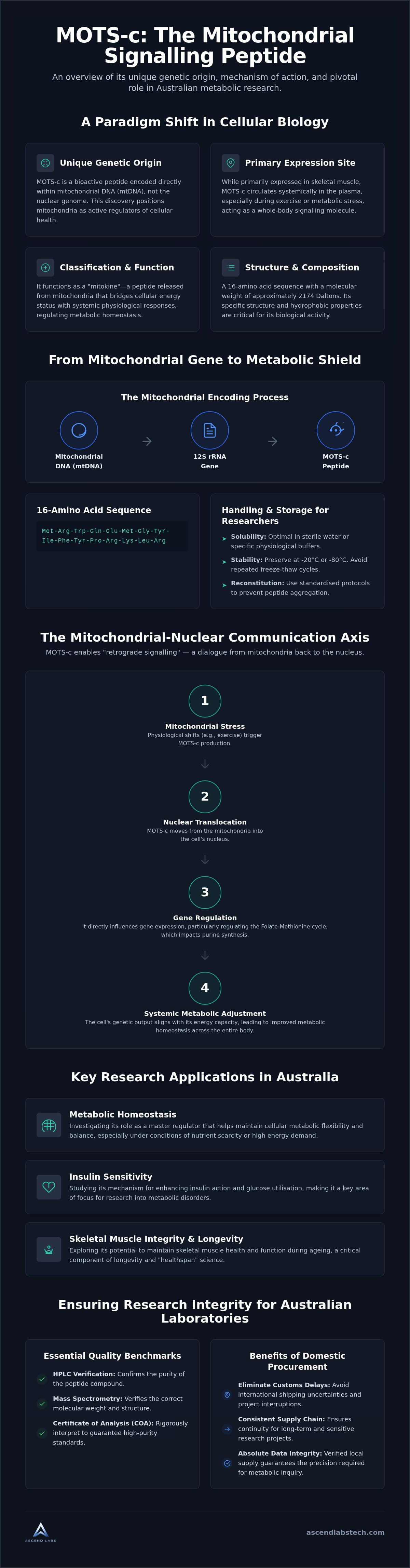
The discovery of the mots-c research peptide has fundamentally altered our understanding of mitochondrial-nuclear crosstalk. MOTS-c, or Mitochondrial Open Reading Frame of the 12S rRNA-c, is a bioactive 16-amino acid peptide. Unlike the vast majority of signalling molecules, it's encoded directly within the mitochondrial DNA (mtDNA) rather than the nuclear genome. This specific genetic origin marks a paradigm shift; it suggests that mitochondria aren't merely passive energy producers, but autonomous regulators of cellular health and systemic metabolism.
Current data indicates that MOTS-c is primarily expressed in skeletal muscle tissue. However, it doesn't remain localised. Under specific metabolic conditions, such as physical exertion or nutrient stress, it circulates in the plasma. This systemic presence allows it to function as a "mitokine," bridging the gap between cellular energy status and whole-body physiological responses. It's this unique mobility that makes it a primary focus for researchers investigating metabolic disorders and longevity science.
The Unique Mitochondrial Encoding Process
The genetic architecture of the mots-c research peptide is defined by its location within the 12S ribosomal RNA (rRNA) gene of the mitochondrial genome. It's translated from a short open reading frame (sORF), a discovery that has expanded the known proteome of the organelle. While traditional peptides are nuclear-encoded and imported into the mitochondria, MOTS-c represents a retrograde signalling mechanism. This process allows the mitochondria to communicate their functional status directly to the nucleus, influencing gene expression in response to metabolic shifts. This evolutionary retention of signalling capability underscores the mitochondrion's role as a sophisticated metabolic sensor that operates independently of nuclear instruction.
Biochemical Structure and Stability
From a biochemical perspective, MOTS-c is composed of a specific 16-amino acid sequence: Met-Arg-Trp-Gln-Glu-Met-Gly-Tyr-Ile-Phe-Tyr-Pro-Arg-Lys-Leu-Arg. This sequence possesses a molecular weight of approximately 2174 Daltons and a specific isoelectric point (pI) that influences its solubility and interaction with cellular membranes. For researchers in Australian laboratories, maintaining the structural integrity of the peptide is paramount for experimental reproducibility.
MOTS-c exhibits significant hydrophobic properties, which dictates its behaviour in various laboratory solvents. To ensure precise calibration in experimental settings, practitioners should consider the following biochemical characteristics:
- Solubility: The peptide typically demonstrates optimal solubility in sterile water or specific physiological buffers, though its hydrophobic nature may require careful titration.
- Storage Stability: Integrity is best preserved at temperatures of -20°C or -80°C; repeated freeze-thaw cycles should be avoided to prevent degradation.
- Reconstitution: Reconstitution protocols must be standardised to avoid peptide aggregation, which can compromise the accuracy of in-vitro data.
Mechanism of Action: The Mitochondrial-Nuclear Communication Axis
The mitochondrial-nuclear communication axis represents a sophisticated feedback loop essential for cellular adaptation. While traditional biology focuses on nuclear control over organelles, the mots-c research peptide facilitates "retrograde signalling." This process allows the mitochondria to actively dictate nuclear gene expression in response to physiological shifts. It's a bi-directional dialogue where the organelle reports its energetic status to the nucleus, triggering systemic metabolic adjustments. This mechanism ensures that the cell's genetic output aligns with its current energy production capacity.
A critical component of this signalling involves the regulation of the Folate-Methionine cycle. By influencing this pathway, the mots-c research peptide directly impacts de novo purine synthesis and cellular methylation capacity. This biochemical intervention ensures that the cell maintains metabolic flexibility during periods of high demand or nutrient scarcity. The ability of a mitochondrial peptide to intervene in such fundamental nuclear processes underscores its role as a master regulator of metabolic homeostasis.
Nuclear Translocation and Gene Regulation
The translocation of MOTS-c from the mitochondria to the nucleus is a precisely controlled event. It's primarily triggered by metabolic stressors, such as exercise-induced signals or acute glucose deprivation. Once inside the nucleus, the peptide interacts with transcription factors, specifically binding to the Antioxidant Response Element (ARE). This interaction promotes the expression of cytoprotective genes, enhancing the cell's ability to withstand oxidative stress. Research suggests that the binding affinity of the peptide to these specific DNA sequences is a primary driver of stress-response gene activation, allowing for rapid cellular adaptation to environmental challenges.
AMPK Activation and Metabolic Homeostasis
Central to the action of MOTS-c is its ability to activate the 5-adenosine monophosphate-activated protein kinase (AMPK) pathway. This activation occurs through the modulation of intracellular AMP levels, effectively mimicking a low-energy state within the cell. The subsequent increase in AMPK activity leads to enhanced glucose uptake and accelerated fatty acid oxidation, which are fundamental to systemic metabolic health and energy balance.
This mechanism aligns with broader findings in mitochondrial peptide research, highlighting how these molecules serve as endogenous regulators of longevity. By bypassing traditional hormonal pathways, MOTS-c provides a direct route to improving insulin sensitivity at the cellular level. For researchers conducting sensitive metabolic assays, ensuring the purity of these compounds is vital; obtaining verified reagents from specialised domestic sources remains the most reliable method for maintaining experimental integrity and data accuracy.
Key Research Applications in Metabolic and Longevity Science
The application of the mots-c research peptide extends beyond simple metabolic regulation, encompassing a broad spectrum of longevity and structural research. In sedentary laboratory models, it's often characterised as an "exercise mimetic" due to its ability to replicate the molecular signatures of physical exertion without mechanical stimulus. This makes it a primary candidate for investigating sarcopenia, where researchers focus on the maintenance of skeletal muscle integrity and the prevention of age-related atrophy.
Recent frameworks have also begun to explore its role in neurodegenerative research. By modulating mitochondrial function within the central nervous system, researchers aim to determine if retrograde signalling can mitigate the metabolic decline often observed in cognitive dysfunction models. These diverse applications necessitate a compound that maintains its biochemical profile through every stage of the assay, ensuring that experimental outcomes are a result of peptide action rather than reagent degradation.
Insulin Sensitivity and Glucose Disposal
The mots-c research peptide has shown significant promise in studies investigating glucose disposal pathways. A primary mechanism of interest is the induction of GLUT4 translocation to the cell membrane in skeletal muscle cells, which facilitates glucose uptake independently of traditional insulin pathways. This specific action is a cornerstone of insulin sensitising peptide research, providing a unique model for studying metabolic flexibility. Researchers evaluate its impact on adipose tissue thermogenesis, analysing how it shifts cellular environments from energy storage to energy utilisation through fatty acid oxidation.
Longevity and Cellular Senescence Research
Longevity science has identified a compelling correlation between endogenous MOTS-c levels and biological age. Centenarian studies indicate that specific genetic variants associated with higher MOTS-c expression are linked to exceptional lifespan, positioning the peptide as a key biomarker in ageing research. In laboratory settings, researchers analyse how MOTS-c treatment influences senescent cell markers, particularly its ability to reduce the pro-inflammatory secretome associated with cellular ageing.
There's also emerging interest in the synergistic potential of combining this molecule with klow peptide australia. These protocols investigate whether dual-peptide signalling can provide a more comprehensive approach to cellular rejuvenation than single-agent models. This integrated methodology is becoming standard in high-end longevity research across Australia, where precision and reagent purity remain the highest priorities for data integrity.
Procurement and Quality Verification for Australian Laboratories
Sourcing the mots-c research peptide for sophisticated metabolic assays requires a rigorous vetting process that extends beyond simple vendor selection. For the Australian scientific community, the primary hurdle isn't just availability, but the preservation of chemical integrity during transit. High-purity research necessitates a compound that has undergone stringent verification. Data integrity is non-negotiable. Practitioners must prioritise reagents that provide comprehensive documentation to ensure that observed experimental outcomes are not skewed by impurities or degraded sequences.
High-Performance Liquid Chromatography (HPLC) remains the gold standard for assessing the purity of mitochondrial peptides. A benchmark of 98% purity or higher is essential for most in-vitro and in-vivo applications. Without this level of refinement, residual contaminants may induce unintended cellular responses, effectively compromising the validity of the research. You can secure the precision of your laboratory data by sourcing verified research compounds from a domestic gatekeeper that prioritises batch-specific testing and transparent quality standards.
Interpreting Purity and Verification Reports
A Certificate of Analysis (COA) is more than a formality; it's a technical blueprint of the peptide's identity. When reviewing mass spectrometry data for the mots-c research peptide, the primary peak must align precisely with the theoretical molecular weight of the 16-amino acid sequence. Any significant secondary peaks suggest the presence of truncated sequences or synthesis byproducts. The presence of trifluoroacetic acid (TFA) salts, often used in the purification process, must also be quantified. High residual TFA levels can alter the pH of culture media, potentially interfering with sensitive metabolic signalling assays and leading to inconsistent reproducibility across batches.
The Advantages of Domestic Australian Supply
The Australian climate presents unique challenges for peptide stability, particularly during the final stages of logistics. International procurement often exposes sensitive compounds to fluctuating temperatures and prolonged transit times, which can lead to peptide deamidation or oxidation. Domestic supply chains mitigate these risks by ensuring significantly shorter delivery windows and more controlled handling environments. Dealing with a local supplier also eliminates the risk of international customs seizures, which frequently disrupt research timelines. Secure, discreet, and rapid domestic shipping ensures that the chemical structure of the peptide remains intact from the laboratory to the point of reconstitution, maintaining the high standards required for Australian metabolic inquiry.
Ensuring High-Purity Standards with Ascend Labs
Ascend Labs operates as an authoritative gatekeeper for mitochondrial research compounds within Australia. We provide a specialised service for the scientific community, focusing on the provision of the mots-c research peptide with uncompromising chemical integrity. Our operation is built on the principle that metabolic inquiry requires reagents that meet exact specifications. There is no room for ambiguity in laboratory settings; therefore, we ensure that every compound in our inventory undergoes a rigorous verification process before it reaches your facility.
Our commitment to transparency is evidenced by comprehensive COA and HPLC verification for every batch of the mots-c research peptide. This focus on chemical purity prevents the data inconsistencies that often arise from international sourcing. By maintaining a strict domestic shipping model, we support the operational efficiency of Australian research laboratories. This approach ensures that sensitive compounds are not exposed to the degradation risks associated with long-haul international logistics or customs delays, preserving the peptide's structural stability for your assays.
The Ascend Labs Quality Assurance Framework
The selection process for our metabolic research compounds is governed by a philosophy of clinical precision. We don't merely act as a vendor; we function as a disciplined curator of high-end biotechnology. Our catalogue is a sophisticated collection of research chemicals, including advanced metabolic regulators like retatrutide and other growth factor peptides. This authoritative framework ensures that practitioners have access to reagents that have been verified through HPLC and mass spectrometry standards, meeting the expectations of advanced scientific inquiry.
Supporting the Future of Australian Peptide Science
The advancement of mitochondrial-nuclear signalling research in Australia depends on the availability of high-purity reagents. We believe in substance over style, prioritisng laboratory-grade accuracy over marketing hyperbole. By providing a reliable domestic source for the mots-c research peptide, we enable researchers to focus on data acquisition and the discovery of new metabolic pathways without the distraction of supply chain instability. This dedication to quality assurance and operational discretion makes us a principled partner for the most demanding research projects.
Securing the integrity of your next study begins with the quality of your starting materials. We invite researchers to utilise our verified compounds to ensure that their experimental outcomes are both accurate and reproducible. You can maintain the highest standards of metabolic inquiry by choosing a partner that understands the technical nuances of mitochondrial-derived signalling and the logistical requirements of the Australian scientific landscape.
Advancing Mitochondrial Inquiry in Australian Research
The transition of mitochondria from passive energy producers to active genomic regulators represents a profound shift in modern metabolic science. Understanding the 16-amino acid sequence and the retrograde signalling pathways of the mots-c research peptide is vital for practitioners investigating cellular homeostasis or longevity. It's clear that precision in these studies is only possible when the underlying chemical reagents are verified to the highest laboratory standards, ensuring every observation is a true reflection of biological action.
Maintaining research continuity requires a partner that prioritises substance and accuracy. By utilising HPLC verified peptides accompanied by comprehensive COA documentation, you eliminate the variables that compromise sensitive data. Rapid domestic Australian shipping ensures the structural integrity of your compounds is preserved from synthesis to the laboratory bench. We invite you to Secure High-Purity MOTS-C for Your Research at Ascend Labs. We're committed to supporting your contribution to the evolving landscape of mitochondrial science.
Frequently Asked Questions
What is the recommended storage protocol for MOTS-c in an Australian laboratory?
Lyophilised mots-c research peptide must be stored at -20°C or -80°C for long-term stability within an Australian laboratory environment. Once you've reconstituted the peptide, it's best kept at 2-8°C and used within a short timeframe. Repeated freeze-thaw cycles will degrade the amino acid sequence; researchers should aliquot the solution into single-use vials to maintain experimental integrity and prevent structural breakdown.
Is MOTS-c soluble in bacteriostatic water or does it require a specific buffer?
MOTS-c is generally soluble in sterile water or phosphate-buffered saline (PBS) for most in-vitro applications. While bacteriostatic water is frequently used for its preservative properties, some researchers report better stability with specific physiological buffers that maintain a neutral pH. You should always add the solvent slowly to the vial to avoid mechanical stress and ensure complete dissolution without peptide aggregation.
How does MOTS-c differ from other mitochondrial-derived peptides like Humanin?
MOTS-c is a 16-amino acid peptide primarily focused on metabolic regulation and AMPK activation, whereas Humanin consists of 24 amino acids and acts as a cytoprotective agent. While both are mitochondrial-derived peptides, their signalling targets differ significantly. Humanin is often studied for its neuroprotective effects, while MOTS-c is the primary focus for research into insulin sensitivity and skeletal muscle metabolism.
Can MOTS-c be used in conjunction with other metabolic research compounds?
Yes, researchers often pair the mots-c research peptide with other metabolic agonists like KLOW or Retatrutide to study synergistic effects on cellular energy. These combinations allow for a more comprehensive analysis of mitochondrial-nuclear crosstalk and its impact on systemic metabolic health. Ensure that each compound's purity is verified independently to avoid confounding variables in your laboratory data.
What is the typical purity level required for peer-reviewed MOTS-c research?
Peer-reviewed research typically requires a minimum purity level of 98% as verified by High-Performance Liquid Chromatography (HPLC). Using lower-grade compounds can introduce synthesis byproducts that interfere with cellular signalling, leading to results that are difficult to replicate. Most high-tier journals expect batch-specific COA documentation to confirm that the peptide sequence is accurate and free from significant contaminants.
How does domestic Australian shipping impact the shelf-life of MOTS-c?
Domestic Australian shipping significantly reduces the risk of peptide degradation by minimising exposure to the extreme heat common in local transit. International orders often face long delays in customs facilities that aren't temperature-controlled, which can compromise the peptide's secondary structure. Sourcing locally ensures that the compound remains stable and reaches your laboratory in its optimal lyophilised state.
What are the primary signs of peptide degradation to look for during reconstitution?
The primary signs of degradation during reconstitution include persistent cloudiness, visible aggregation, or the presence of "floaters" that won't dissolve. A high-quality peptide should form a clear, colourless solution upon the addition of a suitable solvent. If the solution remains turbid after gentle swirling, it's likely the peptide has undergone oxidation or deamidation, rendering it unsuitable for precise research.
Are there specific HPLC markers that identify a high-quality MOTS-c batch?
A high-quality MOTS-c batch is identified by a single, sharp peak on the HPLC chromatogram at the expected retention time. The absence of significant secondary peaks indicates that the synthesis and purification processes have successfully removed truncated sequences or residual reagents. Verification through mass spectrometry should also show a dominant peak corresponding to the theoretical molecular weight of approximately 2174 Daltons.


