

With one laboratory reporting over 5,300 purity verification requests for metabolic compounds in a single year, the scale of unregulated inquiry in Australia is impossible to ignore. For practitioners conducting retatrutide vs tirzepatide research, the transition from dual to triple agonism represents more than just a clinical milestone; it's a fundamental shift in biochemical potency. You likely recognise that the current regulatory landscape in Australia remains complex, often leaving researchers to navigate a market saturated with unverified or potentially contaminated materials from overseas sources.
This analysis provides an authoritative technical comparison of these mechanisms to ensure your laboratory operations maintain the highest standards of precision. You'll gain a clear understanding of how the addition of the glucagon receptor interaction distinguishes retatrutide from the dual GIP and GLP-1 pathways of tirzepatide. We will outline verified laboratory protocols and examine the logistics of securing a reliable domestic supply chain within the 2026 Australian market environment. This ensures your data remains accurate and your research integrity is never compromised by inferior chemical inputs.
Key Takeaways
- Understand the biochemical distinction between dual and triple receptor agonism to better predict metabolic outcomes in laboratory settings.
- Analyse the latest 2026 clinical data to compare dose-response curves and potency markers essential for retatrutide vs tirzepatide research.
- Master standardised storage and reconstitution protocols to preserve the structural integrity of sensitive metabolic research compounds.
- Evaluate the advantages of domestic Australian supply chains for maintaining cold chain requirements and ensuring COA-verified purity.
The Evolution of Metabolic Agonism in Australian Research
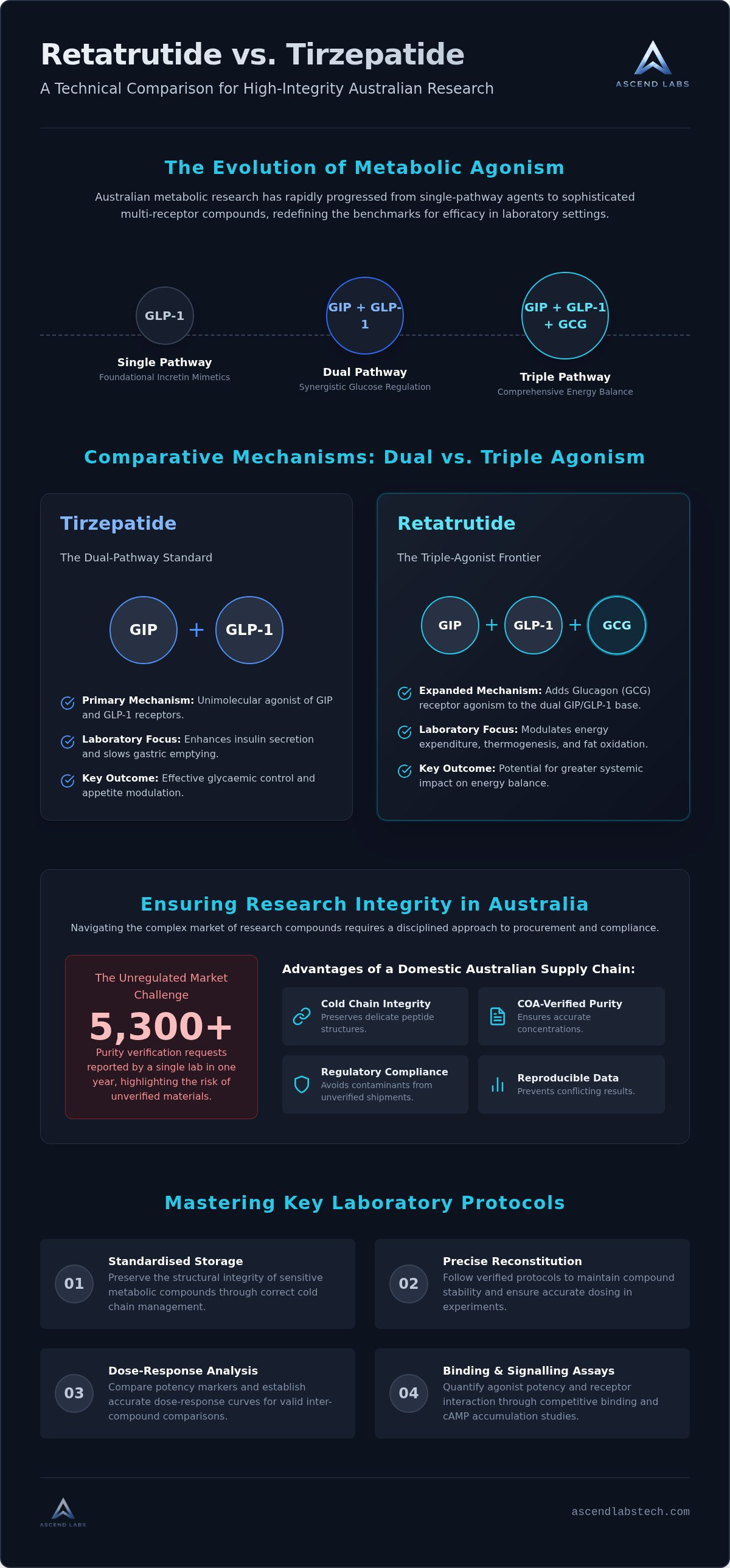
The trajectory of metabolic pharmacology in Australia has transitioned rapidly from single-pathway interventions to complex multi-receptor synergies. Historically, the focus remained on GLP-1 receptor agonists, which provided a foundational understanding of incretin mimetics. However, the introduction of the Tirzepatide dual-agonist mechanism, targeting both GIP and GLP-1 receptors, redefined the benchmarks for metabolic efficacy. By 2026, the Australian research landscape has matured, moving beyond simple glucose regulation toward the more sophisticated interactions found in triple-agonist compounds. This progression is central to current retatrutide vs tirzepatide research, where the addition of a third hormone pathway offers a new frontier for laboratory inquiry. Modern Australian studies now demand a higher level of precision, focusing on how these compounds interact at a cellular level to influence systemic energy balance.
From Dual to Triple Agonism
Adding the glucagon (GCG) receptor alongside GIP and GLP-1 marks a significant milestone in peptide synthesis. While dual agonists focused on insulin secretion and appetite suppression, the triple-agonist profile of Retatrutide introduces direct modulation of energy expenditure through the glucagon pathway. This shift forces a move from simple glycaemic control to biochemical cooperation across multiple pathways. Australian laboratories are currently prioritising in-vitro studies that examine how these three receptors cross-talk. Comparing these mechanisms is vital for retatrutide vs tirzepatide research aimed at establishing accurate dose-response curves in local studies. These efforts explore the potential for increased thermogenesis and fat oxidation that was previously limited in dual-receptor models.
Regulatory Context for Australian Researchers
Operating within the Australian framework requires a disciplined approach to procurement and compliance. It's vital to distinguish between therapeutic goods approved for clinical use and compounds intended strictly for laboratory research. In 2026, the TGA has issued several alerts regarding unverified peptide contaminants found in international shipments, which can compromise experimental data. Sourcing high-purity peptides from domestic, Australian-owned entities is the most reliable method to ensure chemical integrity. This domestic focus helps maintain the cold chain, which is essential for preserving the delicate structure of metabolic agonists. Using COA-verified compounds also ensures that the concentrations used in trials are accurate, preventing the conflicting data on receptor binding affinities that often plague studies using unverified materials.
Australian metabolic research is now defined by this transition toward greater complexity. By integrating multiple receptor pathways, researchers are uncovering deeper insights into metabolic regulation that were previously inaccessible. Maintaining the integrity of these studies depends entirely on the quality of the compounds utilised. As we move further into 2026, the emphasis on domestic quality control and precise biochemical profiling will only increase, setting a new standard for excellence in the field.
Comparative Mechanisms: Dual vs Triple Receptor Agonism
Understanding the molecular architecture of these peptides is essential for retatrutide vs tirzepatide research. While tirzepatide established a high benchmark for dual-receptor agonism, retatrutide expands this scope by incorporating a third hormonal pathway. This addition represents a fundamental shift in how researchers approach metabolic rate and lipid homeostasis. In a controlled laboratory environment, these interactions are typically quantified through competitive binding assays and cAMP accumulation studies. Researchers measure the potency of each agonist by its ability to activate specific intracellular signalling pathways, requiring compounds with precise molecular structures to achieve reproducible data.
Tirzepatide: The Dual-Pathway Standard
Tirzepatide functions as a unimolecular agonist of both the GIP and GLP-1 receptors. In laboratory models, the GIP component acts synergistically with GLP-1 to enhance insulin secretion and improve glucose tolerance. Research consistently shows that this dual action slows gastric emptying and modulates appetite centres more effectively than single GLP-1 agonists. It remains the foundational control in most metabolic studies due to its well-documented binding affinities and predictable pharmacokinetics. This dual-pathway approach provides a stable baseline for comparing more complex multi-receptor agonists.
Retatrutide: The Triple-Agonist Frontier
Retatrutide represents the triple-agonist frontier by integrating the glucagon (GCG) receptor alongside GIP and GLP-1. According to Phase 2 Retatrutide trial data, this triple-hormone mimetic achieves superior metabolic outcomes through a balanced interaction with all three targets. Glucagon receptor activation is particularly significant as it directly influences thermogenesis and hepatic lipid metabolism, increasing energy expenditure in a way that dual agonists cannot match. The triple-agonist advantage lies in its ability to simultaneously suppress caloric intake while actively elevating the metabolic rate through glucagon-mediated pathways. This complex binding profile requires meticulous laboratory oversight to ensure that receptor cross-talk is accurately mapped during retatrutide vs tirzepatide research.
The biochemical implications of these interactions suggest that triple-agonism offers a more comprehensive approach to metabolic dysfunction. However, the sensitivity of these triple-agonist compounds makes the quality of the research material paramount. For laboratories seeking to replicate these complex interactions, sourcing metabolic research compounds with verified certificates of analysis is the only way to ensure experimental validity. Maintaining the cold chain during domestic distribution further protects the structural integrity of these sensitive peptides, ensuring that the binding affinities observed in the laboratory align with established benchmarks.
Analysing Research Potency and Clinical Trial Data
Quantitative data from 2026 clinical assessments has established a clear hierarchy in agonist potency. While both compounds demonstrate high affinity for metabolic receptors, the divergence in their dose-response curves is significant. In recent retatrutide vs tirzepatide research, the triple-agonist model has consistently outperformed dual-agonist benchmarks in terms of total metabolic throughput. Data indicates that retatrutide research models have achieved a 28% reduction in body weight over an 80-week period, whereas tirzepatide benchmarks typically hover around the 22% marker. These figures aren't merely clinical outcomes; they represent the increased pharmacological pressure exerted by the addition of the glucagon receptor pathway.
Efficacy Benchmarks in Metabolic Research
The primary driver of this potency gap is the rate of fat oxidation. Triple agonists activate hepatic glucagon receptors, which increases energy expenditure beyond the appetite suppression provided by GLP-1 and GIP. Integrating mitochondrial peptide research into these studies has further highlighted how cellular energy centres respond to multi-receptor stimulation. By measuring glycaemic control markers such as HbA1c and fasting insulin levels, researchers can observe a more aggressive correction of metabolic dysfunction in triple-agonist models. This quantitative analysis allows for the development of more precise protocols for longitudinal studies.
The Critical Role of Purity Verification
For any comparative study to remain valid, the compounds must meet a 99%+ purity threshold. Impurities in research peptides, often found in unverified international shipments, introduce variables that can confound experimental results. Contaminants such as residual TFA (trifluoroacetic acid) or truncated peptide sequences have been linked to liver toxicity concerns and unexpected inflammatory responses in research subjects. Interpreting HPLC (High-Performance Liquid Chromatography) and MS (Mass Spectrometry) data is the only way to confirm that the observed metabolic effects are due to the peptide itself and not a byproduct of poor synthesis. In the Australian context, where the TGA has issued specific warnings regarding unapproved metabolic compounds, domestic COA verification acts as the primary safeguard for experimental integrity. Without these stringent standards, the risk of data corruption and off-target toxicity remains unacceptably high.
Laboratory Protocols: Stability and Purity Standards
Establishing reproducibility in retatrutide vs tirzepatide research requires more than just high-quality compounds; it demands rigorous laboratory protocols. Lyophilised peptides are generally stable, yet their structural integrity remains vulnerable to environmental stressors. Standardised storage protocols dictate that vials be kept at -20°C for long-term preservation, while short-term storage (under 90 days) should be maintained at 2-8°C. Triple agonists, such as retatrutide, exhibit a heightened sensitivity to light and temperature fluctuations compared to dual agonists. Before beginning any procedure, researchers must verify the integrity of the lyophilised "puck". A uniform, solid, and white appearance is the hallmark of a successful lyophilisation process. Any signs of discolouration, shrinkage, or a "melted" appearance indicate potential moisture ingress or thermal degradation, which will inevitably confound experimental results.
Optimising Reconstitution and Dilution
Reconstitution must be performed within a sterile field using laboratory-grade bacteriostatic water (0.9% benzyl alcohol). Determining the precise concentration (mg/mL) is a critical step for accurate dosing; for example, adding 2mL of diluent to a 10mg vial yields a 5mg/mL concentration. When introducing the diluent, it's essential to aim the stream against the glass wall of the vial rather than directly onto the peptide. Triple agonists are particularly susceptible to mechanical shear. Shaking or aggressive agitation can lead to peptide denaturation, rendering the compound inactive. Instead, a gentle swirling motion should be employed until the solution is completely clear and free of particulates.
Stability Monitoring in Long-Term Studies
Once reconstituted, the half-life of these peptides in solution is limited. While tirzepatide maintains relatively high stability for up to 28 days when refrigerated, retatrutide research suggests a more conservative window for triple agonists to ensure peak potency. Researchers must monitor for signs of denaturation, such as cloudiness, precipitation, or a change in the solution's viscosity. Labelling protocols should be meticulous, including the date of reconstitution, the specific batch number, and the calculated concentration. Proper organisation in the laboratory's refrigerated storage units prevents light exposure and accidental temperature spikes.
Recent Australian health alerts have underscored the dangers of unverified metabolic compounds, specifically citing liver injury risks associated with contaminated international batches. These issues are often exacerbated by poor handling and a lack of purity verification at the source. To mitigate these risks and ensure the validity of your data, it's vital to only utilise COA-verified metabolic research compounds sourced from reliable domestic suppliers. This ensures that your primary focus remains on the biochemical mechanisms rather than the variable quality of the research materials.
Sourcing High-Purity Research Compounds in Australia
The procurement of metabolic peptides within the Australian jurisdiction requires a disciplined approach to quality assurance. For specialists engaged in retatrutide vs tirzepatide research, the provenance of the compound is as critical as the experimental design itself. A reputable supplier is defined by its ability to provide transparent, batch-specific Certificates of Analysis (COAs) that verify both chemical identity and absolute purity. By prioritising domestic supply chains, researchers can bypass the significant risks associated with international customs, where sensitive materials are often subjected to prolonged delays and thermal fluctuations. This domestic focus ensures that the high-purity standards established during synthesis are maintained until the moment of laboratory receipt.
Domestic Logistics and Quality Control
Avoiding the complexities of international border agencies is vital for preserving the structural integrity of temperature-sensitive agonists. When compounds are held in unregulated environments at the border, the cold chain is frequently compromised, leading to peptide denaturation and unpredictable experimental outcomes. Ascend Labs ensures that every batch utilised in retatrutide vs tirzepatide research meets a 99%+ purity standard through rigorous domestic quality control measures. This commitment to precision is supported by Australian-based technical assistance, allowing for direct communication regarding specific research requirements or batch data. Our 2026 domestic shipping timelines are specifically optimised to minimise transit duration, ensuring that sensitive metabolic compounds arrive in peak condition.
Securing the Future of Australian Metabolic Science
The reproducibility of scientific data relies entirely on the consistency of the compound supply. As the field of metabolic science advances toward more complex triple-agonist models, the need for clinical-grade standards in the laboratory becomes even more pronounced. Researchers can stay informed of the latest developments in peptide synthesis and availability through the Ascend Labs peptide catalogue. Maintaining these high standards across all research phases is not merely a matter of compliance; it's a foundational requirement for the advancement of Australian biotechnology. Ascend Labs remains a principled partner, dedicated to providing the high-purity materials necessary for serious scientific inquiry. Our operational discretion and commitment to verification provide the security required for advanced metabolic studies.
Advancing Metabolic Inquiry with Precision Agonists
The transition from dual to triple-receptor agonism marks a definitive maturation in metabolic pharmacology. As 2026 clinical data indicates, the inclusion of the glucagon pathway offers a potent mechanism for energy expenditure that dual-agonists alone cannot replicate. Success in retatrutide vs tirzepatide research depends entirely on the precision of your laboratory protocols and the chemical integrity of your starting materials. By prioritising COA-verified compounds and domestic logistics, you eliminate the variables of international customs and thermal degradation that frequently compromise experimental reproducibility.
Ascend Labs remains committed to supporting the Australian scientific community with compounds that meet the most stringent laboratory-grade standards. As an Australian-owned and operated institution, we provide the transparency and operational discretion required for advanced metabolic studies. We invite you to Explore the Ascend Labs Catalogue for COA-Verified Retatrutide and Tirzepatide to secure your next batch of high-purity research materials. Your commitment to rigorous inquiry deserves a partner that values scientific truth above all else.
Frequently Asked Questions
Is Retatrutide more effective than Tirzepatide in research models?
Retatrutide has demonstrated superior efficacy in metabolic research models, particularly regarding total weight reduction markers. Phase 3 data from 2026 indicates weight loss of up to 28% over 80 weeks in retatrutide models compared to approximately 22% for tirzepatide. This increased potency is attributed to the triple-agonist mechanism, which engages the glucagon receptor alongside GIP and GLP-1 for enhanced metabolic pressure.
What are the legal requirements for buying Retatrutide in Australia for research?
In Australia, these compounds are strictly intended for laboratory research and are not approved for human consumption by the TGA. Researchers must ensure they source materials from Australian-owned entities to navigate the complexities of domestic compliance. While some peptides fall under the Personal Importation Scheme with a prescription, the TGA has issued specific warnings against importing unapproved metabolic agonists due to safety and contamination risks.
How does the glucagon receptor agonism in Retatrutide affect metabolic research?
Glucagon receptor agonism distinguishes retatrutide by directly stimulating thermogenesis and hepatic lipid metabolism. Unlike dual agonists that primarily focus on appetite suppression and insulin secretion, triple-agonism actively increases energy expenditure. This allows researchers to study the synergy between caloric restriction and metabolic rate elevation within a single biochemical framework, providing a more comprehensive view of metabolic regulation.
What are the signs of liver toxicity in low-quality peptide products?
Liver toxicity in research models is often indicated by significant elevations in transaminase enzymes, such as ALT and AST. Low-quality or unverified peptide products often contain contaminants like residual trifluoroacetic acid (TFA) or truncated sequences that trigger inflammatory responses. Researchers should monitor for hepatic stress markers to ensure that observed metabolic changes aren't confounded by chemical impurities or poor synthesis standards.
Can Retatrutide and Tirzepatide be used in the same research protocol?
Retatrutide and tirzepatide are frequently utilised in the same research protocol for head-to-head comparative analysis. These studies are essential for mapping the relative potency and dose-response curves of dual versus triple-agonist mechanisms. Maintaining identical environmental conditions and using COA-verified materials for both compounds is necessary to ensure the resulting data is statistically valid and reproducible across different laboratory settings.
How should I store lyophilised Tirzepatide to ensure maximum stability?
Lyophilised tirzepatide should be stored at -20°C in a temperature-controlled laboratory freezer to ensure maximum long-term stability. For short-term use under 90 days, refrigerated storage at 2-8°C is acceptable. It's vital to keep the vials in a dark environment, as light exposure can lead to peptide degradation and a subsequent loss of binding affinity, which can skew experimental results.
Why is a Certificate of Analysis (COA) essential for metabolic peptides?
A Certificate of Analysis (COA) is essential because it provides empirical verification of a peptide's purity and molecular identity through HPLC and Mass Spectrometry. In retatrutide vs tirzepatide research, even a 1% variance in purity can introduce significant confounding variables. COAs act as a primary safeguard against contaminated or under-dosed materials that could invalidate an entire study or lead to off-target toxicity.
What solvent is best for reconstituting Retatrutide for laboratory use?
Laboratory-grade bacteriostatic water, containing 0.9% benzyl alcohol, is the preferred solvent for reconstituting retatrutide. This diluent provides an antimicrobial environment that is necessary for multi-dose vials used over several days. When reconstituting, the solvent should be added slowly to avoid mechanical shear, as aggressive agitation can denature the sensitive triple-agonist structure and reduce its overall biochemical activity in the laboratory.


