

For the serious Australian researcher, the term laboratory grade peptides is not a marketing label; it is a rigorous analytical commitment to molecular identity and domestic transparency. You're likely aware that the integrity of your data depends entirely on the chemical purity of your compounds. Managing inconsistent batch quality from international suppliers or deciphering opaque HPLC/MS data shouldn't be part of your experimental variables. When your work requires absolute precision, the source of your material becomes as critical as the hypothesis itself.
This reference provides a definitive framework for evaluating laboratory grade peptides within the Australian research environment of 2026. We examine the technical benchmarks for purity verification, the nuances of interpreting analytical reports, and the protocols for securing a domestic supply of verified compounds like Retatrutide and MOTS-C. By establishing a clear standard for procurement and verification, you can eliminate customs risks and focus on the precision of your inquiry. This guide serves as a technical manual for those who prioritise substance, data, and uncompromising quality in their laboratory operations.
Key Takeaways
- Define the specific analytical benchmarks that distinguish laboratory grade peptides from industrial-grade materials to ensure experimental integrity.
- Master the interpretation of HPLC and Mass Spectrometry data to confirm the precise molecular identity and purity of every batch.
- Evaluate the necessity of different purity thresholds, such as >98% or >99%, for specific metabolic and recovery research protocols.
- Protect the stability of lyophilised compounds by leveraging a domestic-only supply chain that avoids the degradation risks of international transit.
- Establish a professional framework for the secure procurement of verified research compounds like Retatrutide and MOTS-C in Australia.
Defining Laboratory Grade Peptides within the Australian Scientific Landscape
The classification of laboratory grade peptides represents a specific threshold of chemical purity and analytical verification designed for rigorous scientific inquiry. Precision is the baseline. Unlike industrial or commercial raw materials, these compounds are engineered to eliminate the confounding variables that compromise experimental data. In the Australian research sector, the designation serves as a technical assurance that a compound possesses the exact molecular identity required for precise modelling. This classification ensures that the substance remains a stable, predictable tool for investigation rather than a variable that introduces noise into a study.
Establishing a domestic standard for these compounds is essential for consistency. International procurement often exposes researchers to batch-to-batch variability and a lack of transparent documentation. By adhering to a strict domestic standard, the Australian scientific community can ensure that materials like Tirzepatide or Growth Factor Peptides meet the precise requirements of their protocols. This standard is underpinned by the complex process of chemical peptide synthesis, where every step is controlled to ensure the final product reflects the intended amino acid sequence without degradation. Domestic supply chains further reinforce this by maintaining a controlled chain of custody from the point of verification to the laboratory bench.
The Distinction Between Research and Pharmaceutical Grades
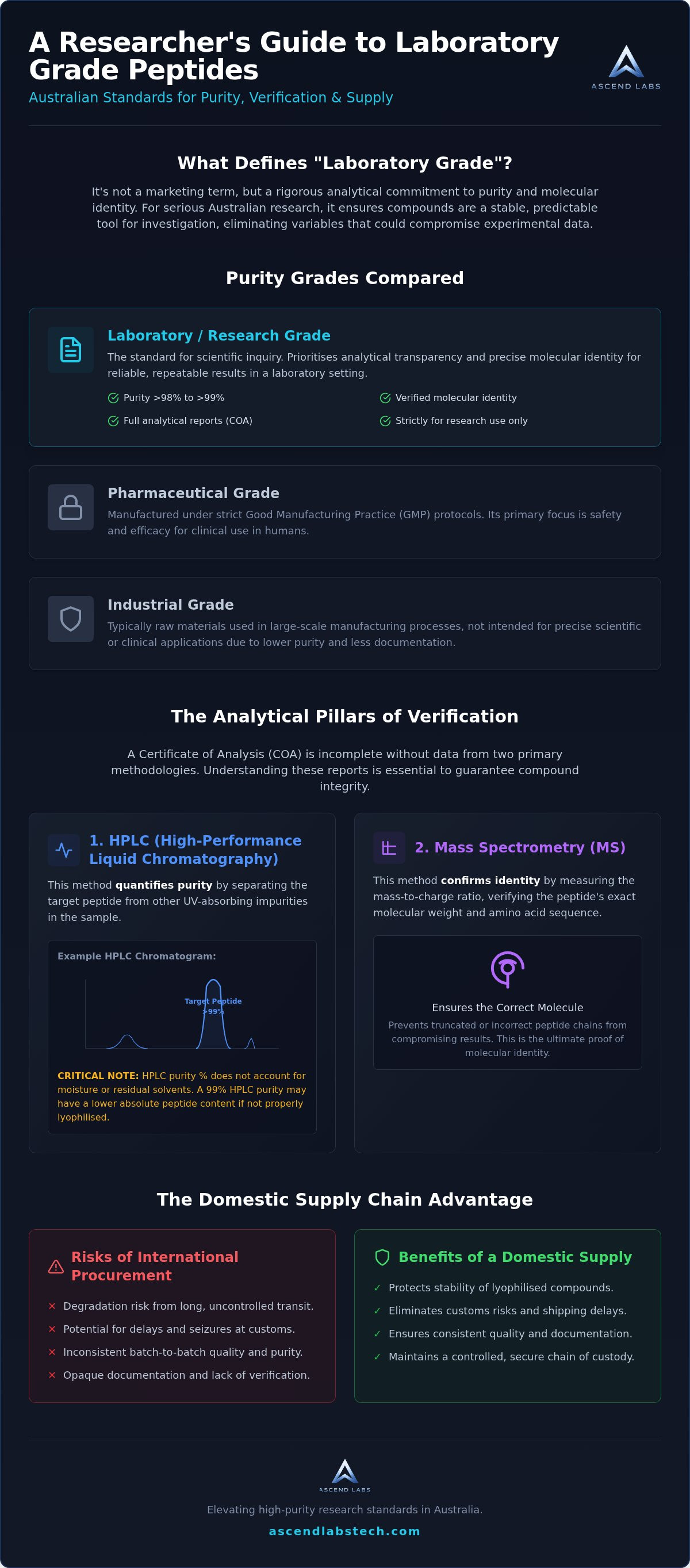
The primary differentiator between research and pharmaceutical grades lies in their regulatory framework and intended application. Pharmaceutical grade peptides are manufactured under strict Good Manufacturing Practice (GMP) for clinical use in humans. Conversely, research grade peptides prioritise analytical transparency and molecular precision for laboratory settings. In Australia, the mandate is clear: these compounds are strictly for research use only and are not for human consumption. This distinction ensures that the focus remains on scientific discovery rather than clinical administration, allowing for a more agile but equally rigorous verification process for advanced metabolic compounds. It's a standard built for the specialist who requires data over delivery systems.
Core Characteristics of High-Purity Research Peptides
Molecular weight verification serves as the first pillar of identity for any high-purity peptide. Accurate sequence mapping prevents the presence of truncated peptides, which are incomplete chains that can mimic the target molecule and skew results. Beyond the peptide itself, the presence of residual solvents, moisture, and counter-ions must be quantified. High-purity standards typically target a threshold of >98% purity, ensuring that the influence of impurities on biological assays is negligible. For Australian practitioners working with complex sequences like Retatrutide or KLOW, these core characteristics are non-negotiable benchmarks for reliability. Verification isn't just a step in the process; it's the foundation of the experiment's validity. To ensure your laboratory work is supported by the highest standards, you can visit Onyx Biolabs for laboratory grade research peptides.
The Analytical Pillars: HPLC, Mass Spectrometry, and COA Verification
Verification of laboratory grade peptides relies on two primary methodologies: High-Performance Liquid Chromatography (HPLC) and Mass Spectrometry (MS). HPLC quantifies the relative purity of the sample, while MS confirms the identity of the molecule itself. Without both, a Certificate of Analysis (COA) is incomplete. For researchers, understanding these reports is the only way to ensure that metabolic compounds like Tirzepatide or MOTS-C meet the required specifications. Precise data is the only currency that matters in a laboratory setting.
High-purity claims are often misunderstood by those outside the analytical field. HPLC purity refers only to the percentage of the target peptide relative to other UV-absorbing components. It does not account for moisture, residual solvents, or counter-ion salts. Consequently, a 99% HPLC purity rating might actually represent a lower absolute peptide content if the lyophilisation process was incomplete. This distinction is critical when calculating dosages for in-vitro or in-vivo research protocols.
Interpreting HPLC Chromatograms for Research Accuracy
HPLC works by separating components based on their chemical properties as they pass through a stationary phase. In a high-quality report, you should see a single, sharp peak with a clean, flat baseline. If the baseline is "noisy" or shows secondary peaks, it indicates the presence of impurities or truncated sequences. A common pitfall involves co-eluting impurities, where two different substances exit the column simultaneously. To achieve the highest degree of reliability, researchers should look for reports that adhere to established peptide reference standards. This ensures the separation method is robust enough to detect even subtle contaminants that could skew experimental results.
Mass Spectrometry: Confirming Molecular Integrity
While HPLC tells you how much of a substance is present, Mass Spectrometry confirms the identity of that substance. The report lists a theoretical mass, derived from the amino acid sequence, and an observed mass. These numbers must align within a narrow margin of error. The [M+H]+ peak is the most critical indicator; it represents the parent molecule with a single proton added. Significant deviations suggest the compound is either degraded or synthesised incorrectly. This level of scrutiny is essential to rule out cross-contamination between batches, which remains a significant risk in high-volume international manufacturing facilities.
A valid COA must be batch-specific. Many suppliers provide "typical" analysis reports that reflect an older batch rather than the one currently in your hands. Third-party testing offers an additional layer of security by removing the conflict of interest inherent in in-house manufacturer data. When evaluating a source, prioritise those who offer transparent, verifiable data for their metabolic research compounds. This commitment to transparency defines the technical standard for Australian research in 2026.
Purity Grades Compared: Research, Pharmaceutical, and Industrial Standards
Selecting the correct purity threshold is a critical decision that dictates the reliability of any experimental outcome. Not all synthetic products are equal. While crude materials might suffice for initial screenings, they are unsuitable for the meticulous requirements of advanced metabolic studies. Using sub-standard materials introduces impurities that can interfere with cell receptor binding, leading to false positives or data that cannot be replicated. In the Australian research context, where grant funding and peer review demand absolute transparency, the choice of laboratory grade peptides is a foundational requirement for any serious inquiry.
The hidden costs of utilising lower-grade peptides often manifest as wasted time and compromised assays. Impurities such as residual scavengers or incomplete deprotection can alter the chemical environment of a study, forcing researchers to troubleshoot variables that should have been controlled at the point of procurement. Precision demands purity. By prioritising verified standards, practitioners ensure that the biological responses observed are a direct result of the peptide sequence rather than a reaction to synthesis by-products.
The Hierarchy of Peptide Purity
Peptide purity is categorised into tiers based on the extent of post-synthesis purification. Crude peptides, typically containing 50% to 70% of the target sequence, are primarily utilised for initial epitope mapping or high-throughput work where cost prioritisation outweighs the need for precision. As the requirement for specificity increases, so does the necessary purity level. A 95% threshold is the standard for generating antibodies or conducting general research. However, for structural analysis or metabolic inquiry, the industry benchmark shifts to 98% or 99% purity. When evaluating these tiers, researchers should consult the Peptide Guidance regarding impurity profiles, as these contaminants often consist of truncated sequences or chemically modified versions of the target molecule that can skew sensitive results.
Why 99% Purity is Essential for Advanced Studies
Studies involving advanced metabolic research compounds, such as Retatrutide, necessitate the highest available purity. Minor impurities aren't just inert fillers; they can act as unintended agonists or antagonists at the receptor level. This creates off-target effects that mask the true biological activity of the peptide. For Australian longitudinal research programmes, reproducibility is paramount. If the purity of a compound fluctuates between batches, the data becomes skewed, rendering long-term comparisons invalid. High-purity laboratory grade peptides also exhibit superior stability during storage. Acidic or basic impurities can accelerate the degradation of the peptide bond over time, but a 99% pure compound remains stable for longer, preserving the integrity of the research from the first day of the study to the final analysis.
Procurement Logistics: Stability, Storage, and Domestic Chain of Custody
The stability of laboratory grade peptides is inherently fragile. These delicate sequences of amino acids are susceptible to degradation from thermal fluctuations, UV exposure, and mechanical stress. Ensuring the integrity of the compound requires more than just high-purity synthesis; it demands a rigorous logistical framework that prioritises a secure domestic chain of custody. For Australian researchers, the geographical distance from international manufacturing hubs presents a significant challenge to molecular stability. When a compound is exposed to uncontrolled environments during transit, the risk of peptide denaturation increases, potentially rendering experimental results invalid.
Navigating the Australian research chemical landscape securely involves understanding the vulnerability of these materials. Domestic supply chains act as a critical gatekeeper, ensuring that compounds don't spend weeks in customs warehouses or transit hubs where temperature control is often neglected. A transparent, local procurement model allows for precise tracking and faster delivery, which is essential for maintaining the analytical standards established during the manufacturing phase. Precision in the lab begins with precision in the supply chain.
Maintaining the Cold Chain in the Australian Climate
Lyophilisation, or freeze-drying, is the standard method for stabilising peptides for transport. This process removes moisture through sublimation, leaving a stable "cake" that resists degradation at room temperature for short periods. However, prolonged exposure to the intense Australian climate during transit can compromise the peptide's secondary structure. International procurement often involves multiple customs checkpoints and varying storage conditions, increasing the risk of thermal stress. By opting for a domestic-only supply chain, researchers can significantly reduce the time a compound spends in transit. For more detailed insights into local logistics, consult our Peptide Supply Australia: Research Procurement Guide. Domestic shipping ensures that the period between the climate-controlled facility and the end-user is as brief as possible, preserving the molecular integrity of the material.
Secure Handling and Reconstitution Protocols
Upon arrival, laboratory grade peptides should be transferred immediately to a controlled environment. For short-term use, storage at 2-8°C is sufficient, but long-term preservation requires temperatures of -20°C or below to prevent hydrolysis. Reconstitution is the most critical phase of handling. The use of bacteriostatic water is essential for research stability, as it contains 0.9% benzyl alcohol to inhibit bacterial growth, which is vital for multi-use vials in a laboratory setting. When preparing compounds like MOTS-C, researchers must avoid vigorous agitation; the mechanical force can denature the peptide and alter its biological activity. Detailed handling instructions can be found in our resource on how to Purchase MOTS-C Australia: A Technical Resource. Following these protocols ensures that the compound remains chemically active and the data remains reliable.
Secure your project's integrity by choosing metabolic research compounds verified for the highest purity and handled with technical precision.
Ascend Labs: Elevating High-Purity Research Standards in Australia
Ascend Labs operates as a disciplined curator in the Australian biotechnology sector, providing a reliable domestic source for high-purity compounds. We've built our operation on a "Substance Over Style" philosophy, prioritising rigorous analytical data over marketing hyperbole. In an environment where batch consistency is often compromised by international logistics, we act as an authoritative gatekeeper for the scientific community. Our commitment ensures that every vial of laboratory grade peptides delivered to a researcher meets the exacting standards required for reproducible results. We don't just supply chemicals; we provide the foundational integrity required for serious inquiry.
Supporting the Australian research sector requires more than just supply. It demands a deep immersion in quality assurance. We maintain a strict 99%+ purity benchmark for our primary compounds, verified through batch-specific analysis. This meticulous approach eliminates the risks associated with overseas procurement, such as customs delays or thermal degradation during transit. By focusing exclusively on domestic supply, we preserve the chemical integrity of our materials from the point of verification to the laboratory bench. It's a standard built for specialists who value data and precision above all else.
A Specialised Catalogue for Advanced Research
Our curated range focuses on advanced metabolic research compounds that are central to contemporary inquiry. The catalogue includes high-demand sequences such as Retatrutide and Tirzepatide, alongside specialised compounds like KLOW and MOTS-C. Beyond metabolic studies, we provide a sophisticated selection of Growth Factor Peptides and Neuromodulator Peptides designed for recovery and neurological research. Practitioners choose Ascend Labs because we understand that the precision of their work depends on the precision of our molecules. Every compound in our range is strictly for research use only and is not for human consumption, maintaining the clear boundary required for professional scientific practice.
Transparency and Integrity in Australian Supply
Transparency is the cornerstone of our operational ethics. Every domestic batch undergoes a rigorous verification process to confirm its molecular identity and purity. We provide the technical data researchers need to execute their studies with total confidence, ensuring that no experimental variables are introduced by the material itself. Our goal is to provide a seamless, verified procurement path that allows the Australian scientific community to focus entirely on their research objectives. You can explore our full range of laboratory grade peptides by following this link to View the Ascend Labs Research Catalogue.
Securing Analytical Certainty in Australian Research
The integrity of scientific inquiry in 2026 demands more than just access to compounds; it requires an uncompromising commitment to analytical verification. By prioritising clinical-grade HPLC and Mass Spectrometry data, researchers ensure their results are built on a foundation of absolute molecular identity. This standard is further reinforced by a secure domestic chain of custody, which protects the stability of fragile sequences from the degradation risks inherent in international transit. Choosing verified laboratory grade peptides is the critical first step in eliminating experimental variables and ensuring reproducibility in complex metabolic studies.
Ascend Labs remains 100% Australian owned and operated, specialising in advanced metabolic research compounds with meticulous batch-specific verification. We're dedicated to providing the transparency and technical precision that the Australian scientific community requires for success. Browse the Ascend Labs High-Purity Catalogue to secure the integrity of your next project. We look forward to supporting your scientific objectives with the precision your work deserves.
Frequently Asked Questions
What exactly defines a peptide as "laboratory grade"?
A peptide is classified as laboratory grade when it meets a specific threshold of chemical purity, typically exceeding 98%, and is accompanied by comprehensive analytical verification. This designation ensures the material is suitable for precise scientific modelling by eliminating confounding variables. It distinguishes these compounds from industrial raw materials. Every batch of laboratory grade peptides must undergo rigorous testing to confirm its amino acid sequence and molecular identity before it's considered fit for research applications.
How do I verify the purity of a peptide batch from the COA?
Verification requires a dual-pronged approach: examining the High-Performance Liquid Chromatography (HPLC) chromatogram and the Mass Spectrometry (MS) report. The HPLC results should display a single, sharp peak with a clean baseline, indicating the relative purity of the peptide. Simultaneously, the MS data must show an observed molecular mass that aligns with the theoretical mass of the sequence. Always ensure the Certificate of Analysis is batch-specific rather than a generic template from the manufacturer.
Why is domestic shipping important for peptide stability in Australia?
Domestic shipping is critical because it significantly reduces the time a compound spends in transit and minimises exposure to uncontrolled thermal environments. Peptides are fragile molecules that can denature when subjected to the intense Australian climate or prolonged customs delays. By utilising a domestic supply chain, researchers maintain a tighter chain of custody. This ensures the lyophilised cake remains stable and the molecular integrity of the compound is preserved until it reaches the laboratory.
Can laboratory grade peptides be used for human consumption?
No, these compounds are strictly not for human consumption and are intended for in-vitro or in-vivo research use only. In Australia, laboratory grade peptides are classified as research chemicals. They aren't manufactured under the specific Good Manufacturing Practice (GMP) protocols required for clinical administration. Adhering to this distinction is essential for maintaining professional ethical standards and complying with the regulatory framework established by the Therapeutic Goods Administration for unapproved substances.
What is the difference between HPLC purity and absolute purity?
HPLC purity represents the percentage of the target peptide relative to other UV-absorbing impurities detected during chromatography. It's a relative measurement. Absolute purity is a more comprehensive metric that accounts for non-UV-absorbing contaminants, including residual water, counter-ions, and salts. A sample might show 99% HPLC purity but possess a lower absolute peptide content if the lyophilisation process left significant residual moisture or TFA salts within the vial.
How should I store lyophilised peptides to ensure maximum shelf-life?
Lyophilised peptides should be stored in a temperature-controlled environment, ideally at -20°C or -80°C for long-term preservation. For short-term experimental use, refrigeration at 2-8°C is acceptable, provided the vials are kept away from light and moisture. It's vital to allow the vial to reach room temperature before opening. This prevents atmospheric moisture from condensing on the powder, which can lead to rapid hydrolytic degradation of the peptide bonds.
What are the common impurities found in lower-grade research peptides?
Lower-grade peptides often contain truncated sequences, which are incomplete chains formed during synthesis that can mimic the target molecule. Other common contaminants include residual solvents like acetonitrile, scavengers used during deprotection, and high levels of counter-ions like trifluoroacetic acid (TFA). These impurities aren't just inert; they can interfere with cell receptor binding or cause unexpected toxicity in biological assays, ultimately compromising the reliability and reproducibility of your research data.
Does Ascend Labs provide third-party verification for all compounds?
Yes, Ascend Labs provides batch-specific verification for all compounds in our catalogue to ensure they meet our 99% purity benchmark. We prioritise transparency by offering the analytical data researchers need to validate their experimental variables. This includes detailed HPLC and Mass Spectrometry reports for advanced metabolic and recovery compounds. By acting as a domestic gatekeeper, we ensure that every compound we supply adheres to the highest technical standards in the Australian market.


