

The distinction between a breakthrough and a failed study often rests on the precision of the metabolic pathway targeted. In the rigorous climate of 2026, conducting klow vs mots-c research isn't merely a matter of general metabolic interest; it's a requirement for absolute biochemical specificity. You likely recognise that while both compounds influence cellular energy, the overlap in metabolic claims often creates unnecessary noise during the experimental design phase. It's difficult to maintain scientific integrity when sourcing high-purity compounds within Australia remains a logistical challenge.
This analysis provides a technical evaluation of these distinct chemical profiles, focusing on the specific mechanistic differences between AMPK activation and multifaceted longevity pathways. We promise to clarify the confusion surrounding these compounds by providing a framework for selecting the appropriate peptide for your specific study. We'll examine the distinct research applications for each, alongside the HPLC verification standards required to maintain integrity within Australian laboratories. By the end of this briefing, you'll have a clear understanding of how to differentiate these tools for your metabolic investigations, ensuring your data remains robust and reproducible.
Key Takeaways
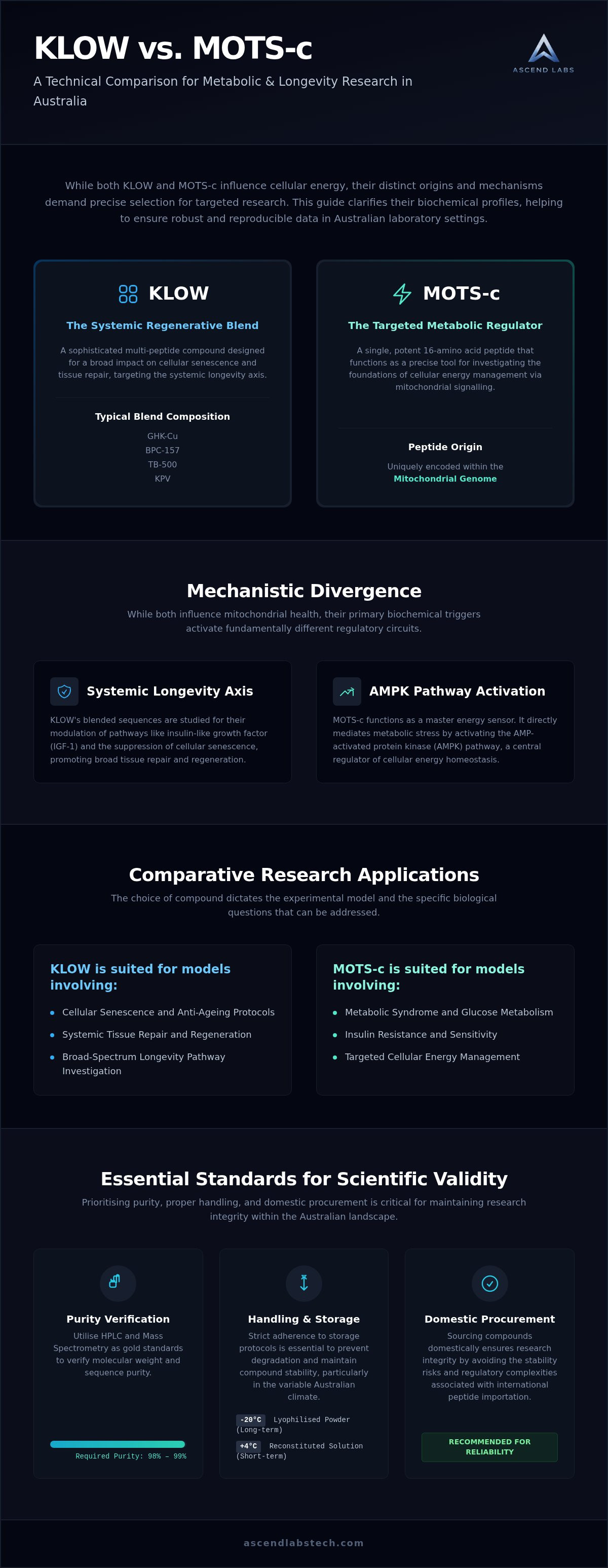
- Distinguish between the mitochondrial DNA-encoded signalling of MOTS-C and the multi-peptide regenerative profile of the KLOW blend for precise experimental targeting.
- Examine the mechanistic divergence in klow vs mots-c research, specifically how MOTS-C utilizes the AMPK pathway compared to the systemic longevity axis of KLOW.
- Evaluate the suitability of each compound for specific research models, ranging from metabolic syndrome and insulin resistance to cellular senescence and tissue repair.
- Prioritise scientific validity by utilizing HPLC and Mass Spectrometry verified compounds that meet the rigorous purity standards of Australian laboratory environments.
- Ensure research integrity through domestic procurement, avoiding the stability risks and regulatory complexities associated with international peptide importation.
Defining KLOW and MOTS-C in Mitochondrial Research
Mitochondria act as critical sensors of cellular homeostasis, exerting influence far beyond ATP production. They utilise mitochondrial-derived peptides (MDPs) as retrograde signalling molecules, allowing the organelle to communicate directly with the nucleus. This communication pathway is central to current klow vs mots-c research, as laboratories seek to understand how these compounds modulate metabolic and regenerative responses. The conceptual framework for comparing these molecules involves distinguishing between targeted mitochondrial signalling and broader systemic repair protocols.
The primary subject of many mitochondrial studies is MOTS-c (mitochondrial open reading frame of the 12S rRNA-c). This 16-amino acid peptide is uniquely encoded within the mitochondrial genome rather than the nuclear DNA. It functions as a potent metabolic regulator, specifically translocating to the nucleus during times of metabolic stress to promote adaptive gene expression. It's a precise tool for researchers investigating the foundations of cellular energy management.
In contrast, the KLOW research compound represents a sophisticated multi-peptide approach. While its nomenclature suggests an association with the Klotho longevity axis, laboratory applications of KLOW in 2026 focus on its specific blend of regenerative sequences. It typically incorporates GHK-Cu, BPC-157, TB-500, and KPV. These components are studied for their collective impact on cellular senescence and tissue repair, providing a broader experimental scope than the targeted metabolic signalling of MOTS-C.
The Origins of Mitochondrial Signalling
Mitochondrial communication via MDPs was significantly redefined following the discovery of MOTS-C by Lee and Cohen in 2015. Their work established that mitochondria could actively signal the nucleus to adjust systemic insulin sensitivity and glucose metabolism. This discovery shifted the focus of anti-ageing research from purely nuclear-driven processes to the retrograde signalling capacity of the mitochondria. KLOW-related sequences have since emerged as complementary tools, allowing researchers to investigate how mitochondrial health intersects with broader systemic repair mechanisms.
Chemical Composition and Stability
Maintaining the integrity of these peptides requires strict adherence to laboratory protocols, particularly within the variable Australian climate. MOTS-C is a relatively small, 16-amino acid chain with a high degree of sensitivity to temperature fluctuations. KLOW, being a blend of distinct peptide sequences, presents a more complex stability profile that demands meticulous handling. High-purity standards are essential for reliable data.
- Storage: Lyophilised powders must be kept at -20°C for long-term stability.
- Reconstitution: Once reconstituted, peptides should be stored at 4°C and used within a specific experimental window to prevent degradation.
- Verification: HPLC and Mass Spectrometry are the gold standards for ensuring that the molecular weight and sequence purity meet the 98% to 99% benchmarks required for valid scientific inquiry.
The choice between these compounds depends on whether the study aims to isolate mitochondrial-nuclear signalling or evaluate a synergistic regenerative response.
Mechanistic Divergence: AMPK vs. Klotho Pathways
The fundamental distinction between these research compounds lies in their primary biochemical triggers. While both are involved in mitochondrial health, they activate different regulatory circuits to maintain cellular homeostasis. Understanding this divergence is essential for experimental accuracy in klow vs mots-c research, as the choice of compound determines whether a study targets acute energy sensing or long-term systemic regulation.
Mitochondrial-derived peptides like MOTS-C prioritise metabolic equilibrium through the AMP-activated protein kinase (AMPK) pathway. In contrast, the pathways associated with KLOW focus on the modulation of insulin-like growth factor (IGF-1) and the suppression of cellular senescence. These mechanisms influence the cell in fundamentally different ways, dictating their suitability for specific laboratory models.
MOTS-C: The Master Energy Sensor
MOTS-C functions as a direct mediator of metabolic stress. When cellular energy levels drop, MOTS-C activates AMPK, which serves as the cell’s primary fuel sensor. This activation promotes adaptive gene expression, specifically enhancing glucose uptake and stimulating fatty acid oxidation in-vitro. Beyond immediate energy management, MOTS-C plays a vital role in mitochondrial biogenesis, allowing researchers to study the expansion of mitochondrial networks in response to metabolic challenges. It is a precise tool for investigating the foundations of metabolic flexibility and insulin sensitivity.
KLOW: The Longevity Axis Regulator
KLOW research focuses on a broader regulatory scale, primarily through its interaction with the Klotho protein. This protein is recognised for the multifaceted roles of Klotho in managing phosphate homeostasis via FGF23 signalling and protecting the cell from oxidative damage. Unlike the rapid energy shifts triggered by MOTS-C, KLOW-mediated pathways involve the long-term modulation of IGF-1 signalling. This interaction is critical in studies of cellular senescence, where the objective is to observe the inhibition of inflammatory markers and the preservation of tissue integrity. It's often selected for models investigating the systemic markers of biological ageing.
The choice between these tools depends on the specific biological target of the inquiry. MOTS-C addresses the immediate energetic state, whereas KLOW provides a framework for investigating the underlying longevity axis. For Australian investigators conducting high-precision studies, sourcing metabolic research compounds with verified analytical standards is the only way to ensure data reproducibility across these complex pathways.
Comparative Analysis: Metabolic Regulation vs. Longevity Protocols
The selection process in klow vs mots-c research requires a precise alignment between the compound's biochemical profile and the intended research model. While both peptides exert influence over mitochondrial health, their primary applications diverge when addressing specific metabolic or cognitive pathologies. Investigators must distinguish between the acute energetic modulation required for metabolic syndrome models and the systemic regulatory oversight needed for longevity studies. This distinction ensures that the experimental data reflects the specific pathway under inquiry without confounding variables.
MOTS-C remains the superior tool for studies involving insulin resistance and metabolic flexibility. It activates AMPK indirectly, which facilitates glucose disposal and mimics the metabolic signature of physical exertion. For laboratories focusing on exercise-mimetic effects or the reversal of diet-induced obesity in-vitro, MOTS-C provides a direct lever for adjusting cellular fuel preferences. Its role in enhancing fatty acid oxidation makes it a foundational component of metabolic research protocols.
KLOW serves a distinct niche within neuroprotection and age-related cognitive decline research. Its association with the Klotho protein allows researchers to investigate the mitigation of oxidative stress within neural tissues. Studies targeting the preservation of synaptic plasticity and the inhibition of neuroinflammatory markers often prioritise KLOW due to its broader influence on the longevity axis. While MOTS-C manages the immediate energy budget, KLOW provides the framework for investigating the structural integrity of the ageing cell.
Selecting the Appropriate Research Compound
The decision to utilise one compound over the other rests on the specific cellular target. MOTS-C should be prioritised for models requiring rapid shifts in mitochondrial biogenesis or acute metabolic adaptation. KLOW is the superior choice for lifespan extension models where the objective is to observe the delay of cellular senescence. If the research goal involves the systemic regulation of IGF-1 or the suppression of the senescence-associated secretory phenotype (SASP), KLOW offers the necessary mechanistic depth.
Observed Synergy in Combined Studies
Theoretical frameworks in 2026 suggest significant synergistic potential when utilizing both compounds in a single research protocol. Co-administration may allow for a dual-layered approach: MOTS-C optimises the energetic efficiency of the mitochondria, while KLOW manages the systemic environment that dictates cellular lifespan. Establishing a dual-peptide protocol requires meticulous titration and HPLC-verified purity to ensure that the interactions remain predictable. This combined approach is particularly relevant in complex models of systemic metabolic failure where both energy production and structural signalling are compromised.
Research Standards: Purity Verification in the Australian Landscape
Scientific validity is inseparable from chemical purity. In the current 2026 research environment, investigators face significant risks when sourcing compounds without rigorous verification. A June 2026 poll indicated that testing of research peptides purchased online showed purity levels ranging from a negligible 1% to the required 100%. For those conducting klow vs mots-c research, these fluctuations represent more than a logistical hurdle; they are a direct threat to the reproducibility of experimental data. Australian laboratories must insist on comprehensive analytical documentation to ensure that observed metabolic effects are attributable to the peptide rather than residual solvents or truncated sequences.
The Certificate of Analysis (COA) serves as the authoritative gatekeeper in Australian research procurement. It acts as a transparent record of both HPLC and MS results, signed by the verifying chemist. Relying on vague quality claims is no longer sufficient for peer-reviewed inquiry. Serious investigators should prioritise metabolic research compounds that are accompanied by full, batch-specific analytical verification to maintain the highest standards of scientific integrity.
Navigating HPLC and Mass Spectrometry
High-Performance Liquid Chromatography (HPLC) is the primary method for determining the quantitative purity of a sample. When interpreting results for a complex blend like KLOW, the chromatogram should ideally display distinct, sharp peaks corresponding to each active constituent, with minimal baseline noise. Identifying impurities is critical. Even a 2% variance in purity can introduce confounding variables in-vitro, particularly in sensitive metabolic assays. For a detailed breakdown of these technical requirements, consult our HPLC Peptide Purity: Guide for Australian Researchers (2026).
Mass Spectrometry: The Gold Standard for Identity
While HPLC confirms how much of a substance is present, Mass Spectrometry (MS) confirms what that substance actually is. This is particularly vital for MOTS-C, a 16-amino acid peptide where the exact molecular mass must be verified to ensure the sequence hasn't been truncated during synthesis. MS provides the definitive molecular fingerprint required for high-stakes metabolic studies. You can explore the necessity of these verification layers in our briefing on Mass Spectrometry Verified Peptides: The Gold Standard for Australian Research.
Analytical precision is the only safeguard against the "garbage in, garbage out" phenomenon in biotechnology. By verifying the molecular weight and sequence identity through Mass Spectrometry, researchers can be confident that their MOTS-C samples contain the exact 16-amino acid structure encoded by mitochondrial DNA. This level of scrutiny is what separates disciplined scientific inquiry from speculative experimentation.
Procuring High-Purity Compounds for Domestic Scientific Inquiry
The final phase of any experimental design is the secure procurement of necessary chemical reagents. For investigators conducting klow vs mots-c research, the transition from a theoretical framework to laboratory application depends entirely on the stability of the compounds provided. Sourcing from a domestic Australian supplier offers a level of logistical oversight that international vendors cannot replicate. This proximity ensures that the biochemical integrity established during synthesis is preserved throughout the final mile of delivery, protecting the validity of the resulting data.
Establishing a long-term research chemical partnership requires more than just a transaction; it demands a shared commitment to transparency and meticulous quality control. As regulatory scrutiny in Australia increases throughout 2026, the value of a domestic partner that prioritises ethical operational discretion and technical accuracy becomes paramount. Reliable data starts with a reliable source, and for high-stakes metabolic studies, the supply chain is as critical as the hypothesis itself.
The Value of Domestic Supply Chains
Domestic supply chains eliminate the stability risks associated with prolonged international transit. Peptides like MOTS-C are sensitive to thermal fluctuations. Every hour spent in an unmonitored customs warehouse increases the probability of peptide degradation, which can lead to inconsistent in-vitro results. By utilising a local provider, laboratories benefit from climate-controlled domestic shipping that maintains the required temperature range from the facility to the benchtop. Bypassing the complexities of international customs also avoids the regulatory delays that often stall critical metabolic studies. Localised technical support further ensures that Australian researchers can access immediate clarification on batch-specific data or reconstitution protocols without navigating time-zone discrepancies.
Ascend Labs: A Partner in Scientific Discovery
Ascend Labs operates as an authoritative gatekeeper for high-purity research compounds, specifically tailored to the requirements of the Australian scientific community. Our catalogue features HPLC and Mass Spectrometry verified KLOW and MOTS-C, ensuring that every vial meets the rigorous 98% to 99% purity benchmarks required for valid peer-reviewed inquiry. We act as a principled institution committed to scientific truth, ensuring that every batch undergoes internal testing to guarantee clinical-grade purity before it enters our inventory. For a comprehensive guide on selecting a reliable partner in the current landscape, researchers should review the Reputable Peptide Supplier Australia: The 2026 Researcher’s Verification Checklist.
Our commitment to transparency is reflected in the provision of batch-specific Certificates of Analysis for all metabolic research compounds. By maintaining a domestic focus, we ensure that Australian laboratories have access to the precise tools needed for sophisticated metabolic signalling and longevity axis studies. This disciplined approach to supply allows investigators to focus entirely on their scientific objectives, confident in the chemical identity and purity of their research materials.
Advancing Metabolic Science in 2026
The evolution of mitochondrial-derived peptide studies requires a disciplined approach to compound selection. By distinguishing between the acute energy sensing of the AMPK pathway and the systemic longevity axis of Klotho-related signalling, investigators can better align their experimental models with specific biochemical outcomes. Success in klow vs mots-c research depends entirely on the accuracy of these mechanistic targets.
Scientific validity within the Australian landscape relies on rigorous analytical standards. Ensuring that your research materials are HPLC and Mass Spectrometry verified is the only way to eliminate confounding variables from your data. Domestic procurement further protects these standards by providing a climate-controlled supply chain that bypasses the instability of international transit.
As you refine your protocols for 2026, partnering with a supplier that prioritises clinical-grade transparency is essential. We invite you to Explore the Ascend Labs Research Catalogue to source specialised metabolic research compounds with guaranteed purity. Your commitment to precision is the foundation of tomorrow's breakthroughs.
Frequently Asked Questions
What is the primary difference between KLOW and MOTS-C in research?
The primary difference lies in their biochemical pathways and genomic origins. MOTS-C is a mitochondrial-derived peptide that directly activates AMPK to regulate energy metabolism. KLOW is a multi-peptide blend studied for its influence on the Klotho longevity axis and cellular senescence. While MOTS-C targets acute metabolic signalling, KLOW research focuses on broader systemic repair and the modulation of insulin-like growth factor pathways.
Can MOTS-C and KLOW be used together in the same study?
Combined protocols are increasingly common in complex klow vs mots-c research models. This dual approach allows investigators to observe the synergy between mitochondrial energy optimisation and systemic longevity signalling. Researchers typically titrate each compound separately to establish a baseline before observing their combined influence on mitochondrial biogenesis and cellular senescence markers in-vitro. It's a sophisticated method for studying multifaceted metabolic decline.
How should I store MOTS-C and KLOW to maintain purity in Australia?
Peptides require strict thermal management to prevent degradation in the Australian climate. Lyophilised powders should be stored at -20°C for long-term stability. Once you've reconstituted the compounds for laboratory use, keep them at 4°C and shield them from light. Using these materials within a specific experimental window is essential to ensure the chemical identity remains intact for your data; otherwise, thermal degradation may occur.
Is a Certificate of Analysis (COA) mandatory for research peptides?
A COA is essential for ensuring the scientific validity of your findings. It provides a transparent record of the batch-specific HPLC and Mass Spectrometry results required for peer-reviewed publication. Without this documentation, researchers cannot verify the purity or identity of their compounds. This lack of transparency introduces confounding variables that can compromise the reproducibility of an entire study, especially in sensitive metabolic assays.
What purity level is required for in-vitro mitochondrial studies?
Mitochondrial studies require a minimum purity level of 98%, though 99% is the preferred benchmark for high-precision inquiry. Even a small variance in purity can introduce residual solvents or truncated sequences that trigger unintended cellular responses. Using HPLC-verified compounds ensures that the observed metabolic effects are purely attributable to the peptide sequence under investigation. This standard is critical for maintaining the integrity of Australian laboratory results.
Does Ascend Labs provide mass spectrometry data for KLOW?
Ascend Labs provides comprehensive Mass Spectrometry and HPLC data for every batch of KLOW and MOTS-C. This verification confirms the exact molecular weight and sequence identity of each component within the blend. We act as a disciplined curator of research materials, ensuring that Australian laboratories receive only the most meticulously verified compounds. This data is provided to ensure researchers can proceed with their investigations with absolute confidence.
How long does domestic shipping take for research compounds in Australia?
We prioritise discreet domestic shipping to ensure the logistical integrity of your research materials. Most laboratories receive their orders within standard Australian transit times, typically ranging from one to three business days depending on the location. This rapid delivery model is designed to preserve peptide stability by reducing the time compounds spend in transit compared to international alternatives. It's a more secure logistical framework for sensitive metabolic reagents.
Are KLOW and MOTS-C peptides legally restricted for research use in Australia?
These compounds are regulated under the Therapeutic Goods Act 1989 and are strictly for in-vitro laboratory research. They aren't approved for human consumption. Australian regulators have made unapproved peptides a compliance priority in 2026. It's essential to source from a domestic supplier that adheres to these professional standards to ensure your laboratory remains compliant with current national guidelines. This ensures scientific inquiry remains within the established regulatory framework.


