

If your Certificate of Analysis claims 99% purity, can you confidently identify the baseline noise or secondary peaks that might suggest otherwise? For many Australian researchers, the challenge is no longer just sourcing compounds but distinguishing between authentic laboratory data and sophisticated forgeries. Relying on international suppliers often introduces unacceptable lead times and opaque quality assurance protocols, making it difficult to secure hplc verified peptides australia that meet international benchmarks. Scientific integrity is compromised when the validity of your in-vitro data depends on a document you cannot fully audit.
We understand that scientific rigour requires more than just taking a label at face value. To maintain the highest standards in your laboratory, you must be able to interpret the raw data yourself. This guide provides a technical framework for analysing HPLC and Mass Spectrometry results, ensuring you have the expertise to verify research compounds with absolute precision. We will examine the critical distinctions between purity and identity, helping you select domestic suppliers that prioritise clinical-grade transparency and meticulous batch testing.
Key Takeaways
- Establish a technical baseline for purity by understanding why a minimum threshold of 98–99% is essential for viable in-vitro research data in Australia.
- Develop the analytical skills required to interpret complex chromatograms and distinguish primary compound peaks from secondary baseline noise.
- Identify the sophisticated red flags of forged or recycled Certificates of Analysis to ensure you are consistently sourcing genuine hplc verified peptides australia.
- Implement a methodical, step-by-step protocol for validating every batch of research material before it enters your laboratory environment.
- Recognise the critical role of domestic supply chains in preserving the chemical integrity and document transparency of sensitive metabolic research compounds.
Understanding HPLC Verification in the Australian Research Sector
In the Australian research sector, the integrity of in-vitro studies depends entirely on the chemical fidelity of the compounds used. High-performance liquid chromatography (HPLC) serves as the primary analytical benchmark for this verification. It's a sophisticated chromatographic technique used to isolate and quantify peptide molecules within a complex sample. By forcing a liquid solvent through a column filled with adsorbent material, the process separates components based on their unique interactions with the stationary phase. This level of granularity is essential for researchers who require hplc verified peptides australia to ensure their data remains untainted by unexpected chemical variables.
Australian standards for laboratory inquiry generally dictate a minimum purity threshold of 98% to 99%. Anything below this baseline introduces a high risk of experimental noise that can invalidate a study's conclusions. Verification isn't just about confirming the peptide's presence; it's about ensuring that residual solvents, moisture, or scavengers like Trifluoroacetic acid (TFA) are within strictly defined limits. These contaminants are often byproducts of the solid-phase peptide synthesis (SPPS) process and must be meticulously removed to meet domestic quality benchmarks.
Why Purity Standards Matter for Scientific Rigour
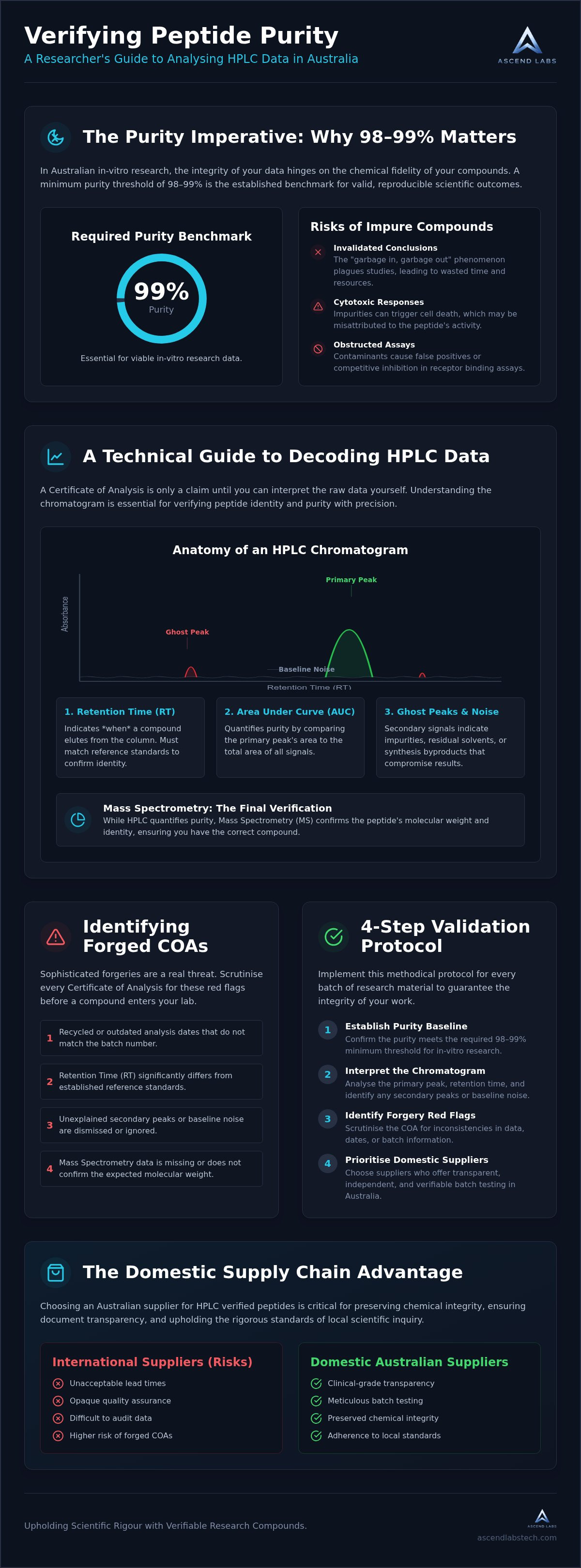
Experimental precision is non-negotiable in biotechnology. Impure compounds frequently trigger cytotoxic responses in cellular models, leading to cell death that researchers might misattribute to the peptide’s biological activity. Contaminants can also obstruct receptor binding assays, causing false positives or competitive inhibition that derail months of investigation. For results to be reproducible across different laboratories, consistent batch-to-batch purity must be maintained through rigorous quality assurance. This discipline protects the researcher from the "garbage in, garbage out" phenomenon that plagues less rigorous studies.
The Role of HPLC in Research-Grade Compounds
HPLC provides a quantitative profile of a compound’s chemical cleanliness, acting as a final gatekeeper before a sample enters the lab. It measures the exact concentration of the target peptide—such as Tirzepatide or MOTS-C—relative to all other detected substances in the vial. This data allows a disciplined researcher to audit the chemical profile of their materials before beginning a study. When sourcing hplc verified peptides australia, the goal is a singular, sharp peak on the chromatogram that represents a high-fidelity research compound intended strictly for in-vitro application. Ascend Labs maintains these standards by providing independent batch testing for every compound in our specialised metabolic and growth factor catalogue, ensuring all products are sold for research purposes only.
A Technical Guide to Interpreting HPLC and Mass Spectrometry Data
Technical data provides the bedrock for experimental reproducibility. An HPLC report is only as valid as the researcher’s ability to interpret the resulting chromatogram. For those sourcing hplc verified peptides australia, the document must be scrutinised to ensure the primary peak accurately represents the target compound, such as Retatrutide or Tirzepatide. Without this analytical rigour, a certificate remains a mere claim rather than a verified fact. Laboratory integrity requires a deep immersion in the raw data to confirm that the materials used in your study meet the necessary purity thresholds.
Analysing the HPLC Chromatogram
The first metric of interest is the Retention Time (RT). This value indicates exactly when a compound elutes from the chromatographic column under specific conditions. If the RT for a sample of MOTS-C differs significantly from established reference standards, it suggests a potential identity mismatch or a change in chemical properties. Purity is then quantified through the Area Under the Curve (AUC) method. By integrating the total area of the primary peak and comparing it to the cumulative area of all detected signals, a percentage of purity is derived. Researchers must also remain vigilant for "ghost peaks" or secondary signals. These signals often indicate the presence of residual solvents or synthesis byproducts that could compromise in-vitro cellular responses.
Identity Verification via Mass Spectrometry
While HPLC establishes the concentration of the target molecule, it cannot definitively confirm its identity. Mass Spectrometry (MS) must accompany HPLC to verify that you actually have the correct molecule. This process involves ionising the sample and measuring the mass-to-charge ratio of the resulting ions. The observed molecular weight is then compared against the theoretical mass of the peptide. For instance, in mitochondrial peptide research, even a minor variance in the mass profile of MOTS-C can signal the presence of truncated sequences or amino acid substitutions. This level of verification is essential to prevent the use of mislabelled compounds in complex assays.
Adhering to the TGA's guidance on analytical validation provides a framework for these laboratory expectations. Ascend Labs facilitates this transparency by providing detailed reports for every compound in our collection. Researchers can access our catalogue of metabolic research compounds to review batch-specific data for materials intended strictly for research purposes. This methodical approach ensures that your inquiry is supported by verifiable chemical truths, maintaining the high-end standard required for Australian scientific inquiry.
Identifying Forged or Outdated Certificates of Analysis (COA)
The Australian research landscape is currently navigating a period of heightened regulatory scrutiny. In June 2026, the Therapeutic Goods Administration (TGA) prioritised unapproved peptides as a compliance focus, making document accuracy more critical than ever for legitimate inquiry. For researchers seeking hplc verified peptides australia, the challenge is no longer just finding a supplier, but auditing the veracity of the documentation provided. The Australian market is frequently flooded with recycled or photoshopped Certificates of Analysis (COA) that do not reflect the actual contents of the vial. Scientific integrity is compromised when a researcher relies on a document that has been digitally altered to meet marketing claims.
Red Flags in Peptide Documentation
Blurred text or inconsistent fonts on a PDF report are immediate indicators of digital manipulation. Sophisticated researchers scrutinise the alignment of headers and the resolution of the chromatogram; if the data appears pixelated while the surrounding text is sharp, the report has likely been altered. A legitimate COA must also feature a batch number that corresponds exactly to the label on the physical vial. This link ensures that the data you're reviewing actually belongs to the compound in your hand. If a supplier refuses to provide the full raw data file or a high-resolution version of the report upon request, the compound's purity should be considered unverified. Transparency is a requirement, not an optional service.
The Problem with Generic Manufacturer Reports
Many vendors operate as mere intermediaries, passing on generic manufacturer reports from overseas factories without conducting independent verification. These reports often lack the specific date and laboratory credentials required for a high-fidelity audit. A primary trust signal is the temporal consistency between the HPLC analysis date and the purchase date. If a report is over six months old, it's unlikely to represent the current batch. Independent third-party testing within Australia provides an essential layer of security, ensuring that the compound has been evaluated by a recognised analytical institution. This process identifies potential degradation that may have occurred during international transit. Ascend Labs acts as a disciplined curator, performing independent batch testing on all metabolic research compounds to ensure our data remains transparent and current. All compounds, including Retatrutide and MOTS-C, are provided strictly for in-vitro research purposes, supported by documentation that meets rigorous Australian standards.
Step-by-Step Protocol for Validating Peptide Purity Standards
A rigorous verification protocol is the only safeguard against the variability of the global research chemical market. For the Australian scientific community, this process must be methodical; it begins long before a vial reaches the laboratory bench. Verification is not a single event but a continuous chain of custody that ensures the integrity of your in-vitro data. By following a structured sequence, researchers can mitigate the risks of chemical degradation and document fraud. Ascend Labs organises its operation to support this level of scrutiny, positioning itself as a disciplined partner for those who require hplc verified peptides australia for their inquiry.
Phase 1: Pre-Purchase Supplier Audit
Before any transaction occurs, a researcher must perform a thorough audit of the supplier’s quality assurance standards. Request a sample Certificate of Analysis (COA) for the specific batch of retatrutide or other metabolic compounds you intend to study. It's essential to confirm that the supplier offers domestic Australian shipping. International transit often involves significant thermal fluctuations and customs delays that can compromise the cold-chain integrity of sensitive peptides. A legitimate supplier will provide both HPLC and Mass Spectrometry data as standard, allowing you to verify both purity and molecular identity before the compound leaves the facility. These materials are provided strictly for research purposes only, and the documentation should reflect this specialised application.
Phase 2: Post-Arrival Batch Verification
The arrival of the compound marks the second phase of the protocol. Immediate visual and data-driven cross-referencing is required to maintain laboratory standards. The batch ID printed on the physical vial must correspond exactly to the provided HPLC report; any discrepancy here is a primary red flag. Inspect the physical state of the lyophilised powder. High-quality research peptides should appear as a white, uniform "cake" or fine powder. Any signs of discolouration or a "melted" appearance suggest moisture ingress or thermal stress during transit. Once the physical and document checks are complete, store the vials at -20°C immediately. This preservation step is vital to maintain the purity level verified in the HPLC report. To ensure your laboratory is equipped with high-fidelity materials, you can view our metabolic research compounds and review the batch-specific data we provide for every compound in our catalogue.
Ascend Labs: Meticulous Standards for Australian Scientific Inquiry
Ascend Labs operates as a principled institution for the Australian scientific community. We act as an authoritative gatekeeper of peptide quality; our role is to curate a catalogue where chemical truth is the only metric of success. For researchers who require hplc verified peptides australia, we provide a domestic supply chain that eliminates the risks associated with international transit and customs interference. Professional ethics and operational discretion are the foundational pillars of our service, ensuring that every compound arrives with the exhaustive documentation necessary for serious inquiry. We don't just provide chemicals; we provide a reliable foundation for scientific discovery.
The Ascend Labs Quality Assurance Framework
Our commitment to integrity is reflected in a rigorous verification process that prioritises raw data over superficial marketing claims. Every compound in our collection undergoes independent analytical testing to ensure a minimum purity threshold of 99%. We understand that in-vitro studies depend entirely on this level of precision. By maintaining a strict domestic focus, we ensure that sensitive compounds like MOTS-C and KLOW are not subjected to the thermal stress of global shipping. This approach preserves the chemical fidelity established during the initial synthesis, providing researchers with the high-fidelity substance they require for reproducible results.
Accessing the Research Catalogue
The Ascend Labs catalogue is designed for specialists who value precision and technical depth. Our range includes metabolic research compounds, recovery peptides, and neuromodulator sequences, all provided strictly for laboratory research. The catalogue is structured to facilitate the verification protocols discussed in this guide, offering transparent access to the following:
- Technical specifications for triple-agonist compounds like Retatrutide.
- Batch-specific data including Mass Spectrometry and HPLC reports for Tirzepatide.
- Specialised mitochondrial sequences such as MOTS-C, verified for molecular identity.
Researchers can secure their laboratory requirements through our sophisticated online portal. This system provides direct access to hplc verified peptides australia without the significant lead times typical of international vendors. Every product we offer is intended strictly for in-vitro application, supported by a transparent verification framework that meets the highest Australian standards. By choosing a domestic partner that values scientific truth above all else, you protect the integrity of your research and the validity of your experimental outcomes.
Securing the Future of Australian Laboratory Inquiry
The integrity of your research depends on the chemical fidelity of your materials. By mastering the interpretation of HPLC and Mass Spectrometry data, you move beyond passive reliance on labels and toward active analytical verification. This expertise ensures that your cellular models and assays aren't compromised by the "garbage in, garbage out" phenomenon caused by synthesis byproducts or thermal degradation during transit. Sourcing hplc verified peptides australia from a domestic partner further secures your inquiry by maintaining strict cold-chain integrity and providing transparent, batch-specific documentation that meets 2026 regulatory expectations.
Ascend Labs remains committed to acting as a disciplined curator for the scientific community. Our framework prioritises independent HPLC and Mass Spec verification, clinical-grade purity standards, and secure domestic Australian shipping to ensure your laboratory receives only high-fidelity compounds. This methodical approach protects the reproducibility of your work and the long-term validity of your findings. We invite you to View the Ascend Labs Research Catalogue to secure the precise compounds required for your next phase of in-vitro inquiry. Your pursuit of scientific truth deserves a foundation of absolute chemical certainty.
Frequently Asked Questions
What is the minimum HPLC purity required for research peptides in Australia?
Australian research standards generally dictate a minimum purity threshold of 98% to 99% for viable in-vitro inquiry. Compounds that fall below this baseline introduce an unacceptable risk of cytotoxic noise or receptor binding interference, which can invalidate experimental results. Maintaining this clinical-grade standard is essential for ensuring that your laboratory data is both accurate and reproducible across different studies.
How often should a peptide supplier update their HPLC reports?
A supplier must provide a new HPLC report for every individual synthesis batch. Purity is a variable that can fluctuate between runs, meaning a report from a previous lot cannot be used to verify current inventory. If a Certificate of Analysis is more than six months old, it's likely no longer representative of the active stock, and a fresh analytical audit should be requested to maintain scientific rigour.
Can I trust an HPLC report provided by the manufacturer?
Relying solely on manufacturer-provided data is often insufficient for high-fidelity research. Independent, third-party verification in Australia provides a necessary layer of objectivity and confirms that the compound hasn't degraded during transit from the factory. Sophisticated researchers prioritise suppliers who act as disciplined curators, performing their own batch testing to ensure document transparency and chemical integrity.
What is the difference between HPLC and Mass Spectrometry?
HPLC and Mass Spectrometry serve two distinct but complementary analytical functions. HPLC measures the purity of a sample by quantifying the concentration of the target peptide relative to other substances. Mass Spectrometry confirms the actual identity of the molecule by measuring its molecular weight; this ensures the compound you're using is the correct sequence and not a truncated or mislabelled analogue.
How do I know if a peptide Certificate of Analysis (COA) is fake?
Identifying a forged COA requires a meticulous inspection of the document's digital integrity. Red flags include inconsistent fonts, blurred chromatograms, or pixelated logos that suggest the report has been altered. You should also cross-reference the batch ID on the vial with the report and verify the credentials of the testing laboratory to ensure they are a recognised analytical institution.
Why is domestic Australian supply important for peptide purity?
Domestic supply is vital for preserving the cold-chain integrity and document accuracy of hplc verified peptides australia. International shipping frequently exposes sensitive compounds to extreme thermal fluctuations and customs delays that can trigger peptide degradation. Sourcing within Australia ensures that the purity verified in the lab is maintained throughout the final leg of logistics, protecting the fidelity of your research materials.
Is HPLC verification necessary for all types of research peptides?
Analytical verification is necessary for every compound intended for laboratory inquiry, regardless of its complexity. Whether you're working with simple recovery sequences or advanced metabolic research compounds, the purity level remains the primary variable in experimental success. Without batch-specific HPLC data, there's no way to confirm that your results aren't being influenced by residual solvents or synthesis byproducts.
How should HPLC-verified peptides be stored to maintain their purity?
Lyophilised peptides must be stored in a controlled environment at -20°C to prevent moisture ingress and chemical degradation. While some compounds are stable at 4°C for short periods, long-term storage at sub-zero temperatures is the only way to preserve the purity level confirmed in the original HPLC report. Once reconstituted, peptides should be used immediately or divided into single-use aliquots to avoid repeated freeze-thaw cycles.


