

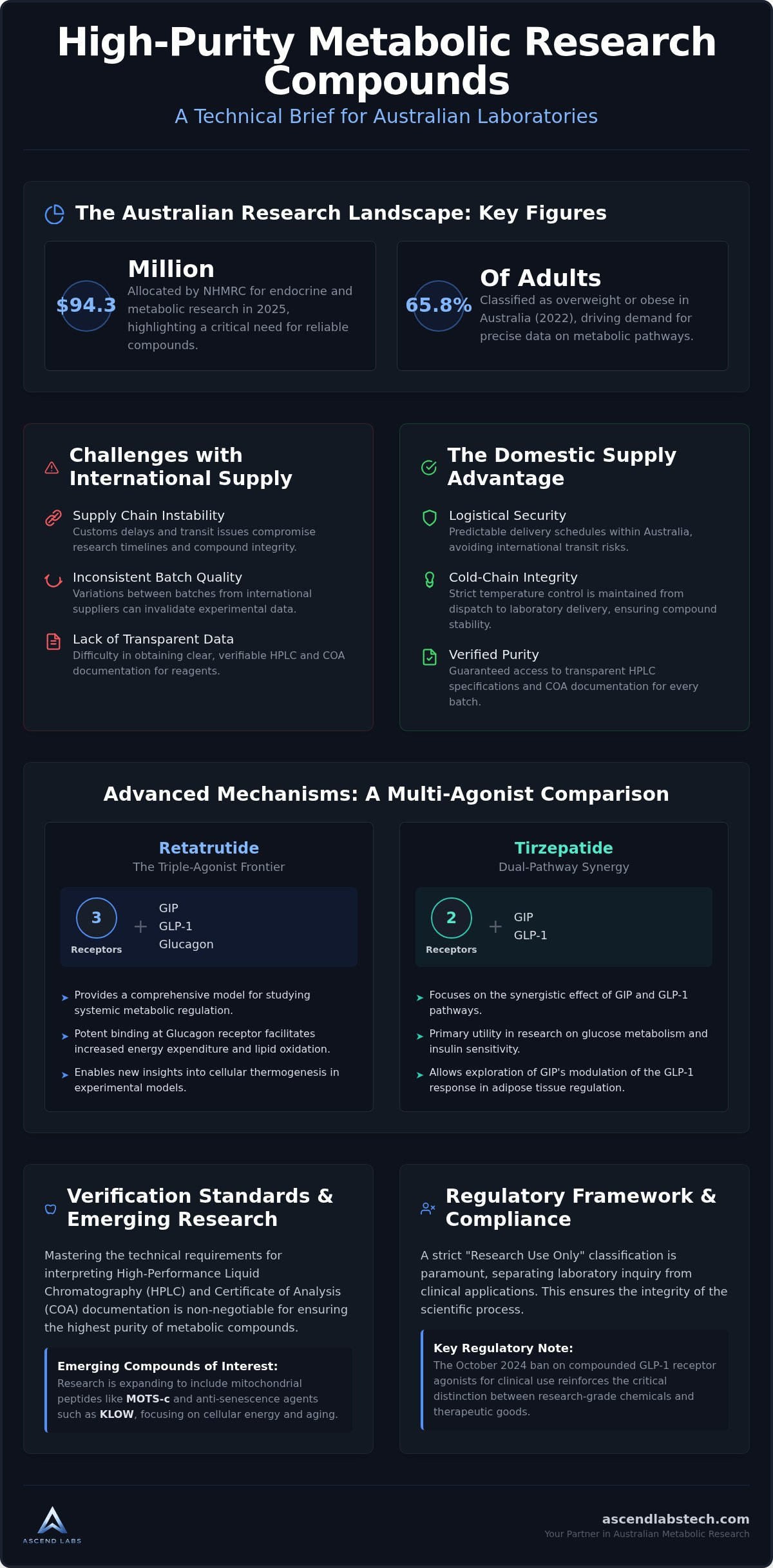
The integrity of a research outcome is only as robust as the chemical purity of its underlying reagents. With the NHMRC allocating 94.3 million dollars to endocrine and metabolic research in 2025, the demand for high-purity metabolic research compounds australia has reached a critical threshold. Many Australian scientists find themselves hindered by international supply chain instability, inconsistent batch quality, and the persistent lack of transparent HPLC data. It's a professional frustration when technical inquiry is stalled by the absence of a reliable domestic partner.
We understand that scientific progress requires precision, transparency, and logistical security. This technical guide provides a clinical analysis of advanced metabolic peptides, including triple agonists like Retatrutide and mitochondrial compounds such as MOTS-c. We'll examine the protocols for verifying compound integrity, the advantages of domestic supply chains, and the evolving regulatory landscape for 2026. This briefing provides the framework for securing high-purity compounds that meet the rigorous standards of Australian laboratory research.
Key Takeaways
- Analyse the biochemical differences between triple-agonist compounds like Retatrutide and dual-pathway peptides to refine metabolic research protocols.
- Explore the emerging applications of MOTS-C and KLOW in cellular energy metabolism and senescence studies within the Australian scientific landscape.
- Master the technical requirements for interpreting HPLC and COA documentation to ensure the highest purity of metabolic research compounds australia for your laboratory.
- Identify the logistical benefits of domestic supply, focusing on rapid delivery and cold-chain integrity to maintain the stability of sensitive research reagents.
The Landscape of Metabolic Research Compounds in Australia
Metabolic research compounds are defined as high-purity synthetic peptides and biochemical agents engineered to investigate specific metabolic processes. These tools are indispensable for mapping cellular energy expenditure, hormonal signalling, and endocrine regulation within a controlled laboratory setting. In the Australian scientific community, the focus has expanded from traditional single-pathway analysis to the interrogation of complex, multi-receptor interactions.
The procurement of high-purity metabolic research compounds australia allows laboratories to bypass the inconsistencies of international markets. Early Australian research was largely defined by insulin-centric studies; however, the field has evolved into a sophisticated discipline exploring multi-agonist synergies. This progression requires reagents that meet exacting purity standards to ensure that experimental data remains reproducible and technically sound.
Adherence to the "Research Use Only" classification is a non-negotiable standard for professional inquiry. These compounds are strictly for laboratory analysis and are not intended for human or veterinary use. Following the October 2024 ban on compounded GLP-1 receptor agonists for clinical applications, the distinction between research-grade chemicals and therapeutic goods has become a primary focus for regulatory compliance. This framework ensures that metabolic inquiry remains separate from clinical practice, preserving the integrity of the scientific process.
The Shift Toward Multi-Agonist Research
Australian laboratories are transitioning from single-receptor models to advanced multi-receptor agonists. This shift is driven by the need to understand how simultaneous activation of GIP, GLP-1, and glucagon receptors influences systemic metabolism. With 65.8% of Australian adults classified as overweight or obese in 2022, the demand for precise data on these pathways is acute. Current research trends for 2026 prioritise the study of mitochondrial efficiency and lipid oxidation, moving beyond simple glucose management to a holistic view of metabolic health.
Supply Chain Security for Australian Science
International procurement of sensitive peptides often introduces unacceptable variables into the research timeline. Customs delays and inadequate temperature control during transit can degrade compound integrity before they reach the laboratory. Domestic supply is the only reliable method for maintaining strict cold-chain protocols. By utilising a domestic Australian provider, researchers secure a predictable delivery schedule and technical verification of compound purity. This logistical stability is essential for maintaining the momentum of long-term metabolic studies and ensuring that every batch meets the required HPLC specifications.
Advanced Mechanisms: Analysing Retatrutide and Tirzepatide
The characterisation of multi-receptor agonists represents a significant leap in endocrine inquiry. Two specific agents, Retatrutide and Tirzepatide, currently dominate the technical discourse regarding metabolic research compounds australia. These peptides allow for the precise manipulation of incretin pathways, providing researchers with the tools to investigate complex physiological feedback loops within a controlled laboratory environment.
Retatrutide: The Frontier of Triple Agonist Research
Retatrutide is distinguished by its unique ability to target three distinct pathways: the GIP, GLP-1, and Glucagon receptors. This triple-agonist approach provides a more comprehensive model for studying metabolic regulation than traditional dual-pathway agents. Retatrutide exhibits potent binding affinity at the Glucagon receptor, facilitating increased energy expenditure and lipid oxidation in experimental settings. In-vitro observations indicate that this simultaneous activation results in pronounced metabolic rate fluctuations, offering new insights into cellular thermogenesis. For those conducting high-level inquiry, understanding Retatrutide: The Frontier of Triple Agonist Research in Australia is essential for modern laboratory protocols.
Tirzepatide and Dual Agonism Pathways
Tirzepatide functions as a dual GIP and GLP-1 receptor agonist. Its primary research utility lies in the synergistic effect of these two pathways on glucose metabolism and insulin sensitivity. Unlike single-agonist models, Tirzepatide allows for the exploration of how GIP receptor signalling modulates the GLP-1 response, particularly in the context of adipose tissue regulation. The structural differences between Retatrutide and Tirzepatide research grades are significant; while both utilise a C20 fatty diacid moiety for extended stability, Retatrutide’s inclusion of the glucagon-binding domain necessitates a distinct amino acid sequence. Researchers seeking to expand their laboratory capabilities should review our technical catalogue for verified batches of these compounds.
The binding affinity of these peptides determines their efficacy in research models. Tirzepatide shows a biased agonism toward the GIP receptor, whereas Retatrutide maintains a balanced profile across all three targets. This differentiation is critical when designing studies that focus on specific cellular outcomes, such as mitochondrial biogenesis or hepatic lipid clearance. Selecting high-purity metabolic research compounds australia ensures that binding affinity data remains accurate and reproducible across multiple experimental cycles.
Mitochondrial and Cellular Research: MOTS-C and KLOW
While multi-receptor agonists manage systemic endocrine responses, the frontier of intracellular inquiry focuses on the mitochondria. Understanding the intersection of mitochondrial health and systemic function requires reagents that can penetrate cellular membranes and modulate nuclear gene expression. For laboratories sourcing metabolic research compounds australia, the emphasis has shifted toward peptides like MOTS-c and KLOW, which provide a window into the fundamental mechanics of cellular energy and senescence.
MOTS-C and Metabolic Flexibility
MOTS-c is a 16-amino acid peptide encoded within the mitochondrial genome. It acts as a signalling molecule that mediates retrograde communication between the mitochondria and the nucleus. In research models, MOTS-c is primarily utilised to investigate the activation of the 5'-adenosine monophosphate-activated protein kinase (AMPK) pathway. This activation is a key regulator of lipid metabolism and glucose uptake, making MOTS-c an essential tool for studying metabolic flexibility.
Experimental data suggest that MOTS-c influences nuclear gene expression in response to metabolic stress. This mechanism is central to The Role of Mitochondrial Peptide Research in Modern Longevity Science, where researchers examine how mitochondrial-derived peptides counter age-related metabolic decline. Maintaining a 2026 purity standard of 99.005% is critical for these assays, as even minor contaminants can skew AMPK activation data and compromise the validity of the metabolic model.
KLOW: Analysing Anti-Ageing Research Potentials
The KLOW peptide represents the secreted form of the human Klotho protein, a primary biomarker in longevity and cellular integrity studies. In February 2026, IP Australia accepted multiple patent claims regarding the composition and use of secreted Klotho, reflecting the growing importance of this compound in the domestic research landscape. KLOW is currently employed in protocols designed to investigate cellular senescence and the protective effects of Klotho on vascular and neural tissues.
Standardising concentrations for in-vitro longevity assays is a prerequisite for reproducible results. Researchers typically focus on the peptide’s ability to inhibit oxidative stress pathways and modulate insulin-like growth factor 1 (IGF-1) signalling. Because KLOW is highly sensitive to concentration gradients, precise measurement and high-purity reagents are mandatory. These studies are instrumental in identifying how cellular integrity can be preserved across extended metabolic timelines.
Technical handling of these mitochondrial peptides requires meticulous lab discipline. Both MOTS-c and KLOW are fragile biochemical agents that are susceptible to thermal degradation and shear stress. Utilising domestic metabolic research compounds australia ensures these compounds are transported under strict cold-chain conditions, preventing the structural breakdown that often occurs during prolonged international transit. Maintaining the primary sequence integrity is the only way to ensure that the observed cellular responses are a direct result of peptide action rather than degraded fragments.
Verification Standards: Interpreting COA and HPLC Data
Verification is the cornerstone of scientific integrity. In the procurement of metabolic research compounds australia, relying solely on manufacturer claims is insufficient for high-stakes inquiry. Analytical verification via High-Performance Liquid Chromatography (HPLC) and Mass Spectrometry (MS) is required to ensure that the reagents used in metabolic models are free from contaminants that could confound experimental results. Without these benchmarks, the reproducibility of a study is fundamentally compromised.
The Anatomy of a High-Quality COA
A Certificate of Analysis (COA) provides the quantitative data necessary to validate a compound's quality. While many vendors provide summary sheets, a rigorous COA must include the full HPLC chromatogram. A purity level of 98% or higher is the industry benchmark for research-grade peptides. When reviewing the chromatogram, the primary peak should be sharp and well-defined. Significant shoulder peaks or excessive baseline noise indicate the presence of truncated sequences or residual solvents, both of which compromise the specificity of the research. Batch consistency is verified by comparing the date of analysis against the current inventory, ensuring the compound hasn't undergone degradation during storage.
Mass Spectrometry and Molecular Integrity
HPLC confirms purity, but it doesn't confirm identity. Mass Spectrometry (MS) is required to verify that the synthesised peptide matches the intended molecular sequence. By measuring the mass-to-charge (m/z) ratio, researchers can confirm that the compound's molecular weight aligns with the theoretical value. Mass spectrometry serves as the gold standard for peptide identity because it provides a definitive fingerprint based on the precise molecular weight of the compound. For Australian labs, third-party verification adds an essential layer of security, providing an unbiased assessment of the compound's integrity before it enters the laboratory workflow.
Identifying red flags in verification data is a critical skill for any lead researcher. High levels of Trifluoroacetic acid (TFA), a common residual salt from the synthesis process, can be cytotoxic in certain cell culture models if not properly monitored. Similarly, excessive moisture content can lead to rapid peptide degradation upon reconstitution, leading to inconsistent results across different vials of the same batch. If a COA lacks specific data on these impurities or fails to provide a clear HPLC trace, the integrity of the metabolic research compounds australia should be questioned. Researchers requiring technically verified reagents can view our catalogue of HPLC-tested compounds to ensure their data remains beyond reproach.
Securing Domestic Supply for Australian Metabolic Inquiry
The procurement of metabolic research compounds australia requires a partner that understands the intersection of biochemical integrity and logistical precision. While local providers often focus on a single metropolitan area, Ascend Labs operates as a national resource for the Australian scientific community. Our operation is designed to support the 94.3 million dollars in metabolic research funding recently allocated by the NHMRC by providing a reliable, domestic alternative to the risks of international procurement. We prioritise the needs of Australian researchers, ensuring that technical inquiry isn't stalled by supply chain instability.
Logistics and Domestic Reliability
Precision. Stability. Speed. These three pillars define our approach to domestic logistics. International transit introduces variables that are often fatal to peptide integrity, such as customs-related temperature spikes and prolonged handling delays. By shipping exclusively within Australia, we maintain strict control over the cold-chain process from our facility to your laboratory. Our packaging protocols are designed for discretion and security, ensuring that sensitive reagents like Tirzepatide or neuromodulator peptides arrive in a state of optimal stability. This domestic focus eliminates the unpredictability of international customs, allowing for tight adherence to research timelines.
Consistency is the foundation of any long-term metabolic study. We support ongoing research projects by maintaining a stable inventory of high-demand compounds, preventing the data gaps that occur when a primary reagent becomes unavailable. Whether your lab is investigating recovery peptides or growth factor signalling, our domestic infrastructure ensures that your next batch is always accessible. This reliability allows lead researchers to plan complex, multi-stage experiments with the confidence that their chemical supply is secure.
The Ascend Labs Commitment to Quality
Ascend Labs functions as a disciplined curator of high-purity biochemicals. Our catalogue, ranging from the latest triple agonists like Retatrutide to specialised compounds like KLOW and MOTS-c, is maintained to rigorous laboratory standards. We don't act as a mere vendor; we position ourselves as a principled institution that values scientific truth. Every compound in our inventory undergoes a meticulous verification process to ensure it meets the 2026 purity benchmarks discussed in this guide. This commitment to quality ensures that the data generated in your lab is a true reflection of the peptide’s biological action.
By providing a technical resource for Australian researchers, we help bridge the gap between complex biochemical theory and practical laboratory application. Our focus remains on the delivery of clinical-grade compounds that withstand the scrutiny of peer-reviewed research. We invite you to Explore the Ascend Labs metabolic research compound catalogue to secure the high-purity reagents necessary for your next phase of inquiry. Selecting metabolic research compounds australia from a domestic specialist is the most effective way to ensure the integrity and continuity of your scientific work.
Advancing Australian Metabolic Inquiry in 2026
The evolution of metabolic inquiry from simple glucose models to complex triple-agonism and mitochondrial signalling requires a corresponding shift in reagent quality. Success in the laboratory depends on the technical verification of every batch, ensuring that primary sequences remain intact and free from contaminants. By prioritising domestic supply chains, researchers can eliminate the variables associated with international shipping and customs delays, maintaining the strict cold-chain integrity required for sensitive peptides.
Securing high-purity metabolic research compounds australia is the most critical step in ensuring the reproducibility of your scientific data. Our commitment to quality is backed by HPLC and Mass Spectrometry verified batches, ensuring your laboratory receives only the highest-standard reagents. With specialised Australian domestic shipping protocols and clinically authoritative research support, we act as a disciplined partner in your scientific progress. Secure high-purity metabolic compounds for your next Australian research project at Ascend Labs. We look forward to supporting the next generation of Australian metabolic breakthroughs.
Frequently Asked Questions
Where can I buy metabolic research compounds in Australia for laboratory use?
Ascend Labs provides high-purity metabolic research compounds australia specifically for the scientific community. Our domestic operation ensures that laboratories can source reagents without the risks and delays of international transit. Every compound in our catalogue is technically verified to meet strict laboratory standards, ensuring that your experimental data remains consistent and reproducible across all phases of your inquiry.
Are Retatrutide and Tirzepatide available for research purposes in Australia?
Yes, these compounds are available as research-grade chemicals for laboratory analysis. While agents like Tirzepatide are approved for clinical use under specific brand names, the research-grade versions are intended strictly for in-vitro or animal studies. Researchers use these peptides to investigate dual and triple-agonist pathways in metabolic regulation, provided they adhere to the "Research Use Only" classification and relevant state poisons standards.
How do I verify the purity of peptides from an Australian supplier?
Verification requires the analysis of High-Performance Liquid Chromatography (HPLC) and Mass Spectrometry (MS) data provided by the supplier. A high-quality reagent should display a purity level of at least 98%. You should look for a sharp, singular peak on the HPLC chromatogram and a molecular weight that aligns with the theoretical sequence on the MS report. Professional suppliers will provide these documents to confirm batch integrity.
What is the difference between research-grade and pharmaceutical-grade peptides?
The primary difference lies in the intended application and regulatory oversight. Pharmaceutical-grade peptides are manufactured under Good Manufacturing Practice (GMP) standards for human consumption and clinical use. Research-grade peptides are produced for laboratory inquiry and are not evaluated by the TGA for safety or efficacy in humans. These compounds are strictly for scientific study to map biochemical pathways and cellular responses.
How are research peptides shipped within Australia to maintain stability?
Domestic shipping utilises express logistics and strict cold-chain management to prevent thermal degradation. Because peptides are sensitive to temperature fluctuations, they're shipped in insulated, discrete packaging to ensure they remain stable during transit. This domestic approach is superior to international shipping; it minimises the time sensitive compounds spend outside of a controlled environment, preserving the primary peptide sequence.
Can individual researchers purchase MOTS-C and KLOW for independent studies?
Individual researchers can purchase MOTS-c and KLOW provided the compounds are used exclusively for legitimate laboratory research. These mitochondrial and longevity-related peptides are essential for studying cellular energy and senescence. It's the researcher's responsibility to ensure that their facility and protocols comply with the Schedule 4 classification of peptides in Australia, maintaining the strict boundary between scientific inquiry and prohibited human use.
What documents should I expect when purchasing laboratory research compounds?
You should expect a comprehensive documentation package that includes a Certificate of Analysis (COA) and detailed analytical traces. This should encompass the HPLC chromatogram to verify purity and a Mass Spectrometry report to confirm the identity of the metabolic research compounds australia. These documents serve as your technical guarantee that the reagents provided meet the exacting requirements of a professional scientific laboratory.
Is a Certificate of Analysis (COA) provided with every research compound?
A COA is provided with every batch at Ascend Labs to ensure full transparency and scientific rigor. This document is not merely a summary; it's a technical record of the compound's chemical profile, including purity percentages and moisture content. Providing a COA with every order allows researchers to maintain precise records of their reagents, which is essential for the peer-review process and experimental replication.


