

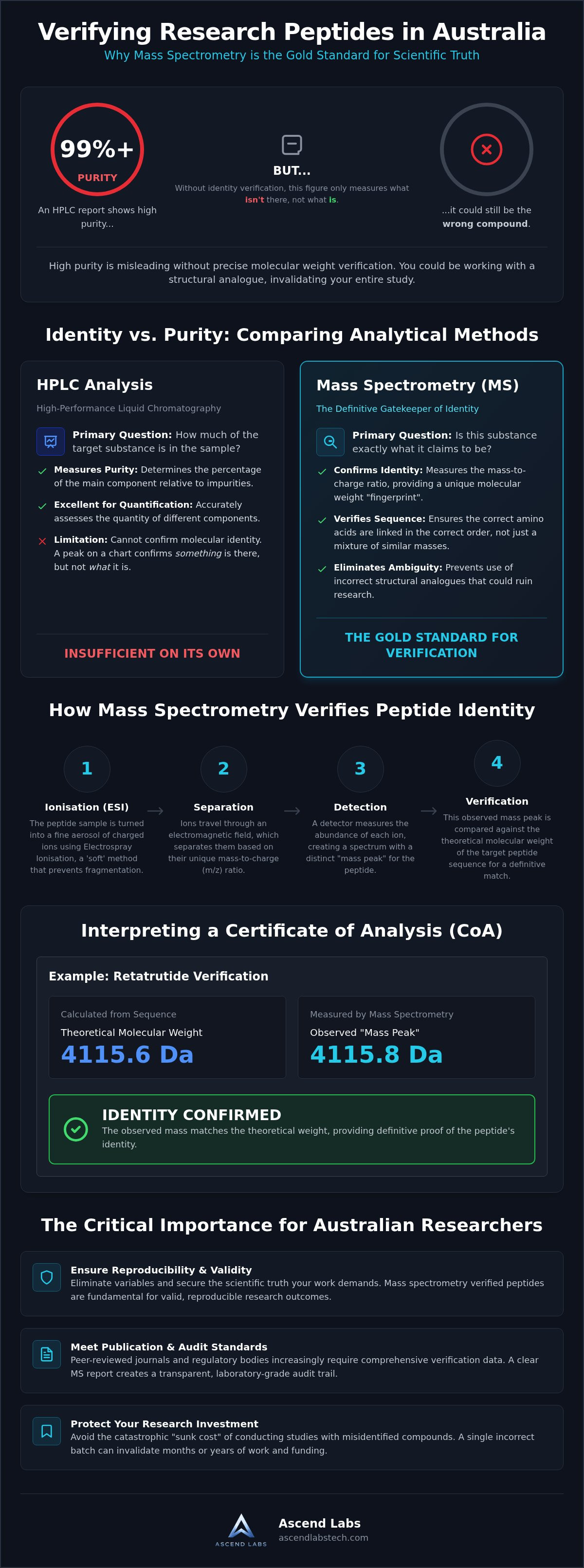
High-purity percentages on a Certificate of Analysis are often misleading. Without precise molecular weight verification, these figures represent a measure of what isn't there, rather than confirming what is. For researchers across Australia, the reliance on mass spectrometry verified peptides has become the only acceptable standard for ensuring that a sequence is exactly what it claims to be. You've likely felt the frustration of batch inconsistency or the quiet anxiety that comes with using unverified compounds in sensitive, high-stakes studies.
We understand that your work demands absolute certainty and reproducibility. This article will help you master the technical rigour of mass spectrometry to ensure the absolute identity and integrity of your research peptides. We'll examine how to navigate complex analytical data and establish the transparent documentation required for robust audit trails. By the end of this briefing, you'll possess the framework needed to eliminate variables and secure the scientific truth your inquiry deserves.
Key Takeaways
- Learn why HPLC purity reports are insufficient on their own and how mass spectrometry provides the definitive confirmation of molecular identity.
- Discover why mass spectrometry verified peptides serve as the critical gatekeeper for scientific truth in the Australian research landscape.
- Master the technical ability to interpret Electrospray Ionisation (ESI) data and verify the "mass peak" against theoretical molecular weights.
- Gain a practical framework for cross-referencing batch numbers and digital Certificates of Analysis to ensure a transparent, laboratory-grade audit trail.
- Understand the rigorous verification standards required for high-end metabolic compounds like Retatrutide and KLOW to ensure reproducible research outcomes.
The Critical Role of Mass Spectrometry in Australian Peptide Research
Scientific truth begins with identity. In the laboratory, visual inspection offers zero insight into molecular structure. For Australian researchers, the reliance on mass spectrometry verified peptides is a fundamental requirement for experimental validity. While high-performance liquid chromatography (HPLC) is excellent for determining purity, it cannot confirm the specific sequence or structure of a compound. Mass spectrometry serves as the definitive gatekeeper, ensuring that the substance in the vial is exactly what the researcher intended to study.
The analytical precision of Mass spectrometry (MS) allows for the measurement of the mass-to-charge ratio of ions. This process provides a molecular weight that acts as a unique signature for the compound. Without this data, a researcher risks working with structural analogues. These are compounds that may appear identical under less rigorous testing but possess entirely different biological properties. Within the context of sensitive metabolic research, such a discrepancy can lead to catastrophic data errors and irreproducible results.
Beyond Visual Appearance: The Science of Molecular Identity
Every vial of lyophilised powder looks identical to the naked eye. However, at the molecular level, the differences can be profound. MS operates by ionising chemical compounds to generate charged molecules. It then measures their transition through electromagnetic fields. This process creates a "molecular fingerprint" that is impossible to forge. Relying on simple assays or visual checks is insufficient when the integrity of a multi-month study is at stake. By utilising mass spectrometry verified peptides, researchers move beyond the limitations of appearance and secure confirmed molecular weight data.
Why Australian Labs Prioritise MS Verification
The Australian scientific community maintains some of the most rigorous standards in the world. With the Therapeutic Goods Administration (TGA) making unapproved peptide products a compliance priority in 2026, the demand for transparency has never been higher. Researchers must avoid the "sunk cost" of conducting studies with misidentified materials. A single batch of incorrectly identified peptide can invalidate years of work and thousands of dollars in funding. Peer-reviewed publication standards increasingly require comprehensive verification data as a prerequisite for submission. Providing a clear MS report ensures that your research meets the expectations of the global scientific community and stands up to the scrutiny of audit trails.
Establishing MS as the foundational requirement for any sophisticated research protocol is no longer optional. It is the only way to guarantee that compounds like Retatrutide or MOTS-C are structurally sound before they ever reach the laboratory bench. This meticulous approach to verification is what separates professional research from speculative enquiry.
Decoding the Mechanism: How Mass Spectrometry Verifies Peptide Identity
The verification process begins with the transition of the solid peptide into the gas phase. For large, delicate biomolecules, Electrospray Ionisation (ESI) is the preferred technique. It applies a high voltage to a liquid sample, creating a fine aerosol of charged droplets. As the solvent evaporates, the peptide ions are released intact. This soft ionisation method is critical. It ensures the molecule doesn't fragment before reaching the detector, allowing for a precise measurement of the parent ion. Without this controlled transition, the molecular structure would degrade, rendering the analysis useless for identity confirmation.
Once ionised, the particles are separated based on their mass-to-charge (m/z) ratio. The resulting data produces a "mass peak" which represents the most abundant ion in the sample. This peak is the primary evidence of identity. It must correspond to the calculated weight of the target sequence. Fragmentation patterns provide a secondary layer of structural confirmation. By observing how the molecule breaks under controlled conditions, researchers can verify the connectivity of the peptide chain. This ensures that the compound is not merely a mixture of similar masses, but a correctly synthesised sequence.
Advanced peptide sequencing often employs tandem mass spectrometry (MS/MS). This involves two stages of mass analysis. The first stage isolates the parent ion, while the second stage analyses the fragments produced by collision-induced dissociation. This method allows for the identification of specific amino acid sequences with absolute certainty. Utilising mass spectrometry verified peptides provides the structural baseline required for high-stakes laboratory protocols. You can explore our curated catalogue of verified research compounds to ensure your data remains beyond reproach.
Confirming Theoretical Molecular Weight
Precision in peptide synthesis is measured in Daltons (Da). When assessing a compound like retatrutide, the experimental mass peak must align perfectly with its theoretical molecular weight. A deviation of even a few mass units suggests a synthesis error or the presence of a structural analogue. As of 2026, the standard tolerance for mass variance in high-resolution peptide verification is typically maintained within 0.1 Daltons of the theoretical value. This level of accuracy is the only way to confirm that the substance in the vial is the intended research material.
De Novo Sequencing and Structural Integrity
Identity is more than just total mass. MS/MS provides the capability for de novo sequencing, which determines the amino acid sequence from scratch without prior knowledge of the sample. This process is essential for identifying post-translational modifications, such as acetylation or amidation, which could significantly affect research outcomes. The adoption of mass spectrometry verified peptides ensures that the peptide backbone is intact and correctly synthesised from the N-terminus to the C-terminus. It eliminates the risk of using truncated sequences that might pass a standard purity test but fail to produce the expected biological response.
Identity vs Purity: Comparing Mass Spectrometry and HPLC Analysis
Analytical integrity relies on the distinction between quantity and identity. High-Performance Liquid Chromatography (HPLC) is the industry standard for measuring "how much" of a substance is present in a sample. It calculates the relative concentration of the primary compound against detectable impurities. However, HPLC is fundamentally limited because it cannot define "what" that substance is. For absolute certainty, researchers must utilise mass spectrometry verified peptides to confirm the molecular signature of their compounds.
A dangerous "false positive" scenario exists when a laboratory relies solely on purity data. A vial may return a 99% purity rating on a chromatogram while containing the wrong peptide sequence entirely. This occurs when a structural analogue or a synthesis error results in a compound that mimics the expected behaviour of the target peptide under specific chromatographic conditions. Consequently, an HPLC verified peptides australia report is only scientifically valid when paired with a corresponding mass spectrometry (MS) analysis. Without MS, the purity percentage is a measure of concentration for an unverified subject.
HPLC: The Metric of Concentration
HPLC operates by separating compounds based on their hydrophobicity. The resulting chromatogram displays peaks that represent different molecules as they elute from the column. The area under the primary peak determines the purity level. While this is effective for identifying degradation by-products or residual trifluoroacetic acid (TFA), it cannot distinguish between different peptides that possess similar hydrophobic properties. If two distinct sequences share the same retention time, they will appear as a single peak. This creates a significant blind spot that only mass-based verification can resolve.
Mass Spectrometry: The Metric of Authenticity
Mass spectrometry provides the authenticity that HPLC lacks. It is immune to "co-elution" errors because it filters molecules by their specific atomic weight rather than their interaction with a solvent. For complex metabolic compounds like Tirzepatide, this level of scrutiny is non-negotiable. MS can detect non-peptide contaminants or truncated sequences that might hide within the baseline of an HPLC report. By isolating the mass-to-charge ratio, MS ensures that the researcher is working with the exact molecular structure required for their protocol. This dual-layer approach effectively filters out the noise, leaving only the confirmed chemical truth.
Relying on a single analytical dimension is a risk that modern Australian research cannot afford. The integration of mass spectrometry verified peptides into laboratory standards ensures that every data point generated is grounded in verified identity. When purity and identity are confirmed through separate, rigorous methodologies, the resulting research gains a level of credibility that stands up to the most demanding peer-review processes.
Interpreting Certificates of Analysis: A Researcher’s Guide to Verification Data
A Certificate of Analysis (COA) serves as the primary document of trust between a supplier and a laboratory. However, the presence of a document does not inherently guarantee the integrity of the compound. For Australian researchers, the ability to critically audit these reports is a vital skill. When reviewing mass spectrometry verified peptides, you must look beyond the summary table and interrogate the raw analytical data. A genuine report provides a transparent window into the molecular state of the batch. Fraudulent ones often rely on obfuscation and templated graphics.
The first step in any verification protocol is cross-referencing the batch number on the physical vial with the digital COA provided. If these identifiers don't match exactly, the analytical data is irrelevant to your specific sample. It's also essential to prioritise third-party, independent testing over in-house manufacturer reports. Independent facilities have no commercial incentive to overlook synthesis errors or impurities. This separation of interests is the only way to ensure that the scientific truth remains uncompromised by the pressures of production cycles.
Key Data Points in a Mass Spec Report
A standard mass spectrometry report is defined by its spectral graph. The X-axis represents the mass-to-charge ratio (m/z), while the Y-axis indicates the relative abundance or intensity of the ions detected. You should primarily look for the [M+H]+ parent ion peak, which represents the protonated molecular weight of the peptide. If this peak doesn't align with the theoretical mass of your compound, the identity is incorrect. Verify the date of analysis against the batch production date to ensure the data is current and batch-specific. This prevents the reuse of old data for new, unverified batches.
Spotting Counterfeit or Templated Reports
Fraudulent documentation is a rising concern in the research chemical industry. You can often identify red flags by examining the visual quality of the report. Low-resolution graphics, "photoshopped" headers, or mismatched fonts are immediate indicators of a templated document. A legitimate testing facility will always be a recognised independent laboratory with verifiable contact information. Pay close attention to the noise-to-signal ratio across different reports from the same supplier. If every graph looks identical with the same baseline noise, it's highly probable that the data has been duplicated rather than generated from a fresh analysis of mass spectrometry verified peptides.
Maintaining a rigorous audit trail is the only way to protect the validity of your research results. By scrutinising every data point, you eliminate the risk of using misidentified compounds in your studies. You can review our transparent verification standards to see how we maintain the absolute integrity of every batch in our catalogue.
Ascend Labs: Meticulous Verification Standards for Premium Research Compounds
The integrity of a research project is inextricably linked to the quality of its chemical inputs. At Ascend Labs, we operate as a disciplined curator of high-end research materials, positioning ourselves as an authoritative gatekeeper for the Australian scientific community. Our commitment to providing mass spectrometry verified peptides is absolute. We don't view verification as an optional secondary step. Instead, it's the foundational requirement for every compound that enters our catalogue. This rigorous approach ensures that the molecular identity of every batch is confirmed before it reaches your laboratory bench.
Our selection process focuses on high-purity metabolic and recovery compounds, including Retatrutide, KLOW, and Tirzepatide. By prioritising scientific truth and professional ethics, we provide a level of security that is often missing in the broader market. We understand that your research requires more than just a product; it requires a reliable partner who values data and precision as much as you do. Every compound we offer is backed by meticulous documentation, allowing you to maintain a transparent audit trail for your most sensitive studies.
The Ascend Labs Quality Assurance Protocol
Our quality assurance programme is designed to eliminate the variables that compromise research outcomes. We employ a multi-stage screening process that begins with the selection of laboratory-grade standards and concludes with independent, third-party verification. By ensuring all researchers have access to verifiable analytical data, we foster an environment of transparency and trust. This protocol isn't just about meeting industry benchmarks. It's about setting a new standard for excellence in the Australian biotechnology sector. We provide the technical weight and professional discretion required by advanced practitioners who cannot afford to risk their results on unverified materials.
Securing Verified Compounds for Your Next Study
Navigating our catalogue is a straightforward process designed for specialists. We focus on metabolic research compounds and recovery peptides, ensuring that each offering meets our strict criteria for structural integrity. One of the primary advantages of partnering with us is our focus on domestic Australian supply. International shipping often involves prolonged customs delays and the potential for temperature fluctuations that can compromise lyophilised proteins. By shipping directly from within Australia, we maintain superior cold-chain integrity and ensure your mass spectrometry verified peptides arrive in optimal condition. This logistical efficiency allows you to focus on your research without the anxiety of international transport variables.
Scientific progress relies on the elimination of doubt. When you choose your laboratory supplies, you're choosing the baseline for your data's credibility. We invite you to prioritise integrity and precision in your next protocol. You can explore our catalogue of MS-verified compounds to secure the laboratory-grade materials your research deserves.
Securing the Integrity of Your Scientific Inquiry
The distinction between molecular concentration and true identity is the difference between a variable result and a definitive discovery. While purity metrics provide a necessary baseline, the adoption of mass spectrometry verified peptides represents the only way to confirm that your research subject is structurally correct. By interrogating molecular weights and cross-referencing parent ion peaks, you protect your study from the inherent risks of structural analogues and synthesis errors. This level of technical rigour ensures that your data stands up to the most demanding peer-review processes and maintains a robust audit trail.
Ascend Labs operates as a disciplined curator for the Australian research sector, offering compounds that adhere to strict laboratory-grade purity standards. Every batch in our catalogue is independently verified by mass spectrometry to ensure absolute transparency and reproducibility. Through discreet domestic Australian shipping, you can maintain cold-chain integrity while bypassing the uncertainties of international logistics. We invite you to Explore the Ascend Labs Catalogue of MS-Verified Peptides and secure the foundational truth of your next study. Elevate your experimental standards with the quiet confidence that only verified data can provide.
Frequently Asked Questions
What is the difference between HPLC and Mass Spectrometry for peptides?
HPLC measures the purity of a sample by separating molecules based on their hydrophobicity, while mass spectrometry determines the identity by measuring molecular mass. HPLC tells you how much of a substance is present, but it cannot confirm the specific sequence. Mass spectrometry provides the definitive confirmation that the substance in the vial is exactly what you intended to study.
Can a peptide be 99% pure but still be the wrong compound?
Yes, it's entirely possible for a vial to return a 99% purity rating while containing an incorrect molecular sequence. This occurs when a structural analogue or a synthesis error elutes at the same time as the target peptide during HPLC analysis. Without mass spectrometry verified peptides, researchers risk using a highly pure sample of a misidentified compound, which can invalidate an entire study.
How do I read the molecular weight peak on a mass spec report?
You verify the identity by identifying the primary peak on the X-axis, which represents the mass-to-charge (m/z) ratio. This experimental value should align with the theoretical molecular weight of the peptide, typically appearing as the [M+H]+ ion. If the peak deviates by more than a narrow tolerance, usually 0.1 Daltons in high-resolution reports, the structural integrity of the batch is compromised.
Why is third-party testing better than manufacturer-provided COAs?
Third-party testing removes the inherent conflict of interest found in manufacturer-provided reports. Independent laboratories provide an unbiased audit of the chemical composition, ensuring the data is a transparent reflection of the batch's state. This separation of interests is essential for maintaining a laboratory-grade audit trail that stands up to the scrutiny of peer-reviewed publication standards.
Are all research peptides in Australia mass spectrometry verified?
No, many suppliers in the Australian market rely solely on HPLC data or utilise templated reports that aren't specific to the current batch. Verification standards vary significantly across the industry. At Ascend Labs, we treat mass spectrometry as a non-negotiable requirement for every batch to ensure that researchers receive the structural certainty required for sophisticated metabolic and recovery protocols.
What is tandem mass spectrometry (MS/MS) and when is it needed?
Tandem mass spectrometry (MS/MS) involves two stages of mass analysis to determine the precise amino acid sequence of a peptide. It's needed when researchers must verify the structural integrity of the peptide backbone or identify specific post-translational modifications. This method provides a "de novo" sequence that confirms the peptide was synthesised correctly from the N-terminus to the C-terminus.
How does mass spectrometry identify contaminants in a peptide sample?
Mass spectrometry identifies contaminants by detecting ions that don't match the theoretical mass-to-charge ratio of the target peptide. While HPLC might hide non-peptide impurities within the baseline of a chromatogram, MS isolates these molecules based on their unique atomic weight. This allows for the detection of residual reagents or truncated sequences that could interfere with sensitive biological assays.
Does mass spectrometry testing affect the price of research peptides?
Rigorous analytical testing influences the cost of research compounds as it reflects the investment in high-resolution equipment and independent laboratory expertise. While external academic facilities in Australia may charge between $85 and $250 per sample for basic analysis, these costs are a necessary investment in data integrity. The expense of verification is negligible compared to the cost of conducting a study with unverified materials.


