

For the serious researcher, the distance between an overseas laboratory and a local bench is measured not in kilometres, but in the degradation of molecular integrity. You likely recognise that even a minor thermal excursion during transit or a prolonged delay at the border can render a batch of Tirzepatide or MOTS-C scientifically invalid. Securing a reliable domestic peptide supply australia is no longer a matter of convenience; it's a fundamental requirement for reproducible data.
We understand the frustration of customs seizures and the quiet anxiety of working with potentially under-dosed or counterfeit compounds. This guide ensures you master the complexities of sourcing high-purity research compounds within Australia while maintaining chemical integrity and regulatory compliance. You will gain the expertise needed to secure fast, domestic delivery of independently verified materials. We will examine the necessity of HPLC and mass spectrometry verification, the logistics of cold-chain stability, and the specific procurement protocols for advanced metabolic agents like Retatrutide.
Key Takeaways
- Identify the technical benchmarks for research integrity, including the requirement for ≥99% purity verified through High-Performance Liquid Chromatography (HPLC).
- Navigate the logistical advantages of a domestic peptide supply australia to eliminate the risks of customs seizures and potency loss from heat exposure.
- Understand the critical regulatory distinctions between laboratory research compounds and scheduled therapeutic goods to ensure full compliance within the Australian framework.
- Master the vetting process for potential research partners by auditing their commitment to batch-specific, independent third-party verification.
- Secure the chemical stability of advanced metabolic compounds like Retatrutide and MOTS-C through specialised domestic handling and procurement protocols.
Navigating the Australian Peptide Research Landscape in 2026
The Australian biotechnology sector is experiencing a significant shift in its approach to peptide science. While global interest in metabolic pathways grows, local researchers are refining their focus on high-fidelity data. Peptides are short chains of amino acids that provide the foundation for this inquiry, acting as precise chemical tools for cellular signalling. It's essential to distinguish these research-grade compounds from prescription medications. While therapeutic versions exist for clinical use, research peptides are strictly designated for laboratory analysis and are not intended for human consumption.
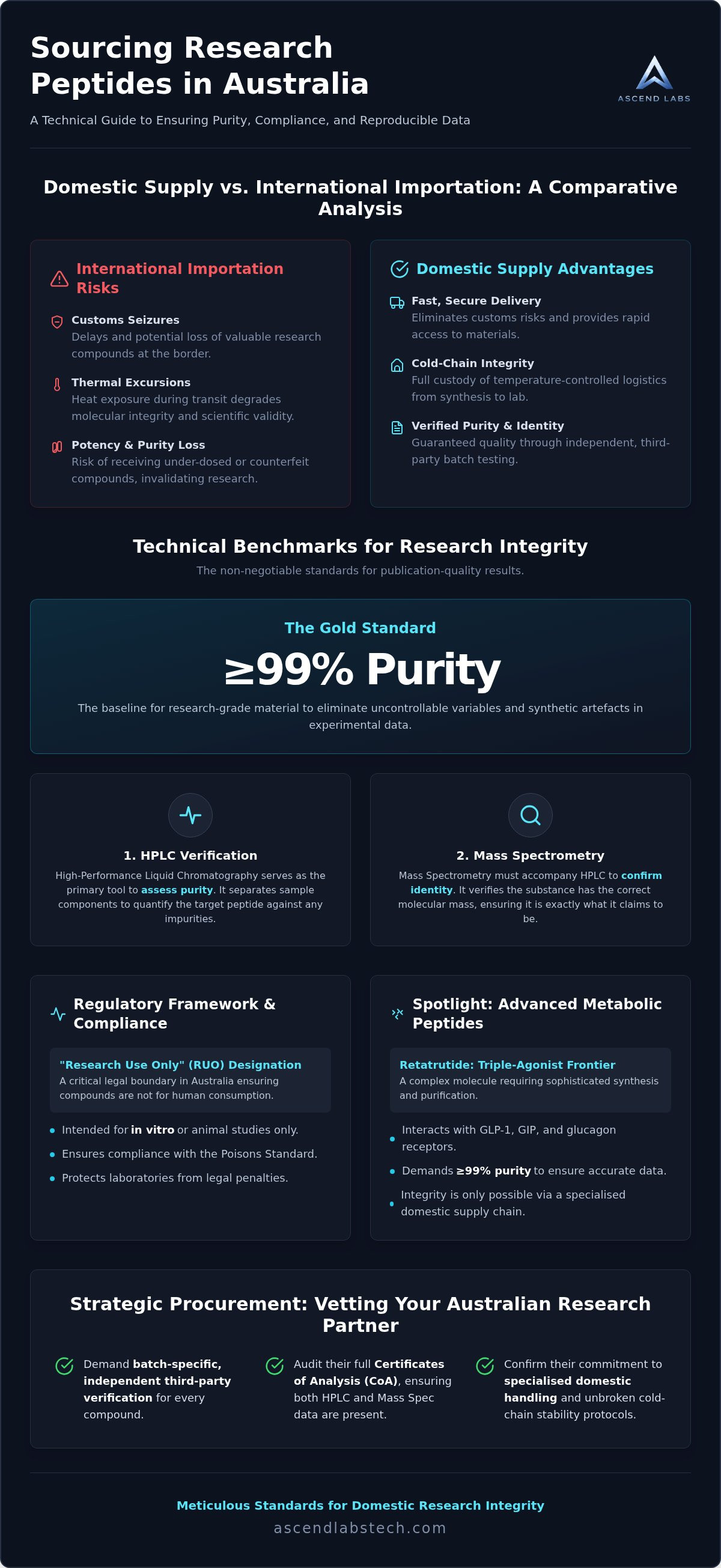
Australian researchers are increasingly abandoning international procurement models. The risks associated with overseas shipping, including thermal instability and regulatory delays, have made the domestic peptide supply australia a strategic priority. Within Australian laboratory standards, a domestic peptide supply is defined as the procurement of high-purity research materials through local specialists who maintain full custody of the cold chain and quality verification protocols.
The Regulatory Framework for Research Compounds
In Australia, the "Research Use Only" (RUO) designation is a critical legal boundary. These compounds are intended for in vitro or animal studies rather than human consumption. Institutional and private laboratories must ensure their procurement processes reflect this distinction to remain compliant with the Poisons Standard. While the TGA has increased its scrutiny of unapproved peptide markets in 2026, legitimate research remains a protected and vital scientific pursuit. Adhering to these standards ensures that laboratories avoid the legal penalties associated with mischaracterised substances, which can include significant fines in jurisdictions like the Australian Capital Territory. Researchers don't want to risk their institutional standing on unstable or unregulated imports.
The Rise of Advanced Metabolic Peptides
The current scientific zeitgeist is dominated by advanced metabolic agents. There's a profound interest in Retatrutide, a triple-agonist that represents the frontier of peptide engineering. Sourcing these complex molecules locally is difficult because they require sophisticated synthesis and purification. Triple-agonists interact with GLP-1, GIP, and glucagon receptors simultaneously, necessitating a level of purity that exceeds standard commercial offerings. Specialised metabolic research demands higher purity tiers, typically ≥99%, to ensure that receptor binding data isn't compromised by chemical impurities or synthetic byproducts. Maintaining this level of precision is only possible through a supply chain that prioritises integrity over volume.
Technical Benchmarks: Purity and Verification Standards
Scientific validity begins with chemical purity. In the context of a domestic peptide supply australia, the baseline for research-grade material is established at ≥99% purity. Anything below this threshold introduces uncontrollable variables into experimental data, potentially obscuring biological responses with synthetic artefacts. Achieving this "Gold Standard" requires meticulous purification processes that remove truncated sequences and residual solvents. For those advancing Australian peptide and protein science, these benchmarks are non-negotiable requirements for publication-quality results.
High-Performance Liquid Chromatography (HPLC) serves as the primary tool for assessing purity. This technique separates the components of a sample, allowing researchers to quantify the presence of the target peptide against any impurities. However, HPLC alone is insufficient. Mass Spectrometry must accompany it to confirm the correct molecular mass. While HPLC tells you how pure the substance is, Mass Spectrometry confirms that the substance is exactly what it's claimed to be. Reliable suppliers provide batch-specific Certificates of Analysis (CoA) that document both findings for every lot produced.
Interpreting the Certificate of Analysis (CoA)
A legitimate CoA is more than a summary; it's a technical roadmap of the compound's integrity. When reviewing an HPLC chromatogram, focus on the primary peak. Any secondary peaks, or "shoulders," indicate impurity peaks that could interfere with your research. The "Mass Spec" result should align precisely with the theoretical molecular weight of the peptide. Generic reports are often recycled across multiple batches, whereas batch-specific verification ensures the vial in your hand matches the data on the page. When selecting a domestic peptide supply australia, the presence of batch-specific data is the most reliable indicator of a supplier's transparency. Researchers can verify batch-specific data to ensure their reagents meet these stringent criteria.
Verification of Complex Sequences
The synthesis of longer or more intricate sequences presents unique challenges. Peptides like Tirzepatide involve complex side-chain protections and long-chain assemblies that increase the likelihood of deletion sequences. Similarly, mitochondrial-derived peptides require specialised handling to maintain their structural characteristics. For instance, the MOTS-C technical resource highlights how secondary verification is essential for ensuring these compounds retain their intended bioactivity. Without these rigorous checks, the integrity of metabolic research is fundamentally compromised.
Domestic Supply vs. International Importation: A Comparative Analysis
Procuring research compounds from international vendors often appears cost-effective on a per-vial basis, yet this perspective ignores the systemic risks inherent in cross-border logistics. The primary obstacle is the "Customs Risk." In 2026, the Therapeutic Goods Administration (TGA) has significantly increased its scrutiny of peptide imports, with infringement notices for unlawful importation reaching A$3,756 for individuals. Beyond the legal complications, international procurement lacks basic accountability. If a shipment from an offshore vendor is seized or arrives with compromised purity, the Australian researcher has no legal recourse or path for remediation.
A domestic peptide supply australia provides a strategic alternative by shifting the burden of regulatory compliance and logistical integrity to a local partner. Accountability is anchored in Australian professional standards and local business transparency. This ensures that the Total Cost of Research (TCR) remains predictable. When the variables of seizure and long-distance transit are removed, the researcher can focus on data collection rather than logistical troubleshooting. Reliability is the foundation of any disciplined laboratory environment.
Thermal Stability and Transit Times
Lyophilised peptides are more resilient than their reconstituted counterparts, but they remain highly sensitive to extreme thermal fluctuations. During a 14-day international transit, a package may endure unconditioned cargo holds or transit hubs where temperatures frequently exceed 40°C. Such prolonged exposure can trigger the degradation of delicate molecular structures, resulting in a loss of potency that is often invisible to the naked eye. Domestic shipping reduces this exposure window to 24-48 hours. By utilising local express networks, a domestic peptide supply australia ensures that compounds maintain their chemical integrity through minimal environmental stress and professional handling.
The Financial Reality of Seized Shipments
The initial purchase price is a deceptive metric if the successful delivery rate is inconsistent. To understand the true financial impact, researchers must apply a "cost per successful delivery" framework. If a laboratory pays for an international shipment that is confiscated at the border, the actual cost of the research material effectively doubles or triples when a replacement is eventually sourced. Domestic procurement eliminates this volatility. Secure delivery protocols and end-to-end tracking provide a reliable timeline for experimental planning. When you factor in the time lost to delays and the risk of institutional scrutiny following a customs seizure, the domestic model is the only viable path for serious scientific inquiry.
Strategic Procurement: Vetting Your Australian Research Partner
Vetting a research partner is an exercise in scientific due diligence. While many vendors prioritise order volume, a sophisticated partner focuses on the integrity of the individual batch. When evaluating a domestic peptide supply australia, the researcher must scrutinise the supplier's commitment to transparency. This isn't demonstrated through flashy branding; it's proven through the availability of technical data and a clinical communication style that mirrors the standards of a professional laboratory. A supplier who speaks with authority on molecular mass and chemical stability is inherently more reliable than one using retail-centric language.
The most effective research partners in Australia focus exclusively on the local market. This dedication allows them to manage the complexities of the Poisons Standard and local logistics with greater precision. By operating within a single regulatory framework, these suppliers can ensure that every vial meets the specific documentation requirements of Australian institutional review boards. This niche focus is a hallmark of a disciplined curator rather than a high-volume reseller.
Meticulous Standards for Modern Laboratories
A serious research partner maintains internal quality control protocols that extend far beyond basic procurement. This includes temperature-controlled archiving and specialised storage conditions designed to prevent molecular degradation before the compound even reaches your facility. The "substance over style" approach is a reliable indicator of a disciplined operation. If a supplier's documentation prioritises marketing over mass spectrometry results, they are likely unsuitable for high-precision inquiry. Professional laboratories require a partner that treats every vial as a critical component of a larger scientific narrative.
The Importance of Specialised Catalogues
The breadth and depth of a product list reveal the supplier's technical expertise. A refined catalogue focusing on growth factor peptides or neuromodulators suggests a curator who understands the nuances of metabolic science. Finding niche compounds like KLOW or MOTS-C domestically indicates a sophisticated supply chain capable of managing complex synthesis and purification. This level of specialisation reflects a disciplined curator who values scientific truth over a broad, unverified inventory. A focused catalogue ensures the domestic peptide supply australia is backed by deep technical knowledge of each compound. Researchers can review the verified catalogue to assess these standards firsthand.
Ascend Labs: Meticulous Standards for Domestic Research
Ascend Labs functions as a disciplined curator within the Australian scientific community. We act as an authoritative gatekeeper, ensuring the integrity of the domestic peptide supply australia remains uncompromised by the inconsistencies of the global market. Our role isn't merely to facilitate procurement; it is to enforce a standard of chemical excellence that allows researchers to operate with absolute certainty. By specialising in advanced metabolic and recovery research compounds, we provide the technical precision required for sophisticated laboratory inquiry. We speak with the quiet confidence of an expert, catering to an audience that values data and precision over hyperbolic marketing.
Our operational model prioritises transparency and integrity above all else. We understand that in high-stakes research, there is no room for ambiguity. Every decision we make, from the selection of our synthesis partners to our local storage protocols, is designed to instill a sense of security and trust. We don't present ourselves as a mere vendor, but rather as a principled institution that operates with a high degree of professional ethics and operational discretion. This commitment to substance ensures that your research is built on a foundation of verified chemical truth.
The Ascend Labs Verification Protocol
Our verification process is methodical and uncompromising. Every batch in our 2026 catalogue undergoes rigorous analysis to secure comprehensive CoA and HPLC data. We prioritise transparency by providing batch-specific reports that confirm purity levels of ≥99%. This protocol is critical for complex sequences like Retatrutide and Tirzepatide, where synthetic precision is a baseline requirement. Every operation is guided by a strict "Research Use Only" philosophy, ensuring that our materials are handled with the professional ethics required by the Australian research landscape. We maintain meticulous records for every compound, including KLOW and MOTS-C, ensuring that the molecular mass aligns precisely with theoretical expectations.
Securing Your Research Future
Engaging with Ascend Labs means partnering with an Australian-owned entity that understands the local regulatory and logistical environment. Our domestic supply chain removes the volatility of international transit, providing a stable foundation for longitudinal studies. We provide more than just chemical reagents; we offer a partnership based on scientific truth and operational discretion. The reliability of your materials will be the deciding factor in the quality of your results. Explore the Ascend Labs research peptide catalogue to secure the integrity of your next project and ensure your laboratory remains at the forefront of Australian biotechnology.
Advancing the Integrity of Australian Peptide Research
The pursuit of scientific excellence requires an uncompromising approach to reagent quality. Transitioning to a secure domestic peptide supply australia eliminates the variables of international transit and regulatory interference, allowing your laboratory to focus entirely on the generation of reproducible data. High-purity research demands more than just a vendor; it requires a partner committed to independent, batch-specific verification.
Ascend Labs provides this foundation through 100% domestic shipping and meticulously documented HPLC and Mass Spectrometry reports. By specialising in advanced metabolic agents like Retatrutide and MOTS-C, we ensure that your procurement process mirrors the sophistication of your experimental design. This disciplined approach to chemical curation protects the integrity of your research from synthesis to delivery. When you align your procurement with technical rigour, you secure the future of your scientific inquiry.
We invite you to View the Ascend Labs Research Catalogue to integrate these standards into your next study. Your commitment to precision deserves a supply chain that shares your scientific values.
Frequently Asked Questions
Is domestic peptide supply legal in Australia for research purposes?
Domestic supply is legal when the compounds are designated strictly for laboratory and in vitro research. These materials fall under the Research Use Only (RUO) framework, which distinguishes them from scheduled therapeutic goods intended for clinical use. Institutional and private laboratories must ensure all procurement aligns with the Australian Poisons Standard to maintain regulatory compliance during their investigations.
What is the typical purity level for research-grade peptides in Australia?
High-purity research requires a minimum purity level of ≥99% as the technical baseline. This standard ensures that experimental data isn't compromised by synthetic impurities or deletion sequences. Verification is conducted using High-Performance Liquid Chromatography (HPLC) to quantify the primary peptide peak and Mass Spectrometry to confirm the exact molecular mass of the compound.
How long does domestic peptide shipping take across Australia?
A domestic peptide supply australia typically reaches its destination within 24 to 48 hours via express courier networks. This rapid transit is essential for maintaining the chemical integrity of the compounds. Unlike international shipping, which can take 14 days or longer, domestic delivery minimises exposure to extreme thermal fluctuations that occur in unconditioned cargo holds.
Why should I choose an Australian supplier over a cheaper international option?
Domestic suppliers eliminate the customs risk that often results in seizures and TGA infringement notices, which can reach A$3,756. While international vendors might offer lower initial prices, the total cost of research increases when shipments are confiscated or arrive degraded. Choosing a local partner provides accountability, secure tracking, and a guaranteed chain of custody for sensitive metabolic agents.
Can I get a Certificate of Analysis (CoA) for my specific batch of peptides?
Batch-specific Certificates of Analysis are mandatory for any disciplined laboratory operation. These reports should include both HPLC and Mass Spectrometry data for the specific lot number you receive. Generic or recycled reports are insufficient for high-precision research, as they don't account for the subtle synthetic variations that can occur between different production runs.
How should I store my research peptides once they arrive?
Lyophilised research peptides should be stored in a temperature-controlled environment to prevent molecular degradation. For long-term archiving, a freezer set to -20°C is standard, while short-term storage is typically maintained at 4°C. It's vital to keep the vials in a dark, moisture-free environment, as exposure to light and humidity can trigger premature hydrolysis or oxidation.
What happens if my research compound is damaged during transit?
Accountability is a primary benefit of a domestic peptide supply australia. If a compound is compromised during transit, a local partner provides clear protocols for replacement and remediation. This level of service is rarely available with offshore vendors, where the researcher often bears the full financial loss for damaged or lost materials.
Are these peptides suitable for clinical trials or human consumption?
These compounds are strictly not for human consumption or clinical trials. Every vial is designated as a research chemical intended for laboratory analysis and animal studies only. Utilising these materials for therapeutic purposes is a violation of the RUO framework and carries significant legal and safety risks under Australian regulation.


