

The transition from dual-pathway agonism to the simultaneous activation of GLP-1, GIP, and glucagon receptors marks the most significant shift in metabolic science since the inception of incretin mimetics. As the scope of triple agonist peptide research expands in 2026, the focus for Australian investigators has shifted from mere efficacy to the absolute precision of molecular synthesis. You're likely aware that while the TRIUMPH-3 trials demonstrated weight loss averages reaching 22.6 per cent over 80 weeks, the integrity of your data depends entirely on the chemical purity of your compounds. Inconsistent batches from international vendors and the volatility of customs delays often compromise sensitive research timelines and results.
This briefing provides a rigorous technical analysis of triple agonist mechanisms, comparative efficacy against dual-agonists like Tirzepatide, and the analytical standards required for valid inquiry. We'll examine the synergistic effects of glucagon receptor activation, the necessity of domestic HPLC verification to bypass international logistics instability, and the protocols for establishing a secure Australian research supply chain. By the conclusion, you'll understand how to verify compound identity and maintain the stringent controls necessary for advanced metabolic study in an increasingly complex regulatory environment.
Key Takeaways
- Understand how the synergistic activation of GLP-1, GIP, and Glucagon receptors shifts metabolic study from dual-pathway management to total physiological optimisation.
- Analyse the specific molecular binding affinities of Retatrutide, the current benchmark for triple agonist peptide research and multi-pathway receptor engagement.
- Compare the performance metrics of established dual-agonists like Tirzepatide against the enhanced metabolic throughput of triple-pathway compounds.
- Establish rigorous verification protocols using HPLC and Mass Spectrometry to ensure the chemical identity and purity of research-grade peptides.
- Identify the critical benefits of domestic Australian sourcing to maintain compound stability and avoid the procedural delays of international customs.
Defining Triple Agonism: GLP-1, GIP, and Glucagon Receptor Synergy
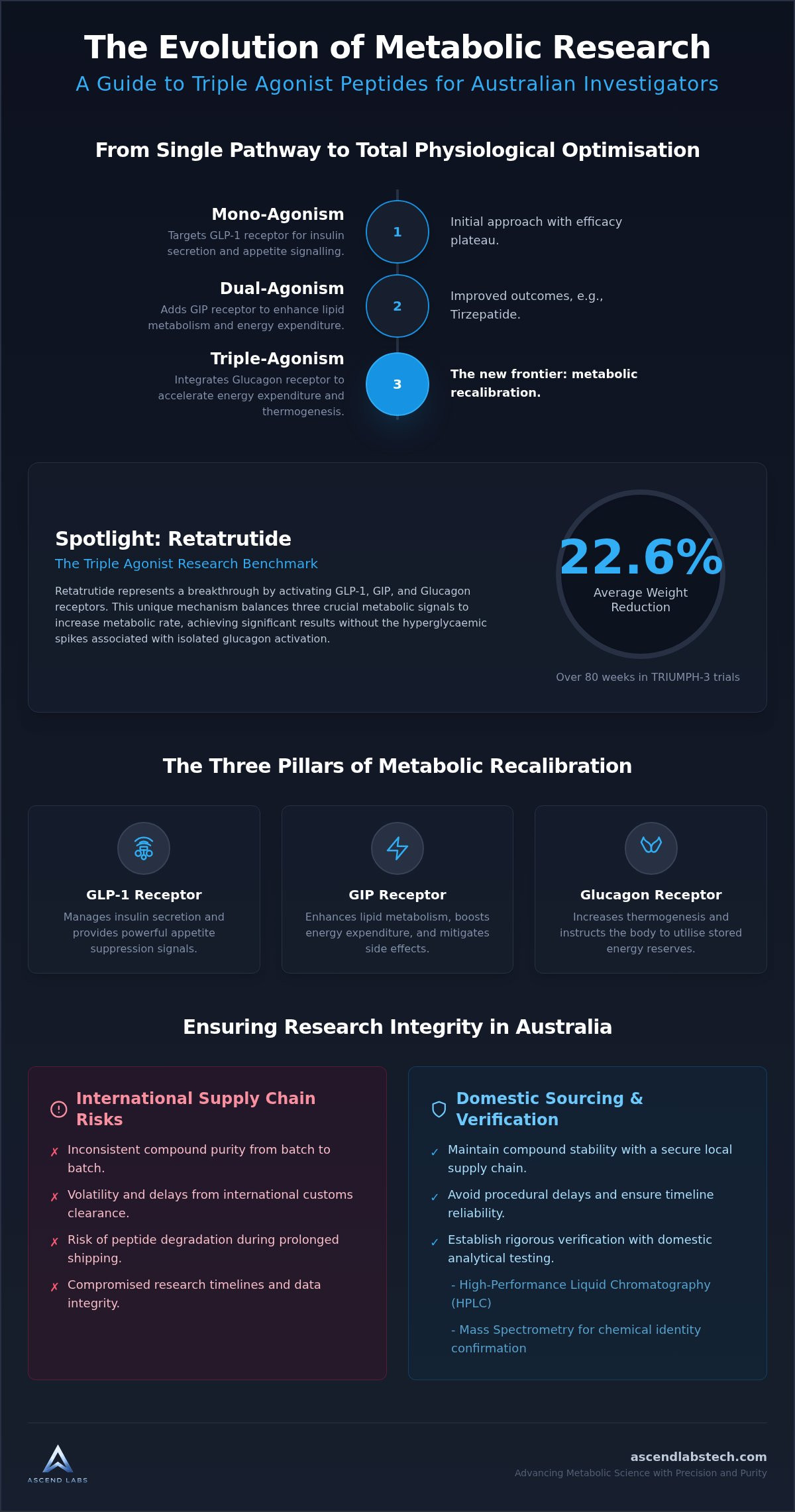
The evolution of metabolic pharmacology has progressed from single-receptor targeting to a sophisticated, multi-pathway approach. Triple agonists represent the current pinnacle of this trajectory. By targeting three distinct metabolic pathways simultaneously, these compounds achieve synergistic effects that were previously unattainable with mono or dual-pathway agents. Within the context of triple agonist peptide research, the integration of Glucagon Receptor (GCGR) activation alongside GLP-1 and GIP receptors creates a comprehensive physiological response. This trio allows researchers to examine not just appetite suppression, but the active acceleration of energy expenditure.
The Three Pillars of Metabolic Research
Historically, research focused heavily on GLP-1 (Glucagon-like peptide-1) for its role in managing insulin secretion and appetite signalling. While effective, GLP-1 mono-agonism often reaches a plateau in efficacy. The introduction of GIP (Glucose-dependent insulinotropic polypeptide) helped enhance lipid metabolism and energy expenditure. Perhaps most importantly, GIP agonism appears to mitigate the gastrointestinal side effects often observed in pure GLP-1 research models, allowing for higher tolerable thresholds in laboratory studies.
The addition of Glucagon receptor agonism completes the triad. Glucagon increases thermogenesis and regulates hepatic glucose, essentially instructing the body to utilise stored energy. While Retatrutide is the most prominent molecule in this category, the broader field of triple agonist peptide research seeks to balance these three signals to achieve what is now termed metabolic recalibration. This transition from mono-agonists to the current triple-agonist frontier reflects a shift from symptom management to fundamental physiological reorganisation.
Research Objectives in 2026
Current laboratory inquiry is increasingly centred on complex conditions such as obesity, non-alcoholic fatty liver disease (NAFLD), and metabolic syndrome. In 2026, the focus has moved beyond simple weight reduction. Researchers are now investigating how these compounds influence liver fat fractions and insulin sensitivity over extended periods. The data from recent TRIUMPH-3 trials, showing average weight reductions of 22.6 per cent over 80 weeks, has set a high benchmark for efficacy that dual-agonists struggle to match.
Laboratory protocols now prioritise total metabolic recalibration, a state where the subject's baseline energy expenditure is elevated while appetite remains suppressed. Triple agonism is the concurrent stimulation of GLP-1, GIP, and GCG receptors. Establishing this balance requires high-purity compounds that are verified through rigorous analytical standards. For Australian researchers, securing these compounds domestically ensures that the sensitive peptide sequences remain stable and free from the degradation often caused by international shipping delays.
Analysing the Retatrutide Mechanism: A Breakthrough in Multi-Pathway Research
Retatrutide serves as the primary model for modern triple agonist peptide research, representing a significant shift in how investigators approach metabolic dysfunction. While earlier dual-pathway compounds focused primarily on insulin sensitivity and satiety, Retatrutide introduces a third dimension: the Glucagon receptor (GCGR). This specific binding affinity allows for the direct manipulation of energy balance by increasing the metabolic rate. In laboratory models, this mechanism has been shown to achieve weight reduction averages of up to 22.6 per cent over 80 weeks, as documented in the TRIUMPH-3 trials. The breakthrough lies in how the molecule balances these three signals without causing the hyperglycaemic spikes typically associated with isolated glucagon activation.
Receptor Binding Affinities
Quantifying the potency of Retatrutide across its three targeted receptors is essential for establishing reproducible research protocols. The peptide is engineered to maintain high-affinity binding at the GIP and GLP-1 receptors while providing a balanced, potent activation of the GCGR. Comparing dual and triple agonists highlights that the inclusion of the glucagon component is what drives the superior lipid oxidation observed in multi-pathway studies. Maintaining sequence integrity is critical during synthesis. Any degradation in the peptide chain can result in a loss of the specific GCGR activation, which effectively reduces the compound's functionality to a standard dual-agonist. For in-vitro applications, researchers must also account for the peptide's solubility and stability in various media to ensure consistent ligand-receptor engagement.
Mitochondrial and Metabolic Impact
The metabolic impact of triple agonism extends deep into cellular function, specifically influencing mitochondrial biogenesis. By stimulating the glucagon receptor, Retatrutide encourages the upregulation of genes involved in thermogenesis and fatty acid oxidation. This process converts stored lipids into usable energy, effectively increasing cellular energy expenditure. Beyond weight and glucose regulation, 2026 research directions are expanding into the neuroprotective and cardiovascular potentials of these pathways. Investigators are currently examining how triple-pathway activation might mitigate neuroinflammation or enhance myocardial efficiency in metabolic syndrome models. Establishing a baseline with verified research compounds is foundational for any laboratory seeking to explore these advanced physiological outcomes. As the scope of triple agonist peptide research grows, the focus remains on the precision of these mitochondrial interactions and their long-term impact on metabolic health.
Comparing Dual and Triple Agonists: Tirzepatide vs Retatrutide in Laboratory Studies
Tirzepatide remains the established benchmark for dual-agonist studies, primarily targeting the GLP-1 and GIP receptors to regulate glucose and satiety. However, triple agonist peptide research has introduced Retatrutide as a more aggressive model for metabolic acceleration. The fundamental difference lies in the addition of the Glucagon receptor pathway. While Tirzepatide focuses on insulin sensitivity and appetite suppression, Retatrutide adds direct stimulation of energy expenditure. This makes it the emerging standard for studies requiring accelerated metabolic throughput and the investigation of thermogenic pathways.
Mechanism and Pathway Differentiation
The inclusion of Glucagon agonism transforms the research outcome from metabolic management to metabolic optimisation. In Tirzepatide models, the GIP component primarily serves to enhance insulin secretion and potentially reduce GLP-1 related nausea. Retatrutide's third pathway, the GCGR, acts as a thermogenic trigger. This increases the cost-to-data ratio efficiency for researchers in 2026, as triple agonists provide insights into lipid oxidation that dual-agonists cannot replicate. Safety profiles remain comparable in laboratory settings, though Retatrutide requires more precise titration to manage the increased metabolic flux effectively.
Selecting a Research Compound
Selecting between these compounds depends entirely on the specific objectives of the study. Tirzepatide is ideal for foundational metabolic studies where the primary focus is insulin regulation or appetite signalling. It's a stable, well-documented compound with a vast library of existing comparative data. Conversely, Retatrutide offers specific advantages for advanced investigations into metabolic rate, mitochondrial biogenesis, and hepatic glucose regulation. Researchers often utilise Retatrutide when the objective is to push the boundaries of weight reduction and energy expenditure beyond the dual-agonist plateau.
Integrating both compounds into a comparative protocol allows for a clear analysis of how the Glucagon receptor influences outcomes. Investigators often start with Tirzepatide to establish a baseline before introducing Retatrutide to observe incremental gains in energy expenditure. This tiered approach ensures data integrity and provides a comprehensive view of multi-receptor engagement. It's essential to source these compounds from a domestic supplier to ensure that the molecular sequence of the triple agonist remains intact during transit, as the GCGR binding site is particularly sensitive to environmental degradation during international shipping. Maintaining this sequence integrity is the only way to ensure the validity of triple agonist peptide research in a controlled laboratory environment.
Quality Assurance Protocols: Verifying Purity in Australian Research Peptides
The integrity of triple agonist peptide research depends entirely on the chemical fidelity of the compounds utilised. Given the structural complexity of molecules like Retatrutide, which involve specific binding at three different receptors, even minor sequence errors can lead to non-target effects. Verification requires a dual-analytical approach. High-Performance Liquid Chromatography (HPLC) remains the gold standard for determining the purity of the peptide, while Mass Spectrometry (MS) confirms the exact molecular weight and sequence identity. Without these two metrics, a compound remains effectively unverified and unsuitable for rigorous laboratory inquiry.
Interpreting Analytical Reports
Researchers must look beyond the final purity percentage listed on a Certificate of Analysis (COA). Identifying impurities involves scrutinising the HPLC chromatogram for secondary peaks that indicate the presence of truncated sequences or residual reagents. These impurities can interfere with sensitive ligand-receptor binding assays, leading to skewed or irreproducible data. It's also vital to ensure the COA is batch-specific rather than a generic template provided by a manufacturer. A COA must include a clear HPLC trace and MS report to be considered valid. Relying on unverified or grey market international vendors introduces significant risks, including potential contamination, unknown ingredients, and a total lack of sterility.
Laboratory Standards in 2026
In 2026, the threshold for sensitive metabolic research has shifted toward higher refinement. While 95 per cent purity was once considered acceptable, the current standard for advanced multi-pathway study is a minimum of 99 per cent. This higher tier of refinement is necessary to ensure that the physiological responses observed in research models are attributable solely to the peptide agonism. Another critical factor is the concentration of residual Trifluoroacetic acid (TFA). High levels of TFA can be cytotoxic in cell culture and alter the pH of research models, potentially confounding the results of thermogenic pathway investigations.
Implementing internal verification steps for every new batch is the only way to maintain a disciplined research environment. This involves cross-referencing vendor data with independent laboratory analysis to confirm sequence consistency. For Australian investigators, sourcing from a domestic partner that provides pre-verified, COA-backed compounds is the most efficient way to manage these quality controls. You can access COA-verified metabolic research compounds to ensure your laboratory protocols meet these exacting 2026 standards. By eliminating the variables associated with unverified supply chains, you protect the reproducibility of your data and the scientific validity of your findings in the field of triple agonist peptide research.
Sourcing Research Compounds: Domestic Supply and Analytical Excellence
The transition from theoretical framework to laboratory application requires a procurement strategy that prioritises chemical stability and logistical reliability. For Australian investigators, the challenges of triple agonist peptide research are often compounded by the volatility of international supply chains. Securing high-purity compounds like Retatrutide or Tirzepatide from overseas frequently results in protracted delays and potential degradation. Transitioning to a domestic supply model eliminates these variables, ensuring that the molecular integrity of the peptide is preserved from the point of synthesis to the laboratory bench.
Domestic Logistics and Security
Navigating the complexities of Australian Customs is a significant hurdle for many research institutions. International shipments of sensitive metabolic compounds are often subject to lengthy inspections, which can expose delicate peptide sequences to suboptimal temperatures. Domestic sourcing bypasses these risks entirely. By utilising Australian-owned and operated facilities, researchers benefit from rapid, climate-controlled transit that maintains the structural sequence of the compound. This speed is essential for maintaining strict research timelines. Discreet and professional handling ensures that both institutional and independent laboratories can operate with the necessary level of operational discretion.
The Ascend Labs Commitment
Ascend Labs functions as a disciplined gatekeeper for the Australian scientific community, providing access to a curated selection of high-purity metabolic compounds. Every batch in the inventory undergoes rigorous verification to meet the 2026 standards for analytical excellence. Researchers can access comprehensive HPLC and Mass Spectrometry data for every product, ensuring that the identity and purity of the compound are never in question. This commitment to transparency is foundational to supporting ethical, high-standard inquiry across the country. You can explore the Ascend Labs Research Catalogue to source verified triple agonist compounds for your next study.
Maintaining regulatory compliance is a core tenet of our operational philosophy. All compounds, including Retatrutide and other metabolic research peptides, are supplied strictly under a "not for human consumption" mandate. These materials are intended solely for laboratory research and in-vitro applications. By adhering to these stringent standards, Ascend Labs ensures that triple agonist peptide research in Australia remains at the forefront of global metabolic science while upholding the highest levels of professional and ethical integrity. Securing your supply through a domestic partner is the most effective way to protect your data and advance your research objectives without the interference of international logistical instability.
Advancing the Frontiers of Metabolic Inquiry
The transition from dual-pathway management to triple-receptor agonism represents a fundamental recalibration of metabolic science. By integrating Glucagon receptor activation, investigators can now explore physiological outcomes that extend far beyond simple appetite suppression. The validity of triple agonist peptide research depends entirely on the precision of the compound and the reliability of the supply chain. Maintaining a minimum 99 per cent purity standard via HPLC and Mass Spectrometry is the only way to ensure that laboratory data remains reproducible and scientifically sound.
Securing these compounds through a domestic Australian partner eliminates the inherent risks of international transit and customs-related degradation. Ascend Labs provides the analytical rigour and logistical security required for high-stakes metabolic study. Our specialised inventory is verified to the highest clinical standards, allowing you to focus on the data rather than the variables of procurement. You can Secure High-Purity Retatrutide for Your Research and ensure your laboratory operates with the absolute certainty that modern metabolic science demands. We're committed to supporting your next breakthrough in multi-pathway research.
Frequently Asked Questions
What is a triple agonist peptide in metabolic research?
A triple agonist is a single molecular entity designed to activate three distinct hormone receptors simultaneously. In the field of triple agonist peptide research, this typically involves the concurrent stimulation of the GLP-1, GIP, and glucagon receptors. This integrated approach allows investigators to study synergistic metabolic effects that aren't achievable through mono or dual-pathway agonism alone.
How does Retatrutide differ from Tirzepatide for laboratory studies?
Retatrutide introduces glucagon receptor (GCGR) agonism to the dual GLP-1 and GIP activation found in Tirzepatide. This third pathway directly influences hepatic glucose regulation and elevates energy expenditure. While Tirzepatide is the established benchmark for insulin sensitivity research, Retatrutide is utilised for studies requiring more aggressive metabolic acceleration and lipid oxidation analysis.
Why is HPLC verification essential for triple agonist research peptides?
High-Performance Liquid Chromatography (HPLC) is the gold standard for determining the exact purity of complex peptide chains. Because triple agonist peptide research relies on precise molecular binding at three distinct sites, even minor impurities can lead to non-target effects. HPLC identifies truncated sequences or residual reagents that could compromise the integrity and reproducibility of laboratory data.
Can I source Retatrutide for research purposes in Australia?
Yes, Retatrutide is currently available for laboratory inquiry through domestic Australian suppliers specialising in high-purity research compounds. Sourcing within Australia is the most reliable way to avoid the logistical delays and potential compound degradation associated with international customs. These materials are provided strictly for research purposes and are not for human consumption.
What are the primary metabolic pathways targeted by triple agonists?
Triple agonists target the GLP-1, GIP, and Glucagon receptor pathways to create a comprehensive physiological response. GLP-1 manages insulin secretion and satiety signals, while GIP enhances lipid metabolism and energy balance. The addition of Glucagon agonism increases thermogenesis and regulates hepatic glucose output, facilitating a total recalibration of the subject's metabolic rate.
Is triple agonist research limited to obesity and diabetes models?
No, the scope of inquiry has expanded into non-alcoholic fatty liver disease (NAFLD), metabolic syndrome, and cardiovascular efficiency. Researchers are also investigating the neuroprotective potentials of multi-pathway agonism in 2026. These compounds provide a versatile framework for studying any condition where cellular energy expenditure and mitochondrial biogenesis are critical factors.
How should research-grade peptides be stored to maintain sequence integrity?
Lyophilised peptides should be stored in a climate-controlled environment at -20°C for long-term stability. Once reconstituted, compounds are highly sensitive to temperature fluctuations and should be kept at 2 to 8°C for immediate use. Avoiding repeated freeze-thaw cycles and direct light exposure is essential for maintaining the sequence integrity required for valid ligand-receptor engagement.
What information should be present on a legitimate Peptide COA?
A legitimate Certificate of Analysis (COA) must include a batch-specific HPLC chromatogram and a Mass Spectrometry (MS) report. These documents confirm the purity percentage and the exact molecular weight of the peptide sequence. It should also specify the levels of residual TFA (Trifluoroacetic acid) to ensure the compound meets the 99% purity threshold required for sensitive metabolic research.


