

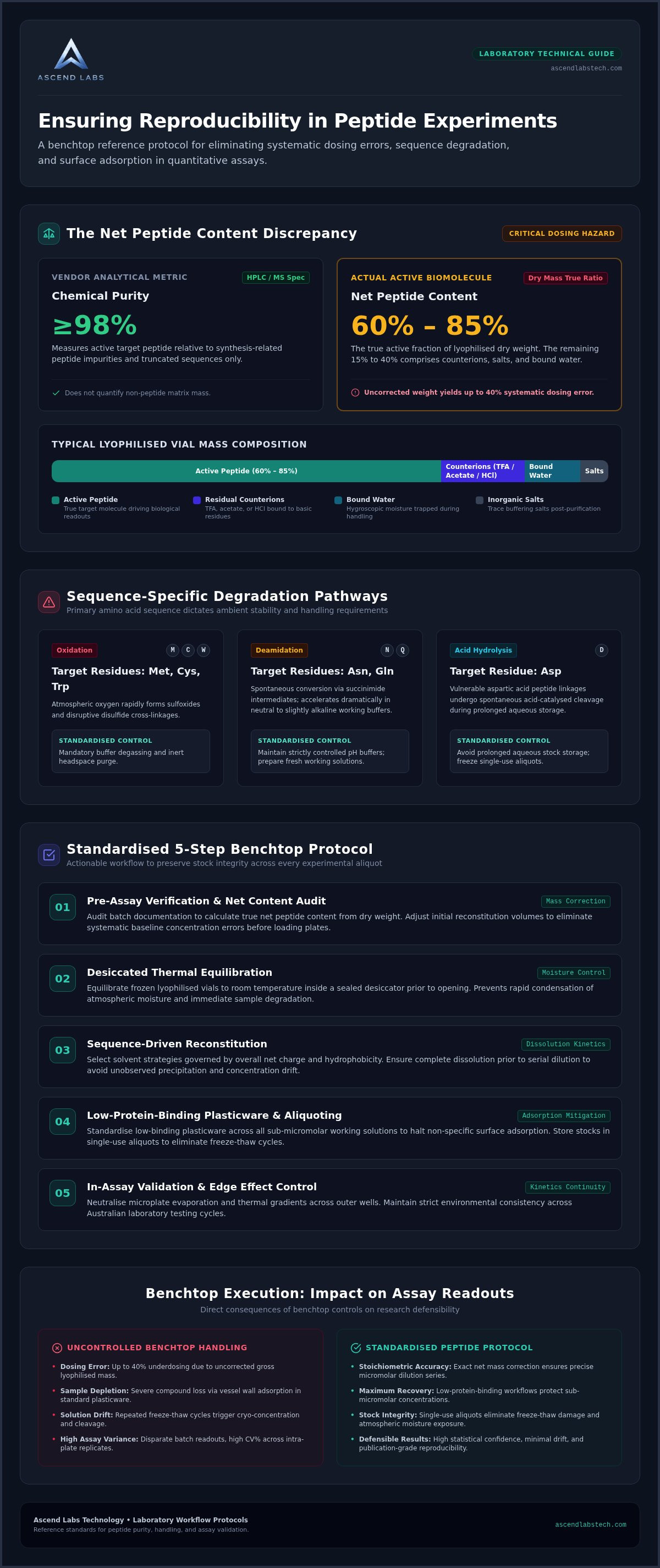
Even when an analytical certificate confirms a chemical purity of ≥98%, actual net peptide content by dry weight frequently sits between 60% and 85%. Treating gross lyophilised mass as pure active peptide introduces systematic dosing errors of up to 40% before a plate is ever loaded. When conducting quantitative in-vitro assays, ensuring reproducibility in peptide experiments demands far more than relying on nominal vendor specifications. Inconsistent batch readouts, sudden precipitation during dilution phases, and sample degradation from unmonitored freeze-thaw cycles routinely leave researchers struggling with unexplained experimental drift.
Most laboratory teams understand the frustration of losing valuable research hours to variable data, yet standard procedures often overlook the micro-handling controls that dictate molecular stability. You can eliminate these confounding variables by mastering a disciplined benchtop protocol that accounts for counterion mass, vessel adsorption, and sequence-specific dissolution kinetics. This laboratory checklist provides an actionable, standardised workflow to govern compound reconstitution, preserve stock integrity across every aliquot, and secure defensible, publishable results with high statistical confidence.
Key Takeaways
- Audit incoming batch documentation to distinguish actual net peptide content from gross lyophilised mass, eliminating systematic baseline concentration errors.
- Implement sequence-driven reconstitution strategies governed by amino acid charge and hydrophobicity, ensuring reproducibility in peptide experiments across every working dilution.
- Mitigate non-specific binding and sample depletion by standardising low-protein-binding plasticware workflows across all sub-micromolar solutions.
- Preserve compound stability through single-use aliquoting and desiccated thermal equilibration, preventing moisture condensation and cryo-concentration damage.
- Neutralise microplate edge effects and laboratory environmental variables to ensure consistent assay kinetics and publication-grade statistical confidence.
Understanding the Underlying Drivers of Variability in Peptide Research
Peptide experimental reproducibility is the capacity to generate identical, statistically consistent analytical and biological readouts across independent assays using synthetic peptide lots prepared under identical structural specifications. While pre-clinical investigations often attribute disparate data to macro-level biological variance, irreproducibility frequently originates at the benchtop via subtle chemical degradation and mechanical loss. Achieving absolute continuity demands proactive control over solvent chemistry, ambient thermal exposure, and hydration kinetics.
Synthetic peptides are delicate biomolecules. Unlike resilient small-molecule compounds, their secondary structural conformations and side-chain functionalities remain exceptionally vulnerable to ambient handling errors. In-vitro consistency degrades when laboratories treat dry lyophilised matter as an inert powder rather than a dynamic chemical entity. Foundational parameters in chemical peptide synthesis and purity variations show that incomplete coupling or divergent cleavage mechanisms introduce trace synthesis-related impurities. When these profiles interact with inconsistent benchtop dissolution methods, experimental variance becomes unavoidable.
To visualise how synthesis workflows, protecting-group removals, and downstream analytical checks dictate material fidelity before compounds reach the assay bench, review the procedure below:
Sequence-Specific Vulnerabilities: Oxidation, Deamidation, and Hydrolysis
Primary amino acid sequences dictate inherent degradation pathways. Methionine, cysteine, and tryptophan residues demand rigorous degassing protocols; exposure to atmospheric oxygen rapidly generates sulfoxides or disruptive disulfide cross-linkages. Asparagine and glutamine residues undergo deamidation via succinimide intermediates, a transformation accelerating dramatically in neutral to slightly alkaline working buffers. Additionally, vulnerable aspartic acid linkages undergo spontaneous acid-catalysed cleavage when maintained in prolonged aqueous storage, quietly destroying target concentration.
Distinguishing Gross Lyophilised Weight from Net Peptide Content
A frequent driver of experimental discrepancy is conflating gross lyophilised mass with actual active peptide content. Standard solid-phase peptide synthesis leaves substantial non-peptide residue within the lyophilised matrix. A typical vial contains:
- Residual counterions: Trifluoroacetate (TFA), acetate, or hydrochloride ions bound to basic amino acid residues.
- Bound atmospheric water: Hygroscopic moisture trapped within the crystalline matrix during post-lyophilisation handling.
- Inorganic trace salts: Residual buffering salts remaining after purification passes.
Consequently, net peptide content typically ranges between 60% and 85% of total mass. Failing to correct for this offset leads to systematic underdosing by as much as 40%, rendering micro-molar comparisons invalid. Rigorous research workflows depend on verified analytical documentation and established methods of peptide purity testing to establish precise net stoichiometry prior to dilution. Proactive characterisation provides the baseline for ensuring reproducibility in peptide experiments across extended project timelines.
Pre-Assay Verification Checklist for Research-Grade Compounds
Incoming quality control forms the verifiable baseline of every experimental protocol. Relying solely on a vendor's top-line summary leaves downstream readouts vulnerable to unmonitored impurities. Before unsealing any lyophilised container, Australian laboratories operating under AS/NZS 2243.2:2021 chemical management standards must cross-reference analytical documentation against physical container characteristics. Maintaining comprehensive batch records from intake to benchtop dilution establishes the traceability required for peer-reviewed validation.
Systematic incoming material control eliminates batch variability before an assay begins. To maintain complete data integrity, execute the following three-point verification sequence upon receiving research compounds:
- Container integrity audit: Verify that the crimp cap, septum, and internal vacuum seal remain fully intact without micro-fissures or seal displacement.
- Analytical data review: Audit original high-performance liquid chromatography and mass spectrometry data to verify baseline purity standards.
- Traceable accessioning: Log manufacturer batch codes, net peptide specifications, counterion types, and receiving dates into your laboratory inventory.
Auditing Analytical Documentation: HPLC and Mass Spectrometry
Inspect the raw analytical documentation rather than accepting a simple nominal percentage. On the reversed-phase high-performance liquid chromatography (RP-HPLC) chromatogram, check for a sharp, symmetrical main peak resolved clearly to baseline. Secondary shoulder peaks indicate closely related impurities, such as truncation sequences or diastereomers generated during synthesis. Next, confirm identity via electrospray ionisation mass spectrometry (ESI-MS). The observed mass-to-charge (m/z) ratios must correspond precisely to the theoretical monoisotopic mass of the target compound, confirming that protecting groups were completely cleaved during manufacturing.
Physical Cake Inspection and Moisture Elimination
Examine the physical appearance of the lyophilised material through the vial. A stable preparation presents as a uniform, porous lyophilised cake or a finely dispersed powder. A collapsed, gummy, or glassy residue indicates that moisture penetrated the container or that the peptide experienced thermal fluctuation during transit. Sourcing through reliable domestic cold-chain logistics helps protect compound integrity against ambient transit heat before delivery.
Atmospheric moisture absorption during initial opening remains a quiet point of experimental failure. Because lyophilised cakes are intensely hygroscopic, uncapping a cold vial exposes the material to immediate ambient condensation. This triggers rapid deamidation and weight distortion. Always equilibrate sealed vials inside a desiccator at controlled room temperature (20°C to 22°C) for a minimum of 20 to 30 minutes before removing the stopper.
Adhering to strict incoming validation ensures that every milligram introduced into your experimental system matches theoretical specifications. When designing complex analytical matrices, source independently validated materials by reviewing available laboratory-grade synthetic research compounds to establish defensible baselines across every project.
Standardised Reconstitution Protocols: A Step-by-Step Benchtop Guide
Reconstitution represents the most frequent point of user-introduced experimental error. Assuming uniform aqueous solubility across diverse sequences inevitably leads to erratic dosing, partial suspension, or irreversible precipitation. Because primary structure dictates secondary folding and surface polarity, solvation behavior depends directly on the ratio of charged to uncharged, hydrophobic residues. Ensuring reproducibility in peptide experiments requires replacing broad assumptions with a calculated, stepwise solvation strategy.
Direct addition of physiological buffers like PBS to dry powder frequently causes immediate aggregation. Saline environments screen ionic interactions that would otherwise keep individual peptide chains apart. To circumvent this kinetic barrier, always adhere to a structured three-phase reconstitution workflow:
- Solvation assessment: Calculate the net charge and hydrophobic residue count before touching a pipette.
- Primary dissolution: Dissolve the lyophilised matrix at a high concentration in a minimal volume of primary solvent.
- Secondary dilution: Bring the clear stock up to working concentration by slowly introducing your target assay buffer.
Determining Net Charge and Selecting Appropriate Solvents
Determine the theoretical net charge of the target sequence at neutral pH by evaluating the balance between acidic residues (Asp, Glu) and basic residues (Lys, Arg, His), alongside terminal groups. For acidic peptides carrying a net negative charge, initiate reconstitution in a minute volume of dilute basic buffer, such as 0.1% ammonium hydroxide or 1% ammonium bicarbonate, before titrating with neutral media.
Basic peptides with a net positive charge dissolve cleanly in sterile deionised water or 10% to 30% analytical-grade acetic acid. For sequences containing over 50% hydrophobic residues (Leu, Ile, Val, Phe, Trp), pre-dissolve the cake in minimal research-grade DMSO or acetonitrile. Keep final organic solvent fractions below 0.5% to 1.0% in downstream cell-based assays to prevent non-specific cytotoxicity. Always use deoxygenated, sterile-filtered solvents to shield vulnerable side chains against ambient oxidation.
Mechanical Dissolution: Agitation Versus Vortexing Constraints
Mechanical shear ruins peptide assemblies. Introduce the chosen reconstituting solvent slowly down the internal glass wall of the vial, avoiding direct high-velocity pipetting onto the cake. Swirl the vessel gently with a continuous circular wrist motion until the solution clarifies entirely.
Vortex mixers create high liquid shear stresses and bubble entrainment. This interfacial foaming strips the native hydration layer, accelerates structural misfolding, and drives macroscopic aggregation. If a hydrophobic sequence resists standard dissolution, sonicate the sealed vial in a cold-water bath for 30 to 60 seconds. Confirm complete visual clarity against a dark background prior to aliquoting, guaranteeing uniform compound dispersion throughout the liquid column.
Mitigating Surface Adsorption, Storage Degradation, and Solution Drift
Reconstituted peptide solutions face rapid chemical and physical degradation if vessel interfaces remain unmonitored. While bulk stock solutions maintain reasonable stability, sub-micromolar experimental dilutions encounter severe non-specific binding (NSB). In standard untreated borosilicate glass or general polypropylene consumables, hydrophobic residues adhere aggressively to vessel walls. At concentrations below 100 ng/mL, this surface adsorption can deplete active compound mass by 40% to 80% within 24 hours, skewing calculated EC50 values and destroying inter-assay precision.
Preventing concentration drift requires a two-pronged operational strategy: eliminating surface loss through material selection and suppressing thermal degradation via rigorous cryopreservation controls. Ensuring reproducibility in peptide experiments demands that consumables and cold-storage conditions receive the same scrutiny as reagent purity.
Consumable Selection: Low-Retention Plastics and Surface Passivation
Deploy certified low-protein-binding (LPB) polypropylene tubes and low-retention pipette tips across all experimental dilution series. Standard polypropylene features hydrophobic micro-crevices that trap lipophilic peptide side chains. Certified LPB plastics use specialised surface polymers that consistently achieve recovery rates above 85% to 90%. Pre-wetting pipette tips two to three times before dispensing saturates exposed binding sites, ensuring accurate volumetric transfer. Where downstream cellular protocols allow, adding 0.01% to 0.05% non-ionic surfactant (such as Polysorbate-20) or 0.1% bovine serum albumin passivates exposed plastic surfaces, halting non-specific peptide loss entirely.
Cryopreservation Parameters and Thermal Monitoring
Repetitive freeze-thaw cycles cause cryo-concentration, phase separation, and mechanical shearing. As water solidifies, peptide molecules concentrate in shrinking inter-crystalline liquid channels, accelerating aggregation and hydrolysis. To preserve compound integrity across multi-week studies, adhere to the following physical storage controls:
- Single-use aliquoting: Subdivide reconstituted stocks immediately into single-use experimental volumes, ensuring no working aliquot undergoes more than one freeze cycle.
- Deep thermal stability: Maintain long-term aliquots at -80°C rather than standard -20°C storage to arrest chemical degradation kinetics.
- Manual-defrost preservation: Store materials strictly in dedicated manual-defrost freezers; cyclic auto-defrost heating spikes accelerate ice recrystallisation and peptide fragmentation.
- Inert gas purging: Displace vial headspace air with high-purity argon or nitrogen before freezing to protect methionine, cysteine, and tryptophan residues against atmospheric oxidation.
In-Assay Validation and Environmental Controls for Australian Laboratories
Maintaining analytical precision during the assay phase requires strict management of micro-environmental variables across entire microplates. When running biochemical or cell-based readouts, inconsistent incubation temperatures, evaporative volume losses, and localized thermal gradients introduce significant data skew. Facilities accredited by NATA under ISO/IEC 17025:2017 must control ambient temperatures between 20°C and 22°C with relative humidity maintained between 20% and 50%. These tolerances prevent static interference on micro-balances and avoid hygroscopic condensation during reagent dispensing.
Differentiating true biological responses from compound handling artifacts requires running rigorous internal controls on every assay plate. Ensuring reproducibility in peptide experiments depends on matching precise physical plate design with documented environmental continuity across all experimental batches.
Plate Layout Architecture and Evaporation Control
Multi-well microplates remain highly susceptible to edge effects during incubation. Peripheral wells lose volume faster via evaporation, concentrating solutes and creating artificial kinetic spikes along perimeter rows. Mitigate these physical artifacts by adopting structured plate architecture:
- Perimeter buffering: Fill the entire outer boundary (rows A and H, columns 1 and 12 on a 96-well format) with 200 µL of sterile deionised water or buffer to create a thermal and evaporative barrier.
- Solution equilibration: Bring all peptide working dilutions and detection reagents to the target operating temperature in a dry-block bath prior to plating, avoiding cold-shock gradients.
- Randomised spatial replicates: Distribute technical replicates randomly across central inner wells rather than grouping identical concentrations together, neutralising subtle inter-well thermal differentials.
Securing Verified Supply Chains Across Australia
Environmental control on the benchtop proves futile if compounds suffer undetected thermal stress before reaching the facility. International procurement channels often introduce unpredictable transit delays, border holding intervals, and broken cold chains that accelerate sample degradation. Sourcing through reliable domestic cold-chain logistics eliminates these transit risks, guaranteeing temperature-regulated handling from inventory storage directly to the testing facility.
Australian research teams must establish auditable record-keeping protocols that comply with AS/NZS 2243.2:2021 standards. Log the supplier batch number, reconstitution timestamp, precise primary solvent volume, and dilution factor into laboratory notebooks before initiating any multi-well plate run. For validated in-vitro studies, accessing independently verified research peptides and compounds provides the batch consistency necessary to produce defensible, publishable analytical data across diverse experimental phases.
Securing Long-Term Fidelity in Experimental Peptide Assays
Achieving rigorous scientific outcomes demands the systematic elimination of micro-handling variables. From calculating true net peptide content rather than relying on gross mass to deploying low-protein-binding consumables, small physical controls safeguard active concentration across every dilution series. Ensuring reproducibility in peptide experiments ultimately relies on uniting disciplined benchtop workflows with fully authenticated starting materials.
When experimental designs eliminate repeated freeze-thaw cycles, mitigate plate-edge evaporation, and verify counterion chemistry, batch-to-batch drift ceases to confound your results. Ascend Labs supports Australian research facilities with pure research-grade compounds verified through comprehensive RP-HPLC and mass spectrometry batch documentation. Reliable domestic cold-chain distribution protects compound stability throughout transit, ensuring your materials arrive with their molecular integrity intact for in-vitro analysis.
With disciplined protocols governing compound reconstitution and storage, your laboratory can confidently produce the robust, publication-grade data necessary to advance serious scientific inquiry.
Frequently Asked Questions
Is it acceptable to vortex peptide solutions to accelerate dissolution?
No, vortexing should be avoided because vigorous mechanical agitation causes rapid shear stress and interfacial air foaming. This physical disruption strips delicate hydration shells, inducing secondary structure denaturation and irreversible aggregation. Instead, dissolve compounds by swirling the vial gently with a circular wrist motion. If a hydrophobic sequence resists solvation, brief, temperature-controlled sonication in an ice-water bath for 30 to 60 seconds provides safe energy dispersion without shearing peptide bonds.
Can I store reconstituted peptides at four degrees Celsius between assay runs?
Storing reconstituted peptides at 4°C is suitable only for short-term handling across a single working day. Aqueous storage above freezing invites spontaneous chemical degradation, including rapid deamidation of asparagine residues and microbial proliferation. For workflows focused on ensuring reproducibility in peptide experiments, solutions must be divided immediately into single-use aliquots and preserved at -80°C. Never leave aqueous peptide stocks at 4°C overnight if you expect consistent stoichiometric concentrations across subsequent assays.
How much peptide mass is lost through non-specific plastic adhesion?
Non-specific plastic binding can deplete active peptide mass by 40% to 80% within 24 hours when solutions are dilute. Sub-micromolar working preparations (below 100 ng/mL) suffer the most severe losses because lipophilic amino acid chains adhere to hydrophobic micro-cavities in untreated polypropylene. Standardising protocols on certified low-protein-binding consumables and pre-wetting pipette tips elevates recovery rates above 90%, preventing artificial curve shifts and ensuring accurate dose-response metrics across biological replicates.
What happens if a peptide solution displays persistent optical cloudiness?
Persistent optical cloudiness indicates incomplete dissolution or the spontaneous formation of insoluble macromolecular aggregates. Delivering a cloudy suspension into an assay well guarantees inconsistent dosing, as particulate mass settles unevenly across the plate. Do not filter cloudy solutions; doing so strips the active compound out of solution. Instead, adjust solvent conditions by introducing a minute fraction of dilute acid, base, or organic cosolvent like DMSO to restore thermodynamic equilibrium and achieve full visual clarity.
How do freeze-thaw cycles compromise peptide secondary structure?
Repeated freeze-thaw cycles induce cryo-concentration, forcing peptide molecules into concentrated micro-domains of unfrozen liquid as water crystallises. This localized density surge accelerates intermolecular aggregation, promotes beta-sheet fibril formation, and exposes fragile peptide backbones to mechanical shear from growing ice crystals. Additionally, cyclical freezing alters local pH balances, triggering deamidation and peptide cleavage. Preparing pre-measured, single-use aliquots completely removes freeze-thaw stress, preserving native molecular conformation across extended research schedules.
Can net peptide content differ significantly between two identical lots?
Yes, net peptide content often varies between independent synthesis lots, even when nominal HPLC purity ratings appear identical. Net peptide content reflects the actual percentage of peptide mass relative to counterions, residual synthesis salts, and bound moisture. One lot might exhibit 72% net content while another holds 81%. In ensuring reproducibility in peptide experiments, laboratories must adjust their reconstitution masses using lot-specific analytical documentation rather than assuming gross dry powder equals 100% active compound.
Is bacteriostatic water suitable for cell-based metabolic research assays?
Bacteriostatic water is unsuitable for in-vitro cell-based research because it contains 0.9% benzyl alcohol as an antimicrobial preservative. While effective at inhibiting bacterial growth, benzyl alcohol disrupts cell membrane integrity, alters metabolic viability readouts, and impairs mitochondrial function in culture. For biochemical and cellular research, always reconstitute lyophilised peptides using sterile, deoxygenated deionised water, analytical-grade dilute acids or bases, or buffered saline matching downstream experimental parameters.


