

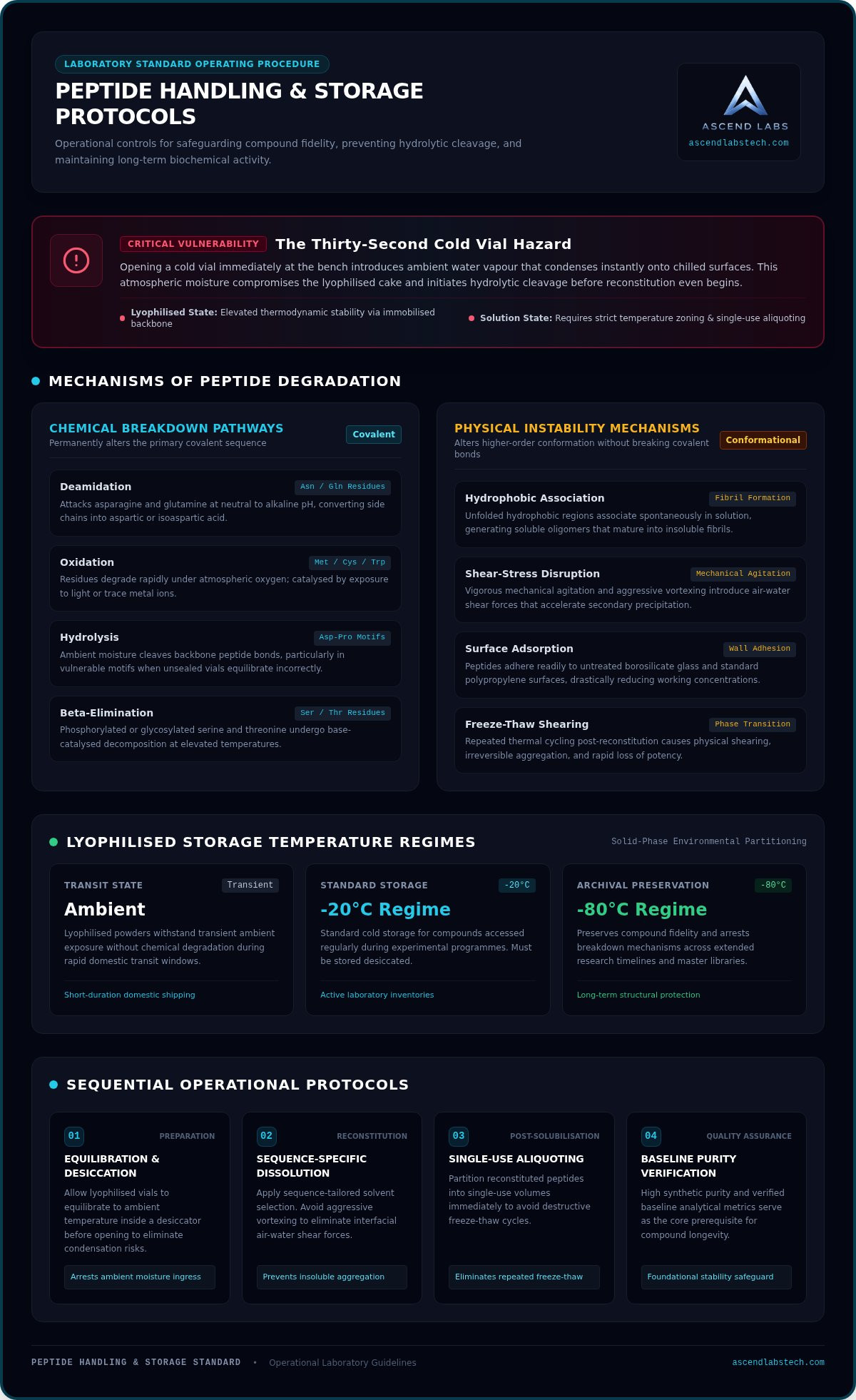
The most destructive variable in peptide research isn't synthetic quality; it's often the thirty seconds spent opening a cold vial at the laboratory bench. Atmospheric moisture condenses instantly on chilled surfaces, introducing water vapour that compromises a lyophilised cake and initiates hydrolytic cleavage before solvent addition even begins. This peptide handling and storage guide establishes the rigorous operational controls necessary to safeguard compound fidelity from receipt to assay. If you've ever encountered unexplained baseline drift or watched a sensitive sequence aggregate after an unavoidable freeze-thaw cycle, you already recognise how unforgiving these macromolecules can be.
Peptide integrity is governed by phase-specific thermodynamics, demanding distinct, sequential handling measures across solid and solution states. You'll master precise laboratory protocols for temperature zoning, solvent selection, and sterile aliquoting that protect biological activity and maintain purity over extended timelines. Ahead, we detail the environmental controls and reconstitution workflows required to eliminate oxidation, avoid enzymatic degradation, and ensure reproducible experimental outcomes.
Key Takeaways
- Identify primary chemical degradation pathways, including deamidation and beta-elimination, to implement targeted pre-emptive controls in the laboratory.
- Establish rigorous temperature equilibration and desiccator workflows for lyophilised vials to prevent moisture condensation during benchtop access.
- Apply sequence-specific solvent selection and dissolution protocols detailed in this peptide handling and storage guide to eliminate aggregation risks.
- Implement strict single-use aliquoting regimens post-reconstitution to prevent physical shearing and hydrolysis caused by repeated freeze-thaw cycles.
- Understand why verified baseline purity and quality synthesis remain the foundational prerequisite for long-term compound stability.
Mechanisms of Peptide Degradation: Why Handling Protocols Matter
Fundamentally, peptides are short chains of amino acids linked via amide bonds, lacking the complex tertiary folds that often shield larger proteins from degradation. Without robust structural protection, these synthetic chains remain exceptionally vulnerable to rapid chemical cleavage and physical denaturing when exposed to routine benchtop environments. Maintaining analytical fidelity demands an operational understanding of precisely how environmental vectors trigger decomposition.
To visualise how poor bench habits compromise vial integrity, review this practical demonstration:
Every laboratory standard operating procedure relies on mitigating specific decomposition routes. By consulting this peptide handling and storage guide, researchers can systematically eliminate the experimental variability caused by both chemical breakdown pathways and physical aggregation mechanisms.
Chemical Instability Pathways in Synthetic Peptides
Chemical degradation permanently alters the primary covalent sequence of a peptide. The dominant pathways encountered during routine research include:
- Deamidation: Readily attacks asparagine (Asn) and glutamine (Gln) residues, particularly at neutral to alkaline pH, converting side chains to aspartic or isoaspartic acid.
- Oxidation: Highly susceptible residues including methionine, cysteine, and tryptophan degrade rapidly under atmospheric oxygen, often catalysed by light or trace metal ions.
- Hydrolysis: Ambient moisture cleaves peptide backbone bonds, particularly vulnerable Asp-Pro motifs, when unsealed vials equilibrate incorrectly.
- Beta-Elimination: Phosphorylated or glycosylated serine and threonine residues undergo base-catalysed decomposition at elevated temperatures.
Physical Instability: Aggregation and Fibril Formation
Physical instability alters higher-order conformation without breaking covalent bonds, yet it renders reagents biologically inactive:
- Hydrophobic Association: Unfolded hydrophobic regions associate spontaneously in aqueous solutions, generating soluble oligomers that mature into insoluble macroscopic fibrils.
- Shear-Stress Disruption: Vigorous mechanical agitation, such as aggressive vortexing, introduces interfacial air-water shear forces that accelerate irreversible secondary precipitation.
- Surface Adsorption: Peptides adhere avidly to untreated borosilicate glass and standard polypropylene walls, significantly reducing actual working concentrations in dilute assays.
Establishing disciplined bench protocols isn't merely an administrative exercise. It's the singular control mechanism protecting baseline purity, preventing assay failure, and securing experimental reproducibility across your laboratory workflows.
Storage Protocols for Lyophilised Peptides: Temperature and Moisture Control
A common operational flaw in modern laboratories is treating solid-phase peptides with the same handling assumptions as aqueous solutions. In their lyophilised state, peptides possess elevated thermodynamic stability because removing unbound water immobilises the peptide backbone and arrests hydrolytic cleavage. However, maintaining this protective state requires strict environmental partitioning between ambient transit and cold storage conditions.
Lyophilised powders withstand transient ambient exposure without degradation during rapid domestic transit windows. For extended stability, compound preservation mandates distinct, temperature-controlled environments tailored to experimental timelines.
Temperature Regimes: Ambient, -20°C, and -80°C
Thermal regulation must reflect your laboratory's usage frequency and archiving schedule:
- Short-Term Bench Storage (-20°C): Lyophilised peptides remain stable at minus 20 degrees Celsius for several weeks to several months. This regime suits active working projects where vials are accessed periodically.
- Long-Term Archiving (-80°C): Archiving sequences for periods exceeding one year requires deep cryogenic preservation at minus 80 degrees Celsius to suppress molecular movement entirely.
- Frost-Free Freezer Hazard: Never store research peptides in automated frost-free laboratory freezers. These units employ periodic heating cycles to prevent ice build-up, exposing vials to destructive thermal cycling that induces premature structural breakdown.
When sourcing analytical-grade materials, selecting verified research peptides dispatched through dependable cold-chain distribution safeguards that these baseline thermal baselines remain uncompromised prior to bench delivery.
Managing Hygroscopic Condensation and Vial Equilibration
Lyophilised cakes are exceptionally hygroscopic; they act like sponges for atmospheric water vapour. If you retrieve a vial from minus 20 degrees Celsius and immediately uncap it, cold air inside the vessel pulls in surrounding ambient moisture. Condensation forms instantaneously on the powder surface, turning a stable dry cake into a semi-hydrated matrix primed for rapid hydrolysis.
To eliminate this variable, adhere to a strict vial equilibration protocol within this peptide handling and storage guide:
- Desiccator Equilibration: Transfer the sealed container directly from the freezer into a sealed desiccation chamber. Allow the container to equilibrate to ambient room temperature for at least thirty minutes before uncapping.
- Inert Gas Purging: If you use only a portion of the lyophilised powder, flush the container headspace with dry nitrogen or argon before resealing. Displacing residual oxygen and ambient moisture preserves the remaining cake against oxidation and hydrolytic decay.
Reconstitution Methodology: Solvent Selection and Dissolution Techniques
Solubilising a peptide requires matching solvent chemistry to the compound's net electrical charge and hydrophobicity profile. Adding an arbitrary volume of sterile water to an unfamiliar sequence invites irreversible precipitation. Once a peptide crashes out of solution, recovering its monomeric state without harsh chemical manipulation becomes exceedingly difficult. Establishing a systematic, stepwise dissolution pathway protects compound integrity from the outset.
A comprehensive peptide handling and storage guide treats reconstitution as a precise titration rather than a single addition. Solvent choice dictates both the rate of dissolution and the long-term thermodynamic stability of the resulting liquid phase.
Solvent Selection Hierarchy Based on Peptide Sequence
Determine overall net charge by calculating basic residues (Arg, Lys, His) against acidic residues (Asp, Glu) alongside terminal charges:
- Neutral Peptides (Net Charge 0): Soluble peptides exhibiting balanced charges generally dissolve cleanly in sterile deionised water or bacteriostatic water containing 0.9% benzyl alcohol.
- Basic Peptides (Net Positive Charge): Solubilise using dilute sterile acetic acid (0.1% to 1.0% v/v) to protonate residues and encourage solvent interaction before diluting with aqueous buffer.
- Acidic Peptides (Net Negative Charge): Dissolve in dilute ammonium hydroxide (0.1% to 0.5% v/v) or dilute sodium bicarbonate to maintain deprotonation, then adjust to the target working volume.
- Hydrophobic Sequences (>50% Hydrophobic Residues): Pre-solubilise the lyophilised cake in a minimal volume of analytical-grade dimethyl sulfoxide (DMSO) or acetonitrile. Once completely clear, slowly dilute with sterile aqueous buffer, ensuring final organic solvent concentrations remain below downstream assay tolerance thresholds.
Dissolution Technique: Swirling versus Mechanical Agitation
Physical handling during solvent delivery directly impacts aggregation kinetics. Introduce the reconstitution vehicle slowly down the inner glass wall of the vial using a calibrated pipette, preventing the liquid jet from impacting the powder cake directly.
Gently roll and swirl the vial between your palms to wet the entire surface area. Never submit the vial to high-speed vortexing. Intense mechanical agitation generates high-shear air-liquid interfaces that unfold exposed residues, promoting rapid fibril formation and foaming that permanently denatures the sequence.
Reconstitution Verification and Analytical Confirmation
Hold the reconstituted solution against a contrasting light background to inspect for micro-particulates, persistent turbidity, or optical refraction. Allow several minutes for full hydration, as some tightly packed hydrophobic cores hydrate slowly.
Verifying optical clarity ensures the peptide has fully dispersed as monomers rather than suspension aggregates. Consult our guide on peptide purity testing to understand baseline verification parameters and confirm that your reconstituted working solutions reflect the analytical benchmarks documented by the supplier.
Post-Reconstitution Management: Aliquoting and Shelf-Life Maximisation
Transitioning a compound from a stable lyophilised solid to an aqueous solution fundamentally alters its thermodynamic behaviour. In liquid suspension, water molecules act as active chemical reactants in hydrolytic cleavage, while unrestricted molecular motion exponentially increases collision frequency and aggregation rates. Managing reconstituted compounds demands distinct protocols from those applied to dry powders.
The core objective of any advanced peptide handling and storage guide is preserving post-reconstitution potency across the entire experimental lifecycle. Mitigating rapid solution-phase decay requires strict aliquoting discipline and intentional consumable selection.
The Single-Use Aliquot Strategy
The single greatest threat to reconstituted peptides is repeated thermal cycling. As an aqueous solution freezes, forming ice crystals exert physical shear stresses that disrupt peptide conformation. Simultaneously, cryo-concentration forces solutes and buffer salts into narrow liquid channels, shifting local micro-pH and driving accelerated degradation.
To eliminate this damage, partition reconstituted stock immediately into single-use experimental volumes:
- Calculate exact volume requirements per assay to avoid preparing excess solution.
- Dispense stocks directly into individual microcentrifuge tubes rather than drawing repeatedly from a master vial.
- Label every container systematically with compound identity, precise concentration, reconstitution solvent, and preparation date.
- Store working aliquots at minus 20 degrees Celsius for multi-month applications, or transfer to minus 80 degrees Celsius for extended preservation.
Container Selection: Low-Binding Polypropylene Plastics
Peptide loss does not occur through chemical breakdown alone; physical surface adsorption can rapidly deplete your working concentration. Hydrophobic residues exhibit strong affinity for standard borosilicate glass and conventional laboratory plastics, often reducing usable yield by 20% or more in dilute solutions (concentrations below 1 mg/mL).
Always specify certified low-retention, low-binding polypropylene cryovials. These vessels feature chemically inert surfaces that minimise non-specific molecular binding. Furthermore, select vial sizes that match your aliquot volume; excessive container headspace traps ambient air, exposing dissolved residues to unnecessary oxidative stress.
Reconstituted Solution Stability Windows
Reconstituted peptide viability drops sharply compared to dry cakes:
- Refrigerated Storage (2°C to 8°C): Aqueous solutions should generally be consumed within several days. Compounds solubilised in bacteriostatic water containing benzyl alcohol may remain viable for up to three weeks depending on sequence vulnerability.
- Frozen Storage (-20°C to -80°C): Frozen single-use aliquots remain stable for several months, provided temperatures remain constant.
- The Zero-Refreeze Rule: Once an aliquot is thawed for experimental use, never return it to the freezer. Discard any residual liquid or consume it within immediate parallel assays.
Sourcing High-Purity Compounds: The Foundation of Peptide Stability
Rigorous bench protocols cannot compensate for flawed chemical synthesis. If a lyophilised peptide contains residual scavengers, truncated deletion sequences, or excess counter-ion contaminants like trifluoroacetate (TFA) salts, baseline stability deteriorates rapidly regardless of storage temperature. These chemical artefacts actively catalyse premature hydrolysis and auto-oxidation within the sealed vial. Adhering to this peptide handling and storage guide yields reproducible experimental results only when your starting material is chemically pristine.
A stable experimental workflow requires verifiable starting purity, pairing methodical laboratory practice with verified compound provenance.
Analytical Verification: HPLC and Mass Spectrometry Standards
Analytical transparency forms the bedrock of experimental validity. High-Performance Liquid Chromatography (HPLC) establishes purity profiles, verifying that the target sequence meets or exceeds modern analytical benchmarks of 99% purity. This process separates the intact peptide from closely eluting synthesis fragments.
Liquid Chromatography-Mass Spectrometry (LC-MS) confirms theoretical molecular mass, identifying deletion sequences or incomplete deprotection artefacts. Always cross-reference manufacturer batch data against established peptide purity verification standards before dissolving rare or complex sequences.
Securing Research Compounds with Direct Domestic Dispatch
International freight pathways expose fragile synthetic chains to unpredictable variables. Cross-border consignments face prolonged customs clearances, administrative delays, and uncontrolled tarmac temperatures that degrade sensitive amide bonds before arrival.
Dedicated domestic Australian dispatch mitigates these environmental risks through rapid transit windows. Ascend Labs distributes verified, laboratory-grade compounds directly across Australia, ensuring that temperature-sensitive agents remain uncompromised throughout transit. Specialised reagents, including Retatrutide research peptides and mitochondrial compounds, require strict chain-of-custody controls to perform reliably across complex cellular or metabolic assays.
Review the verified compounds available across the Ascend Labs research catalogue to source high-purity research materials dedicated strictly to scientific investigation.
Elevating Laboratory Standards for Reproducible Peptide Research
Experimental precision hinges on managing peptides with phase-specific thermodynamic discipline. By adhering to the protocols outlined in this peptide handling and storage guide, research teams eliminate premature degradation caused by ambient moisture condensation, solvent mismatch, and destructive freeze-thaw cycles. Meticulous laboratory technique ensures that sensitive sequences retain their primary structure and biological potency throughout extended study timelines.
Even the most rigorous storage protocols can't rescue inferior starting material. Ascend Labs supports Australian scientific laboratories by supplying strictly research-grade compounds verified via HPLC and mass spectrometry. With dedicated domestic Australian dispatch preserving baseline compound stability, you can eliminate transit-related thermal excursions and protect experimental validity.
Pair verified analytical quality with disciplined benchtop execution to secure genuine assay reliability and maintain reproducible scientific inquiry.
Frequently Asked Questions
How should lyophilised research peptides be stored upon arrival at the laboratory?
Lyophilised research peptides should be transferred immediately into a dedicated, non-frost-free freezer upon laboratory arrival. For experimental protocols running within a few months, storage at minus 20 degrees Celsius is sufficient. For multi-year archival preservation, maintain vials at minus 80 degrees Celsius. Keep containers stored in sealed desiccation boxes with fresh indicator silica gel to ensure the dry cake remains protected against ambient humidity.
Why is it critical to bring peptide vials to room temperature before opening them?
Lyophilised peptide powders are highly hygroscopic. If you uncap a frozen or refrigerated vial immediately at the bench, ambient moisture condenses rapidly on the cold interior glass and powder matrix. This instantaneous condensation hydrates the cake, triggering premature hydrolytic degradation and bond cleavage. As outlined in our peptide handling and storage guide, always equilibrate sealed vials inside a desiccator for thirty minutes before unsealing.
Can reconstituted peptide solutions be refrozen after initial thawing?
Reconstituted peptides shouldn't ever be refrozen once thawed. Secondary freeze-thaw cycles subject delicate peptide bonds to severe physical shear stresses generated by expanding ice crystals. Cryo-concentration also causes localised pH swings that accelerate aggregation and chemical cleavage. Researchers should always divide reconstituted master stock into single-use aliquots at the point of initial dissolution, thawing only what is required for an individual experimental run.
What is the recommended solvent for reconstituting highly hydrophobic research peptides?
Highly hydrophobic peptides containing high ratios of non-polar amino acids dissolve best when pre-solubilised in a minimal volume of analytical-grade dimethyl sulfoxide (DMSO) or acetonitrile. Once the powder dissolves into a completely transparent monomeric solution, slowly add sterile water or experimental buffer to reach the final working volume. Ensure the final organic solvent concentration remains below the tolerance threshold of your downstream biological or cellular assay.
How long do reconstituted peptide solutions retain their stability in the refrigerator?
Reconstituted peptide stability at 2 to 8 degrees Celsius depends heavily on sequence composition and solvent selection. Peptides reconstituted in sterile water typically remain chemically intact for two to seven days before hydrolysis accelerates. Utilising bacteriostatic water containing 0.9% benzyl alcohol can extend refrigerated viability up to three weeks by inhibiting microbial proliferation, provided the peptide sequence contains no readily oxidisable methionine or cysteine residues.
What container materials best prevent peptide loss through surface adsorption?
Certified low-retention or low-binding polypropylene plastics provide optimal recovery for reconstituted peptides. Standard laboratory borosilicate glass and untreated polystyrene carry net surface charges and hydrophobic domains that bind peptides non-specifically, stripping substantial compound mass from dilute solutions. Selecting microcentrifuge tubes engineered with chemically inert, low-adsorption polymers guarantees that actual working concentrations remain consistent with your intended experimental parameters.
How do repeated freeze-thaw cycles physically degrade peptide integrity?
Ice crystal formation during freeze-thaw cycles exposes peptides to damaging physical shear forces that disrupt secondary and tertiary conformation. As liquid water freezes into solid ice, remaining solutes concentrate into narrow interstitial channels. This cryo-concentration process alters ionic strength, forces hydrophobic associations, and accelerates irreversible fibril aggregation. Following a disciplined peptide handling and storage guide by preparing single-use aliquots completely prevents this physical degradation.
Why does initial synthesis purity directly affect the long-term storage stability of a peptide?
Initial synthesis purity dictates baseline chemical stability because synthesis contaminants act as persistent degradation catalysts. Residual scavenger molecules, truncated deletion fragments, and counter-ion trifluoroacetate (TFA) salts facilitate auto-oxidation and hydrolytic cleavage within the container. Verified high-purity peptides exceeding 99% purity minimise these reactive side-products, ensuring the compound maintains structural fidelity throughout long-term cryogenic storage and subsequent reconstitution.


