

What does the purity percentage on a vial actually tell you? When assessing high purity peptide vials, a headline figure is difficult to compare without context such as the analytical method, sample tested and batch identity.
A purity result is one part of a quality assessment, not a complete account of a vial’s identity, composition or suitability for a research protocol. Batch-specific documentation helps put the result in context and supports a more informed procurement decision.
This guide explains what a purity figure can and can’t establish, which analytical details and batch records to review, and how to assess supplier information without treating it as independent verification. It also covers practical considerations for research-only procurement in Australia. Ascend Labs supplies research compounds across metabolic, growth factor, recovery and neuromodulator categories. The focus is on evidence, traceability and careful interpretation, rather than a percentage in isolation.
Key Takeaways
- Assess high purity peptide vials using more than a headline percentage. Purity alone doesn’t establish identity, concentration or suitability for a research design.
- Interpret analytical results in context by considering the method, sample and measurement reported.
- Compare identity evidence, purity results, batch traceability and labelling. Note what each can and can’t establish on its own.
- Use a procurement checklist to define research requirements, match compound identity, review batch evidence and maintain clear records.
- Explore Ascend Labs’ research-only catalogue by category, including metabolic, growth factor, recovery and neuromodulator peptides.
What Does High Purity Mean for Research Peptide Vials?
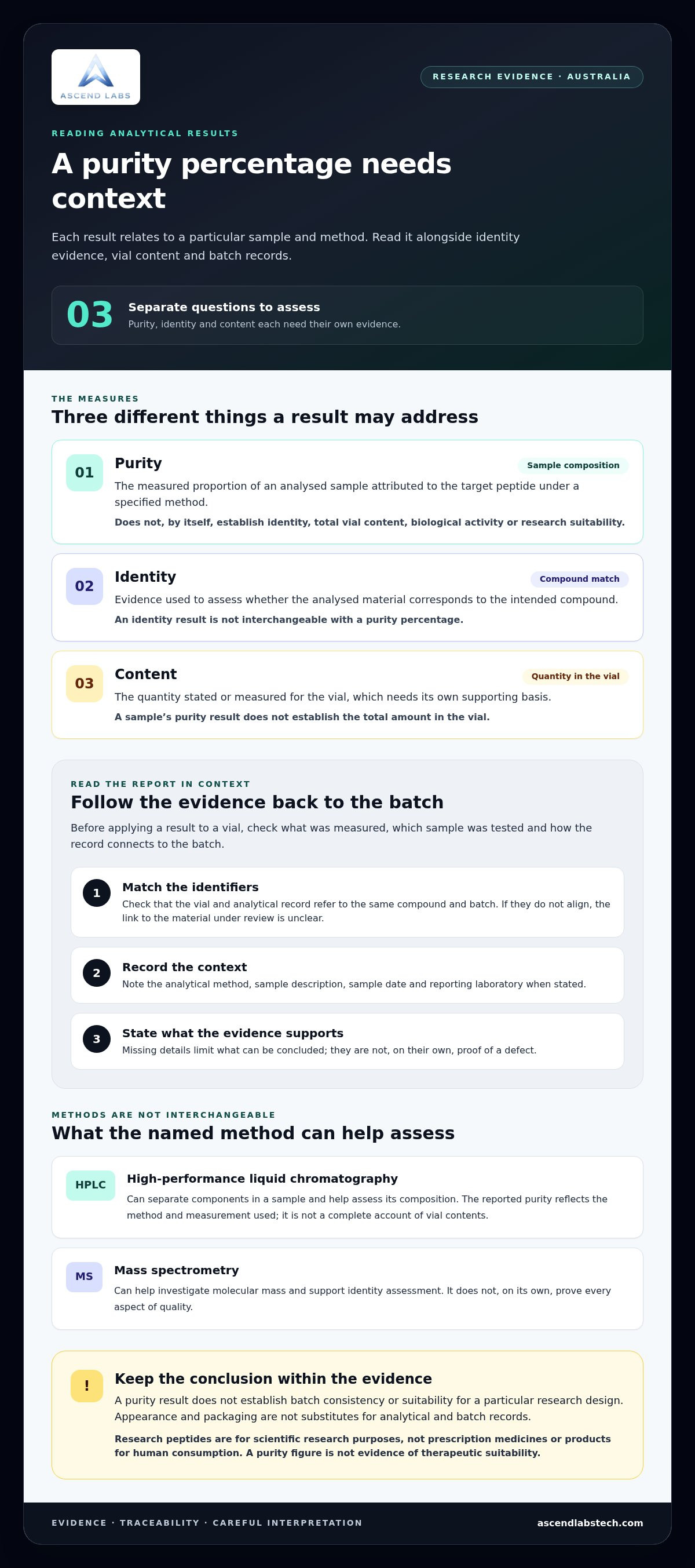
Peptide purity is the measured proportion of an analysed sample attributed to the target peptide under a specified analytical method. It describes a feature of that sample, not every quality attribute of the material in a vial. The result depends on what was tested and how it was measured, so a purity figure needs context before it can inform a research decision.
This distinction matters when comparing high purity peptide vials. A percentage alone doesn’t establish the compound’s identity, the total amount in the vial, consistency between batches or suitability for a particular research design. Each is a separate question that requires its own evidence.
Purity, identity and concentration are different measures
Purity concerns sample composition. It doesn’t, by itself, demonstrate biological activity or research performance. Identity testing provides evidence that the analysed material corresponds to the intended compound. Concentration or total content concerns how much material is present, which is different from the proportion attributed to the target peptide in an analysed sample.
Keep these measures distinct:
- Purity: the reported composition-related result for the analysed sample.
- Identity: evidence used to assess whether the material matches the intended compound.
- Content: the quantity stated or measured for the vial, which needs its own supporting basis.
Batch consistency and suitability for a research design also need separate consideration. One result can’t establish that different batches are equivalent or that a compound is appropriate for a specific experimental purpose.
Purification methods, including high-performance liquid chromatography (HPLC), form part of peptide production and analysis. For background on synthesis and purification, see Peptide Synthesis and Purity. Interpret the method named in a record in relation to the specific sample and reported result.
What a vial label can, and cannot, tell you
A label can provide identifiers such as a compound name, batch reference or stated content. These details are useful when they connect the vial to relevant batch documentation. On their own, they don’t show how a purity claim was measured or whether the analysed sample corresponds to that batch.
For a percentage claim, look for the analytical method, the sample analysed and the batch it represents. Appearance and packaging aren’t substitutes for these records. A vial may look consistent and carry a clear label, but neither observation confirms identity or purity.
Research peptides and metabolic compounds discussed here are supplied for scientific research purposes. They are not prescription medicines or products for human consumption. Keep procurement and use within the scope of laboratory research, and don’t treat a purity figure as evidence of therapeutic suitability.
How to Interpret Purity Evidence Without Overreading the Result
An analytical result answers a defined question about a particular sample using a particular method. It doesn’t automatically describe every vial in a batch or establish every quality attribute. When comparing high purity peptide vials, ask: what was measured, in which sample, and how does the result relate to this batch?
Read the analytical method in context
High-performance liquid chromatography (HPLC) can separate components in a sample and help assess its composition. The reported purity result reflects the method and measurement used. It shouldn’t be treated as a complete account of vial contents. Mass spectrometry can help investigate molecular mass and support identity assessment, but neither method alone proves every aspect of quality.
Read the stated method alongside the sample description and result. A purity percentage and an identity result are not interchangeable. Neither should be treated as proof of total vial content, batch consistency or suitability for a particular research design. For more detail on interpreting analytical approaches, see this peptide purity testing guidance.
Regulatory expectations for medicines can differ from the interpretation of research analytical data. The FDA’s regulatory information relates to the United States. It isn’t an Australian standard or evidence that a research vial meets a particular specification. Keep claims tied to what the cited report actually measures.
Connect every result to the correct batch
A result is most informative when its batch identifier matches the identifier on the vial and supporting records. If the identifiers don’t align, the link between the test result and the material under review is unclear. That limits interpretation, but it isn’t proof that the material is poor quality.
Note the sample date, analytical method and reporting laboratory when these details are stated. They help establish what was tested and provide context for comparing records. A document without clear sample or batch information may still contain useful data, but it can’t confidently be applied to a particular batch without that link.
- Match: Check that the vial and analytical record refer to the same compound and batch.
- Contextualise: Record the method, sample date and reporting laboratory when stated.
- Qualify: Describe missing details as limits on what the evidence supports, not as proof of a defect.
For research-only compounds, ground procurement decisions in documented evidence rather than inferred assurances. Researchers can also explore research compound categories in the Ascend Labs catalogue.
Compare High Purity Peptide Vials Using More Than a Percentage
A useful comparison separates what the documentation states from what it can reasonably support. When comparing high purity peptide vials, assess each evidence category on its own. Don’t treat a single figure or document as proof of overall quality.
| Evidence category | What it may support | What it cannot establish alone |
|---|---|---|
| Identity evidence | Whether the tested sample is consistent with the intended compound, based on the method and result reported. | Purity, total vial content, batch consistency or suitability for a research design. |
| Purity result | The reported proportion attributed to the target peptide in the analysed sample, interpreted in the context of the stated method. | Identity, the total amount in the vial or the quality of untested batches. |
| Batch traceability | A link between the vial, its batch identifier and the records presented for that batch. | Whether the test method or result is sufficient for every research purpose. |
| Product labelling | Identifiers such as the stated compound name or batch reference, which can help connect a vial to supporting records. | Independent confirmation of identity, purity or content. |
Which documentation helps assess a research vial?
A certificate of analysis (CoA) should identify the batch it relates to and state the reported analytical results. Compare the compound name and batch identifier on the CoA with the vial label and associated records. A mismatch makes the connection uncertain and limits how confidently the result can be applied to that vial.
A CoA is useful, but its presence doesn’t automatically validate every statement in a product listing. Check what the document actually reports, which sample was analysed and whether the method is described. Keep supplier statements distinct from the results shown in analytical records.
How to compare claims fairly
For a like-for-like comparison, look for similar methods, reporting bases and sample contexts. If those details differ or aren’t available, percentages may not be directly comparable. An isolated figure or superlative such as “highest purity” doesn’t provide enough information to assess the evidence.
Record which details are documented and which remain claims. This gives procurement a more disciplined basis without implying performance or quality beyond the available evidence. Ascend Labs’ catalogue lets you explore research compounds by category. All products are supplied for scientific research purposes. See the research peptide catalogue.
A Practical Australian Research Procurement Checklist for Peptide Vials
Start a procurement record with the research question, not a headline purity claim. This checklist helps Australian researchers assess high purity peptide vials against defined requirements and traceable documentation. Keep procurement and use within scientific research purposes. These compounds are not prescription medicines or products for human consumption.
Document the research requirement before procurement
Define the intended compound and the documentation your laboratory needs to evaluate it. Requirements can differ by research design, so identify the relevant evidence before comparing product information.
- Define the research requirement. Record the compound identity relevant to the study and specify the evidence your protocol or laboratory records require. Choose according to the research question, not a percentage viewed in isolation.
- Match the compound identity. Compare the name in the product information with the identity stated in supporting analytical records. Note differences in terminology or identifiers rather than assuming they refer to the same material.
- Review batch evidence. Check whether analytical documents identify a batch and report results for a sample associated with it. Look for the method and sample context where stated. Record gaps as limits on interpretation, not automatic evidence of a quality problem.
- Record the procurement. Capture the product identifier, batch reference, procurement date and associated analytical documents in your laboratory records. Keep them together so the material can be traced to the information considered at the time of selection.
Record batch details for research traceability
Consistent records make it easier to connect research materials with study documentation and later results. Save relevant product information and analytical records against the batch reference, and use a consistent naming approach in the laboratory. This supports traceability without implying that one test establishes every attribute or that different batches are equivalent.
Ascend Labs supplies research peptides and metabolic compounds across Australia. Keep product-specific conclusions tied to the evidence available for that product and batch. This checklist concerns documentation and procurement only. It doesn’t provide preparation, administration, storage or handling instructions.
Explore Research Peptide Vials Through Ascend Labs
Ascend Labs is an Australian-owned supplier of research peptides and metabolic compounds, serving customers nationally. Its catalogue covers research categories, helping laboratory researchers explore compounds relevant to their area of inquiry. A product listing is a starting point, not a substitute for analytical evaluation.
Browse compounds by research category
The catalogue includes metabolic research compounds, growth factor peptides, recovery peptides and neuromodulator peptides. It also includes named compounds such as Retatrutide, Tirzepatide, KLOW and MOTS-C. These are category and compound references, not claims about purity, identity testing, batch results or performance.
Browsing by category can help narrow the compounds relevant to a research question. Evidence for a specific vial is a separate consideration: interpret stated information within its documented scope, and distinguish supplier descriptions from independent analytical findings. A category name or product listing alone doesn’t establish the result of a particular test.
Make the next step evidence-led
Before procurement, consider the research requirement alongside the compound identity and documentation relevant to the batch. Keep these elements distinct. A purity figure, where reported, should be interpreted with its method and sample context. It doesn’t independently confirm every other attribute of the vial.
Ascend Labs products are supplied for scientific research purposes only. They are not prescription medicines or products for human consumption. Maintain that research-only boundary when exploring the catalogue and making procurement decisions.
Browse the research peptide range and assess the available product information against your laboratory requirements.
Make Your Next Research Procurement Evidence-Led
For high purity peptide vials, a percentage is only one part of the assessment. Consider what the analytical result measures, whether identity and batch records align, and how well the documentation supports your research requirements. Clear procurement records preserve that context for your laboratory.
Ascend Labs is an Australian-owned supplier serving customers nationally. Its research catalogue spans metabolic compounds, growth factor peptides, recovery peptides and neuromodulator peptides. Products are supplied for scientific research purposes, not human consumption.
Use a documentation-led approach to support informed research procurement.
Frequently Asked Questions
What does high purity mean for peptide vials?
High purity describes the measured proportion of a sample attributed to the target peptide under a specified analytical method. It’s a composition-related result, not a complete measure of vial quality. For high purity peptide vials, interpret the percentage alongside the method, sample and batch details. Purity alone doesn’t confirm identity, total vial content, consistency between batches or suitability for a particular research design.
Does a high purity percentage prove a peptide vial is suitable for research?
No. A purity percentage reports a result for an analysed sample, but it doesn’t establish every factor relevant to a research design. Consider the compound’s identity, the batch linked to the result, the analytical method and any other documentation your study requires. A high figure isn’t proof of performance or suitability. Base procurement on the evidence available and the requirements of the intended laboratory work.
What should a peptide certificate of analysis include?
A certificate of analysis (CoA) should identify the compound and the batch it relates to, and report analytical results with enough context to interpret them. Useful details include the method used, the sample tested and, where stated, the date and reporting laboratory. Compare the batch identifier on the certificate with the vial label. A CoA’s presence alone doesn’t verify every claim in a product listing or establish unreported quality attributes.
Can HPLC confirm peptide identity?
HPLC can separate components in a sample and support a purity assessment, but an HPLC result alone shouldn’t automatically be treated as definitive identity confirmation. Interpretation depends on the method and evidence reported. Identity assessment may involve other analytical approaches, such as mass spectrometry, which can help investigate molecular mass. Review what each result supports, and don’t infer that one technique establishes purity, identity and total vial content at once.
How can I compare peptide purity claims between suppliers?
Compare claims only when the analytical method, reporting basis and sample context are sufficiently clear. Check whether the result relates to a specific batch and whether the documentation identifies the tested material. If these details differ or are missing, percentages may not be directly comparable. Treat unsupported superlatives and isolated figures as claims, not complete evidence, and distinguish documented analytical results from product listing descriptions.
Are high purity peptide vials for human use?
No. Ascend Labs supplies its peptides and metabolic compounds for scientific research purposes, not for human consumption or as prescription medicines. A purity claim doesn’t establish safety, therapeutic suitability or approval for human use. Keep procurement and use within the stated research-only context, and don’t interpret analytical information as personal medical guidance. This applies even when a product description uses terms such as “high purity” or “research grade”.
Why does batch traceability matter for research peptide vials?
Batch traceability connects a vial to the records and analytical results associated with that specific batch. Matching identifiers across the label, certificate of analysis and laboratory records helps researchers document which material was procured and considered in a study. Without a clear match, a result may not confidently apply to the vial in question. That gap limits interpretation, but it isn’t proof by itself that the material is defective.


