

When a catalogue listing makes a prominent claim, the research specification matters more. If you’re sourcing metabolic research peptides online in Australia, start by asking whether a compound fits a defined laboratory question and whether its product information is detailed enough to assess.
Certificates and research-use labels can provide useful context, but they have limits. A research-use disclaimer doesn’t remove applicable Therapeutic Goods Administration requirements, and documentation alone can’t establish that a compound is suitable for a particular study.
This guide explains how to define research scope, assess product information and interpret supplier transparency without confusing laboratory materials with prescription medicines for human consumption. It also covers the Australian procurement context and the boundaries researchers should keep in view. Ascend Labs is an Australian-owned supplier with domestic shipping across Australia. Its catalogue includes metabolic research compounds such as Retatrutide, Tirzepatide and MOTS-C. The aim is to help you assess research fit and available evidence before relying on a product’s prominence in a catalogue.
Key Takeaways
- Define your laboratory question, model and endpoints before narrowing down relevant metabolic research compounds.
- Assess compound identity separately from claims about its proposed mechanism, using relevant published literature to guide your review.
- When sourcing metabolic research peptides online, look for interpretable batch references, analytical methods and report dates.
- Read certificates of analysis in context: their value depends on what they identify and what the analysis covers.
- Once your research scope is clear, explore Ascend Labs’ Australian catalogue, including Retatrutide, Tirzepatide, KLOW and MOTS-C.
What “metabolic research peptides online” means for Australian laboratories
Metabolic research peptides online are compounds sourced through online channels for controlled scientific investigation of metabolism-related questions, not for personal treatment. The phrase describes a procurement route and a broad research area. It doesn’t identify a single interchangeable class of compounds or establish clinical effectiveness.
Peptides are chains of amino acids, but their structures and functions vary. For a foundation on peptide structure and general functions, see What are peptides? In laboratory research, relevance depends on the specific compound, the question being studied and the experimental model. A “metabolic” label on a product page is not enough to establish fit.
What qualifies as a metabolic research peptide?
Researchers assess compounds in relation to a study’s target, model and endpoints. A compound relevant to one investigation may not suit another. Retatrutide and Tirzepatide are examples in the Ascend Labs research catalogue, but their names alone don’t define a study’s scope or demonstrate a proposed mechanism.
Research materials should also be distinguished from approved therapeutic products. A compound’s presence in a research catalogue, or a supplier’s description of it, doesn’t establish its approved therapeutic status. Consider that status separately from any laboratory-use designation.
Research materials are not medicines for personal use
The Ascend Labs catalogue is intended for scientific research purposes. These materials are not prescription medicines for human consumption, and this article doesn’t provide treatment or personal-use guidance.
Keep the evidence boundary clear. Findings from laboratory studies may inform further research, but they don’t, by themselves, establish safety or efficacy in people. A compound label or promotional description also doesn’t prove that a claimed effect will occur in a particular model. Start by defining the research question, then assess whether the compound and available information are relevant to that work.
Match metabolic research compounds to the question your study asks
Start with the study, not the catalogue. A compound’s category label may help narrow a search, but it can’t establish relevance to your research question or show that a proposed mechanism is supported by evidence.
Before considering a compound, define the biological question, experimental model and endpoints. Then review relevant published literature to understand how previous work relates to your proposed study. This helps distinguish broad exploratory research from a study designed to test a specific hypothesis.
Let the research aim guide the selection
In exploratory work, researchers may investigate a broad biological process and refine the question as evidence develops. A hypothesis-led study needs a more specific rationale: the target, model and planned measurements should align with the question being tested.
Assessing model suitability and experimental design requires qualified scientific judgement. A product description or category name can support initial discovery, but it doesn’t replace that assessment. Apply the same discipline when comparing compounds: evaluate each compound’s identity and available evidence separately from claims about its proposed mechanism.
Where Retatrutide and Tirzepatide fit
Retatrutide and Tirzepatide are listed as metabolic research compounds in the Ascend Labs catalogue. Their inclusion identifies catalogue options, not a recommendation for a particular study or evidence of a clinical, weight-loss or therapeutic outcome. This guide focuses on research selection; compound-specific explainers can provide more detail about individual research contexts.
For further background, look for a Retatrutide research overview or a Tirzepatide research compound explainer. Keep your assessment anchored to the study question and relevant literature. Similar category labels don’t mean compounds are interchangeable.
Once you’ve defined your scope and documentation needs, review the metabolic research compounds catalogue. It can help you find products to assess, while the scientific rationale for a selection belongs in the study design.
Assess online peptide listings with an evidence-first checklist
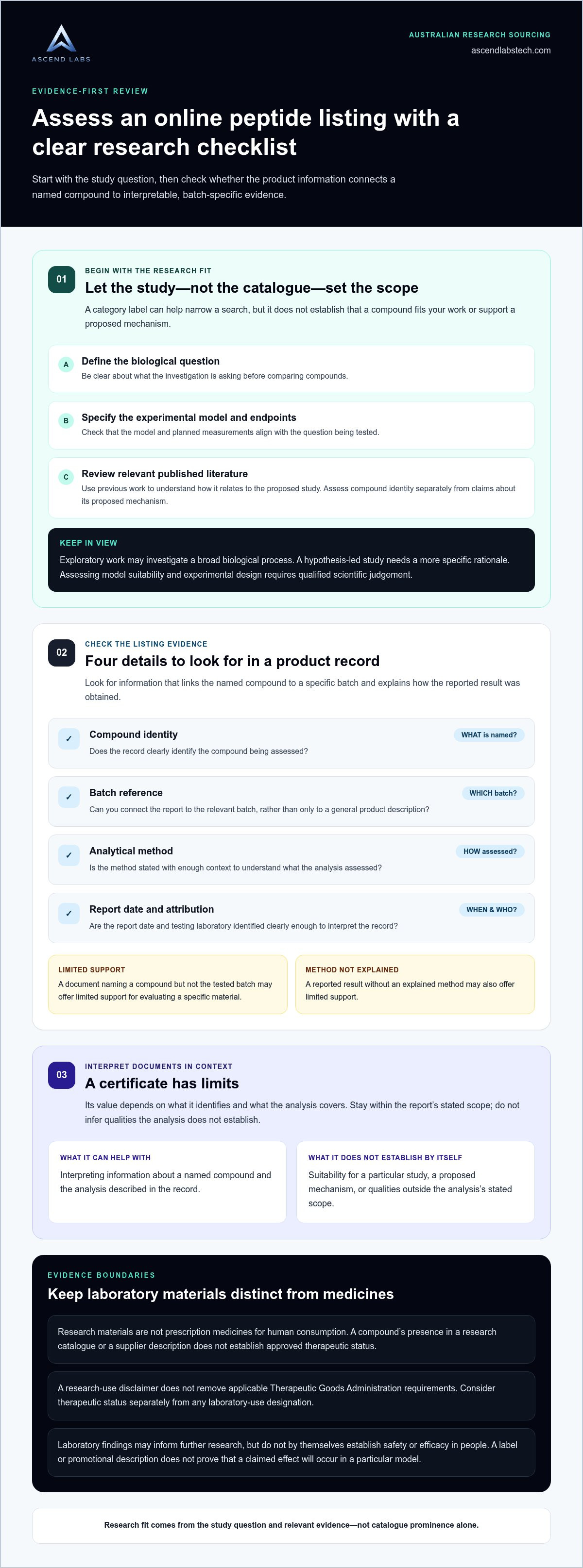
Product descriptions can identify what a listing claims to contain, but research decisions need interpretable evidence. When assessing metabolic research peptides online from suppliers such as Lala Peptides, look for records that connect the named compound to a specific batch and explain how the reported result was obtained.
Use this checklist to structure your review:
- Compound identity: Does the record clearly name the compound being assessed?
- Batch reference: Can you link the report to the relevant batch rather than a general product description?
- Analytical method: Is the method stated, with enough context to understand what it assessed?
- Report date and attribution: Are the date and testing laboratory identified clearly enough to interpret the record?
A certificate is useful only when its identifiers and scope are clear. A document that names a compound but not the tested batch, or reports a result without explaining the method, may offer limited support when evaluating a specific material. Stay within the report’s stated scope. Don’t infer that it establishes qualities the analysis did not assess.
Read the certificate in context
Check that the compound name and batch reference match the material you’re reviewing. Then examine what was measured, the reported result, the analytical method and the laboratory attribution. These details help explain what the document can support, but they don’t automatically establish suitability for your experimental model or research purpose.
Identity testing and purity assessment are distinct. A method may provide evidence relevant to molecular identity, while a separate analysis may estimate the proportion of a measured component under specified conditions. Neither result alone demonstrates sterility, overall quality or suitability for a particular study. A peptide purity testing protocol can help frame the questions to consider when interpreting such results.
What HPLC and mass spectrometry can show
High-performance liquid chromatography (HPLC) separates components in a sample. A chromatogram may support an assessment of the sample’s profile under the method used, but it isn’t a complete quality guarantee. The result depends on the analytical conditions and what the report defines as its measurement.
Mass spectrometry can support molecular identity assessment by measuring mass-to-charge information. Interpret its results within the method and report context. On its own, mass spectrometry doesn’t prove purity, sterility or research suitability. For more technical background, consult a HPLC and mass spectrometry verification resource.
How to procure metabolic research peptides online in Australia
A clear procurement workflow links the study rationale to the material received and the records retained. Before sourcing metabolic research peptides online, treat ordering as part of laboratory planning, not a substitute for scientific review or institutional purchasing controls.
- Define the study. Document the research purpose, model, endpoints and question the work is designed to address.
- Identify the compound. Specify the compound identity required for the study instead of relying on a broad category label or promotional description.
- Review available records. Assess product and batch identifiers, along with any analytical documentation, in light of what the records actually establish.
- Place the order and retain records. Follow your organisation’s purchasing process, then file order details and batch information with the relevant project documentation.
This sequence makes the decision traceable. It also separates the scientific rationale for selecting a compound from the administrative record of its procurement.
Prepare your laboratory records before ordering
Confirm the study purpose, required compound identity and internal purchasing approval before proceeding. Record relevant product and batch identifiers alongside project materials so the procurement can be connected to the study later. Retain order records and associated batch documentation in your laboratory’s established documentation system.
Ascend Labs is an Australian-owned supplier with domestic shipping across Australia. Domestic supply provides a local procurement context, but it doesn’t replace a review of study requirements or relevant material records. Keep procurement decisions separate from any consideration of human use or clinical application.
Keep research-use boundaries clear
Ascend Labs supplies research materials, not prescription medicines for human consumption. Research-use descriptions don’t provide personal-use or treatment guidance, and this article doesn’t cover reconstitution, dosing or administration. Laboratory findings also shouldn’t be treated as evidence of safety or efficacy in people.
Australian requirements can depend on the product and its intended context. Before publishing regulatory claims or making procurement decisions, consult current Therapeutic Goods Administration (TGA) guidance and other applicable Australian sources. Don’t draw legal conclusions from a catalogue label alone.
Explore Ascend Labs metabolic research compounds
Once your research question is defined and you know what documentation matters to your laboratory, the catalogue can help you identify compounds for further review. Ascend Labs is an Australian-owned supplier of research peptides and metabolic compounds, with domestic shipping across Australia.
Which confirmed compounds appear in the catalogue?
The catalogue includes Retatrutide, Tirzepatide, KLOW and MOTS-C as research materials. Their presence in a catalogue doesn’t establish that any one compound is suitable for your study or demonstrate a clinical or therapeutic outcome.
Relevance depends on your research question, experimental model and the evidence available for the work you intend to conduct. Review each listing in that context and assess product and batch information using the checklist above. The metabolic research peptide catalogue is a starting point for finding relevant listings, not a substitute for scientific assessment.
What is the next step for research buyers?
Use a consistent sequence: define the research question, identify a potentially relevant compound, assess the scope of available documentation, then review the corresponding listing. This keeps catalogue prominence separate from evidence and helps make procurement decisions traceable to the study rationale.
Ascend Labs supplies research materials for scientific purposes, not prescription medicines for human consumption. A research-use description doesn’t establish human safety, efficacy or suitability for personal use. Keep product selection within the laboratory context and assess available records according to what they actually show.
For Australian research buyers, the catalogue is a practical next step once research scope and documentation needs are clear. Review listed compounds against your defined requirements before proceeding with your laboratory’s purchasing process.
Make your next procurement decision evidence-led
Sound research procurement begins with a defined question, not a popular listing. Match the compound to your study’s model and aims, then assess whether product and batch records are clear enough to interpret. For metabolic research peptides online, this sequence puts catalogue descriptions in perspective and supports more traceable laboratory decisions.
Ascend Labs is an Australian-owned supplier serving the Australian market. Its research compound catalogue includes Retatrutide and Tirzepatide, among other compounds. These materials are supplied for scientific research purposes, not for human consumption. A catalogue listing is a starting point for review, not evidence of clinical suitability or outcome.
With your research scope and documentation needs established, review the available listings against your requirements.
Clear questions and careful records make each next step more purposeful. Keep that standard at the centre of your research planning.
Frequently Asked Questions
Is it possible to buy metabolic research peptides online in Australia?
Online catalogues list metabolic research compounds for scientific purposes, but a listing alone doesn’t establish whether a particular procurement is appropriate or permitted. Before ordering, define the study question, assess the compound’s relevance and review available product and batch information. Ascend Labs is an Australian-owned supplier of research materials with domestic supply across Australia, not prescription medicines for human consumption. Consult authoritative sources for current Australian regulatory requirements.
How can I assess a research peptide listing before ordering?
Start by checking whether the listing clearly identifies the compound and describes its research context. Then review supporting records for a relevant batch reference, the analytical method, the reported result and what the assessment covers. Keep promotional statements separate from analytical evidence: a broad claim doesn’t explain how a result was measured. Retain relevant listing and batch records in your laboratory’s procurement documentation.
What does a certificate of analysis tell me about a research peptide?
A certificate of analysis may report results from specified tests on a particular batch. Check whether it identifies the compound and batch, states the methods and results, and names the issuing laboratory. Its scope matters: a certificate doesn’t automatically establish sterility, suitability for every experiment, clinical effectiveness or safety for people. Use it as one source of information, not as a complete quality assessment.
Are metabolic research peptides intended for human use?
No. Ascend Labs supplies research materials for scientific purposes, not prescription medicines for human consumption. Laboratory findings don’t establish safety, effectiveness or an appropriate dose for people, and research listings aren’t personal-use guidance. Keep research procurement separate from treatment decisions. Anyone seeking medical care should discuss their circumstances with a registered health professional and use products approved for the relevant purpose.
How do HPLC and mass spectrometry relate to peptide verification?
HPLC separates components in a sample and can support assessment of a reported profile under the method used. Mass spectrometry can support molecular identity assessment through mass-related measurements. These methods address different analytical questions. Neither result alone proves that a compound is suitable for every research application or establishes sterility. Review the method, conditions and stated scope of each report before drawing conclusions.
Can I order research peptides from an Australian supplier for laboratory work?
Australian suppliers may provide domestic procurement of research compounds, with product information and delivery arrangements varying between suppliers. Ascend Labs is an Australian-owned supplier serving the Australian market and supplies research materials for scientific purposes. Before ordering, compare the listing and available records with your laboratory’s requirements, and retain relevant procurement information. Research supply should not be interpreted as approval for human use. Consult authoritative guidance for regulatory questions.
What should I know before browsing an online metabolic peptide catalogue?
Treat a catalogue as a product-discovery tool, not a substitute for research planning or evidence review. Define the study question first, then consider whether a listed compound and its available documentation are relevant to the proposed work. Avoid choosing based on promotional claims or assumed clinical effects. Keep procurement records with laboratory documentation and maintain a clear distinction between research materials and medicines intended for human use.


