

A compound that appears to accelerate tissue repair in a laboratory may tell us little about whether it improves healing in people. That distinction matters when evaluating healing process research compounds, a broad term covering different biological mechanisms, study models and outcomes. Early findings can be valuable, but they are not the same as demonstrated human benefit.
It is understandable to look for a clear link between a compound and faster or more complete repair. Tissue healing unfolds through overlapping stages, and a result in one stage or model may not predict what happens in another. Marketing claims can also go beyond what preliminary evidence supports.
This guide explains the main stages researchers study, from inflammation and tissue formation to remodelling. It shows how to assess evidence by examining the model, measured endpoint and study quality, and how to distinguish laboratory signals from human clinical conclusions. You will also find information on relevant research compound categories, including growth factor peptides, recovery peptides and metabolic research compounds, presented in a scientific research context rather than as therapies. The aim is to help you read claims precisely: understand what a study found, and just as importantly, what it did not establish.
Key Takeaways
- Interpret tissue repair in context: tissue type, injury conditions and experimental model all shape what a study can show.
- Understand how inflammation, cell migration, matrix formation and remodelling create distinct research questions across repair stages.
- Compare healing process research compounds by proposed mechanism, evidence category, measured endpoint and study limitations.
- Use a structured appraisal to examine a study’s question, methods and results, then verify details against the full paper and supplementary material.
- Explore growth factor and recovery peptide categories as areas of scientific research interest, not as evidence of clinical benefit.
What does the healing process mean in research?
In research, healing refers to the biological responses that follow tissue damage. It is not a guaranteed outcome or a single event. A useful distinction is: repair biology studies cellular and tissue responses to damage, while a treatment claim requires evidence that an intervention produces a beneficial outcome in a relevant setting. This helps separate a compound’s proposed role from a demonstrated effect.
Observations depend on what was injured and how it was studied. Skin, muscle and other tissues differ in structure and repair capacity; injury severity and surrounding conditions also matter. A result from one experimental context may not apply to another. This is why healing process research compounds can refer to compounds investigated for very different mechanisms and outcomes.
For a visual introduction to peptide research and its evidence limitations, watch this overview from the Angiogenesis Foundation:
What are the main phases researchers describe?
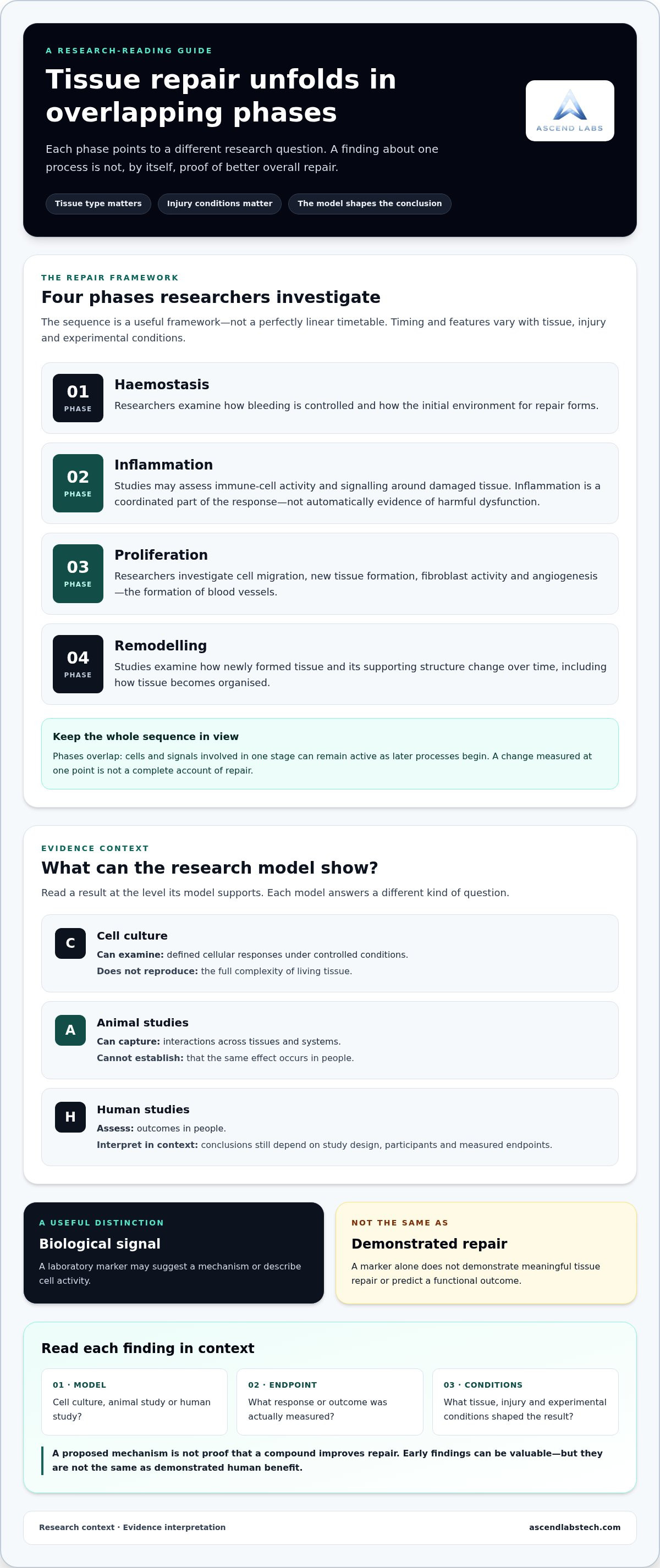
Researchers often organise wound repair into haemostasis, inflammation, proliferation and remodelling. Haemostasis involves processes that limit bleeding; inflammation includes immune activity around the injury; proliferation involves the formation of new tissue and supporting structures; and remodelling reshapes and strengthens that tissue. The Wound Healing Process overview describes these phases and related mechanisms.
This framework is useful, but it is not a perfectly linear timetable. Phases overlap, and their timing and features vary with tissue, injury and experimental conditions. A study may focus on one process, such as immune signalling or matrix formation, without establishing an effect on the overall repair outcome.
Why does the research model matter?
Each model answers a different kind of question. Cell culture can examine defined cellular responses under controlled conditions, but it does not reproduce the full complexity of living tissue. Animal studies capture interactions across tissues and systems, yet findings in animals do not establish the same effect in people. Human studies assess outcomes in people, but their conclusions still depend on the study design, participants and measured endpoints.
Read each finding at the level its model supports. A change in a laboratory marker may suggest a mechanism; it does not, by itself, demonstrate meaningful tissue repair. This guide focuses on interpreting evidence, not clinical advice or self-treatment.
How do the stages of tissue repair shape compound research?
Repair stages give researchers a framework for asking what a biological response does, when it occurs and how it relates to later tissue changes. A compound may be investigated for its influence on one process, but tissue repair depends on connected events rather than a single pathway acting alone.
- Haemostasis: Researchers examine how bleeding is controlled and how the initial environment for repair forms.
- Inflammation: Studies may assess immune-cell activity and signalling around damaged tissue.
- Proliferation: Researchers investigate cell migration, new tissue formation, fibroblast activity and angiogenesis, the formation of blood vessels.
- Remodelling: Studies examine how newly formed tissue and its supporting structure change over time.
Repair phases overlap because cells and signals involved in one stage can remain active as processes associated with later stages begin. A measured change at one point in time should therefore be interpreted in relation to the wider sequence, not treated as a complete account of repair.
What happens during inflammation and proliferation?
Inflammation is a coordinated part of the response to damage, not automatically evidence of harmful dysfunction. Research can examine how immune signalling shapes the local environment and how that activity interacts with cell movement and tissue formation.
During proliferation, researchers study fibroblasts for their role in producing components of connective tissue, while angiogenesis is investigated as part of the development of blood-vessel networks. These are general biological roles, not proof that a particular compound changes them or improves repair. For healing process research compounds, distinguish a proposed mechanism from results that demonstrate an effect in a relevant model.
Why do matrix formation and remodelling matter?
The extracellular matrix is the changing network of proteins and other molecules that supports cells and helps shape their environment. Researchers study how it is deposited, organised and modified during repair. Its structure can influence cell behaviour, so matrix formation is connected to immune signalling, migration and tissue development rather than being an isolated endpoint.
Early evidence of a response may not show whether tissue later becomes organised or functions as intended. Remodelling research therefore looks beyond initial changes to ask how tissue structure develops over time. A marker associated with cell activity or matrix production can help describe a biological process, but it may not predict a functional outcome on its own.
These questions provide context for exploring categories such as growth factor and recovery peptides without assuming a clinical effect. Ascend Labs’ research compound categories are supplied for scientific research purposes.
How can you compare healing process research compounds and findings?
Start with the study, not a ranking of compounds. For each paper, record the compound category, proposed mechanism, model, measured endpoint and stated limitations. This gives you a consistent way to assess healing process research compounds without treating a plausible biological explanation as proof of benefit.
Use evidence labels to describe the type of research reported, not to imply a result. Apply them only after checking the study itself:
| Evidence label | What it describes | What it cannot establish alone |
|---|---|---|
| Mechanistic | Research on a proposed biological process, such as a cellular response or signalling pathway. | That the process changes tissue repair in a whole organism or produces a meaningful outcome. |
| Preclinical | Research conducted before human clinical studies, commonly using cell or animal models. | Safety or efficacy in people. |
| Clinical | A study involving human participants, assessed according to its design and reported endpoints. | Broad effectiveness beyond the population, intervention and outcomes actually studied. |
These labels are not a simple ladder to a positive conclusion. A clinical study may be limited or inconclusive, while a mechanistic result may help generate a research question without answering it. Describe the evidence level and the finding separately.
What can cell and animal studies show?
Controlled cell models can help isolate a biological process and examine how cells respond under defined conditions. Animal models can capture interactions across tissues that cell culture cannot. Neither type establishes that an effect will occur in people. Interpret findings alongside the sample size, controls, methods and whether results have been reproduced. Present a striking result from a small or narrowly designed study with those limits in view.
How should compound categories be described?
Growth factor peptides and recovery peptides are broad research categories, not treatment recommendations. Compounds grouped under one category may prompt different questions, target different processes or have different evidence bases. Avoid assigning a specific repair effect to a category or product unless a relevant primary source supports that exact claim.
For a disciplined comparison, ask: what was tested, in which model, against what control, and using which endpoint? A change in a molecular marker is not automatically a functional improvement. Ascend Labs’ research compound categories are supplied for scientific research purposes; the product range should not be read as evidence of clinical benefit.
How do you evaluate a study on compounds and tissue repair?
A consistent appraisal helps separate what a paper observed from what its authors or later summaries claim. Use the same sequence for each study, then check details against the full paper and any supplementary material. Abstracts alone may omit important information about methods, outcomes and limitations.
- Question: Identify the research question and the proposed effect being tested. Is the study examining a biological mechanism, a tissue response or a functional outcome?
- Model: Record whether researchers used cultured cells, animals or human participants, along with the tissue and injury context. The model determines how far the findings can reasonably be applied.
- Methods: Check the comparison or control, sample size, how the intervention and outcomes were measured, and whether the methods can answer the stated question.
- Endpoint: Note exactly what was measured and when. A molecular marker, tissue appearance and functional measure represent different kinds of evidence.
- Results: Compare the reported findings with the original question. Distinguish statistical observations from biological importance: a measurable difference does not necessarily mean a meaningful change in tissue function.
- Limitations: Review the authors’ caveats and consider what the design leaves unanswered. Keep any conclusion within the boundaries of the evidence.
Which study details deserve close attention?
Check whether the reported outcome was prespecified and measured in a way that fits the research question. Look at how controls were used and whether the sample is large enough to support the authors’ interpretation. Review funding and conflict-of-interest statements where reported. Independent replication can strengthen confidence in a finding, but a single study should still be judged on its methods and results.
For healing process research compounds, verify the compound identity, model, methods and endpoint in the paper itself rather than relying on a headline or product description. Supplementary material may clarify procedures or additional results that affect how a finding should be interpreted.
How should limitations change the conclusion?
Limitations should narrow the claim, not disappear from the summary. A small sample, short follow-up or indirect endpoint may constrain what researchers can infer. For example, an observed change in a laboratory marker does not by itself demonstrate improved tissue function. Describe the result at the level studied, and do not extrapolate a cell or animal observation into an individual health decision.
Ascend Labs’ catalogue is for scientific research purposes. The compounds listed are not evidence of clinical benefit or a substitute for appropriate health advice.
Research compounds in responsible Australian research
Research compounds belong in a clearly defined scientific context. Ascend Labs is an Australian-owned supplier of research peptides and compounds, including growth factor peptides and recovery peptides. These categories may be relevant to investigations of tissue-repair biology, but a category name does not establish a mechanism, study result or benefit. Those claims require support from relevant evidence.
How can research categories be explored without overclaiming?
Start with a research question rather than an expected result. For example, a study might ask whether a compound is associated with a particular cellular response in a specified model. The answer must come from the study, not from the broad label applied to the compound. Verify any proposed mechanism against relevant primary literature, and distinguish what a product description states from what a published experiment has demonstrated.
Ascend Labs’ research compound catalogue provides a place to explore relevant research categories. Use product information for the details it provides. Do not infer unreported mechanisms, specifications or outcomes, and do not treat catalogue inclusion as evidence that a compound has been clinically evaluated.
In Australia, human research involving unapproved therapeutic goods is conducted under the Therapeutic Goods Administration’s Clinical Trial Notification or Clinical Trial Approval scheme. Clinical trials require Human Research Ethics Committee approval. These oversight pathways are distinct from laboratory research and do not convert preliminary findings into established clinical conclusions.
What should readers take away before the next study?
Keep three levels of evidence separate. Biological plausibility suggests a possible explanation for an effect. Preclinical evidence reports findings from non-human research models. Clinical evidence comes from studies involving people, and its conclusions remain specific to the design, participants and outcomes studied. Do not represent any level as stronger than it is.
For healing process research compounds, responsible communication means describing the question, model and observed result accurately, then retaining the limitations. A laboratory observation is not medical advice, treatment guidance or proof of an individual outcome. Research findings should not be used to guide self-directed treatment.
Explore the research catalogue to review compound categories in their scientific context.
Make your next research question evidence-led
Research on tissue repair is strongest when each claim is kept in context. The biological stage being studied, the experimental model and the measured endpoint all shape what a finding can support. A plausible mechanism or preclinical result can guide further investigation, but it is not proof of a clinical outcome.
Apply the same discipline to healing process research compounds: distinguish proposed roles from demonstrated effects, and weigh conclusions against the study’s methods and limitations. This supports clearer evaluation without turning research findings into treatment guidance.
Ascend Labs supplies research peptides and compounds to the Australian research market, with catalogue categories including growth factor peptides and recovery peptides. Explore these categories as research offerings, not as evidence of human benefit.
Careful questions and proportionate conclusions help move tissue-repair research forward. Explore Ascend Labs’ research compound catalogue to view the available research categories.
Frequently Asked Questions
What are healing process research compounds?
Healing process research compounds are substances investigated for how they may relate to biological responses after tissue damage. The term covers varied compound categories, proposed mechanisms and study contexts, rather than one defined class with a shared effect. Researchers assess a particular compound in a specified model and measure defined outcomes. A proposed role or laboratory observation does not establish that a compound improves healing in people or is suitable for treatment.
What are the four stages of the healing process?
The four commonly described stages are haemostasis, inflammation, proliferation and remodelling. Haemostasis helps control bleeding; inflammation involves coordinated immune activity; proliferation includes the formation of new tissue; and remodelling involves changes to that tissue over time. This is an organising framework, not a strict timetable. The stages overlap, and their timing and characteristics vary with the tissue, injury and research model being studied.
Can laboratory research show that a compound improves healing in people?
No. Laboratory research can identify biological responses and generate hypotheses, but a cell or animal study cannot establish that a compound is safe or effective in people. Human outcomes require relevant clinical evidence, and conclusions depend on the study’s design, participants and measured endpoints. Even a human study does not prove a compound will produce the same result for every person or in every clinical context.
How do researchers assess compounds linked to tissue repair?
Researchers examine the question being tested, the compound and its proposed mechanism, the model, methods, controls and measured endpoints. They then assess the results alongside sample size, follow-up and study limitations. For example, a change in a cellular marker is different from a demonstrated functional outcome. Checking the full paper and supplementary material helps clarify what was measured and what conclusions the evidence can support.
Are growth factor and recovery peptides the same type of research compound?
No. Growth factor peptides and recovery peptides are separate broad research categories, and the labels do not establish that their compounds share mechanisms or effects. Research questions may differ between individual compounds, so assess each study on its own methods, model and outcomes. Category names alone are not evidence of a repair effect, clinical benefit or equivalence between compounds.
Are research peptides intended for human consumption?
Research peptides supplied by Ascend Labs are for scientific research purposes, not human consumption. The company does not supply prescription medication for human consumption. Research descriptions and findings are not instructions for personal use, medical advice or treatment guidance. Do not interpret a compound’s availability for research as evidence that it has been assessed or approved for human use.
Why do healing research results differ between studies?
Results can differ because studies may examine different tissues, injuries, models, compounds, methods and endpoints. Timing also matters: a marker measured at one stage may not reflect later tissue changes. Differences in controls, sample size and follow-up can affect interpretation too. Compare studies by these details rather than treating apparently similar findings as directly equivalent, and check whether results have been reproduced.


