

What makes a peptide research reagent a sound fit for a study: its place in a broad catalogue, or the evidence and context behind it? For Australian researchers, peptide research reagents can be difficult to assess when categories overlap and product descriptions leave important questions unanswered.
That uncertainty is understandable. A compound’s research context, available product information and regulatory status all matter. A “research use only” label does not make a product a medicine for human consumption or determine its legal status. The TGA’s heightened scrutiny of unapproved peptide products in 2026 makes careful assessment especially important.
This guide explains the main reagent categories and sets out a practical framework for comparing product information with a defined research purpose. It also introduces Ascend Labs, an Australian-owned supplier with domestic shipping and catalogue categories spanning metabolic, growth factor, recovery and neuromodulator peptides. Use the research question to guide selection, review the supporting information, and keep procurement context in view.
Key Takeaways
- Start with the study question, then identify the relevant peptide category and compare the details provided in each listing.
- Catalogue categories organise peptide research reagents, but category placement does not establish a biological result or suitability for a study.
- A certificate of analysis may provide product-specific analytical information. Interpret reported results in relation to the method and research context.
- Assess domestic supply, product information and research-use positioning as separate parts of Australian procurement planning.
- Explore metabolic, growth factor, recovery and neuromodulator categories, including catalogue examples such as Retatrutide, Tirzepatide, KLOW and MOTS-C.
What Are Peptide Research Reagents? A Clear Guide to the Category
Peptide reagents are peptide materials supplied for scientific research. Peptides are chains of amino acids, and researchers study them in varied biological contexts. The term describes the material’s research supply context, not what it does or whether it fits a particular study.
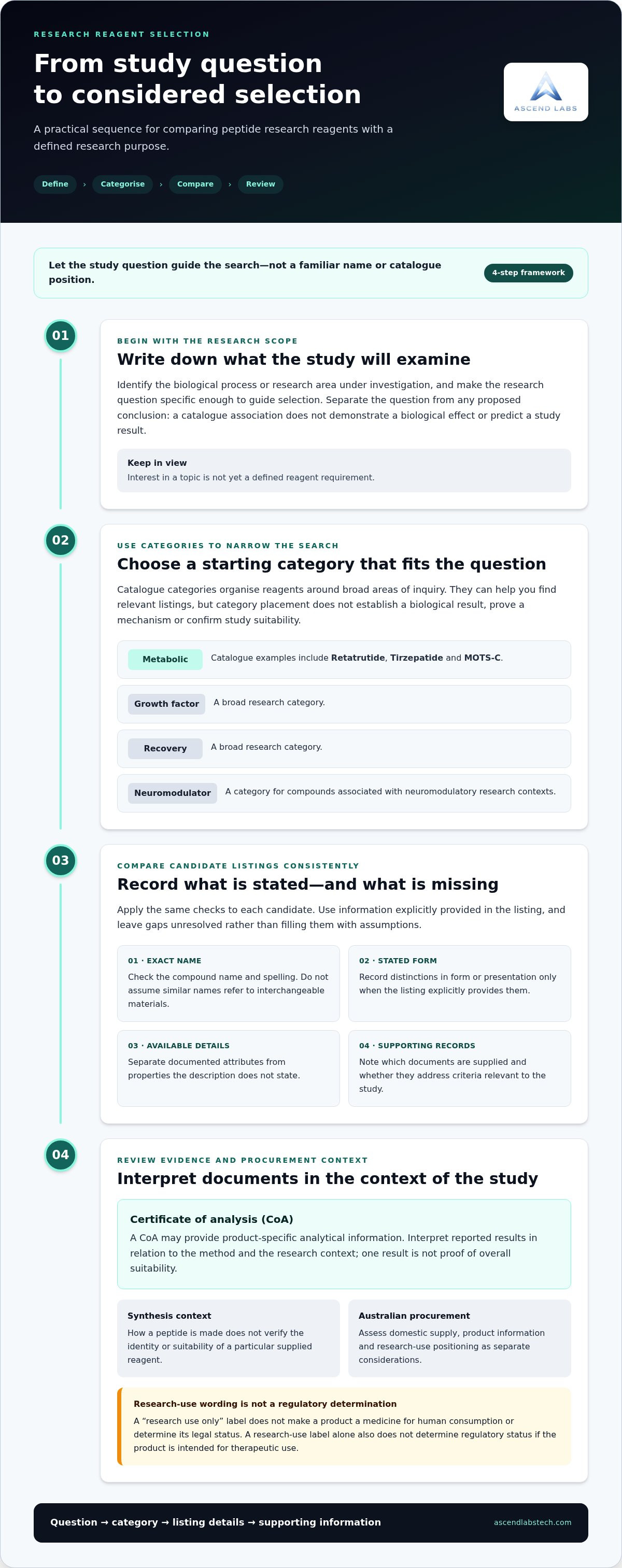
A peptide reagent differs from a general chemical reagent, which may support or measure a laboratory process without being a peptide itself. It also differs from a finished therapeutic product prepared and authorised for a specific medical purpose. Research reagents are supplied for scientific research, not as prescription medicines or products for human consumption. A research-use label alone, however, does not determine regulatory status if a product is intended for therapeutic use.
How peptide reagents fit into laboratory research
Begin with the question, not the catalogue category. A study exploring a metabolic research topic may call for a different class of material from research examining neuromodulatory pathways. A category helps organise compounds around broad areas of inquiry, but it does not establish a biological result, prove a mechanism or show that a reagent suits a particular method.
Keep the research question separate from the conclusion. A compound’s name or catalogue placement may suggest a topic for investigation, but it cannot substitute for evidence generated in the study. Assess the listing details and supporting information against the defined research context.
Peptides can be produced through different synthesis approaches. For background on solid-phase and solution-phase techniques, see Peptide Synthesis Methods. Synthesis context helps explain how peptide materials are made, but it does not verify the identity or suitability of a particular supplied reagent.
Research categories in an Australian peptide catalogue
Categories are a practical first step when navigating a catalogue. Ascend Labs’ research-focused range includes metabolic, growth factor, recovery and neuromodulator peptides. These are broad groupings, not evidence of efficacy or recommendations for a specific experiment. Choose a starting category based on the research question, then assess the details in the individual listing.
- Metabolic: catalogue examples include Retatrutide, Tirzepatide and MOTS-C.
- Growth factor and recovery: these categories group research materials by broad topic.
- Neuromodulator: this category groups compounds associated with neuromodulatory research contexts.
For a closer look at one specific topic, the Retatrutide research overview provides further context. To explore Ascend Labs’ peptide and compound categories, use the catalogue as a starting point and compare each listing with the study question. Classification narrows the search; it does not replace careful evaluation.
Match Peptide Research Reagents to the Question Your Study Asks
A disciplined selection process starts with the research question, not a familiar name or a prominent catalogue position. The same broad topic can encompass distinct questions, each with different selection criteria. Make the process traceable: define the scope, identify the relevant peptide class, compare the listing, then review its supporting documentation.
Start with the research scope, not a trending compound
Write down the biological process or research area under investigation and what the study is designed to examine. Interest in a topic is not yet a defined reagent requirement. For example, distinguish a specific metabolic research question from a general interest in metabolism before using that category to narrow the search. Broader context is available in this overview of the Australian peptide research landscape.
Keep the question and proposed conclusion separate. A catalogue description may associate a compound with a research area, but that association does not demonstrate a biological effect or predict what a particular study will find. Select according to the investigation you plan to conduct, not an assumed outcome or a compound’s popularity.
Turn the research question into product-selection criteria
Once the scope is clear, compare candidate listings using the same criteria. Record what each description states and mark missing information as unresolved rather than filling gaps with assumptions. This makes differences easier to assess and helps separate meaningful product details from differences in wording or presentation.
- Confirm the name: compare the exact compound name and spelling. Do not assume similar names refer to interchangeable materials.
- Check the stated form: record distinctions in form or presentation only when the listing explicitly provides them.
- Compare available details: use information stated in the product description, and separate documented attributes from unstated properties.
- Review documentation: note which supporting records are provided and whether they address criteria relevant to the study.
Manufacturing context can inform how a peptide is produced, but it is not a substitute for product-specific evidence. Bachem’s explanation of Chemical Peptide Synthesis provides background on synthesis methods; it does not establish the identity or study suitability of a specific listing.
Reagent selection does not replace research governance. Study design, institutional oversight and the use of approved protocols remain the researcher’s responsibility. Before procurement, compare the candidate with the study scope and applicable laboratory processes. Ascend Labs’ research peptide and compound catalogue provides categories and listings to review against those criteria.
Assess Peptide Documentation Without Treating One Result as Proof
Product documentation can help researchers assess what is reported about a particular reagent. A certificate of analysis (CoA), when supplied, may provide product-specific analytical information. Its value depends on what it covers, which material it refers to and how closely the information relates to the study’s requirements.
Read a CoA alongside the product listing, rather than treating it as a general endorsement. A reported analytical result describes an observation under stated conditions. It does not automatically establish suitability for every research question, laboratory method or intended application.
What a certificate of analysis can and cannot tell you
CoAs vary in content. Fields such as a compound name, batch or lot reference, test method, result and report date should be treated as present only when they appear on the document. Do not assume a standard set of fields or tests from the title alone. First check that the document identifies the listed compound and product clearly enough to connect the reported information to the material being considered.
Then examine the scope of each result. A measurement may answer a specific analytical question, but not every question about identity, composition, stability or performance. If a field or method is not described, do not infer what was tested. This peptide purity testing protocol offers a deeper discussion of verification considerations.
Read analytical language with appropriate limits
Two terms commonly encountered in analytical chemistry are high-performance liquid chromatography (HPLC) and mass spectrometry. HPLC separates components in a sample, while mass spectrometry measures ions according to their mass-to-charge ratio and can help characterise molecules. These terms describe analytical techniques, not results in themselves. Their mention does not establish that a particular product has undergone either method.
If a purity figure is reported, interpret it in relation to its stated method and conditions. It is not automatically evidence of identity, stability or suitability for a specific study. Likewise, a result from one analytical approach does not necessarily answer questions beyond that method’s scope. Check method-specific claims and specifications against current documentation for the relevant product.
- Match the record: compare the compound and any product or batch identifiers shown in the listing and document.
- Read the method: note which analysis is reported and what the result actually describes.
- Respect the limits: distinguish documented findings from assumptions about other properties or research performance.
Documentation should be read in context, not treated as a universal guarantee. For peptide research reagents, consider each document in relation to the precise product, reported method and research question. This helps distinguish useful evidence from claims the document does not establish.
Plan Australian Procurement for Research Peptide Reagents
Procurement involves more than finding a compound in a catalogue. Australian research teams can assess peptide research reagents across three separate considerations: where supply operates, what product information is available, and how the material is positioned for use. Keeping these questions distinct makes purchasing decisions easier to document and align with organisational processes.
Domestic supply can simplify procurement planning, but it does not establish product suitability or satisfy an institution’s requirements. Review product information and research-use positioning separately. Ascend Labs is Australian-owned, operates within Australia and offers domestic shipping across the country.
Domestic supply and procurement planning
A supplier’s stated operating scope gives buyers context for planning a domestic purchase. It helps distinguish local supply from other procurement arrangements, without implying anything about lead times, costs or regulatory status. Build the purchase record around your organisation’s process, including the selected listing and any supporting product information your team requires.
Before placing an order, confirm that the proposed purchase aligns with internal procurement and research governance. Requirements may differ between organisations and projects, so follow the applicable institutional process rather than assuming one approach fits every laboratory. Keep records consistent: the compound name, relevant listing details and purchasing documents should refer to the same material.
Assess each procurement question on its own:
- Supply: determine whether the supplier’s Australian operating scope suits your purchasing process.
- Product information: assess the details and documentation available for the listed material.
- Research-use positioning: understand the stated purpose and ensure it aligns with your organisation’s governance.
Research-use boundaries and responsible handling
Ascend Labs supplies materials for scientific research, not as prescription medicines for human consumption. Research-use positioning should be understood within that boundary. It does not replace assessment of the intended context, institutional requirements or applicable rules. Procurement suitability depends on the proposed research and the governance that applies to it.
Australian regulatory requirements can be product- and context-specific. Before relying on a regulatory statement, verify the current position through authoritative sources such as the Therapeutic Goods Administration (TGA) and relevant state or territory authorities. Check any summary in procurement material against current official guidance. This section is not a determination of legal status or authorisation.
Responsible purchasing also means keeping the material within the defined research framework and following the organisation’s approved processes for receipt, records and handling. Do not infer clinical suitability from catalogue language or use research materials as a basis for personal experimentation. These boundaries help maintain a clear distinction between research procurement and medical use.
For a domestic starting point, review the research peptide and compound catalogue against your project’s purchasing requirements.
Explore Ascend Labs Peptide Research Reagents by Research Category
A catalogue is most useful when it helps narrow a defined research question, rather than encouraging selection by name alone. Ascend Labs groups its research-focused peptide materials into metabolic, growth factor, recovery and neuromodulator categories. These headings organise discovery; they do not establish a compound’s efficacy, predict an outcome or confirm suitability for a particular study.
Navigate the catalogue by research area
Start with the area your study addresses, then review the closest category and its individual listings. Metabolic research, for example, may be a useful starting point for a question concerned with that broad research area. Growth factor, recovery and neuromodulator categories offer other routes through the catalogue. Let the research question guide the search, then use current listing details to establish what information is available about a specific item.
Named catalogue examples include Retatrutide, Tirzepatide, KLOW and MOTS-C. Treat them as examples for research-focused discovery, not as evidence of a particular result or a recommendation for personal use. Check compound names against the current listing so the item being considered is clearly identified. If a listing provides distinctions in form or other details, compare only what it states.
Keep catalogue browsing purposeful with a short sequence:
- Define the topic: state the research area or question the project addresses.
- Choose a starting category: use the closest broad category to focus discovery, not to infer a biological effect.
- Compare listings: check the compound name and details stated for each relevant item.
- Assess research fit: consider whether the available information aligns with the project’s documented requirements.
Make the next procurement step clear
Before moving from discovery to procurement, compare the current listing with the criteria recorded for the study. Check that the compound name matches the research requirement and note any product information relevant to the planned work. If the description does not address a criterion, leave it unresolved rather than assuming an answer. This keeps the selection rationale clear and supports a consistent handover to procurement or laboratory review.
Supplier information is one part of that decision, not a replacement for institutional review. The research team remains responsible for study design, procurement and applicable governance. Ascend Labs supplies these materials for scientific research purposes, not as prescription medicines for human consumption. Keep catalogue browsing within that research context and separate product discovery from assumptions about clinical use or performance.
For Australian researchers, a focused catalogue can make category-led discovery more straightforward while keeping the research question central. Review listings against documented requirements and organisational processes, then decide whether the available information supports the next procurement step.
Put a Clear Research Brief Behind Your Next Selection
Before browsing, turn your research question into a short procurement brief. Note the relevant category, exact compound name, information needed for internal review and your organisation’s purchasing requirements. This gives peptide research reagents a defined place in the study and keeps the selection rationale clear as it moves through review and procurement.
For Australian research teams, Ascend Labs is an Australian-owned supplier operating exclusively within Australia. Its catalogue spans metabolic, growth factor, recovery and neuromodulator peptide categories. Use these groupings to explore options, then assess individual listings against the work your institution has approved. A category label is a starting point, not a substitute for product-specific assessment or research governance.
A deliberate selection process can stay straightforward: keep the research question at its centre, document the criteria that matter to your project, and proceed when those requirements are clear.
With a defined brief in hand, explore Ascend Labs’ catalogue and compare the listings with your research requirements.
Frequently Asked Questions
What are peptide research reagents?
Peptide research reagents are peptide materials supplied for scientific investigation. Researchers assess them in relation to a defined study, rather than treating a catalogue label as evidence of a particular effect. For example, a project examining a metabolic research question might begin with that broad category, then refine its criteria using the listing and supporting information. The term describes research supply, not approval as a medicine or suitability for human use.
How do I choose a peptide research reagent for a study?
Translate the study aim into criteria you can check. Identify the research area, record the exact compound name required, then compare the stated form and available product details. A comparison table can help: list each criterion, the information source and any unresolved question. Keep the table with the project records and follow your organisation’s review and procurement processes.
What should a certificate of analysis for a peptide show?
A certificate of analysis may contain product-specific analytical results, but its contents depend on the document. Check for identifiers that connect it to the relevant product, such as a compound name or batch reference if provided, then note the methods and results actually stated. Do not assume a document includes a particular field because it is called a certificate. Record any information required by your laboratory’s quality procedures and distinguish it from what remains unreported.
Are peptide research reagents approved for human use?
No. Research reagents are supplied for scientific research and are not automatically approved medicines for human consumption. A research catalogue listing does not, by itself, establish clinical approval or suitability. In Australia, requirements depend on the product and circumstances, so consult current Therapeutic Goods Administration information and other relevant official guidance for the specific context. Research materials should not be used as a substitute for prescribed treatment or personal medical advice.
Can Australian laboratories source peptide research reagents domestically?
Yes. Ascend Labs operates within Australia and offers domestic shipping across the country. For a laboratory purchase, compare the current product listing with your organisation’s procurement requirements, then retain the relevant purchasing and product records together. Do not assume a delivery timeframe or other ordering detail unless it is stated in current information. Internal approval and research governance remain part of the buyer’s process, separate from the supplier’s domestic operating scope.
What is the difference between peptide purity and peptide identity?
Purity and identity address different analytical questions. A reported purity figure may describe the relative signal attributed to the target under a specified analytical method and its conditions. Identity assessment concerns whether the material corresponds to the intended compound. The method and documentation shape how either result should be interpreted. Neither result alone establishes stability, suitability for every procedure or expected performance in a particular research application.


