

A broad label can hide the distinctions that matter in a study: the biological target, the proposed mechanism and the evidence supporting each claim. That is why metabolic research substances are best assessed using a consistent scientific framework, rather than category names alone.
Researchers face a practical challenge when commercial descriptions and scientific evidence appear side by side. Similar-sounding compounds may relate to different targets, models or research questions. To compare them carefully, separate a proposed mechanism from an observed result, and note whether the evidence comes from a particular laboratory model or another type of study.
This guide outlines research areas covered by the metabolic category and offers a practical way to assess substances by target, proposed mechanism and experimental context. It also explains what to consider when reviewing Australian supply options for research purposes. The aim is to help you assess relevance, evidence and terminology without treating a catalogue description as a scientific conclusion.
Key Takeaways
- Metabolic research substances describe a broad research category, not one uniform chemical class.
- When framing a research question, distinguish the biological target, proposed mechanism and measured outcome.
- Compare examples such as Retatrutide and Tirzepatide by study model and evidence type, without treating a proposed mechanism as a proven outcome.
- Use a consistent review process: define the question, examine primary literature, assess documentation and record the boundaries of the study.
- Ascend Labs’ Australian catalogue includes Retatrutide, Tirzepatide, MOTS-C and metabolic research compounds for laboratory and scientific research purposes.
What are metabolic research substances, and what questions do they help researchers frame?
Metabolic research substances are materials studied in laboratory settings to investigate biological processes related to metabolism. The term describes a broad research category, not a single chemical class, medicine or consumer wellness product. It can include compounds with different structures and properties, including peptides. A peptide is a type of molecule; a biological target is the receptor, enzyme or signalling process examined in a study. These terms describe different things and do not imply interchangeable effects.
A useful research question connects a material to a specific target, process and measurement. The word “metabolic” alone does not establish what a substance does, what a study has demonstrated or whether findings apply beyond the model used. For broader context, metabolomics examines chemical processes involving metabolites, including small molecules involved in cell metabolism.
The video below discusses a separate compound. It illustrates why mechanism claims need to be considered in the context of the specific research being discussed.
Which research areas sit under the metabolic umbrella?
Metabolic research can examine processes such as energy balance, glucose regulation and lipid metabolism. The relevant area depends on the question: a study might investigate a signalling pathway, measure a change in a metabolite or examine how a system responds under defined laboratory conditions. The study question determines which biological process is relevant. A category label by itself does not establish an outcome in people or a potential treatment effect.
How are research substances different from medicines?
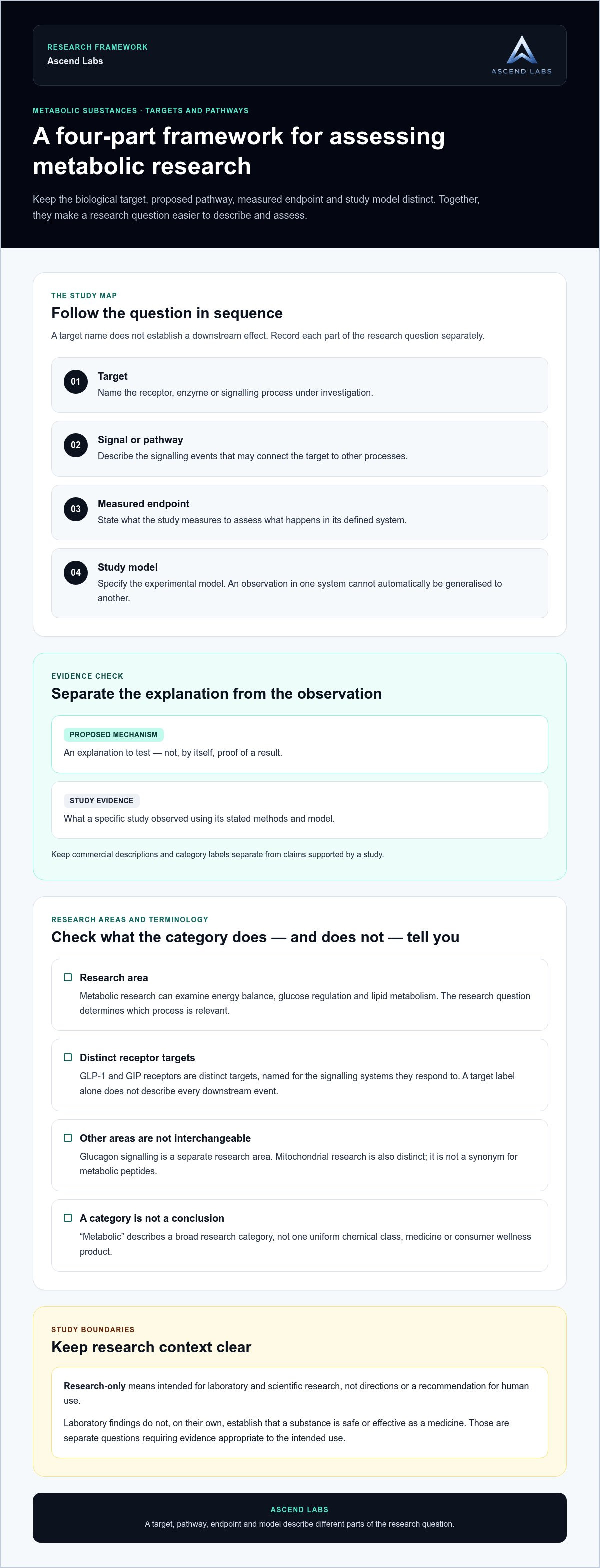
Research-only means a material is intended for laboratory and scientific research, not that it comes with directions or a recommendation for human use. A research material is not a prescription medicine or consumer wellness product. Findings from laboratory work also do not, on their own, establish that a substance is safe or effective as a medicine. These are separate questions that require evidence appropriate to the intended use.
Keeping these boundaries clear helps prevent category names, proposed mechanisms and commercial descriptions from being mistaken for evidence. In this article, “metabolic research substances” refers to materials considered in a laboratory research context, with claims assessed against the study question and available evidence.
Metabolic Substances: Biological Targets and Pathways
A practical way to organise metabolic research substances is to separate three parts of a research question: the target under investigation, the pathway or signalling events that may connect it to other processes, and the measured outcome used to assess what happens in a defined study model. These elements are related, but they are not interchangeable. Naming a receptor identifies a target; it does not, by itself, establish a downstream effect.
Map the question in sequence: target → signal or pathway → measured endpoint → study model. For example, a study might investigate receptor activity, identify a cellular signalling response as the pathway of interest, measure a defined laboratory endpoint and state the model used. The model matters because an observation in one experimental system cannot automatically be generalised to another.
A proposed mechanism is an explanation to test; evidence is what a specific study observed using its stated methods and model. Keeping that distinction visible helps prevent a mechanism description from being mistaken for a demonstrated outcome. For clinical context, MedlinePlus explains that a Comprehensive Metabolic Panel (CMP) measures substances to assess metabolism and chemical balance. A clinical test panel is different from a laboratory research design, but it illustrates why measured substances and the intended interpretation should be stated clearly.
What do GLP-1 and GIP receptor targets mean in research?
The GLP-1 receptor and GIP receptor are distinct biological targets, named for the signalling systems they respond to: glucagon-like peptide-1 and glucose-dependent insulinotropic polypeptide. Researchers can investigate each target and its associated signalling in a specified model, but the target label alone does not describe every downstream event. Tirzepatide is one research compound listed by Ascend Labs. Its mention here identifies a catalogue example, not a claim about outcomes or clinical use.
Where do glucagon signalling and mitochondrial research fit?
Glucagon signalling is another research area, separate from simply naming GLP-1 or GIP receptors. Any compound-specific mechanism or evidence claim in this area needs to be checked against relevant primary literature. Mitochondrial research is also a distinct field of inquiry, not a synonym for metabolic peptides. For that separate topic, see this mitochondrial peptide research overview.
Researchers can browse the research compounds and peptides catalogue to see listed materials, then assess each item against the target, pathway, endpoint and model relevant to their research question.
How can researchers compare metabolic research substances without overreading the evidence?
Keep the compound name separate from claims about it. For each source, record the target and proposed mechanism, then note the study model, measured endpoint and evidence type. This makes it easier to judge whether two papers address the same question, rather than assuming that shared terminology makes their findings directly comparable.
What belongs in a useful comparison table?
Use one row for each compound and study, and include a traceable citation for every specific claim. Retatrutide and Tirzepatide are examples of listed research compounds, but their names alone do not establish a mechanism or outcome. For dedicated context on one of these compounds, see the Retatrutide research background.
| Field | What to record |
|---|---|
| Compound | Retatrutide or Tirzepatide, as named in the cited study. |
| Target and proposed mechanism | The target and mechanism described by the source, with the citation beside the claim. |
| Research question | The specific biological question the study set out to examine. |
| Study model and endpoint | The experimental model and the outcome actually measured. |
| Evidence type and source | For example, a hypothesis, preclinical study or clinical study, plus the primary citation. |
A mechanism label alone cannot establish a research outcome. The endpoint is what the researchers measured. Do not replace it with an inferred benefit or a broader claim.
How should researchers interpret evidence strength?
Describe evidence by its type and context. A hypothesis proposes an explanation to test. A preclinical result reports observations in a non-clinical model. Clinical evidence comes from studies involving people, but its meaning still depends on the study design, population and endpoints. These categories should not be collapsed into a single ranking or presented as interchangeable proof.
Studies may use different models, methods or endpoints, so their results may not support a direct comparison, even when they examine similarly named targets. Check primary sources for specific mechanisms, dates and study details. If results conflict or an important detail is missing, record that uncertainty rather than smoothing it over with confident language. A clear comparison states what was studied, what was observed and what remains unanswered.
What should Australian researchers consider when assessing metabolic research materials?
A disciplined review links the research question to the material, the evidence and the boundaries of the work. Australian researchers should also account for relevant institutional governance and applicable Australian requirements. These depend on the work being undertaken, so one general checklist may not apply to every project.
Use this four-step sequence to keep the assessment focused:
- Define the question. Specify the target or biological process, study model and endpoint of interest. This helps you assess a material’s relevance to a project without relying on a broad category or marketing description.
- Review primary literature. Trace specific mechanism and evidence claims to the original studies. Note the model, methods and limitations, and record uncertainty or conflicting findings rather than treating them as settled.
- Assess documentation. Consider whether the available information identifies the material and connects it to the records for the study. Keep supplier descriptions separate from independent evidence and institutional assessment.
- Record study boundaries. Document what the work examines, what it does not establish, and which model and endpoints support any conclusions. Revisit relevant governance and Australian requirements for the specific project.
For an adjacent area, see this insulin-sensitising peptide research reference. Apply the same care: define the question and verify claims against evidence relevant to it.
Which documentation questions support a rigorous review?
Material identity, batch traceability and analytical documentation can help researchers connect material records to a study and interpret results responsibly. Check whether documentation identifies the material clearly, links it to a particular batch and explains the analytical method and its scope. The presence of a document alone does not establish that every relevant characteristic has been verified. For a focused discussion of verification, see this peptide purity testing guidance.
How should research-only boundaries be communicated?
Describe these materials consistently as intended for laboratory and scientific research purposes. Do not provide human-use directions, dosing guidance or treatment advice. Supplier information describes the material being supplied; it does not replace institutional governance, applicable regulatory interpretation or scientific evidence. Keeping these sources distinct makes claims easier to assess and helps prevent research descriptions from being mistaken for clinical conclusions.
For a catalogue reference, explore the research compounds and peptides.
How does Ascend Labs support Australian research into metabolic compounds?
After defining a research question and reviewing its evidence base, researchers can consider whether a listed material is relevant to the work. Ascend Labs is an Australian-owned supplier of research peptides and metabolic compounds, supplying customers across Australia. Its catalogue includes Retatrutide, Tirzepatide, MOTS-C and other metabolic research compounds.
A catalogue helps identify materials for consideration; it does not establish a compound’s biological effect or determine whether it suits a particular study. Those judgements depend on the research question, relevant primary literature and the study’s defined model and endpoints. Keeping catalogue information separate from scientific conclusions makes the review more transparent.
Which listed compounds are relevant to metabolic research?
Retatrutide and Tirzepatide are listed research compounds. Their inclusion here is descriptive, not a comparison of clinical effects or evidence. To assess relevance, check how a particular study defines its target, model and measured endpoint, then compare those details with the research question.
MOTS-C may be relevant to a research question concerning mitochondrial processes. Assess that subject area on its own terms, checking proposed mechanisms and findings against relevant literature rather than inferring them from a catalogue category. A shared metabolic label does not make compounds equivalent or establish that they address the same pathway.
What is the next step for a research-led review?
Begin with the research question and consult primary literature that addresses it directly. Record the model and endpoints, note limitations, and keep procurement decisions distinct from conclusions about biological effects. A listed compound is not evidence of an outcome, and supplier information is not a substitute for scientific assessment.
Ascend Labs supplies research peptides and compounds for laboratory and scientific research purposes. They are not prescription medicines for human consumption. Keep that research-only boundary clear when reviewing catalogue information and documenting the scope of your work.
Carry a clearer framework into your next research review
Assess metabolic research substances by the question they relate to, not by category label alone. Separate a proposed target or mechanism from what a specific study observed, and compare findings only when study models and measured endpoints provide useful context. Primary literature, careful documentation and clearly recorded study boundaries help keep conclusions proportionate to the evidence.
For Australian researchers reviewing supply options, Ascend Labs is an Australian-owned supplier operating nationally, with a catalogue that includes research peptides and metabolic compounds such as Retatrutide, Tirzepatide and MOTS-C. These materials are supplied for laboratory and scientific research purposes, not as prescription medicines for human consumption. Keep catalogue information distinct from conclusions about biological effects or clinical use.
Start with a precise research question, follow the evidence carefully and use a consistent framework to guide your laboratory review. To explore Ascend Labs’ listed research peptides and compounds, visit the catalogue below.
Frequently Asked Questions
What are metabolic research substances?
Metabolic research substances are materials studied in laboratory or scientific settings to investigate biological processes related to metabolism. The term covers a broad research category, not one uniform chemical class: substances may differ in structure, target and proposed mechanism. A peptide, for example, describes a type of molecule, while a receptor is a biological target. The label alone does not establish an outcome or imply use as a medicine.
Are metabolic research substances the same as weight-loss medicines?
No. Metabolic research substances are considered in a research context, while a medicine is intended for a specific therapeutic use and assessed under relevant standards for that use. A research finding, including one relating to energy balance or a metabolic pathway, does not by itself demonstrate safety or effectiveness as a medicine. Do not treat research materials as weight-loss products or interpret laboratory observations as treatment advice.
How do researchers compare metabolic research compounds?
Compare metabolic research substances using consistent fields: compound name, target, proposed mechanism, research question, study model, measured endpoint, evidence type and source citation. This structure helps distinguish a hypothesis from an observed result and prevents a simple ranking from obscuring differences between studies. Findings from different models or endpoints may not be directly comparable, so record limitations and uncertainty rather than inferring a shared outcome.
What is the difference between GLP-1 and GIP receptor research?
GLP-1 and GIP receptors are distinct biological targets associated with different signalling systems. Research focused on one receptor should not automatically be treated as evidence about the other. To interpret a study, identify the target it examines, the model used and the endpoint measured. A compound’s association with a receptor or pathway is not, by itself, proof of a specific biological or clinical outcome.
Can research compounds be used for human consumption?
No. Research compounds supplied for laboratory and scientific research purposes are not instructions or recommendations for human consumption. Do not interpret a product description, proposed mechanism or laboratory result as dosing guidance or treatment advice. Research findings also do not establish that a material is safe or effective for people. Keep research-only materials separate from prescription medicines and consumer wellness products, and communicate their intended research context clearly.
What documentation should researchers review for a peptide compound?
Review available records for clear material identity, batch traceability and analytical information, including what was tested and the method’s stated scope. These details can help link a material to study records and assess what the documentation does and does not demonstrate. Do not assume that a document verifies every relevant property. Record the source and any gaps, and distinguish supplier information from findings in scientific literature.
What should Australian laboratories consider before sourcing research materials?
Start by defining the research question and reviewing relevant primary literature. Then assess available material information and documentation, record the study model and boundaries, and consider current institutional governance and applicable Australian requirements for the work. Requirements can depend on the project, so a general guide may not cover every situation. Keep procurement decisions separate from scientific conclusions. Ascend Labs is an Australian-owned supplier with domestic supply across Australia.


