

What matters when evaluating neurotransmitter research peptides is not just the peptide itself, but the receptor and experimental model around it. Peptide signals and conventional small-molecule neurotransmitters can interact with neural systems in different ways. Without receptor context, a proposed mechanism can be misleading.
For researchers turning a broad interest in peptide signalling into a focused neuroscience question, this guide explains how peptide-mediated signalling relates to neurotransmission and how to frame a testable study. It also covers how to compare evidence across experimental models and interpret findings within their limitations.
A sound research workflow includes assessing material identity, available documentation and handling requirements. In Australia, “research use only” wording does not replace consideration of the regulatory context or the material’s intended use. The sections below connect biological rationale with evidence quality and responsible research practice, so decisions rest on more than a peptide name or proposed mechanism.
Key Takeaways
- Use peptide identity, receptor interaction and downstream response to map a signalling hypothesis.
- Interpret in vitro, animal and human evidence according to what each model can establish.
- Turn a broad interest in neurotransmitter research peptides into a testable question with a defined target and outcome.
- Strengthen study design by selecting relevant controls and prespecifying outcomes before data collection.
- Assess research materials within an evidence-led workflow, including a review of relevant documentation and study requirements.
What are neurotransmitter research peptides, and how do they fit into brain signalling?
Neurotransmitter research peptides are peptide molecules investigated for their possible roles in communication between neurons or in regulating neural activity. They are part of a broader signalling system that includes conventional small-molecule neurotransmitters, receptors, enzymes and neural circuits. The categories can overlap, but they are not interchangeable: finding a peptide in nervous tissue does not by itself establish that it functions as a neurotransmitter.
A neurotransmitter carries a signal between cells; a neuromodulator adjusts how cells or circuits respond to signals. The distinction is useful, but not absolute. An effect depends on how a molecule is released, which receptors are present, where those receptors are expressed and what the study measures. The same peptide may produce different responses in different tissues or experimental models.
How are neuropeptides different from conventional neurotransmitters?
Glutamate and gamma-aminobutyric acid (GABA) are small-molecule neurotransmitters with well-characterised roles in fast excitatory and inhibitory signalling. Neuropeptides are chains of amino acids. Their synthesis, release and receptor interactions differ from those of conventional transmitters, and peptide signalling can shape neuronal activity over different timescales. For an overview of peptide synthesis and signalling, see What are Neuropeptides?
Classification depends on function, not just chemical structure. Assess a peptide in the context of its release, receptor expression and biological setting. Some peptides found in the nervous system may have other cellular roles, so they should not automatically be labelled neurotransmitters.
What does neuromodulation mean in a research context?
Neuromodulation describes a change in neuronal or circuit activity caused by signalling pathways that influence how cells respond. The effect may depend on receptor subtype, receptor location and the activity of other signalling systems. Researchers should connect a candidate peptide to a defined receptor and measurable response, rather than infer a mechanism from the peptide name alone.
Neuropeptide Y and Substance P are endogenous examples studied in neural signalling. Their biological roles provide a basis for investigation, but a known role in one context does not settle questions about their action in another. Interpret findings in light of the tissue, model, receptor profile and measured outcome. For neurotransmitter research peptides, that context is central to distinguishing an established mechanism from a hypothesis that still requires testing.
How do peptide signals influence receptors, neurons and neural circuits?
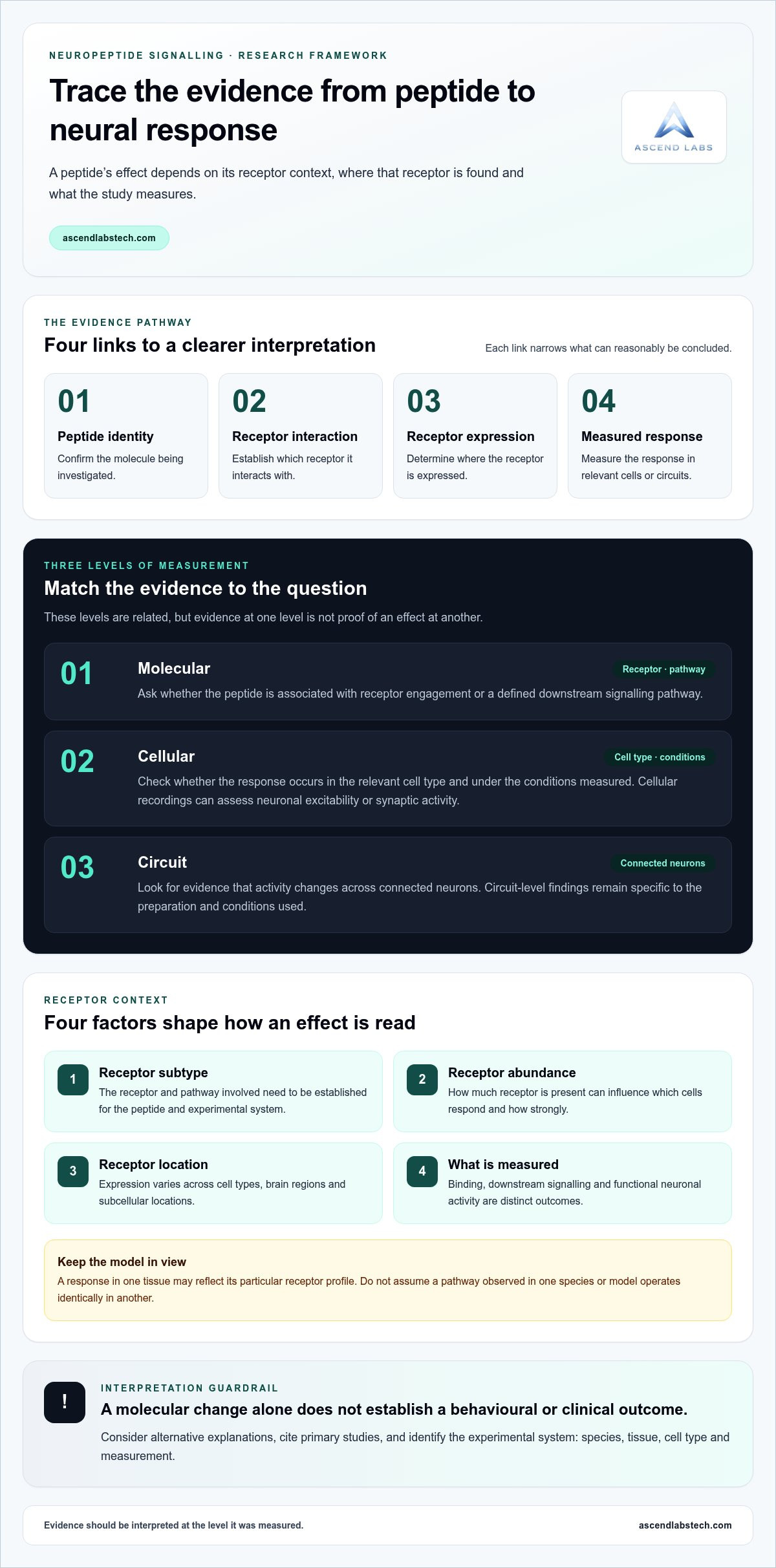
Understanding a peptide’s effect requires more than identifying the molecule. Researchers can trace a chain of evidence: confirm peptide identity, establish which receptor it interacts with, determine where that receptor is expressed, then measure the response in relevant cells or circuits. Each link narrows the interpretation. For example, a change in a cellular marker does not by itself show how a whole neural network will behave.
Receptor context determines how a peptide effect should be interpreted. Receptor subtype, abundance and location can influence which cells respond and how strongly. A peptide may act at a synapse, modulate a neuron’s responsiveness over a longer timescale or contribute to a network-level change. These are related but distinct levels of explanation. Evidence at one level should not be treated as proof at another.
Why do receptor type and location matter?
Many peptide receptors belong to the G protein-coupled receptor (GPCR) family, which can activate intracellular signalling pathways. This is a useful starting point, not a universal rule: the receptor and pathway involved need to be established for the peptide and experimental system being studied.
Receptor expression can vary across cell types, brain regions and subcellular locations. A response detected in one tissue may reflect its particular receptor profile rather than a general property of the peptide. Interpretation also depends on whether the study measures receptor binding, downstream signalling or a functional change in neuronal activity. Do not assume that a pathway observed in one species or model will operate identically in another.
How can researchers connect molecular effects with circuit activity?
Match the measurement to the question. Molecular assays can indicate receptor engagement or downstream signalling. Cellular recordings can show changes in neuronal excitability or synaptic activity. Tissue and circuit-level methods can reveal how groups of cells respond together, but their findings remain specific to the preparation and conditions used.
A molecular change alone does not establish a behavioural or clinical outcome. Each step requires its own evidence, with alternative explanations considered. Evaluate findings in sequence:
- Molecular: Is the peptide associated with receptor engagement or a defined pathway?
- Cellular: Does the response occur in the relevant cell type and under the measured conditions?
- Circuit: Is there evidence that activity changes across connected neurons?
When reviewing evidence on neurotransmitter research peptides, cite primary studies and identify their experimental systems, including species, tissue, cell type and measurement. Researchers assessing materials for peptide signalling studies can review Ascend Labs’ research peptide categories as one part of a documented study workflow.
How should researchers compare evidence on neurotransmitter research peptides?
Evidence is most useful when the study design matches the question. A controlled cell assay may support a claim about receptor activity, while a change in an animal model raises different questions about intact neural systems. Neither result alone demonstrates a human outcome. Compare studies by considering what each model can show, how the experiment was conducted and whether the conclusion stays within those limits.
What can different experimental models tell researchers?
In vitro studies isolate molecular or cellular processes under defined conditions. Animal studies capture interactions within a living system, but findings remain specific to the species, model and conditions used. Human research addresses human participants, yet its design, participant characteristics and measured outcomes still determine what can be concluded. Do not generalise across species or models without supporting data.
| Evidence type | Can help establish | Cannot establish on its own | Common limitation |
|---|---|---|---|
| In vitro | Receptor interaction or cellular responses in a defined system | Effects across an intact organism or human outcomes | Artificial conditions may not reflect living tissue |
| Animal | Responses within a living system and, in some models, circuit-level effects | That the same effect occurs in people | Species and model differences limit translation |
| Human | Findings in the participants and outcomes studied | Conclusions beyond the study design or population | Sample size, controls and study design affect interpretation |
Which questions help assess a peptide study?
Start with the research question, then check whether the controls and outcome measures can answer it. Review the sample characteristics, experimental system and methods used to identify and assess the peptide. Ask whether the authors’ conclusions match their methods and whether independent studies reproduce the finding. A result that appears compelling in one model may still be preliminary.
Material identity is also part of evidence quality. For neurotransmitter research peptides, documentation of peptide identity and purity can help assess whether the material is consistent with the study’s requirements. Consider what the analytical method verifies and whether the documentation relates to the specific material and batch. Purity alone does not establish biological activity, receptor selectivity or a predicted outcome; those require evidence from appropriately designed experiments.
Keep conclusions proportionate: report the model, conditions and measured endpoint alongside the finding. This makes it easier to distinguish a molecular observation from a replicated effect, and a research result from a demonstrated human outcome.
How can a laboratory plan a rigorous peptide signalling study?
A rigorous study begins with a question narrow enough to test. Instead of asking whether a peptide “affects brain signalling”, specify the proposed receptor or pathway, the experimental system and the response to measure. This helps guide model selection, control planning and the limits of the conclusions.
How should a research question guide model and control selection?
Use the question to decide what evidence is needed. A study of receptor engagement calls for different measurements from one examining neuronal activity. Select a model that can address the intended claim, then choose controls that help distinguish the proposed effect from alternative explanations. Prespecify primary outcomes and analysis plans where appropriate, rather than selecting measures after seeing the results.
Plan for the research setting as well. Identify applicable institutional approvals, ethics requirements and other obligations before work begins, particularly where the design involves animals, human participants or sensitive biological materials. Requirements depend on the setting and study, so build them into the protocol rather than treating them as an administrative afterthought.
What should researchers document about peptide materials?
Material records help make results interpretable and support repeatability. Document the peptide identity and batch information, preparation details, storage conditions and handling procedures used in the study. Follow the protocol and relevant material documentation for preparation and storage. Do not assume practices used for one material apply to another.
Review analytical documentation in context. A certificate or test result may support particular claims about a material, but it does not automatically verify every quality attribute or establish biological activity. Record what was assessed, by which method, and how the evidence relates to the material used. For neurotransmitter research peptides, this information is part of the experimental record, not a substitute for appropriate controls or biological evidence.
Reproducibility depends on documented methods and transparent reporting. A clear record lets others assess how the experiment was conducted, understand its limitations and determine whether the findings can be repeated.
Use this workflow to organise the study:
- Define the question: State the target pathway or receptor and the measurable outcome.
- Review the evidence: Note what previous studies show, which models they used and what remains uncertain.
- Select the model: Match its strengths and limitations to the claim being tested.
- Plan controls: Choose controls and prespecified outcomes suited to the question.
- Document results: Record methods, material details, observations and deviations from the protocol.
Where can researchers explore neurotransmitter and neuromodulator peptides in Australia?
Choose research materials based on the scientific rationale, not the other way around. First define the target and the question the study is designed to test. Then establish what the evidence supports, which model is appropriate and what material characteristics the protocol requires. Catalogue review should follow those decisions.
How does research-material sourcing fit into the study workflow?
Ascend Labs is an Australian-owned supplier of research peptides and compounds for scientific use, with neuromodulator peptides in its catalogue. Researchers can review this range alongside a defined study question. A catalogue listing does not establish a mechanism, predict an experimental result or replace careful model selection and study design.
Before a study begins, align material records with the laboratory’s documentation system. Record material identity and batch details, and document preparation, storage and handling in accordance with the study protocol and relevant material information. Consistent records help researchers interpret results and assess whether differences between experiments may relate to methods or materials.
For neurotransmitter research peptides, sourcing is one part of an evidence-led process. The material must fit the research question, while the experiment must provide the evidence needed to evaluate the proposed effect.
What boundaries should guide peptide research communication?
Describe research compounds as materials for scientific research, not as prescription medicines for human use. Avoid dosing instructions or claims about self-experimentation, treatment, diagnosis or disease prevention. These boundaries keep scientific discussion distinct from claims about human use or outcomes.
Australian regulatory requirements can depend on the product and how it is supplied or promoted. For publication, verify current Therapeutic Goods Administration guidance and use precise wording that reflects the specific context. A research-use description does not replace consideration of applicable requirements.
Once the study question, evidence context and material requirements are clear, researchers can review the Australian catalogue as a practical next step.
Build your next study on clear evidence
Strong studies involving neurotransmitter research peptides begin with a precise question, then connect peptide identity to receptor context, experimental model and a measurable outcome. Interpret findings within the limits of the evidence: a molecular or cellular response does not, on its own, establish a circuit-level effect or a human outcome.
Rigour continues through study planning and material review. Select controls that address the research question, prespecify outcomes where appropriate, and document material identity, batch details, preparation and handling. These practices help make results easier to interpret and support transparent reporting.
For Australian research purchasers, Ascend Labs is an Australian-based supplier focused on domestic research-material supply. Its catalogue includes neuromodulator peptides for scientific research. Reviewing the catalogue can be one step in a considered workflow, alongside evaluating evidence and study requirements.
With a focused question and disciplined methods, researchers can approach peptide signalling with clarity and build a stronger foundation for their work.
Frequently Asked Questions
What is a neurotransmitter research peptide?
A neurotransmitter research peptide is a peptide molecule studied for a possible role in neuronal chemical signalling. Researchers investigate how a particular peptide is released, which receptors it interacts with and what cellular or circuit response follows. The term describes a research focus, not a guarantee that every peptide found in nervous tissue acts as a neurotransmitter. Interpretation depends on the specific molecule and experimental evidence.
Are neuropeptides the same as neurotransmitters?
No. Neuropeptides are peptides found in the nervous system, while neurotransmitter describes a signalling role. Some neuropeptides act as neurotransmitters or neuromodulators, but presence in neural tissue alone does not establish that function. Classification depends on evidence about release, receptor interaction and biological effect. A peptide may also influence neural activity indirectly, so state the role being investigated and the model in which it was observed.
How do peptide neuromodulators affect neural signalling?
Peptide neuromodulators can alter how neurons respond to other signals by interacting with receptors and intracellular pathways. The direction and scale of an effect depend on receptor type, expression, cell location and experimental conditions. A measured cellular response may inform a mechanism, but it does not automatically establish a network-level or behavioural effect. Match each claim to the level of evidence and outcome measured.
What is the difference between a peptide neurotransmitter and glutamate or GABA?
Peptides are chains of amino acids, whereas glutamate and gamma-aminobutyric acid (GABA) are small-molecule neurotransmitters. They differ in molecular structure and aspects of their synthesis, release and receptor signalling. Glutamate and GABA are commonly studied in fast excitatory and inhibitory transmission, while peptide signals can also modulate neuronal responsiveness. These broad distinctions do not determine function by themselves; release and receptor context matter.
How can researchers assess evidence for a neurotransmitter peptide?
Start by checking whether the research question, experimental model and measured outcome align. Review the controls, sample characteristics and methods, then ask whether the authors’ conclusions extend beyond what the data show. In vitro findings, animal results and human studies answer different questions and should not be treated as interchangeable. Look for independent replication and report the system studied. Material documentation can support assessment of identity, but does not prove biological activity.
What should a laboratory check when sourcing research peptides in Australia?
Define the study target and material requirements before reviewing a catalogue. Review available information on material identity and batch details, and plan to document preparation, storage and handling under the laboratory’s protocol. Ascend Labs is an Australian-based supplier focused on domestic research-material supply, with neuromodulator peptides for scientific research in its catalogue. Catalogue information supports sourcing decisions, but does not replace evidence appraisal, experimental controls or applicable regulatory review.
Can research peptides be used as medicines or for self-experimentation?
No. Research peptides supplied for scientific research are not presented as prescription medicines for human use and are not intended for self-experimentation. Research findings do not establish that a material is safe or effective for people, nor do they provide a basis for treatment or disease-prevention claims. Keep research materials within their stated scientific purpose, and consult current Australian regulatory guidance when assessing requirements that apply to a particular product or activity.


