

What if a supplier’s most reassuring document still leaves important questions unanswered? Searching for tirzepatide research compounds australia can bring together confident product claims, analytical paperwork and prescription medicines that serve entirely different purposes.
It’s reasonable to want a consistent way to compare suppliers and interpret the evidence they provide. A certificate or test report may support specific claims about a sample, but it doesn’t establish clinical safety, suitability for human use or regulatory approval. In Australia, tirzepatide is a Schedule 4 prescription-only medicine; TGA-approved Mounjaro is accessed by prescription. A research-use label doesn’t make a compound a treatment option.
This guide explains how to assess tirzepatide research compounds for legitimate Australian research, including documentation, traceability and the limits of analytical results. It also distinguishes research procurement from clinical treatment, so you can evaluate supplier information against your research purpose.
Key Takeaways
- Use a document-first checklist to assess compound identity, batch reference, report date, analytical method and issuing laboratory.
- Interpret each analytical result within its scope. One test cannot establish every quality attribute.
- Compare tirzepatide research compounds australia suppliers by the relevance and completeness of their evidence, not by unverified rankings or broad claims.
- Set a clear research purpose, review supplier terms and retain procurement records. Confirm applicable Australian requirements for the product and intended use.
- Follow a deliberate sourcing sequence: define the research scope, assess documentation and terms, then consider an appropriate research-compound catalogue item.
What tirzepatide research compounds are, and what they are not
Tirzepatide is a peptide compound studied for activity at two incretin receptor pathways: glucose-dependent insulinotropic polypeptide (GIP) and glucagon-like peptide-1 (GLP-1). Here, “research compound” means material supplied for scientific investigation, not a product intended to diagnose, prevent or treat a health condition. For anyone assessing tirzepatide research compounds australia, that distinction is fundamental: the research context informs how the material should be understood and procured.
Tirzepatide is a dual GIP and GLP-1 receptor research compound. Receptor-level investigation is distinct from evidence of clinical benefit or suitability for human use.
What does dual GIP and GLP-1 receptor activity mean in research?
GIP and GLP-1 are hormones involved in incretin biology, and their receptors are studied to understand how cells respond to signalling. Describing tirzepatide as acting on both pathways identifies a subject for laboratory investigation. It doesn’t, by itself, explain every biological effect or establish an outcome in people. For a broader introduction to the compound’s background, see Tirzepatide Wikipedia. Receptor-level questions belong to experimental research; conclusions about human health require a separate clinical evidence base.
This distinction matters when reading supplier descriptions. A receptor term is a scientific descriptor, not a guarantee of a particular result in an assay, model or person. Research findings depend on the question being tested and the evidence supporting each conclusion. Keep claims about molecular activity within their proper scope, and don’t infer treatment effects from a research label or brief product description.
Research material is not a human-use medicine
Research compounds are not interchangeable with prescription medicines or approved therapeutic products. Similarity in a compound name or biological target doesn’t establish equivalent formulation, quality controls, authorisation, safety or clinical performance. A research-use statement sets a boundary around intended use; it doesn’t convert the material into a medicine or support personal experimentation.
Ascend Labs is an Australian-owned supplier of research peptides and metabolic compounds, including Tirzepatide. Its products are for research procurement, not prescription medication for human consumption. This guide addresses scientific sourcing only. It isn’t medical advice, a diagnosis or a treatment guide, and it doesn’t provide instructions for personal use.
For a laboratory buyer, keep three questions separate:
- What is being studied? Define the research question and the relevant receptor-level context.
- What is being sourced? Treat the item as research material, not as a substitute for a prescribed medicine.
- What can the evidence support? Distinguish documented material characteristics from claims about clinical effects.
This helps prevent a category error: interpreting scientific language as evidence of therapeutic suitability. Next, assess supplier documentation against the specific research purpose.
How to assess tirzepatide research compounds in Australia
Start with the records, not the headline claim. When sourcing tirzepatide research compounds in Australia, a document-first review helps establish what a supplier’s evidence relates to and where its limits lie. A Certificate of Analysis (COA) can support an evaluation, but its value depends on whether it is identifiable, traceable and relevant to the material being considered.
What should a Certificate of Analysis show?
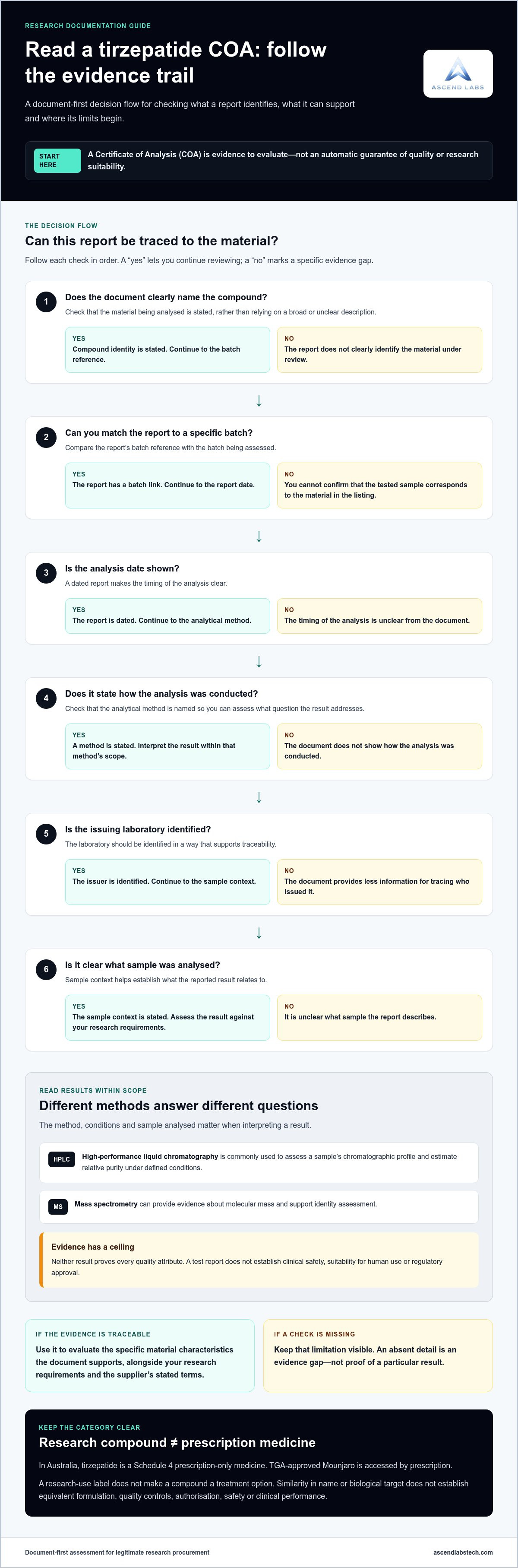
Check that the COA names the compound and links it to a specific batch. It should also show the analysis date, the method used and the issuing laboratory. Together, these details help you assess whether the document is traceable and relevant, rather than relying on a generic report with no clear connection to the material under review.
Use this checklist when reviewing a document:
- Compound identity: Is the named material clearly stated?
- Batch reference: Can you match the report to the batch being assessed?
- Date: Is the report dated, and is the timing clear?
- Analytical method: Does the document state how the analysis was conducted?
- Issuing laboratory: Is the laboratory identified in a way that supports traceability?
- Sample context: Does the report make clear what sample was analysed?
A mismatch matters. For example, a report without a batch reference may not establish that the tested sample corresponds to the material in a current listing. A COA is evidence to evaluate, not an automatic guarantee of quality or research suitability. Consider it alongside your research requirements and the supplier’s stated terms.
How should researchers interpret analytical methods?
Analytical methods answer particular questions. High-performance liquid chromatography (HPLC) is commonly used to assess a sample’s chromatographic profile and estimate relative purity under defined conditions. Mass spectrometry can provide evidence about molecular mass and support identity assessment. These methods have different roles; neither result should be treated as proof of every quality attribute.
Interpretation depends on context: the method and conditions, the sample analysed, and the information included in the report. A percentage or method name alone doesn’t explain what was tested or what conclusions the data support. Don’t assume a result applies to a different batch, or that one analytical result establishes identity, purity and suitability all at once.
For a more detailed framework, consult this peptide purity testing protocol. Assess any product-specific method or result claim against current documentation for the relevant item. General supplier language alone doesn’t establish analytical performance.
Once your evidence criteria are clear, you can apply them to the research compound catalogue as part of a careful procurement review.
Compare Australian tirzepatide suppliers using evidence, not claims
A side-by-side review is more useful than a list of broad quality claims. When comparing tirzepatide research compounds in Australia, focus on what each supplier documents, how directly the evidence relates to the material, and whether research-use terms are clear. The framework below is a comparison aid, not a ranking. Record what you find in the material reviewed and keep evidence gaps visible.
Which supplier details are useful for a research buyer?
Look for a clear product identity and an explicit research-use scope. Then assess whether quality documents connect to an identifiable batch and whether the supply information clearly describes Australian arrangements. Tie each observation to its source, such as a product description, batch document or terms page. Marketing language may point to a claim worth examining, but it isn’t a substitute for evidence.
| Comparison criterion | Supplier A | Supplier B |
|---|---|---|
| Documentation | Record which relevant documents are provided and what each covers. | Record the same evidence categories. |
| Traceability | Note whether documents identify a batch, date, method and issuing laboratory. | Apply the same checks. |
| Research-use terms | Summarise the stated intended-use boundaries. | Summarise the stated boundaries. |
| Product identity | Record the name and description as presented. | Record the corresponding details. |
| Domestic supply information | Note what Australian supply arrangements are explicitly stated. | Record stated information without inferring delivery timing or stock. |
How can a comparison table avoid false equivalence?
Use consistent criteria, but don’t assume two documents are equivalent simply because they share a heading. Separate product specifications from analytical methods and supplier policies. If a detail isn’t in the material you reviewed, mark it “not stated in reviewed material”. That records an evidence gap without claiming the supplier has poor quality or lacks the information elsewhere.
Interpret claims according to their specificity. “Batch-linked report available” can be checked against an identified report; “high quality” is a broad assertion unless supported by relevant evidence. Keep the wording of each claim, its source and any supporting document together in your notes. When a supplier makes a method or result claim, assess whether the referenced material is current and applies to the item being compared.
Batch-linked evidence is more useful than an unqualified purity claim because it connects a stated result to identifiable material and a reviewable record. Even then, a report supports only the conclusions its method and sample context can justify. Don’t treat one metric as proof of every quality attribute or compare figures without understanding how they were generated.
A disciplined comparison describes evidence, not reputations. Avoid supplier rankings and superlatives unless reliable, comparable information supports them. Ascend Labs, an Australian-based domestic supplier, can be assessed against the same transparent criteria. Evaluate product-specific statements against relevant documentation rather than assuming they apply.
Australian research-use boundaries and responsible procurement
Responsible procurement starts before an order is placed. Define the scientific purpose, review the available documentation, assess the supplier’s terms and retain a clear record of the decision. For teams sourcing tirzepatide research compounds in Australia, this workflow helps align purchasing with an established research scope rather than assumptions based on a product description.
What does research-use-only mean for procurement?
“Research use only” describes an intended scientific context. It does not make a compound a prescription medicine, an approved therapeutic product or a suitable option for personal use. Nor does the label itself establish that a proposed activity meets applicable requirements. Ascend Labs supplies research compounds, not prescription medication for human consumption.
Before proceeding, ensure the proposed work is consistent with your organisation’s procedures and relevant ethical, institutional and legal requirements. A research purpose should be specific enough to guide the procurement decision, recordkeeping and oversight. If the intended use changes, pause and reassess the scope rather than relying on the original supplier label.
What should an Australian buyer document?
Keep a research file that lets another authorised reviewer understand what was purchased, why it was selected and what information informed the decision. Record the compound identity and batch reference, then retain the documents and terms reviewed at the time of procurement. This creates a useful audit trail without implying that paperwork alone establishes suitability.
A concise procurement sequence can help standardise the process:
- Define the research purpose: document the project scope and the reason the material is required.
- Review documentation: note which product and batch records were considered, including their dates and stated methods.
- Assess terms: retain the supplier’s research-use wording and any relevant purchase conditions.
- Keep the record: file order documentation and relevant correspondence with the project’s procurement records.
Australian regulatory status may depend on how a product is classified and its intended use. A research-use label should not be treated as authorisation for personal use or as a substitute for checking applicable rules. Before procurement, consult current Australian sources, including relevant Therapeutic Goods Administration information and legislation, and follow your institution’s compliance process. Regulatory guidance can change, so record the source and date of any guidance relied upon.
For organisations, a written process can clarify who reviews product information, who approves procurement and where records are stored. Keep statements about regulatory status precise and tied to an authoritative source. Don’t infer permission from supplier marketing, a product category or the presence of analytical paperwork.
Sourcing tirzepatide research compounds through Ascend Labs
Responsible sourcing follows a clear sequence: define the research scope, compare the evidence, review the terms, then select an appropriate catalogue item. This keeps the decision anchored to the project’s scientific purpose rather than a headline claim or an assumption about what a product can establish.
Ascend Labs is an Australian-owned supplier of research peptides and metabolic compounds, with Tirzepatide in its research-compound range. Its catalogue is for scientific research procurement, not prescription medication for human consumption. For Australian research buyers, catalogue selection should remain within the defined research purpose and applicable organisational requirements.
What to review before proceeding with a catalogue selection
Start by matching the listed compound identity to the research question. Then review the product-specific information for the item and consider whether it addresses the documentation needs established for the project. Read the research-use conditions alongside the product description, not as a separate formality. A catalogue entry can inform a procurement review, but it doesn’t replace assessment of evidence or institutional requirements.
Before selecting, consider whether you can clearly answer these questions:
- Scope: Does the compound align with the documented scientific purpose?
- Identity: Is the listed item identified in a way that matches the research requirement?
- Evidence: Have you reviewed the relevant product-specific information and its limitations?
- Terms: Are the research-use conditions understood and consistent with the intended procurement?
- Records: Can the selection rationale and reviewed documents be retained with project records?
If an evidence requirement remains unresolved, record that clearly before proceeding. Don’t fill gaps with assumptions about composition, analytical results or suitability. Keep the selection within legitimate scientific research procurement; research material is not a substitute for clinical care, diagnosis or a prescribed medicine.
A clear next step for Australian research buyers
Once the research scope and evidence criteria are established, browse the Australian research compound catalogue as part of that considered process. Review the Tirzepatide listing in context, compare its stated information with your project’s requirements, and assess the relevant terms before making a selection. Use the catalogue as a domestic procurement pathway for research compounds, and base your decision on the product information and your research requirements.
Keep the final decision evidence-led. Record what you reviewed, why the item fits the research scope and which requirements govern the work. That disciplined approach supports clearer procurement decisions while maintaining the boundary between scientific research and personal treatment.
Make your next research procurement evidence-led
Turn your evaluation criteria into a repeatable procurement record. A consistent process helps research teams document why a compound was selected, what evidence informed the decision and which conditions apply. When projects evolve, reassess the research scope and relevant documentation rather than relying on an earlier decision by default.
For tirzepatide research compounds australia, Ascend Labs offers a domestic research-procurement pathway. Ascend Labs is Australian-owned and serves the Australian market, with Tirzepatide included in its research-compound range. These compounds are supplied for research, not as prescription medication for human consumption. Keep that distinction clear in procurement decisions and records.
Review the catalogue with your research purpose and documentation requirements in mind, then proceed within the appropriate scientific and organisational boundaries.
Careful evaluation is a strong foundation for responsible research. Take the next step with clarity and confidence.
Frequently Asked Questions
What is tirzepatide studied for in research?
Tirzepatide is studied for activity involving GIP and GLP-1 receptor pathways, which form part of incretin research. A laboratory project might investigate receptor signalling or compare responses under defined experimental conditions. Such work addresses questions about biological mechanisms, not what an individual will experience. Findings from an assay or other research model shouldn’t be presented as evidence of a treatment effect in people.
Is tirzepatide sold in Australia as a research compound the same as a prescription medicine?
No. A research compound and a prescription medicine are different categories, even if they share the name tirzepatide. In Australia, the TGA-approved medicine Mounjaro is prescription-only; its approval and use are distinct from research procurement. A research product’s description or analytical paperwork doesn’t establish that it has the same formulation, authorisation or clinical evidence as a therapeutic product. Check the precise item and its intended category.
What should a tirzepatide Certificate of Analysis include?
A useful COA should identify the compound and relevant batch, state the analysis date and method, and identify the issuing laboratory. Check whether its sample or batch reference matches the material under review, rather than assuming a document applies to every listing or later batch. Keep a dated copy with your procurement records. If identifiers conflict or the report’s scope is unclear, note the gap before relying on it.
How can researchers compare tirzepatide suppliers in Australia?
Use the same review criteria for each supplier, then compare the evidence actually available: product identity, batch-linked records, stated research-use conditions and Australian supply information. For tirzepatide research compounds australia, record where each detail came from and distinguish documented facts from promotional wording. Mark information that isn’t stated in the material reviewed as unavailable in that review, rather than treating the gap as proof of poor quality.
Can research-grade tirzepatide be used for personal weight management?
No. Research-grade tirzepatide isn’t a personal weight-management product, and a research-use label doesn’t authorise self-use. Using research material outside its stated scientific context can expose a person to unknown risks and bypass the safeguards associated with clinical care. If you’re considering weight-management treatment, speak with a registered health practitioner about appropriate options. Don’t use a research listing or laboratory document to make a personal treatment decision.
Does a high purity claim alone prove a research compound is suitable?
No. A purity figure alone doesn’t establish identity, explain the analytical method or show that every relevant quality attribute was assessed. For example, a reported result may relate to one analytical method and a particular sample, not other properties or a different batch. Assess what the underlying report measures and whether it applies to the material in question. Avoid treating an isolated number as a complete quality assessment.
What Australian regulatory information should research buyers check?
Check current TGA guidance and the relevant provisions of the Therapeutic Goods Regulations 1990, and follow your institution’s compliance process. Tirzepatide is a Schedule 4 prescription-only medicine in Australia. The regulations were amended from 1 October 2024 so compounding pharmacists can no longer compound GLP-1 receptor agonists, including tirzepatide, for supply to patients. Product classification and intended use matter, so verify current requirements with authoritative Australian sources before procurement.


