

In the precision-driven environment of Australian biotechnology, can a research outcome ever truly transcend the integrity of its raw materials? For investigators operating within the rigorous strictures of domestic laboratory standards, the answer is a definitive no. You likely recognise that inconsistent purity in imported compounds isn't merely a minor variable; it is a fundamental threat to the validity of longitudinal data and the reproducibility of scientific findings.
This technical reference provides an authoritative analysis of recovery-grade muscle recovery research peptides, detailing their specific molecular mechanisms and the uncompromising verification standards mandated for legitimate inquiry. We promise to move beyond surface-level descriptions to examine the nuanced differences between metabolic and growth factor pathways in tissue repair models. This briefing previews the essential framework for interpreting complex Certificates of Analysis while identifying the specific HPLC-verified compounds necessary to maintain the highest levels of chemical fidelity in an Australian research setting.
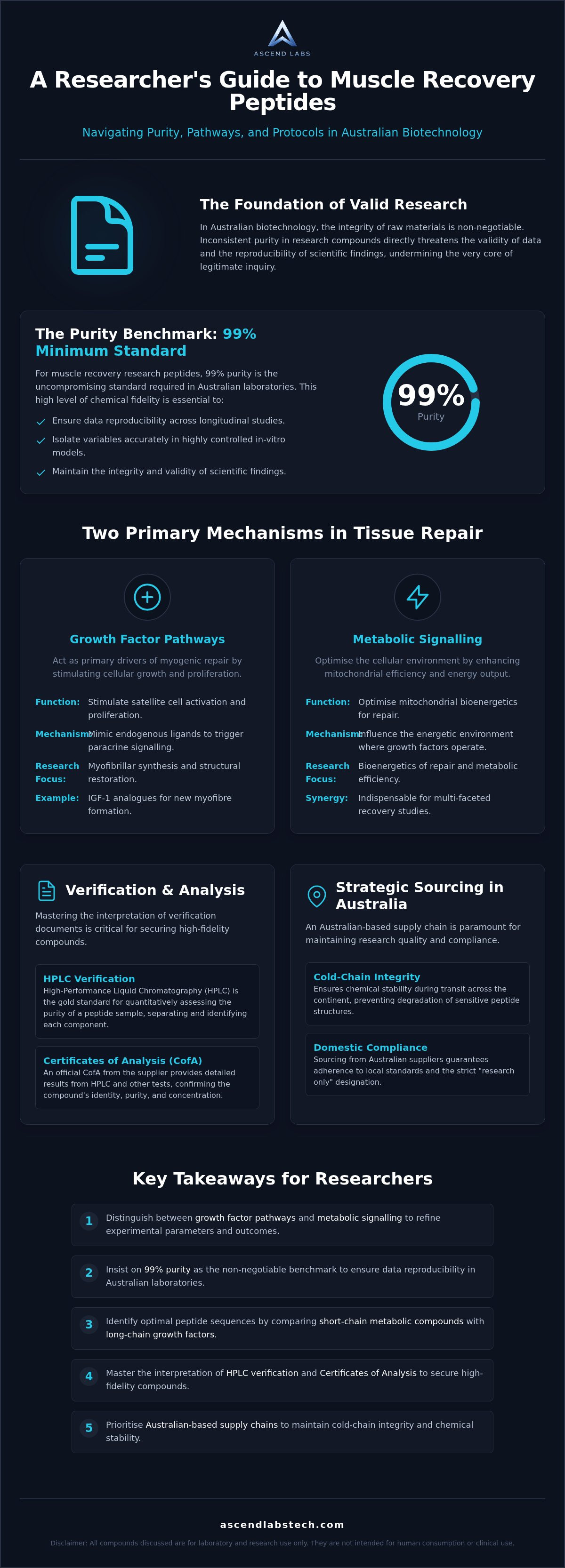
Key Takeaways
- Distinguish between growth factor pathways and metabolic signalling in tissue repair models to refine experimental parameters and research outcomes.
- Understand why 99% purity is the non-negotiable benchmark for muscle recovery research peptides to ensure data reproducibility in Australian laboratories.
- Identify the optimal peptide sequences for specific research targets, comparing short-chain metabolic compounds with long-chain growth factors for muscle and tendon repair.
- Master the interpretation of HPLC verification protocols and Certificates of Analysis to secure high-fidelity compounds from domestic sources.
- Recognise the strategic importance of Australian-based supply chains and cold-chain integrity for maintaining chemical stability during transit across the continent.
The Landscape of Muscle Recovery Research Peptides in Australia
In the precision-driven environment of Australian biotechnology, muscle recovery research peptides are defined as high-purity signalling molecules engineered for specific laboratory applications. These compounds represent a sophisticated departure from broad-spectrum protein supplementation. While traditional studies often focused on macro-nutritional intake to support muscle mass, modern inquiry prioritises the precise modulation of cellular pathways. Understanding Peptides at a molecular level allows researchers to examine how short chains of amino acids act as biological messengers, triggering specific responses within the myogenic lineage.
Tissue repair studies have undergone a fundamental shift, moving from basic protein-based models to targeted peptide sequences that offer unprecedented specificity. In Australia, current research trends are increasingly focused on cellular regeneration and the modulation of inflammatory responses. Investigators are moving away from general systemic observations toward highly controlled in-vitro models. These models allow for the isolation of specific variables, such as satellite cell activation or mitochondrial efficiency, without the confounding factors present in broader systemic research.
The Shift Toward Targeted Molecular Signalling
Specific peptide sequences, particularly those categorised as Growth Factor Peptides, are engineered to mimic endogenous ligands that stimulate repair. This mimicry is central to paracrine signalling research, where the goal is to understand localised recovery within discrete muscle tissue groups. Australian laboratories are increasingly prioritising these targeted sequences over traditional protein models because they allow for a more granular analysis of the molecular triggers behind myofibrillar synthesis. By focusing on these precise interactions, researchers can develop more accurate models for tissue regeneration and metabolic efficiency.
Regulatory Context for Australian Research Compounds
Securing muscle recovery research peptides within Australia requires strict adherence to the "research only" designation. These compounds are intended exclusively for laboratory evaluation and are not for human consumption or clinical use. Sourcing from domestic, Australian-owned suppliers is essential for ensuring compliance with local standards and maintaining research continuity. This domestic focus helps investigators avoid the pitfalls of inconsistent international purity while upholding the ethical standards required for the procurement of metabolic research compounds. Meticulous documentation, including HPLC verification, remains the standard for any serious inquiry into myogenic repair pathways.
Evaluating Growth Factor and Metabolic Mechanisms in Tissue Repair
Research into muscle recovery research peptides has progressed beyond simple amino acid supplementation to target specific molecular pathways with surgical precision. Investigators now categorise these compounds into two primary functional groups: growth factors that drive cellular proliferation and metabolic peptides that optimise mitochondrial bioenergetics. Understanding the interplay between these mechanisms is essential for developing comprehensive tissue repair models that reflect real-world physiological responses.
While many general studies focus on basic collagen synthesis, advanced laboratory inquiry prioritises the bioenergetics of repair. The synergy between structural signalling and energetic output defines the current frontier of myogenic science. Metabolic compounds don't just provide energy; they influence the environment in which growth factors operate, making them indispensable in multi-faceted recovery studies.
Growth Factor Peptides and Cellular Proliferation
Growth factors act as the primary drivers of myogenic repair at the cellular level. IGF-1 analogues, for instance, play a pivotal role in stimulating satellite cell activation and proliferation. These cells are the precursors to new muscle tissue; their activation is a prerequisite for the formation of new myofibres and the repair of existing structural damage. By modulating these pathways, researchers can observe the impact of growth factors on protein synthesis and the rate of structural restoration. For a detailed breakdown of these mechanisms, consult our Growth Factor Peptides Australia: Scientific Research Guide.
Metabolic Peptides: Mitochondrial Efficiency in Recovery
If growth factors provide the blueprint for repair, metabolic peptides provide the necessary fuel. MOTS-C, a mitochondrial-derived peptide, is frequently utilised in research to evaluate metabolic flexibility and ATP production during repair phases. It's a critical tool for understanding how mitochondrial efficiency can modulate systemic inflammatory responses in research models. This metabolic optimisation ensures that the energetic cost of cellular regeneration doesn't become a limiting factor in tissue repair. Researchers looking to integrate these pathways into their protocols can Purchase MOTS-C Australia: A Technical Resource for Research Procurement (2026) to ensure the highest levels of chemical fidelity.
The bioenergetics of muscle tissue repair are inherently complex. Synergy between different peptide classes is often the focal point of sophisticated recovery studies. For example, a growth factor may initiate the repair signal, but the efficiency of that signal depends on the mitochondrial health of the target tissue. Laboratories often evaluate these combinations to determine how metabolic research compounds can enhance the efficacy of structural repair models. For those conducting high-fidelity inquiries, sourcing from an authoritative Australian peptide supplier ensures that purity standards meet the requirements of domestic laboratory protocols.
Laboratory Standards: Purity, Verification, and HPLC Analysis
Scientific integrity rests on the chemical fidelity of the compounds used in any experimental protocol. For muscle recovery research peptides, the industry benchmark is a minimum of 99% purity. This stringent threshold isn't arbitrary; it's a foundational requirement to ensure that observed cellular responses are the result of the peptide itself rather than residual reagents or truncated sequences. Inconsistent purity levels introduce uncontrolled variables that can lead to false positives or irreproducible data, ultimately compromising the validity of longitudinal tissue repair studies.
Australian researchers must prioritise compounds that have undergone rigorous domestic verification. Relying on outdated or generic data from international sources often leads to significant discrepancies in laboratory outcomes. Establishing a reliable baseline for myogenic repair requires a meticulous approach to quality assurance that begins with a thorough understanding of analytical chemistry. Precision in the laboratory starts with the absolute certainty of the compound's molecular profile.
The HPLC Verification Process
High-Performance Liquid Chromatography (HPLC) functions as the primary gatekeeper for compound integrity. This process separates impurities from the primary peptide sequence based on their unique elution times. When interpreting a chromatogram, researchers look for a single, sharp peak. A clean peak indicates a homogenous sample, whereas multiple smaller peaks suggest the presence of contaminants or degradation products. It's essential for Australian laboratories to demand batch-specific HPLC data. Generic "representative" reports don't account for the subtle variations that can occur during different synthesis cycles.
Mass Spectrometry and Sequence Validation
While HPLC confirms the purity of a sample, Mass Spectrometry (MS) validates its identity. This analytical technique measures the mass-to-charge ratio of ions to confirm that the peptide sequence matches the intended research compound. Sequence validation ensures that the molecular weight aligns perfectly with the theoretical mass of the peptide. Identifying potential contaminants early is vital; even trace amounts of incorrect analogues can skew experimental results in metabolic or growth factor models. Meticulous quality control in Australian peptide supply ensures that researchers are working with the exact molecular structures required for their specific inquiry.
A comprehensive Certificate of Analysis (COA) serves as the definitive document of record for these verification steps. It should provide a transparent overview of both HPLC and MS results, bridging the gap between supplier claims and laboratory reality. For any serious investigation into muscle recovery research peptides, the COA is the primary tool for maintaining research integrity and ensuring that data sets remain robust and defensible within the scientific community.
Comparative Analysis of Recovery Compounds for Research Models
Selection of specific compounds is dictated by the target tissue's physiological demands. In skeletal muscle models, the focus often lies on myofibrillar protein synthesis and satellite cell proliferation. Conversely, tendon and ligament research requires agents with a higher affinity for tenocyte activity and extracellular matrix (ECM) remodelling. Distinguishing between these requirements is the first step in designing a robust experimental protocol. When evaluating muscle recovery research peptides, investigators must consider the structural differences that influence experimental outcomes:
- Molecular Weight: Short-chain sequences generally offer higher stability and different kinetic profiles in-vitro.
- Half-life: Longer-chain growth factors often require precise calibration to account for rapid proteolytic degradation within a medium.
- Target Specificity: Myogenic agents focus on satellite cell activation, while tenogenic agents prioritise the integrity of collagenous structures.
One common inquiry involves how these compounds differ from standard collagen research. While collagen provides the structural scaffold, research peptides act as the active signalling agents that direct the repair process itself. They don't just provide building blocks; they modulate the cellular environment to prioritise specific repair pathways. Understanding these stability parameters allows researchers to calibrate dosage and frequency with greater accuracy, ensuring that the energetic cost of repair is properly modelled.
Peptides for Myogenic Differentiation Studies
Research focusing on myogenic differentiation evaluates compounds that specifically target muscle cell maturation. This is critical for sarcopenia or muscle wasting models, where the goal is to observe the transition from progenitor cells to functional myotubes. Neuromodulator peptides are also gaining prominence in neuromuscular junction recovery research. These studies provide essential insights into how signalling between nerves and muscles can be restored after injury or during degenerative phases.
Connective Tissue vs. Skeletal Muscle Repair
Identifying which peptides show the highest affinity for collagenous structures is essential for tendon-specific research. Unlike skeletal muscle, connective tissue possesses a lower vascular density, requiring compounds that can effectively modulate the ECM without relying on high systemic blood flow. For a comprehensive overview of these agents, see our Peptides for Connective Tissue: 2026 Technical Roundup. Designing protocols for multi-tissue recovery models often involves a tiered approach, utilising both myogenic and tenogenic signalling agents to simulate complex injury environments.
To ensure your laboratory is equipped with compounds that meet these specific research requirements, you can access our verified research catalogue for domestic Australian distribution.
Securing High-Purity Research Compounds via Australian Suppliers
The integrity of a longitudinal study depends entirely on the stability of its chemical inputs. For investigators working with muscle recovery research peptides, the logistical chain is as critical as the synthesis itself. International procurement often introduces unacceptable risks, ranging from prolonged exposure to fluctuating temperatures to the unpredictability of border force interventions. Choosing a domestic Australian supplier isn't merely a convenience; it's a strategic decision to protect the viability of your research data and ensure consistent experimental conditions.
Domestic distribution allows for a degree of oversight that global vendors simply cannot match. By centralising operations within Australia, suppliers can guarantee that sensitive compounds are handled with the meticulous care required for high-end biotechnology. This localised approach ensures that the path from the laboratory to the researcher is as direct and secure as possible, maintaining the chemical fidelity established during the initial verification phase. Secure, discreet logistics are a hallmark of a principled institution that understands the sensitive nature of laboratory-grade chemicals.
Domestic Logistics and Research Stability
Rapid transit is the most effective safeguard against peptide degradation. When compounds spend weeks in international transit, they're often subjected to thermal stress that can compromise their molecular structure. Domestic shipping reduces this window of vulnerability to hours or days, ensuring that muscle recovery research peptides arrive in optimal condition. This speed is especially vital for maintaining cold-chain integrity across the vast Australian continent. Bypassing the complexities of international customs also removes regulatory hurdles that can stall research for months. Ascend Labs plays a pivotal role in supporting the Australian biotechnology sector by providing a reliable, domestic alternative that prioritises research continuity over high-volume retail logistics.
The Ascend Labs Commitment to Purity
Our commitment to scientific integrity is reflected in our rigorous testing protocols. Every batch in our catalogue undergoes comprehensive verification to meet the 99% purity benchmark required for valid scientific inquiry. Professional researchers choose Australian-owned expertise because they value a partner that understands the specific demands of the domestic scientific landscape. We don't just provide chemicals; we provide the certainty required for high-stakes inquiry. We act as an authoritative gatekeeper, ensuring that every compound meets the precise molecular standards your protocols demand. To secure the highest-fidelity compounds for your next study, Explore the Ascend Labs Research Peptide Catalogue and experience the difference of clinical-grade domestic supply.
Advancing the Standards of Myogenic Inquiry in Australia
Precision in laboratory science is not merely a preference; it's a foundational requirement for valid data. We've examined how the distinction between growth factor and metabolic pathways dictates the efficacy of tissue repair models. You now understand that 99%+ purity isn't just a number; it's the critical barrier against experimental noise and irreproducible results. Securing muscle recovery research peptides from domestic sources eliminates the variables of international transit and ensures your inquiry remains robust.
Scientific truth depends on the absolute integrity of your materials. By prioritising batch-specific COAs and HPLC-verified compounds, you're investing in the long-term reproducibility of your findings. Ascend Labs remains committed to acting as the gatekeeper for these standards, providing secure Australian domestic shipping to maintain chemical fidelity from the point of synthesis to the laboratory bench. The future of Australian biotechnology rests on this commitment to substance and meticulous verification.
Secure HPLC-verified compounds for your next research project at Ascend Labs. We look forward to supporting your next breakthrough in cellular regeneration and tissue repair science.
Frequently Asked Questions
What are the most common muscle recovery research peptides used in Australian labs?
The most common muscle recovery research peptides utilised in Australian laboratories include Growth Factor Peptides and specific metabolic compounds like MOTS-C. These agents are selected for their ability to modulate satellite cell activation and mitochondrial efficiency within myogenic models. Researchers prioritise these sequences because they offer targeted molecular signalling for tissue repair studies, moving beyond the limitations of traditional protein-based recovery research.
How do growth factor peptides differ from metabolic peptides in recovery studies?
Growth factor peptides primarily stimulate cellular proliferation and structural maturation within the myogenic lineage. In contrast, metabolic peptides focus on the bioenergetics of the repair process, specifically targeting mitochondrial efficiency and ATP production. While growth factors provide the molecular blueprint for creating new tissue, metabolic compounds ensure the energetic environment is sufficient to support these high-cost biological transformations.
Why is HPLC verification critical for muscle recovery research compounds?
High-Performance Liquid Chromatography (HPLC) is critical because it ensures the chemical homogeneity of the research compound by separating the primary peptide from synthesis impurities. Without HPLC verification, researchers can't be certain that observed cellular responses are caused by the peptide itself. This verification process is essential for maintaining data reproducibility and ensuring that longitudinal studies meet the rigorous standards required for scientific publication.
Can these peptides be used in human clinical trials without further authorisation?
These peptides can't be used in human clinical trials without explicit authorisation from the Therapeutic Goods Administration (TGA) and a Human Research Ethics Committee (HREC). Research-grade compounds are designated for laboratory evaluation only and aren't intended for human consumption. Investigators must adhere to strict Australian regulatory frameworks, ensuring that all myogenic repair studies are conducted within approved in-vitro or non-human research models.
What is the typical purity level required for peer-reviewed peptide research?
Peer-reviewed research typically requires a minimum purity level of 99% for all peptide compounds. This high threshold is necessary to prevent trace contaminants or truncated sequences from skewing experimental results. Laboratories aiming for publication must provide batch-specific verification data, such as HPLC and Mass Spectrometry reports, to prove the chemical fidelity of the compounds used in their tissue repair protocols.
How should research peptides be stored to maintain molecular stability in Australia?
Research peptides should be stored in a temperature-controlled environment, typically at -20 degrees Celsius or lower, to maintain molecular stability. Lyophilised powders must be kept in airtight containers to prevent moisture absorption, which can lead to rapid degradation. In the Australian climate, maintaining a stable cold chain from the point of delivery to the laboratory freezer is essential for preserving the integrity of the peptide sequence.
What are the advantages of sourcing peptides from a domestic Australian supplier?
Sourcing from a domestic Australian supplier reduces the risk of peptide degradation by ensuring rapid shipping and a secure cold chain. Domestic procurement also allows researchers to bypass the complexities of international customs, which can result in significant delays and thermal stress for sensitive compounds. Additionally, Australian-owned suppliers provide technical support that aligns with local laboratory standards and regulatory requirements for metabolic research compounds.
How do mitochondrial peptides like MOTS-C influence muscle recovery research?
Mitochondrial peptides like MOTS-C influence muscle recovery research by optimising metabolic flexibility and ATP synthesis during cellular repair phases. These compounds allow researchers to examine how mitochondrial health impacts the rate of myogenic regeneration. By modulating the energetic environment, MOTS-C helps investigators understand the metabolic constraints that can limit the efficacy of growth factor signalling in various tissue repair models.


