

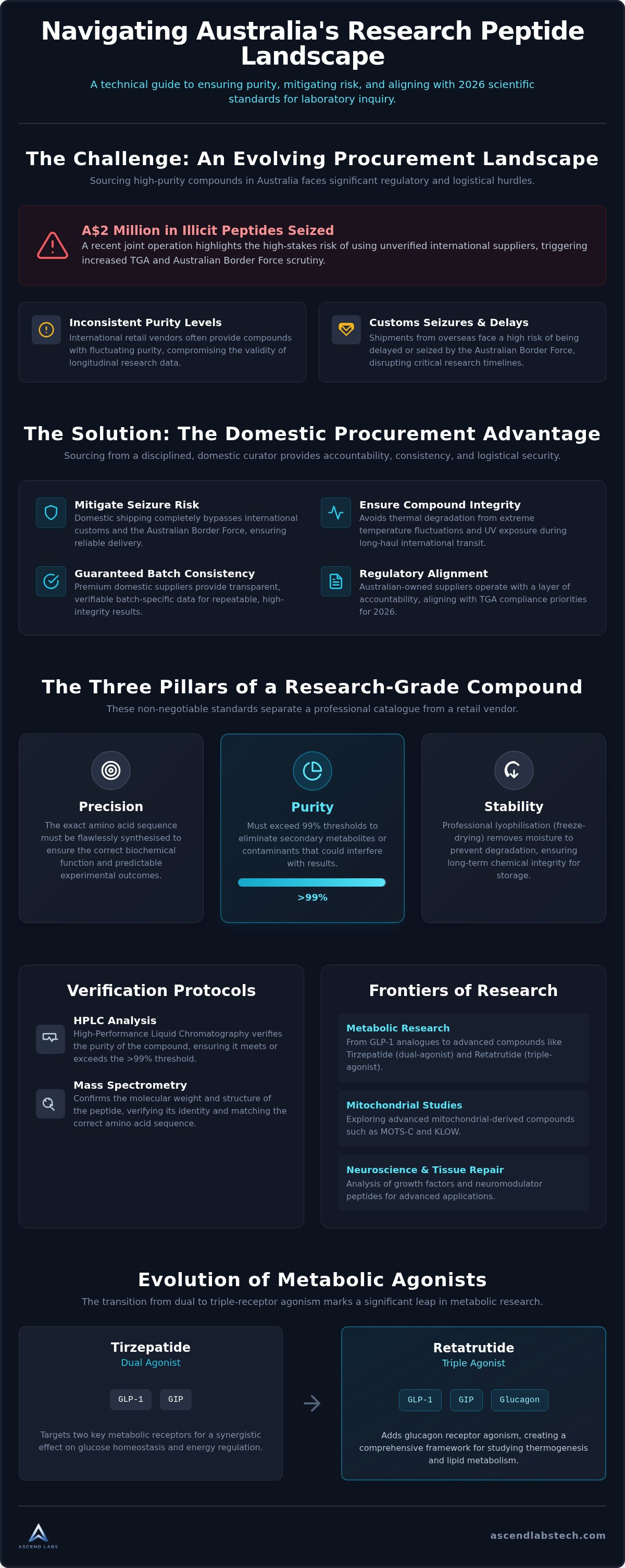
In a recent joint operation, Australian authorities seized over A$2 million worth of illicit peptide products, highlighting the volatile nature of the current procurement landscape. This significant enforcement action underscores the inherent risks of sourcing compounds from unverified or international sources. For serious practitioners, the primary obstacle isn't simply locating a reliable research peptide catalogue australia; it's ensuring the chemical integrity of the compound matches the meticulous precision of the study. You've likely experienced the frustration of inconsistent purity levels or the logistical anxiety of shipments being delayed or seized by the Australian Border Force.
The TGA has scaled up regulatory attention throughout 2026, making the identification of a disciplined curator more critical than ever. This guide provides a comprehensive technical framework for navigating the Australian landscape with a focus on purity standards and domestic procurement for laboratory inquiry. We'll detail the verification protocols necessary for modern research, including HPLC and Mass Spectrometry analysis, and explain how domestic logistics mitigate the risks of customs seizures. You'll gain a clear, data-driven pathway to securing high-purity compounds that meet the highest benchmarks for scientific integrity and operational discretion.
Key Takeaways
- Learn to distinguish between high-volume retail vendors and a sophisticated research peptide catalogue australia designed for rigorous laboratory standards.
- Understand the technical evolution of metabolic research, spanning from established GLP-1 analogues to advanced mitochondrial-derived compounds such as MOTS-C and KLOW.
- Master the interpretation of HPLC and Mass Spectrometry data to verify that every compound meets the non-negotiable purity thresholds required for 2026 scientific inquiry.
- Identify the strategic advantages of domestic Australian procurement, specifically the mitigation of international customs seizures and the prevention of thermal degradation during transit.
- Explore the expanding boundaries of neuroscience and tissue repair through the analysis of growth factor and neuromodulator peptide applications.
Defining the Standards of a Premium Research Peptide Catalogue
Professional scientific inquiry requires a level of precision that retail-centric vendors cannot provide. A legitimate research peptide catalogue australia acts as a disciplined curator, selecting compounds based on analytical data rather than market trends. It's a critical distinction for researchers who require absolute batch consistency across longitudinal studies. While the retail market often prioritises flashy packaging and hyperbolic claims, a premium catalogue focuses on the technical specifications that define laboratory-grade material.
Laboratory-grade standards in 2026 demand more than a simple purity percentage on a label. They require a transparent trail of verification that includes batch-specific data. Institutional trust is built on this clinical transparency; without it, the validity of in-vitro data is compromised. If a supplier doesn't provide verifiable data, they aren't meeting the industry benchmark. Relying on domestic procurement ensures that the material integrity of the compound remains uncompromised by the logistical variables of international transit, such as extreme temperature fluctuations or UV exposure.
The Anatomy of a Research-Grade Compound
Precision: Purity: Stability. These three pillars define a research-grade compound. To understand the baseline requirements, one must first ask What are Peptides? and how their specific amino acid sequences dictate their biochemical function. High-purity standards must exceed 98% or 99% thresholds to ensure that secondary metabolites or contaminants don't interfere with experimental results. The secondary requirement is stable lyophilisation. This freeze-drying process removes moisture to prevent degradation, ensuring the chemical integrity of the peptide remains intact for long-term storage in laboratory environments. Without proper lyophilisation, even the highest purity compound will degrade rapidly once exposed to standard research conditions.
Australian Regulatory and Scientific Context
The Australian domestic landscape is governed by strict oversight. With the TGA scaling up compliance priorities in 2026, sourcing from Australian-owned suppliers provides a layer of accountability that international entities lack. Professional laboratories prioritise a domestic research peptide catalogue australia to mitigate the risk of customs seizures by the Australian Border Force. This domestic focus maintains alignment with the Australian scientific framework, ensuring that researchers can focus on inquiry rather than navigating the complexities of unauthorised importation. By centralising supply within the country, practitioners ensure that every compound used in their laboratory meets the rigorous standards required for domestic scientific validation.
Advanced Metabolic and Growth Factor Compounds
Metabolic research has transitioned rapidly from simple GLP-1 analogues to sophisticated multi-receptor agonists. This evolution represents a significant leap in how researchers approach metabolic dysfunction and energy homeostasis in laboratory settings. A high-calibre research peptide catalogue australia must reflect this progression, offering compounds that allow for the study of complex, synergistic pathways rather than isolated receptor interactions. The current landscape prioritises molecules that can modulate multiple metabolic axes simultaneously, providing a more nuanced understanding of cellular signalling.
Metabolic Research: Retatrutide and Tirzepatide
The current frontier of metabolic inquiry is defined by the shift from dual agonism to triple agonism. While Tirzepatide targets both GLP-1 and GIP receptors, Retatrutide introduces glucagon receptor agonism into the sequence. This triple-action mechanism provides a comprehensive framework for studying thermogenesis and lipid metabolism. Researchers interested in these mechanisms can explore Retatrutide: The Frontier of Triple Agonist Research in Australia for a deeper technical breakdown. Integrating these compounds into multi-phase laboratory protocols requires a precise understanding of how GIP and GLP-1 receptor agonism differ in their downstream signalling.
Growth Factor and Recovery Applications
Beyond metabolic pathways, growth factor peptides are essential for tissue repair and cellular regeneration studies. These compounds are utilised in experiments focusing on muscle and connective tissue repair, where the goal is to observe the acceleration of healing processes in-vitro. A technical resource like the Growth Factor Peptides Australia: Scientific Research Guide offers the necessary context for standardising dosages during these assessments. Key focus areas include:
- Verification of lyophilisation stability for long-term storage.
- Assessment of amino acid sequence accuracy via mass spectrometry.
- Standardisation of molar concentrations for in-vitro protocols.
Precision in these studies is often verified through advanced peptide analysis techniques, ensuring that the molecular weight and sequence of the growth factors align with theoretical models. Scientific practitioners who prioritise data integrity often choose to review the full technical catalogue to ensure their procurement aligns with these rigorous standards. By utilising domestic supply, researchers avoid the degradation risks associated with the prolonged transit times of international shipping; it's particularly critical for sensitive metabolic compounds that require strict temperature controls. Maintaining batch-to-batch consistency is paramount, making the reliability of a domestic research peptide catalogue australia indispensable for longitudinal success.
Mitochondrial and Neuromodulator Research Standards
The expansion of longevity science has placed mitochondrial-derived peptides (MDPs) at the centre of modern biochemical inquiry. Unlike traditional signalling molecules, MDPs are encoded within the mitochondrial genome and act as retrograde signals to the nucleus. A high-calibre research peptide catalogue australia must account for the specific handling requirements of these sensitive molecules. Maintaining the structural integrity of these sequences is essential for observing their effects on metabolic regulation and cellular lifespan. Inconsistent batch quality in this category doesn't just skew results; it can invalidate entire longitudinal studies.
Mitochondrial Peptides: MOTS-C and KLOW
MOTS-C and KLOW represent a sophisticated class of research tools within the Australian anti-ageing sector. MOTS-C is a 16-amino acid peptide primarily studied for its role as an exercise mimetic and its influence on metabolic flexibility. Researchers requiring these compounds can find detailed procurement context in Purchase MOTS-C Australia: A Technical Resource for Research Procurement (2026). KLOW is gaining traction for its potential role in regulating the Klotho protein, which is a key marker in senescence research. Because these sequences are often complex, batch consistency is a non-negotiable standard. Any minor deviation in the amino acid sequence can lead to failed assays or irreproducible data sets.
Neuromodulator Innovations in Neuroscience
Neuromodulator peptides are expanding the boundaries of neuroscience by allowing for the targeted study of cognitive function and neuroprotection. These compounds require exceptional purity levels. Minor contaminants can significantly alter the results of sensitive neurological assays, particularly those involving synaptic plasticity. Within the framework of TGA regulatory standards for peptides, Australian laboratories must ensure their suppliers adhere to rigorous verification protocols. This oversight ensures that the research remains compliant with domestic ethical and scientific frameworks. Future directions for neuromodulator research in Australian labs are moving towards even more specific peptide-receptor interactions, requiring a supplier that functions as a disciplined curator of high-purity stock.
Ensuring batch-to-batch consistency for complex sequences remains the primary challenge for researchers. A reliable research peptide catalogue australia addresses this by providing comprehensive verification data for every lot. This transparency allows practitioners to focus on their inquiry rather than questioning the chemical integrity of their reagents. As neuroscience continues to evolve, the demand for exclusive, high-purity neuromodulators will only increase, making the choice of a domestic partner a strategic necessity for serious scientific inquiry.
Verification Protocols: HPLC and Mass Spectrometry Analysis
Third-party laboratory verification is the non-negotiable benchmark for any professional research peptide catalogue australia. Without independent analysis, a compound's stated purity is merely a marketing claim rather than a scientific fact. For researchers, the validity of an entire study rests on the chemical integrity of the reagents used. If the material is compromised by residual solvents or incorrect amino acid sequences, the resulting data is effectively useless. Identifying a supplier that provides batch-specific documentation is the first step in ensuring laboratory-grade precision.
High-Performance Liquid Chromatography (HPLC) and Mass Spectrometry serve two distinct but equally vital roles. HPLC measures the purity of the sample by separating the peptide from any impurities; the resulting chromatogram should show a single, dominant peak. Mass Spectrometry, conversely, confirms the identity of the peptide by measuring its molecular weight. If the mass-to-charge ratio doesn't align with the theoretical molecular weight of the sequence, the compound is either incorrectly synthesised or degraded. Australian researchers must avoid red flags such as generic Certificates of Analysis (COAs) that lack batch numbers or those issued by the manufacturer rather than an independent third party.
Step-by-Step COA Interpretation
Analysing a COA requires a methodical approach to ensure the physical product matches the digital record. Practitioners should first verify that the batch number printed on the vial corresponds exactly with the number on the report. When reviewing the HPLC chromatogram, the area under the main peak represents the purity percentage; any secondary peaks indicate the presence of contaminants or synthesis by-products. Additionally, the testing laboratory's credentials should be verified to ensure they possess the instrumentation required for high-resolution accurate mass analysis. If a report lacks a date or a clear signature from the analytical chemist, it shouldn't be trusted for serious scientific inquiry.
Purity vs. Potency: A Technical Distinction
The industry standard for research-grade materials is 99% purity. However, a high purity percentage doesn't necessarily account for salt content or residual trifluoroacetic acid (TFA) used during the synthesis process. These components can affect the total molarity of the solution and impact the results of sensitive assays. For instance, in Muscle Recovery Research Peptides: A Technical Reference for Australian Science, the presence of excessive salts can alter cellular osmotic pressure during in-vitro studies. A sophisticated research peptide catalogue australia will provide data on these residual elements, allowing researchers to adjust their protocols with mathematical certainty. Maintaining this level of detail is what separates a disciplined curator from a high-volume retail vendor.
Navigating Domestic Procurement and Logistics in Australia
Procurement represents the final, critical link in the chain of scientific integrity. For an Australian researcher, the transition from identifying a compound to receiving it in the laboratory involves significant logistical variables. While international vendors may offer expansive lists, the reality of cross-border transit in 2026 involves heightened scrutiny and material risk. A domestic research peptide catalogue australia provides more than just convenience; it offers a controlled supply chain that eliminates the volatility associated with global freight and customs intervention.
The Australian Border Force and TGA have significantly increased their monitoring of unapproved peptide imports. Recent joint operations resulted in the seizure of over A$2 million worth of illicit products, illustrating the precarious nature of international sourcing. Beyond the legal risks, the physical integrity of the peptide is at stake during long-haul transit. Exposure to fluctuating temperatures and radiation during international shipping can lead to peptide denaturation or degradation. Domestic logistics bypass these hurdles, ensuring that the chemical signature of the compound remains exactly as verified at the point of synthesis.
The Australian Domestic Advantage
Sourcing locally provides a strategic buffer against the unpredictability of international trade. By utilising an Australian-owned supplier, labs ensure that their materials are already within the domestic regulatory framework. This eliminates the risk of "customs limbo," where sensitive research materials are held for weeks in non-climate-controlled environments. Faster transit times, typically within a few business days, mean that the time between lyophilisation and laboratory arrival is minimised. This speed is essential for maintaining the structural integrity of complex sequences like MOTS-C or Retatrutide. Supporting a domestic biotechnology supply chain also ensures better oversight and accountability for every batch produced.
Procurement Security and Discretion
Security in procurement extends beyond the physical package to include data integrity and financial safety. Professional research institutions require secure, encrypted payment gateways and rigorous data handling protocols to protect their inquiry. A reliable research peptide catalogue australia should operate with standard operating procedures that prioritises discretion and professional delivery. When selecting a supplier for 2026, researchers should use the following checklist:
- Verification of batch-specific HPLC and Mass Spectrometry data.
- Confirmation of domestic Australian dispatch locations.
- Transparent documentation regarding salt content and residual solvents.
- Secure, institutional-grade payment processing.
Establishing a partnership with a disciplined curator allows practitioners to focus entirely on their scientific objectives. The logistical burden is shifted to the supplier, who acts as a professional gatekeeper for quality and compliance. In the evolving Australian landscape, this domestic reliability is no longer an optional luxury; it's a fundamental requirement for any serious longitudinal study. By centralising procurement within Australia, labs secure their research against the external pressures of global shipping and regulatory volatility.
Advancing Scientific Inquiry with Technical Precision
Precision: Verification: Reliability. These aren't merely objectives; they're the baseline requirements for modern laboratory inquiry in 2026. Navigating a professional research peptide catalogue australia requires a commitment to clinical-grade purity and a rejection of the inconsistencies found in retail-style markets. By prioritising batch-specific HPLC and Mass Spectrometry verification, practitioners ensure their data remains valid and reproducible across every phase of their study. Substance must always precede style in the procurement of metabolic and mitochondrial compounds.
Securing your supply chain within Australia isn't just about convenience; it's a strategic necessity for maintaining compound integrity. Domestic shipping effectively mitigates the risks of international seizure and thermal degradation, providing a secure pathway for sensitive research materials. Ascend Labs acts as a disciplined curator for those who value scientific truth above all else. We provide the technical infrastructure necessary for serious inquiry and institutional trust.
Take the next step in standardising your laboratory protocols. View the Ascend Labs Research Peptide Catalogue to access HPLC & MS verified compounds backed by strictly domestic Australian shipping and clinical-grade purity standards. We look forward to supporting your research with the quiet confidence of verified chemical integrity.
Frequently Asked Questions
How do I verify the purity of a peptide from an Australian catalogue?
Verification requires a batch-specific Certificate of Analysis featuring High-Performance Liquid Chromatography results. Practitioners should identify a single, dominant peak on the chromatogram that indicates a purity level of 98% or higher. An independent third-party laboratory must conduct this analysis to ensure the data's objective and verifiable. Generic reports without batch numbers or dates are significant red flags that compromise study validity.
Why should Australian researchers prioritise domestic peptide suppliers?
Domestic procurement eliminates the high risk of international customs seizures by the Australian Border Force. With the TGA scaling up compliance in 2026, international shipments are frequently intercepted or delayed. Domestic supply also protects the material integrity of the compound by reducing transit time. This prevents structural degradation caused by the extreme temperature fluctuations often encountered during long-haul international freight.
What is the difference between HPLC and Mass Spectrometry in peptide testing?
HPLC and Mass Spectrometry serve distinct analytical purposes. High-Performance Liquid Chromatography measures the purity of the compound by separating the peptide from any synthesis by-products. Conversely, Mass Spectrometry confirms the identity of the sequence by measuring its molecular weight. If the mass-to-charge ratio doesn't align with the theoretical model, the peptide's incorrectly synthesised. Both tests are essential for a reliable research peptide catalogue australia.
Can I buy research peptides in Australia for human consumption?
Research peptides are strictly for in-vitro laboratory inquiry and are not for human consumption. In Australia, many of these compounds are classified as Schedule 4 substances. Possession or supply for therapeutic use without a valid prescription is a criminal offence. Professional suppliers provide these materials exclusively to bona fide researchers for scientific study, ensuring that all operations remain within the established Australian legal and ethical frameworks.
What are the most common research peptides used in Australian metabolic studies?
Advanced metabolic studies in 2026 frequently utilise Retatrutide, Tirzepatide, and MOTS-C. Retatrutide's a primary focus for triple agonist research, while Tirzepatide is used to examine dual GLP-1 and GIP receptor pathways. MOTS-C is a mitochondrial-derived peptide used to investigate metabolic flexibility and cellular energy homeostasis. These compounds allow researchers to study complex signalling axes that go beyond the capabilities of traditional single-receptor analogues.
How should research peptides be stored to maintain their integrity?
Lyophilised peptides should be stored in a temperature-controlled environment, typically at -20°C, to ensure long-term stability. Protecting the vials from light and moisture is essential to prevent chemical degradation. Once reconstituted, the compounds are more susceptible to structural breakdown and should be used promptly. Researchers should avoid repeated freeze-thaw cycles, as these can disrupt the delicate amino acid sequences and invalidate experimental results.
What documents should accompany a research-grade peptide order?
Every order must be accompanied by batch-specific analytical documentation, primarily the Certificate of Analysis. This document provides the HPLC chromatogram and Mass Spectrometry data required to verify purity and sequence identity. Additionally, researchers should receive safety data sheets and clear labelling that includes the batch number and storage requirements. This verification trail is necessary for maintaining the transparency of the research peptide catalogue australia.
Is Retatrutide available for research purposes in Australia in 2026?
Retatrutide's available for legitimate scientific inquiry in Australia as of August 2026. It represents the current frontier of triple agonist research and is offered by domestic laboratories for in-vitro applications. Researchers must ensure they source this compound from a disciplined curator that provides batch-specific verification. This ensures the material meets the high-purity standards required for complex metabolic studies without the risks associated with international importation.


