

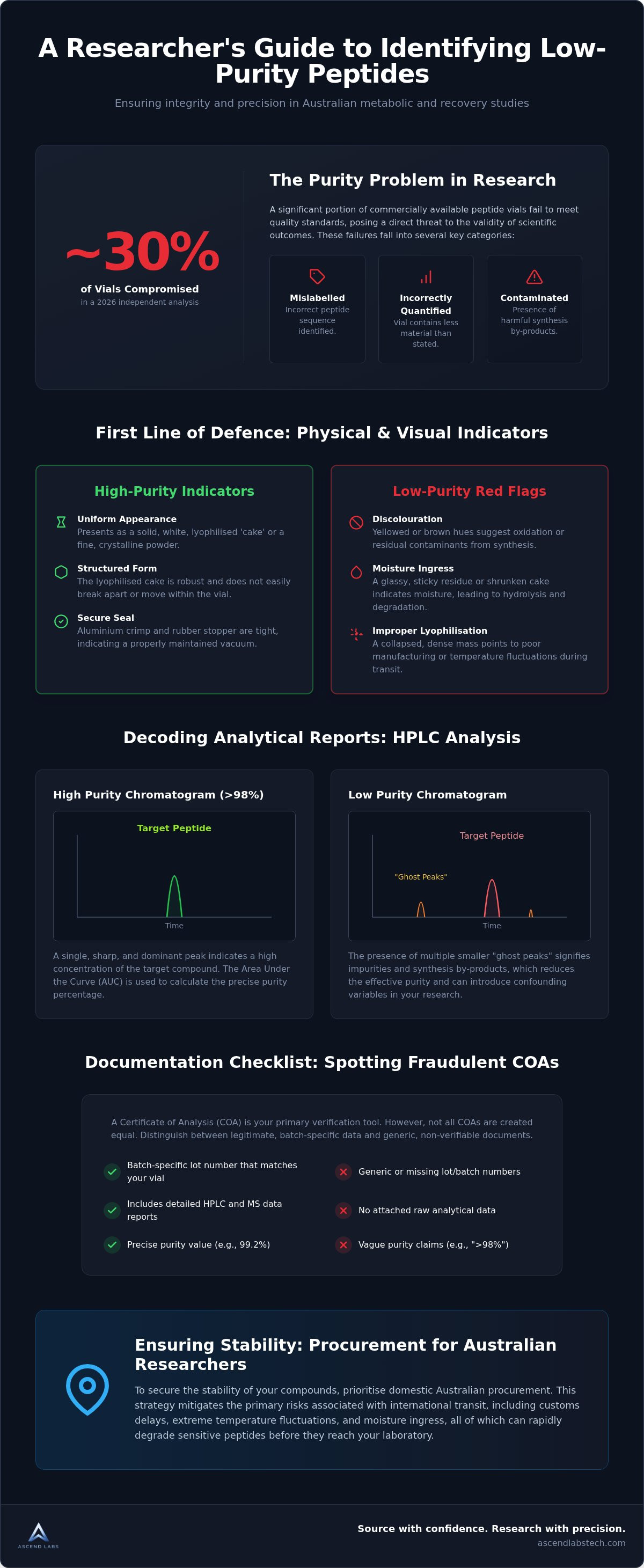
Close to 30% of peptide vials analysed in a 2026 independent testing operation were found to be mislabelled, incorrectly quantified, or contaminated. These clear signs of low purity research peptides represent a significant threat to the integrity of Australian metabolic and recovery studies, particularly as the TGA increases its scrutiny of unapproved compounds. You've likely experienced the professional frustration of results that don't align with theoretical expectations, often suspecting that the chemical integrity of your primary material is the silent culprit. Wasting a strictly allocated laboratory budget on inferior reagents isn't just a financial setback; it's a compromise of your empirical standards.
This guide provides a clinical framework to help you identify critical red flags through meticulous analytical data and physical indicators. We'll move beyond surface-level observations to help you interpret complex HPLC and MS reports while spotting the inconsistencies of fraudulent or generic Certificates of Analysis. By mastering these verification protocols, you'll ensure that your domestic research remains reliable, precise, and unburdened by the risks of unidentified impurities.
Key Takeaways
- Master the interpretation of HPLC chromatograms to identify "ghost peaks" and calculate the precise Area Under the Curve for verified purity.
- Identify visual red flags, including oxidation-induced discolouration and irregular lyophilisation, which serve as immediate signs of low purity research peptides.
- Develop a rigorous protocol for vetting Certificates of Analysis by distinguishing between batch-specific data and generic, non-verifiable documentation.
- Secure the stability of your metabolic or recovery compounds by prioritising domestic Australian procurement to avoid degradation during international transit.
Defining Research Peptide Purity Standards in Australia
Peptide purity represents the exact percentage of the total sample that consists of the intended amino acid sequence. In synthetic chemistry, achieving 100% purity remains a theoretical impossibility. The process of solid-phase synthesis inherently involves microscopic deviations, meaning even the most refined metabolic research compounds contain trace levels of by-products. For Australian investigators, understanding these nuances is the first step in identifying signs of low purity research peptides that could otherwise derail a multi-month trial. Accuracy in this context requires a move away from the "near enough is good enough" mentality, focusing instead on the specific chemical identity of every milligram.
Standard benchmarks categorise compounds into distinct tiers based on their refinement. Research-grade peptides typically maintain a purity threshold of >95%, whereas pharmaceutical-grade standards demand >98%. While the 3% difference may appear negligible on a Certificate of Analysis, the nature of the remaining 5% in a research-grade sample determines the reliability of the resulting data. Australian researchers must decide if their specific protocols, such as recovery or metabolic studies, can tolerate the noise introduced by that 5% variance.
The Impact of Impurities on Scientific Data
Impurities introduce confounding variables that compromise empirical integrity. Truncated sequences, where the peptide chain is shorter than intended, often trigger off-target effects in in-vitro studies. These sequences may bind to unintended receptors, producing false positives or toxicities that don't reflect the true profile of the target compound. Residual solvents such as Trifluoroacetic acid (TFA) are frequently used during synthesis and cleavage. If not properly removed through High-performance liquid chromatography, these acidic residues can alter the pH of a metabolic research environment, leading to skewed results. Crude peptides, which lack these rigorous purification steps, remain entirely unsuitable for sophisticated Australian laboratory trials where precision is the primary objective.
Common Synthesis-Related By-products
The synthesis of high-end compounds like Retatrutide or Tirzepatide requires hundreds of sequential chemical reactions. Errors during these stages result in deletion sequences or incomplete deprotection products. Deletion sequences are the primary impurity in non-verified synthesis, occurring when a specific amino acid fails to couple with the growing chain. Incomplete deprotection occurs when the protective groups on the amino acid side chains are not fully removed, leaving the peptide chemically "masked" and biologically inert. These by-products are often structurally similar to the target peptide, making them difficult to detect without high-resolution analytical equipment. A disciplined curator must examine the specific by-product profile to find hidden signs of low purity research peptides before they compromise a study.
Physical and Visual Indicators of Compromised Integrity
Visual inspection serves as a critical first line of defence for the Australian researcher. A high-quality research compound should present as a uniform, white, lyophilised "cake" or a fine, crystalline powder. If the material appears yellowed, brown, or exhibits any distinct discolouration, these are immediate signs of low purity research peptides. Such hues often indicate oxidation or the presence of residual contaminants from the synthesis process. Similarly, a "glassy" or "sticky" residue adhering to the vial walls suggests moisture ingress, which can rapidly compromise the molecular structure of the compound. While these observations are essential, they remain a preliminary screening tool rather than a final verdict on chemical purity.
Signs of Improper Lyophilisation
Lyophilisation, or freeze-drying, is a delicate process designed to remove solvents while preserving peptide stability. A healthy vial contains a robust, structured cake that resists movement. If the cake has collapsed into a shrunken, dense mass, it often points to poor manufacturing controls or significant temperature fluctuations during transit. Residual moisture is the enemy of stability. Even trace amounts of water can lead to hydrolysis, causing the peptide to break down into inactive fragments. Researchers should also inspect the vial seal. A loose aluminium crimp or a compromised rubber stopper can lead to a loss of vacuum, allowing atmospheric moisture to enter and degrade the sample before it ever reaches the laboratory bench.
Storage-Induced Degradation
The stability of high-purity research compounds is highly dependent on environmental control. Australia’s climate presents unique challenges, particularly regarding heat exposure during domestic transit. If a peptide is subjected to excessive thermal stress, it may undergo deamidation or oxidation, often manifesting as a change in physical texture or solubility. Upon reconstitution, a high-purity peptide should yield a perfectly clear, colourless solution. A "cloudy" or turbid appearance upon the addition of bacteriostatic water or saline indicates peptide aggregation or the presence of insoluble impurities. While visual cues aren't a substitute for HPLC, they provide essential data points for the disciplined curator before proceeding to more expensive analytical stages.
Identifying Analytical Anomalies in HPLC and Mass Spectrometry
Analytical verification remains the ultimate arbiter of chemical integrity. While physical inspection identifies gross negligence, high-performance liquid chromatography (HPLC) provides the quantitative precision required for reproducible metabolic research. This method separates the sample into its individual components based on their interaction with a stationary phase. The resulting chromatogram displays a series of peaks, with the primary peak representing the target compound. The purity percentage is calculated using the Area Under the Curve (AUC) of this primary peak relative to the total area of all detected peaks. Failure to identify extraneous signals is one of the most common signs of low purity research peptides in the Australian market.
A sophisticated report should also include Mass Spectrometry (MS) to verify molecular identity. While HPLC determines how much of a substance is present, MS confirms exactly what that substance is. For a compound like Retatrutide, the observed mass on the MS report must align precisely with its theoretical molecular weight. Any discrepancy exceeding a standard margin of error suggests either a different peptide entirely or a significant presence of residual protecting groups. Australian laboratories must flag these discrepancies immediately to avoid introducing unknown variables into their data sets.
Interpreting HPLC Chromatograms
The hallmark of a high-purity research compound is a single, sharp, and symmetrical peak. Australian researchers should scrutinise the baseline for "ghost peaks" or "shoulder peaks" that appear as small bumps attached to the main signal. These shoulder peaks indicate closely related impurities, such as diastereomers or peptides with a single amino acid deletion, which are notoriously difficult to separate. HPLC measures quantity (purity), while MS measures identity. If the AUC for the primary peak falls below 98%, the noise from these impurities can significantly confound the results of recovery or metabolic studies.
Mass Spectrometry Red Flags
Mass Spectrometry reports that display multiple ionisation peaks often suggest contamination or peptide fragmentation. A clean MS profile shows a clear base peak corresponding to the mass-to-charge ratio of the target peptide. For advanced studies requiring absolute sequence certainty, MS/MS fragmentation provides a deeper level of confirmation by breaking the peptide into smaller ions to map its specific amino acid order. Following a rigorous Peptide Purity Testing Protocol ensures that your materials meet the clinical standards expected in high-end biotechnology. Spotting these signs of low purity research peptides during the data review phase prevents the waste of laboratory resources on sub-standard batches.
Documentation Checklist: Spotting Fraudulent COAs
A Certificate of Analysis (COA) is only as valuable as its traceability. For many suppliers, the COA is a static marketing asset rather than a dynamic record of batch quality. One of the most glaring signs of low purity research peptides is the use of "representative" documentation. This practice involves providing a single report for all subsequent batches, assuming that synthesis conditions remain identical over time. In reality, every synthesis run introduces unique variables. Batch-specific verification is the only acceptable standard for rigorous inquiry in the Australian scientific community.
Digital artifacts often reveal a report's true history. Researchers should apply the "copy-paste" test by checking for inconsistent fonts, misaligned text, or overlapping pixels around the laboratory logo. These artifacts suggest that a previous report has been tampered with to reflect a different compound or a higher purity percentage. Additionally, the synthesis date must logically precede the testing date by a reasonable margin. If a report is dated months or years before the current batch was manufactured, the documentation is irrelevant to your current study. A disciplined curator treats every PDF with a level of forensic skepticism.
The Essential Components of a Valid COA
A legitimate document must include three non-negotiable elements to ensure transparency. First, it requires clear identification of the specific compound, such as MOTS-C or KLOW, rather than a generic chemical category. Second, the batch or lot number on the report must correspond exactly to the physical label on the vial. Finally, a valid report features the signature of the analytical chemist and clear accreditation details for the facility. Without these markers, the document lacks the accountability required for professional metabolic research. These components allow you to trace the material back to its exact point of synthesis.
Verifying Third-Party Results
Reputable labs act as neutral third parties to provide unbiased verification. Researchers should verify the authenticity of a COA by contacting the testing facility directly to confirm the report’s serial number. This step prevents the use of forged documents that have been circulating in the industry. If a supplier refuses to provide the raw HPLC or MS data upon request, this is a definitive red flag. Transparency is a hallmark of integrity in the Australian market. Independent verification ensures that the signs of low purity research peptides are caught before they enter the laboratory environment.
Ensuring High-Purity Procurement in the Australian Market
Sourcing within Australia is a strategic decision for data integrity. International shipping often involves prolonged customs delays, exposing temperature-sensitive compounds to uncontrolled environments. This exposure can induce degradation, making it difficult to distinguish between shipping-related damage and inherent signs of low purity research peptides. By choosing a domestic partner like Ascend Labs, investigators significantly reduce transit times, ensuring that meticulously verified metabolic and recovery compounds arrive in their intended state. Domestic supply chains offer a level of environmental control that international logistics simply cannot guarantee.
Transparency is the foundation of a professional partnership. A supplier’s commitment to clinical-grade standards shouldn't be a mere marketing claim but a verifiable operational fact. This includes providing comprehensive access to raw analytical data and maintaining a disciplined curator's approach to batch selection. In a market where close to 30% of vials may be mislabelled or contaminated, domestic oversight provides a layer of security that protects both the laboratory budget and the validity of the resulting data. Integrity in procurement is as vital as precision in the laboratory.
Criteria for a Reputable Australian Supplier
Consistency is the most reliable metric of quality. A reputable supplier maintains uniform batch quality and documentation across multiple procurement cycles, preventing the drift often seen in high-volume, generic operations. Specialisation in advanced research compounds, such as Retatrutide and Tirzepatide, demonstrates a technical depth and commitment to the evolving needs of the scientific community. To ensure your study begins with a verified foundation, Explore the Ascend Labs Product Range for clinical-grade materials that meet rigorous Australian standards.
Best Practices for Laboratory Intake
Establishing a "Verification on Arrival" (VOA) protocol is essential for maintaining empirical rigor. This internal checklist should include a visual inspection for the physical red flags discussed previously, alongside a cross-reference of the batch number against the provided COA. Proper storage techniques are equally vital in the volatile Australian climate. Maintaining a stable, refrigerated, or frozen environment prevents the deamidation that serves as one of the primary signs of low purity research peptides over time. These small procedural steps ensure that the chemical identity of your research material remains unchanged throughout the duration of your study.
Your research deserves a foundation of absolute precision and uncompromised purity.
Frequently Asked Questions
What is the minimum purity required for reliable research peptides?
The minimum purity threshold for most laboratory studies is 95%, though high-precision metabolic research often requires >98%. Lower purity levels introduce unknown variables that can skew data and cause off-target effects. When purity falls below these benchmarks, the presence of truncated sequences or residual solvents becomes a significant risk. Maintaining these standards is essential for ensuring that the results of your recovery or metabolic studies are scientifically reproducible and valid.
Can I tell if a peptide is low purity just by looking at the vial?
Physical inspection can reveal immediate red flags, but it cannot replace analytical testing. While a yellow tint or a sticky residue are clear signs of low purity research peptides, a perfectly white cake doesn't guarantee chemical integrity. Contaminants or incorrect amino acid sequences are often invisible to the naked eye. You should use visual cues as a preliminary screening method before proceeding with HPLC and Mass Spectrometry to confirm the exact molecular profile.
What is the difference between HPLC and Mass Spectrometry in purity testing?
HPLC and Mass Spectrometry serve two distinct but complementary roles in analytical verification. High-performance liquid chromatography determines the quantity of the target peptide relative to impurities by measuring the Area Under the Curve. Conversely, Mass Spectrometry confirms the identity of the compound by verifying its molecular weight. You need both tests to ensure the sample is not only pure but also the correct chemical sequence for your Australian research protocols.
Why do some research peptides have a yellow tint?
A yellow or brownish tint usually indicates oxidation or the presence of residual contaminants from the synthesis process. High-purity lyophilised peptides should appear as a uniform white cake or crystalline powder. Discolouration suggests that the compound has been exposed to oxygen or that the purification stages were insufficient. This physical change is one of the most reliable visual signs of low purity research peptides and should prompt immediate analytical re-verification.
How do I verify if a Certificate of Analysis (COA) is authentic?
Authenticity is verified by cross-referencing the report's serial number directly with the independent testing facility. You should also check that the batch number on the vial matches the documentation exactly. Look for digital artifacts like misaligned text or inconsistent fonts, which often suggest a report has been tampered with. Reputable Australian suppliers provide transparent access to raw data, allowing you to confirm that the synthesis and testing dates align with your specific batch.
Does a collapsed peptide cake mean the purity is low?
A collapsed cake typically indicates moisture ingress or significant temperature fluctuations during storage or transit. While it doesn't always mean the initial purity was low, it suggests that the peptide’s stability has been compromised. Residual moisture leads to rapid hydrolysis, which breaks down the peptide into inactive fragments. If you observe a collapsed or "melted" cake, it's a strong indicator that the compound may no longer meet the required research standards.
What are the most common impurities found in synthetic peptides?
The most frequent impurities are deletion sequences, where a specific amino acid is missing from the chain, and truncated sequences caused by premature termination. Other common by-products include incomplete deprotection products and residual solvents such as Trifluoroacetic acid. These impurities are often structurally similar to the target peptide, making them difficult to detect. Only high-resolution HPLC can separate these closely related species to ensure the integrity of your metabolic or recovery research.
How does heat during shipping affect peptide purity in Australia?
Excessive heat during transit accelerates chemical degradation processes like deamidation and hydrolysis. In the Australian climate, international shipments are particularly vulnerable to thermal stress during customs delays. This exposure can significantly reduce the shelf life and efficacy of the compound before it reaches the lab. Sourcing from a domestic supplier reduces transit times, ensuring that your research peptides remain stable and unburdened by the risks associated with long-distance environmental exposure.


