

What if the primary cause of your inconsistent experimental data isn't the compound itself, but the invisible clusters formed during reconstitution? For many laboratory professionals, the sight of a cloudy solution or unexpected precipitation represents more than just a minor setback; it signifies a loss of high-value research material. This technical challenge makes avoiding peptide aggregation in solution a critical priority for any researcher who values data integrity. You've likely encountered the frustration of conflicting protocols that fail to account for the specific chemical nuances of your peptide sequence.
Precision. Stability. Reproducibility. We understand that achieving a clear, stable solution is fundamental to successful mitochondrial or metabolic research. This article provides a professional laboratory protocol for maintaining solubility and preventing the formation of high-molecular-weight species. You'll master the precise sequences of solvent selection, pH adjustment, and temperature management required for high-fidelity Australian research results. We will guide you through the transition from a lyophilised powder to a stable, reproducible compound, ensuring the longevity and efficacy of your laboratory assets.
Key Takeaways
- Master the solubility hierarchy to select the most gentle reconstitution solvents, starting with sterile deionised water to preserve compound integrity.
- Apply the "Rule of Two" by maintaining a solution pH at least two units away from the isoelectric point to maximise compound stability.
- Implement the "Aliquot and Freeze" method using low-protein-binding tubes to eliminate repetitive freeze-thaw stress and prevent surface adsorption.
- Understand how high-purity compounds and domestic Australian supply chains assist in avoiding peptide aggregation in solution by minimising the risk of nucleation sites.
- Identify the molecular drivers of aggregation, such as hydrophobic interactions, to proactively prevent the non-specific self-association of monomers.
The Science of Peptide Aggregation: Why Solutions Turn Cloudy
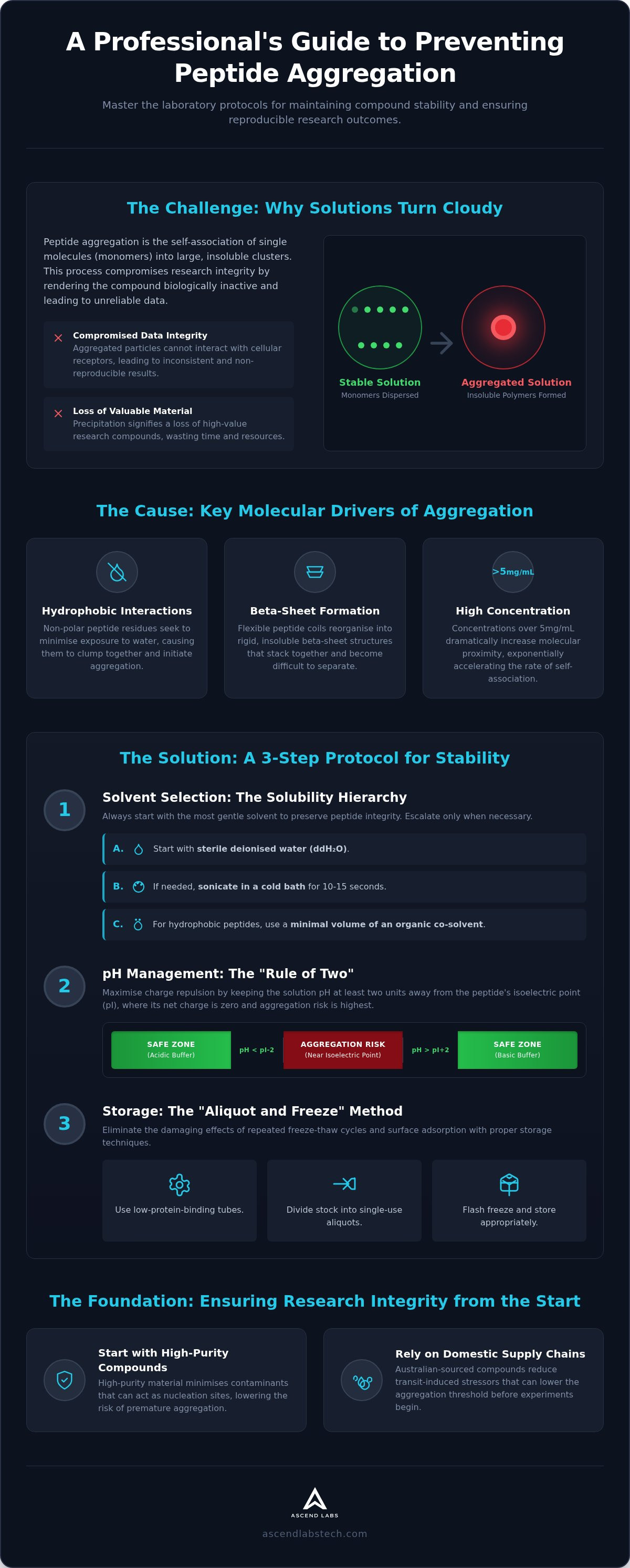
Peptide aggregation is the non-specific self-association of monomers into dimers, trimers, and eventually large, insoluble polymers. In a laboratory setting, this physical change often manifests as visible cloudiness, opalescence, or the formation of distinct precipitates. Understanding The Science of Peptide Aggregation is essential for maintaining the integrity of sophisticated research compounds. When peptides clump, they lose their native tertiary structure, which doesn't just compromise research fidelity but also reduces in-vitro bioavailability. These aggregated particles can't interact effectively with cellular receptors, resulting in skewed data and non-reproducible results. It's clear that avoiding peptide aggregation in solution requires a deep understanding of these molecular interactions before the first drop of solvent is added.
Molecular Drivers: Hydrophobicity and Beta-Sheet Formation
The primary drivers of this instability are hydrophobic interactions and hydrogen bonding. Peptides with a high percentage of non-polar residues, such as those found in certain metabolic research compounds, possess hydrophobic patches that seek to minimise exposure to water. These molecules naturally gravitate toward one another to shield their non-polar surfaces. This often triggers a structural transition where flexible random coils reorganise into rigid, insoluble beta-sheet structures. These sheets stack together with remarkable stability, making them difficult to dissociate once formed. Hydrophobic collapse is the primary initiator of aggregation in aqueous solutions. In Australian laboratories, where high-purity compounds are standard, even minor environmental shifts can trigger this collapse if the sequence is inherently prone to clumping.
The Impact of Concentration on Self-Association
Molecular proximity is a decisive factor in the kinetics of polymerisation. Preparing solutions at higher concentrations, specifically those exceeding 5mg/mL, significantly increases the rate of aggregation by shortening the distance between individual peptide chains. For specific research compounds like MOTS-C or Retatrutide, there exists a critical concentration threshold. Below this limit, the solution remains stable; above it, the likelihood of monomers colliding to form nuclei increases exponentially. We advise researchers to prepare dilute stock solutions where possible to maintain compound longevity. If a high-concentration stock is necessary, it must be handled with extreme care regarding temperature and pH. Utilising high-purity metabolic research compounds from domestic sources helps manage these risks by ensuring the starting material is free from the transit-induced stressors that often lower the aggregation threshold.
Selecting the Optimal Solvent for Reconstitution
Reconstitution is the most vulnerable phase for a research compound. Establishing a strict "Solubility Hierarchy" is essential for maintaining the native state of the peptide and ensuring long-term stability. The protocol begins with the most inert solvents to preserve biological activity. Sterile deionised water (ddH2O) serves as the primary baseline. It's the most gentle option and lacks the ions that might interfere with sensitive downstream assays. If the peptide doesn't dissolve immediately in ddH2O, sonicating the vial in a cold water bath for 10 to 15 seconds is a standard next step before transitioning to more aggressive reagents.
When a sequence contains a high proportion of non-polar residues, water alone is often insufficient to overcome the attractive forces between molecules. A deeper look at the molecular mechanisms of peptide aggregation shows that these hydrophobic interactions require a reduction in the solvent's surface tension. This is where organic co-solvents or pH modifiers become necessary. However, avoiding peptide aggregation in solution requires a "minimal solvent" technique. You should use the smallest possible volume of a concentrated solvent to achieve initial dissolution before slowly diluting the solution with your final experimental buffer. This prevents the compound from crashing out of the solution during the transition.
The Role of Organic Co-Solvents
Dimethyl Sulfoxide (DMSO) is a powerful dipolar aprotic solvent that can dissolve even the most stubborn hydrophobic sequences. For research stability, you should aim for a final DMSO concentration below 5% to minimise potential interference with in-vitro models. If your research involves HPLC analysis, Acetonitrile is often the preferred choice as it's compatible with standard mobile phases. For a technical breakdown of how different solvents interact with verified compounds, you can consult our guide on Peptide Purity Testing. Starting your workflow with high-purity research peptides ensures that the solvent only has to contend with the target sequence rather than unknown contaminants.
Acetic Acid and Ammonium Hydroxide: Counter-Ion Strategy
If the peptide remains insoluble in neutral solvents, adjusting the net charge of the molecule is a reliable strategy. For basic peptides, which have a high count of Arginine, Lysine, or Histidine, 1-10% Acetic Acid is the gold standard. It provides the protons needed to increase the net positive charge, creating electrostatic repulsion between the peptide chains. For acidic sequences rich in Aspartic or Glutamic acid, 0.1% Ammonium Hydroxide is used to increase the net negative charge. We recommend the "Dropwise Addition" method for these reagents. Adding the solvent one drop at a time prevents localised over-saturation, which is a common trigger for irreversible clumping. This methodical approach ensures that your stock solutions remain clear and viable for the duration of your study.
Managing pH and Ionic Strength to Maximise Solubility
The success of any reconstitution protocol depends on the electrochemical environment of the solvent. While many researchers default to a physiological pH of 7.4, this can be a strategic error for many sequences. Avoiding peptide aggregation in solution requires a precise understanding of the Isoelectric Point (pI). This is the specific pH at which a peptide carries no net electrical charge. When the net charge is zero, the electrostatic repulsion between molecules vanishes, allowing hydrophobic patches to interact freely and form precipitates.
To ensure stability, we recommend the "Rule of Two." This protocol dictates that the final solution pH should be maintained at least two units away from the compound's calculated pI. For example, if you are working with metabolic research compounds like MOTS-C, which has a pI of approximately 10.5, it should be reconstituted in a buffer with a pH of 8.5 or lower. This ensures that the molecules carry a significant net charge, creating the repulsion necessary to keep them in a monomeric state. If the pH is too close to the pI, the compound will likely crash out of the solution, regardless of the solvent used.
Ionic strength also plays a pivotal role in maintaining clarity. While some salt is necessary for biological assays, excessively high concentrations can trigger "salting out." In this scenario, salt ions compete with the peptide for water molecules, effectively stripping the hydration shell from the compound and forcing it to clump. The transition from the initial solvent to the final research buffer must be handled with care. We recommend a stepwise dilution protocol. Once the peptide is fully clear in the primary solvent, add the final buffer dropwise while gently swirling the vial. This methodical approach is the most effective way of avoiding peptide aggregation in solution during the final stages of preparation.
Calculating and Navigating the Isoelectric Point
Researchers should use sequence analysis tools, such as the ProtParam tool on the ExPASy server, to determine the pI before attempting reconstitution. Relying on neutral pH is often the worst choice for research peptides because many sequences have pIs in the 5.0 to 7.0 range. At the pI, the net charge is zero, leading to maximum attractive forces between molecules. By identifying this danger zone early, you can select a buffer that keeps the compound far from its point of minimum solubility.
Buffer Selection: PBS vs. HEPES vs. Tris
Phosphate-Buffered Saline (PBS) is the most common buffer in Australian laboratories, yet it's often unsuitable for the initial reconstitution of hydrophobic peptides. The high salt content in PBS can exacerbate clumping before the peptide has fully hydrated. HEPES or Tris buffers are frequently better alternatives as they provide stable pH control with lower ionic interference. Always ensure the peptide is completely dissolved in the primary solvent, such as ddH2O or a minimal volume of DMSO, before slowly introducing the final research buffer. This staged transition prevents the "shock" of sudden ionic changes that often leads to irreversible aggregation.
Best Practices for Handling and Long-Term Storage
Once you've achieved a clear solution, maintaining that state requires disciplined handling. Repetitive freeze-thaw cycles are the most common cause of sudden precipitation in a laboratory environment. Every time a solution transitions from solid to liquid, it experiences localised thermal stress and concentration gradients that favour molecular clumping. The "Aliquot and Freeze" method is the industry standard for avoiding peptide aggregation in solution. By dividing the stock into single-use volumes, you ensure each portion only experiences a single thaw event. This preserves the structural integrity of the peptide and prevents the gradual formation of insoluble polymers.
Surface adsorption is another significant risk to research fidelity. Standard plastic microcentrifuge tubes often have hydrophobic surfaces that "pull" peptides out of solution, leading to a measurable loss of material. We mandate the use of low-protein-binding tubes for all specialised metabolic research compounds. These vials are treated to minimise surface interactions, ensuring that the concentration you calculated remains accurate over time. Protecting these vials from UV light and oxygen is equally vital. We recommend using amber vials or wrapping clear tubes in foil to prevent the photo-oxidation that can destabilise the peptide backbone.
Sonication Protocols: Gentle vs. Aggressive
Disrupting micro-aggregates requires a calibrated touch. If a solution appears slightly hazy after reconstitution, an ultrasonic bath can provide the energy needed to re-disperse the compound. Follow this protocol to ensure safety:
- Fill the sonicator with ice-cold water to prevent heat transfer to the vial.
- Place the vial in the centre of the bath to ensure uniform energy distribution.
- Use "pulse" sonication for 10 to 15 seconds at a time.
- Allow the vial to rest on ice between pulses to maintain a stable temperature.
This method prevents the overheating that causes thermal degradation of sensitive sequences like Retatrutide or Tirzepatide. We strictly warn against the use of probe sonicators for research volumes. The high-intensity energy and potential metal shedding from the probe tip can introduce contaminants and shear the delicate peptide chains.
Storage Temperature and Stability Durability
Storage conditions must align with your research timeline to maintain compound efficacy. A solution kept at 4°C is generally stable for only 24 to 72 hours. For medium-term storage of up to three months, -20°C is acceptable, provided the freezer is a non-frost-free model to avoid temperature fluctuations. For long-term preservation, -80°C is required to halt molecular motion. Maintaining the compound in its powder state remains the most reliable strategy for avoiding peptide aggregation in solution over extended periods. For researchers who require fresh, high-purity lyophilised compounds to replace aged stock, our catalogue of Ascend Labs Products offers verified stability.
Ensuring Research Integrity with High-Purity Australian Peptides
Purity. Verification. Integrity. The foundation of any successful reconstitution protocol is the quality of the lyophilised material. While meticulous technical handling is paramount, the initial purity level directly dictates the success of avoiding peptide aggregation in solution. A compound verified at 98% purity or higher provides a predictable chemical profile, whereas lower-grade materials contain residual TFA, truncated sequences, or synthesis by-products. These contaminants don't just reduce the effective concentration; they actively destabilise the solution by providing the physical architecture required for clumping to begin.
Selecting high-purity compounds is a strategic decision that protects your research data from the noise of synthesis artifacts. In the Australian scientific community, where precision is the baseline, the risk of using unverified materials is too high. High-fidelity results depend on starting with a compound that hasn't been compromised by poor manufacturing or environmental stress. This commitment to quality ensures that the molecular interactions you observe are a result of the peptide's design, not its impurities.
The Nucleation Effect: Why Purity Matters
Aggregation is rarely a spontaneous, uniform event. It typically begins at specific "nucleation sites" where impurities provide a surface for monomer attachment. Even a 2% impurity profile can trigger a chain reaction, where a single non-target molecule acts as a seed for a large, insoluble polymer. This is why strict HPLC and mass spectrometry verification is non-negotiable for serious inquiry. Compounds like Retatrutide, with their complex triple-agonist structures, have unique handling requirements that are easily compromised by trace synthesis residues. High-purity standards ensure your research remains focused on the peptide's biological action rather than the artifacts of its manufacture.
Domestic Supply: Reducing Environmental Stress
The journey from the laboratory to your facility is a critical period of vulnerability. International shipping often exposes compounds to extreme temperature fluctuations, prolonged customs delays, and mechanical vibration. These stressors can induce partial unfolding or "pre-aggregation" in the lyophilised cake, making the compound significantly harder to dissolve later. Ascend Labs operates as a disciplined curator of high-specification compounds, prioritising domestic AU supply to minimise these risks. Reduced transit times across Australia ensure that sensitive compounds, such as MOTS-C, maintain their structural integrity from the moment they are verified to the moment they are reconstituted.
By selecting a domestic partner, researchers gain access to reliable cold-chain logistics specifically designed for the Australian climate. This controlled environment is a fundamental component of avoiding peptide aggregation in solution. We invite practitioners to view our research peptide catalogue to secure the high-purity materials necessary for reproducible, high-fidelity studies. Integrity in the results begins with integrity in the supply chain.
Precision Protocols for Enduring Data Integrity
Success in mitochondrial and metabolic studies depends on the transition from lyophilised powder to a stable, clear solution. By implementing a strict solvent hierarchy and adhering to the "Rule of Two" for pH management, you eliminate the primary drivers of clumping. Avoiding peptide aggregation in solution isn't merely a laboratory convenience; it's a prerequisite for reproducible data and high-fidelity research outcomes across all Australian scientific disciplines. These protocols ensure that your compound remains in its most bioavailable and active state.
Relying on a domestic supply further protects your compounds from the environmental stressors and temperature spikes common in international transit. Combining these rigorous handling protocols with clinical-grade, HPLC and mass spectrometry verified materials ensures your research remains focused on scientific discovery rather than solvent troubleshooting. This methodical approach preserves the longevity of your compounds and the integrity of your experimental results. We remain committed to providing the transparency and quality required for serious inquiry.
We look forward to supporting your next phase of inquiry with the specialised compounds and technical precision your work demands.
Frequently Asked Questions
Why did my peptide solution turn cloudy immediately upon adding water?
Immediate cloudiness usually indicates that the peptide's hydrophobic residues are self-associating rather than interacting with the aqueous solvent. This is a primary challenge in avoiding peptide aggregation in solution, especially with non-polar sequences. It often occurs when the solvent's pH is too close to the isoelectric point. You should immediately assess the sequence's hydropathy and consider a co-solvent or pH adjustment before the precipitate becomes irreversible.
Is it safe to use a sonicator to dissolve peptide aggregates?
Sonication is safe only when performed as a controlled pulse within a chilled ultrasonic bath. You must avoid probe sonicators, as they introduce intense heat and potential metallic contaminants that degrade sensitive compounds. Pulse the vial for 10 to 15 seconds while ensuring it remains on ice between cycles. This energy helps disrupt micro-aggregates without causing the thermal degradation that compromises high-fidelity research results in Australian laboratories.
Can I still use a peptide solution that has partially precipitated?
We don't recommend using a solution once precipitation has occurred because the actual concentration of the remaining monomeric peptide is no longer verifiable. Even if you filter out the visible clumps, the loss of material makes your experimental data inaccurate and non-reproducible. Additionally, aggregated particles can elicit non-specific cellular responses in-vitro, which fundamentally compromises research integrity. It's better to discard the sample and refine your reconstitution protocol.
How many freeze-thaw cycles can a research peptide solution typically withstand?
A research peptide solution should ideally experience zero freeze-thaw cycles after the initial thaw. Repetitive cycles cause localised concentration changes and structural stress that trigger clumping. While some robust sequences might withstand one or two cycles, the risk of avoiding peptide aggregation in solution is best managed by the "Aliquot and Freeze" method. Dividing your stock into single-use volumes ensures that every experiment uses a compound with consistent structural integrity.
What is the best way to adjust the pH of a sensitive peptide solution?
The most precise method involves the dropwise addition of dilute organic acids or bases while gently swirling the vial. Use 1-10% Acetic Acid for basic peptides or 0.1% Ammonium Hydroxide for acidic sequences. This gradual approach prevents localised pH extremes that can cause irreversible damage or sudden precipitation. Always aim for a final pH that is at least two units away from the isoelectric point to maintain maximum electrostatic repulsion.
Does the type of laboratory plasticware affect peptide aggregation?
Laboratory plasticware significantly influences solubility through a process known as surface adsorption. Standard polypropylene tubes often have hydrophobic surfaces that attract non-polar peptide residues, effectively pulling them out of the solution. This leads to a measurable decrease in concentration and can act as a precursor to wider aggregation. You should always utilise low-protein-binding vials to ensure the peptide remains in the bulk solution rather than adhering to the container walls.
How do I determine if my peptide is acidic, basic, or neutral?
You determine the chemical nature of a peptide by calculating its net charge at pH 7.0 based on its amino acid sequence. Sequences rich in Arginine, Lysine, and Histidine are basic, while those containing high levels of Aspartic and Glutamic acid are acidic. Utilising bioinformatics tools to find the isoelectric point (pI) is essential. If the pI is above 7.5, the peptide is basic; if it's below 6.5, the compound is considered acidic.
Why is DMSO often recommended for hydrophobic peptides in Australian labs?
DMSO is recommended because its high dielectric constant and dipolar aprotic nature effectively disrupt the strong hydrophobic interactions found in non-polar sequences. In Australian research environments, it's a standard co-solvent for compounds that are insoluble in aqueous buffers. Provided the final concentration remains below 5%, it's generally compatible with most in-vitro models. It provides a reliable pathway for achieving clear stock solutions when water alone fails to overcome molecular clumping.


