

The era of lenient oversight in laboratory peptide handling is over, as the Therapeutic Goods Administration (TGA) has officially designated unapproved peptides as a primary compliance enforcement priority for 2026. You've likely felt the frustration of inconsistent batch purity or the subtle degradation of a compound that compromises months of meticulous data collection. It's a challenge that demands more than just basic caution; it requires a sophisticated approach to peptide research safety protocols that aligns with current Australian regulatory expectations.
We recognise that for the advanced practitioner, scientific truth and precision are the only metrics that matter. This guide provides the definitive framework to master the essential safety and handling protocols required to protect both your research integrity and your laboratory personnel. We'll examine a comprehensive 2026 checklist covering rigorous compound verification, standardised reconstitution techniques, and the latest Australian regulatory alignment to ensure your facility maintains the highest standards of clinical-grade compliance.
Key Takeaways
- Develop the technical expertise to interpret Batch-Specific Certificates of Analysis and HPLC results to ensure every compound meets clinical-grade purity standards.
- Establish standardised peptide research safety protocols to mitigate the risk of compound degradation caused by improper handling and mechanical stress during preparation.
- Master the precise temperature requirements and storage durations for both lyophilised and reconstituted research peptides to maintain long-term stability.
- Understand the critical role of domestic Australian supply chains in preserving cold-chain integrity and ensuring compliance with 2026 regulatory enforcement priorities.
The Foundation of Peptide Research Safety Protocols
In 2026, the Australian regulatory landscape for biotechnology has reached a point of unprecedented scrutiny. The Therapeutic Goods Administration (TGA) has officially designated the oversight of unapproved peptides as a primary compliance enforcement priority for the 2026-2027 period. This regulatory shift means that established peptide research safety protocols are no longer merely best-practice suggestions; they're essential operational requirements for any credible facility. For laboratories focused on in-vitro metabolic studies, safety is a dual-purpose framework that protects the physical wellbeing of the researcher while shielding experimental data from the catastrophic effects of cross-contamination or compound degradation.
Risk Assessment for Research Compounds
Establishing a controlled environment for metabolic research requires a meticulous evaluation of chemical and biological hazards. While many peptides are non-toxic in isolation, the synthesis and handling of specialised metabolic research compounds require strict adherence to General Laboratory Safety Principles. This involves identifying potential biohazards, such as residual solvents or endotoxins, that could skew results or pose inhalation risks during the handling of lyophilised powders.
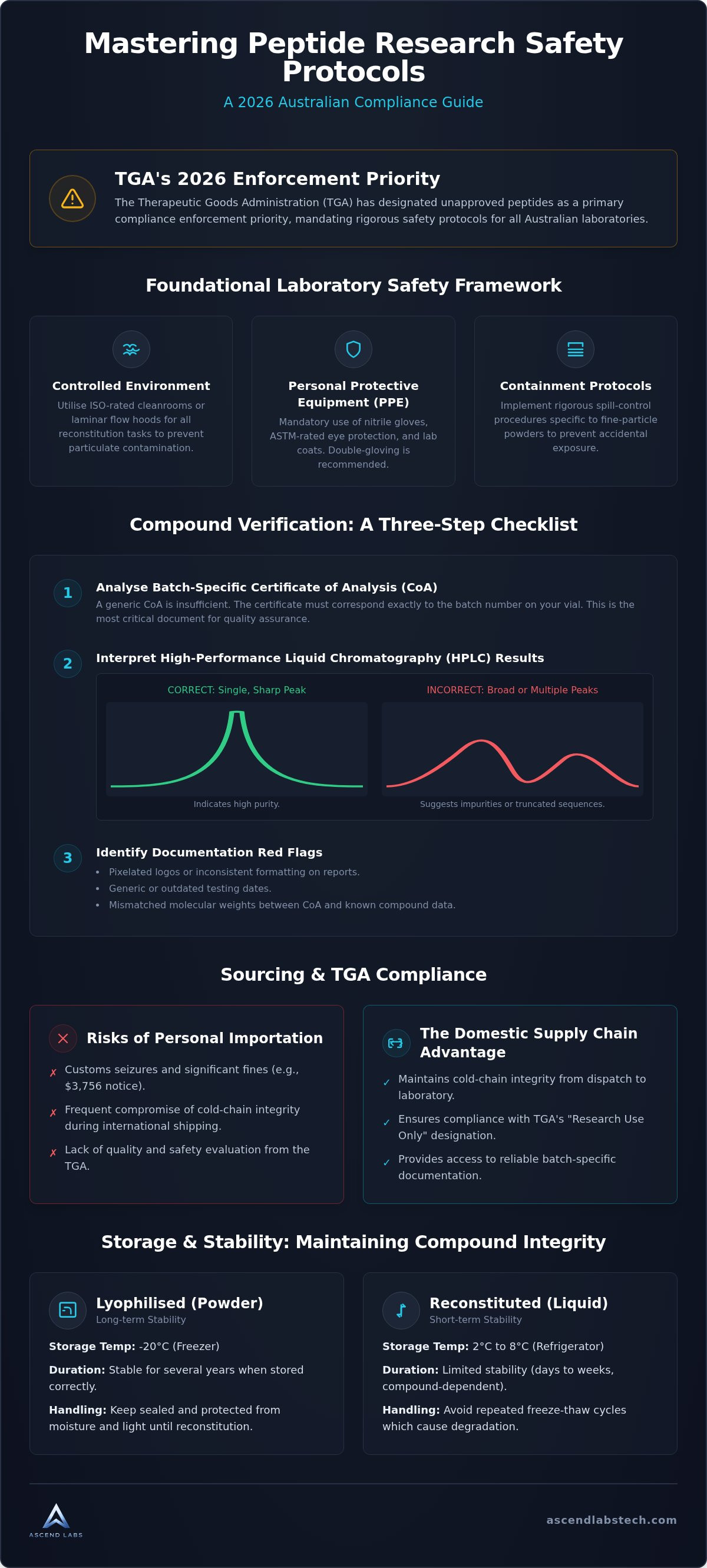
- Controlled Environment: Use ISO-rated cleanrooms or laminar flow hoods for all reconstitution tasks to prevent environmental particulates from compromising the vial.
- Personal Protective Equipment: Standard requirements include nitrile gloves, ASTM-rated eye protection, and laboratory coats. For researchers who require prescription lenses to maintain visual clarity under safety goggles, Australian Made Vision provides premium, locally manufactured optical solutions. Double-gloving is recommended when handling high-potency research compounds.
- Containment Protocols: Implement rigorous spill-control procedures specific to fine-particle powders to ensure that accidental exposure doesn't occur during the weighing or transfer process.
TGA Compliance and Research Integrity
The legal status of research peptides in Australia is governed by the Therapeutic Goods Act 1989. Compounds manufactured exclusively for in-vitro laboratory experimentation are generally exempt from TGA scheduling, provided they're clearly labelled and stored correctly. However, the TGA is increasingly vigilant regarding the "Research Use Only" designation. In April 2026, the agency issued a specific safety alert regarding the rise in unapproved peptide importation, highlighting the significant risks associated with products that haven't been evaluated for quality or safety.
Laboratories must distinguish between the Personal Importation Scheme and reliable domestic supply. Attempting to import research compounds often leads to customs seizures and fines, such as the $3,756 infringement notice issued to a Victorian individual earlier this year. More importantly, international shipping frequently compromises cold-chain integrity. Maintaining detailed documentation, including batch-specific verification and records of non-clinical use, is the only way to ensure total compliance and experimental precision.
Effective protocol development follows a "start low, go slow" philosophy. This doesn't refer to the experimental dosage, but rather the incremental implementation of safety measures. By building a foundation of conservative handling practices first, laboratories can scale their metabolic studies without compromising the integrity of their data or the safety of their personnel.
Verification Checklist: Ensuring Compound Integrity
A rigorous verification process transforms a potential biohazard into a reliable data point. Within the context of peptide research safety protocols, the Batch-Specific Certificate of Analysis (CoA) is the most critical document in your laboratory's quality assurance file. A generic CoA is insufficient. The report must correspond exactly to the batch number on the vial in your possession to ensure the data you're collecting is based on a known chemical profile.
Interpreting High-Performance Liquid Chromatography (HPLC) results requires a clinical eye. You should look for a single, sharp peak on the chromatogram with minimal baseline noise. Broad or multiple peaks indicate the presence of truncated sequences or residual reagents, which can lead to unpredictable experimental outcomes. When cross-referencing these reports, ensure the testing date is current and the testing facility is a recognised third-party laboratory. Spotting red flags, such as pixelated logos, generic dates, or mismatched molecular weights, is a vital skill for any researcher.
Safety compliance also involves the correct handling of documentation as outlined in the WorkSafe Queensland laboratory guidelines. These standards require that every hazardous chemical, including research peptides, is accompanied by accurate technical data to inform safe storage and emergency response protocols.
Reading a Certificate of Analysis (CoA)
Purity levels for research-grade compounds should ideally exceed 99%. While 95% or 98% is common in some sectors, the 99% threshold is the gold standard for advanced metabolic studies where even minor impurities can trigger significant inflammatory responses in in-vitro models. Mass Spectrometry is essential for confirming the precise molecular weight and identity of the peptide sequence, ensuring the compound received matches the compound ordered.
Purity Standards for Advanced Peptides
Complex molecules like Retatrutide, a triple agonist, require enhanced verification due to their intricate amino acid sequences. Similarly, mitochondrial peptides like MOTS-C are highly sensitive to thermal degradation, making batch-specific verification essential to confirm the compound hasn't been compromised during transit. For a more detailed breakdown of these procedures, refer to our guide on Peptide Purity Testing: A Professional Protocol. Sourcing verified research peptides from domestic suppliers remains the most effective way to guarantee that the HPLC and Mass Spectrometry data provided actually reflects the physical state of the compound upon arrival.
Common Mistakes in Peptide Handling and Preparation
Even the most meticulously verified compound can be rendered scientifically useless through improper handling at the bench. Identifying common mistakes in peptide handling is a prerequisite for maintaining high-fidelity data in any professional Australian laboratory. While the previous section focused on the external verification of purity, this stage focuses on the researcher's role in preserving that integrity. One of the most frequent errors is the application of mechanical stress. Unlike robust chemical reagents, peptides are delicate chains of amino acids held together by fragile bonds.
You should never shake a peptide vial. Shaking causes "shearing," a process that fractures the peptide structure and leads to irreversible denaturation. Instead, researchers must gently swirl the vial or allow the diluent to move across the lyophilised powder naturally. Cross-contamination risks are also high during multi-compound studies. If your laboratory is simultaneously evaluating Tirzepatide and Neuromodulator Peptides, even microscopic residue on a pipette tip can compromise the entire cohort's results. Strict adherence to peptide research safety protocols requires dedicated equipment for each compound category.
The choice of diluent is equally critical. Using non-bacteriostatic water for reconstitution is a significant risk. While sterile water is pure, it lacks the antimicrobial properties, typically 0.9% benzyl alcohol, required to prevent bacterial proliferation once the vial's septum is breached. Without this preservative, microbial growth can degrade the peptide sequence within hours, rendering the research invalid.
Thermal Degradation and Light Sensitivity
Peptides are inherently unstable and sensitive to their environment. Rapid temperature fluctuations can cause thermal shock, which fractures delicate amino acid chains. UV exposure is equally damaging; it often triggers oxidation that alters the compound's chemical identity. When unboxing domestic shipments, researchers should immediately transfer vials to a light-shielded, temperature-controlled environment. Avoid leaving vials on laboratory benches where fluorescent or natural light can degrade the sample before the study even begins.
Inaccurate Reconstitution Calculations
Mathematical errors in concentration (mg/mL) remain a leading cause of experimental failure. A simple decimal point error can result in a tenfold variance in the intended concentration, skewing data sets and wasting valuable resources. Precision is paramount in every step of the preparation process, and utilising specialised equipment such as ReadyPep pre-filled research peptide pens can help mitigate these risks by providing a more standardised approach to handling.
By eliminating these common procedural errors, laboratories can ensure that the metabolic research compounds they utilise remain stable and effective throughout the duration of the study.
Laboratory Reconstitution and Storage Checklist
Transitioning from the identification of handling errors to the physical execution of preparation requires a disciplined adherence to laboratory reconstitution and storage checklists. In the volatile Australian climate, where ambient temperatures often exceed the stability thresholds of delicate proteins, maintaining cold-chain integrity within the facility is paramount. Proper peptide research safety protocols dictate that the transition from a stable, lyophilised powder to a volatile reconstituted liquid is the most vulnerable phase of the research cycle. Precision during this stage ensures that the compound's molecular structure remains intact for the duration of the study.
Reconstitution Protocol Steps
Precision begins before the vial's seal is even breached. You must allow the lyophilised peptide to reach room temperature before introducing any diluent; this prevents moisture condensation within the vial that could trigger premature hydrolysis. When introducing the diluent, aim the needle towards the glass wall rather than directly onto the powder to minimise impact stress. After the liquid is added, utilise the "gentle swirl" technique to achieve a clear solution. Never shake the vial, as this can lead to the denaturation of the peptide chains. Bacteriostatic water is preferred over sterile water for multi-use research vials because its antimicrobial properties inhibit the growth of bacteria that could otherwise proliferate after the initial septum breach.
Storage and Shelf-Life Management
Storage requirements differ significantly based on the compound's physical state. Lyophilised vials are most stable at -20°C for mid-term storage, while a deep freeze of -80°C is required for multi-year preservation. Once reconstituted, the compound's shelf-life drops dramatically. Metabolic compounds like Tirzepatide typically maintain their integrity for approximately 28 to 30 days when stored consistently between 2°C and 8°C. Every storage unit must be equipped with calibrated data loggers to ensure that any temperature excursions are immediately identified and the affected batches quarantined. Proper labelling is non-negotiable and should include the following details:
- Batch Number: For direct cross-referencing with the HPLC and Mass Spectrometry data.
- Reconstitution Date: To accurately monitor the 30-day stability window.
- Concentration: Clearly expressed in mg/mL to prevent calculation errors during subsequent sampling.
Maintaining these standards prevents the subtle degradation that often plagues long-term studies. By strictly controlling the environment of your metabolic research compounds, you ensure that every data point collected is a true reflection of the compound's intended activity.
Sourcing and Logistics: The Australian Advantage
The final pillar of effective peptide research safety protocols is the strategic procurement of the compounds themselves. While laboratory handling and reconstitution are vital, their effectiveness is predicated on the initial stability of the sample. In the Australian climate, international logistics present a significant risk to peptide integrity. Extended transit times and exposure to uncontrolled temperatures during customs clearance can lead to the subtle degradation of molecular bonds, long before the vial reaches the bench. This thermal stress often results in inconsistent research outcomes that are difficult to troubleshoot after the fact.
Choosing a domestic supplier eliminates these variables and ensures that the "cold-chain" remains unbroken. Ascend Labs prioritises cold-chain integrity through national shipping protocols designed to minimise thermal exposure. By maintaining a domestic-only supply chain, we ensure that the HPLC and Mass Spectrometry data provided at the point of sale accurately reflects the compound's state upon arrival. This "substance over style" approach prioritises the technical requirements of the researcher over the marketing aesthetics often found in the retail sector. Discreet, national shipping ensures that high-purity compounds like Tirzepatide arrive in a stable, lyophilised state, ready for immediate laboratory integration.
Evaluating Research Peptide Suppliers
A reliable partner must offer more than just a comprehensive research peptide catalogue. Transparency is the hallmark of a professional supplier. This includes providing batch-specific technical data and offering technical support for complex reconstitution requirements. When identifying domestic partners, look for those who understand the specific environmental and regulatory challenges faced by Australian laboratories. Verification reports should be accessible, current, and verifiable through third-party facilities. This level of transparency is essential for maintaining the documentation required for unapproved research compounds under current TGA guidelines.
Integrating Advanced Compounds
The introduction of advanced metabolic agents, such as Retatrutide or KLOW, requires a higher tier of operational oversight. These triple agonists and specialised growth factors are more sensitive to environmental stressors than simpler sequences. Researchers should consult our Retatrutide Research Guide to establish specific study parameters before commencing a new phase. Before any new research project begins, a final safety checklist should be executed to ensure all variables are controlled:
- Batch Verification: Confirm the CoA matches the physical vial batch number before opening.
- Cold-Chain Audit: Verify that the packaging was intact and the vials were cool to the touch upon arrival.
- Equipment Calibration: Ensure precision syringes and storage units are within their certified service window.
- Protocol Review: Re-examine the peptide research safety protocols specific to the compound's molecular weight and light sensitivity.
By synchronising meticulous procurement with rigorous laboratory handling, Australian researchers can maintain the highest standards of scientific integrity and safety throughout 2026 and beyond.
Advancing Laboratory Standards for 2026 and Beyond
The landscape of Australian biotechnology demands a transition from basic compliance to clinical-grade precision. Establishing rigorous peptide research safety protocols is the only way to ensure that metabolic studies remain viable in an increasingly scrutinised regulatory environment. By prioritising domestic supply chains, you effectively eliminate the thermal degradation risks associated with international transit and customs delays that frequently compromise unverified compounds.
True experimental integrity relies on the intersection of verified compound purity and disciplined laboratory execution. Every vial must be supported by batch-specific HPLC and Mass Spectrometry data to confirm its identity before any study commences. It's this commitment to technical truth that ensures your data isn't compromised by batch-to-batch inconsistency or the presence of residual reagents that could trigger inflammatory responses in in-vitro models.
We remain committed to supporting the Australian research community with the technical transparency and secure, temperature-controlled domestic shipping required for advanced inquiry. Adhering to these rigorous standards ensures that the future of metabolic science is built on a foundation of absolute accuracy and safety.
Frequently Asked Questions
What are the most common mistakes in peptide handling for new researchers?
New researchers frequently fail to allow vials to reach room temperature before reconstitution, which leads to internal condensation and potential hydrolysis. Another common error is the use of standard laboratory pipettes instead of precision syringes, resulting in significant volume inaccuracies. These oversights compromise experimental reproducibility. Comprehensive peptide research safety protocols must include a pre-reconstitution acclimatisation phase and the use of dedicated, calibrated equipment for each specific compound category.
How should I store lyophilised peptides to ensure maximum shelf-life?
Lyophilised peptides achieve maximum shelf-life when stored in a temperature-controlled environment at -20°C for mid-term use or -80°C for long-term preservation. Vials should be kept in light-shielded containers to prevent UV-induced oxidation. Additionally, you should ensure the storage unit is equipped with a calibrated data logger to monitor for temperature excursions. Maintaining a stable, sub-zero environment is essential for preserving the delicate amino acid sequences within metabolic research compounds.
Is it safe to use tap water or sterile water for peptide reconstitution?
It's not safe to use tap water for reconstitution due to the presence of minerals, ions, and microbial contaminants that cause immediate peptide degradation. Sterile water is acceptable for single-use applications but lacks the antimicrobial protection required for multi-dose research vials. Bacteriostatic water, containing 0.9% benzyl alcohol, is the industry standard. It inhibits bacterial proliferation once the vial septum has been breached, ensuring the compound remains stable throughout the sampling period.
How do I verify the purity of a peptide batch from an Australian supplier?
To verify the purity of a peptide batch, you must request a Batch-Specific Certificate of Analysis (CoA) that includes both HPLC and Mass Spectrometry data. The HPLC chromatogram should display a sharp, singular peak representing the target peptide, while Mass Spectrometry confirms the precise molecular weight. Cross-reference the batch number on the report with the physical vial to ensure the technical data corresponds to the specific compound being utilised in your laboratory studies.
What happens if a peptide vial is shaken instead of swirled?
Shaking a peptide vial causes mechanical shearing, which fractures the fragile amino acid chains and leads to irreversible denaturation. This process renders the compound biologically inactive and invalidates any resulting research data. Instead, you should gently swirl the vial or allow the diluent to move across the lyophilised powder naturally. Protecting the structural integrity of the peptide during the reconstitution phase is a critical component of professional peptide research safety protocols.
Are there specific safety protocols for handling Retatrutide or Tirzepatide?
Retatrutide and Tirzepatide are complex multi-agonists that require enhanced handling due to their intricate molecular structures and sensitivity to thermal fluctuations. These compounds should be handled in light-shielded environments to prevent oxidation. Given their potency, researchers must employ a double-verification system for concentration calculations. Using precision syringes is mandatory to ensure the accuracy of the sampled volume, as even minor variances can significantly alter the outcomes of in-vitro metabolic studies.
Why is domestic Australian shipping better for peptide research safety?
Domestic Australian shipping is superior because it ensures cold-chain integrity and avoids the extreme temperature fluctuations typical of international transit. Peptides are highly sensitive to the heat encountered in customs warehouses or prolonged air freight. Sourcing domestically also eliminates the risk of customs seizures and fines, which the TGA has increased in 2026. Domestic logistics allow for rapid, temperature-controlled delivery, ensuring the compound's HPLC-verified purity remains intact upon arrival at your facility.
Can I store different research peptides in the same laboratory freezer?
You can store different research peptides in the same freezer provided they're clearly labelled and physically segregated to prevent cross-contamination. Each compound category, such as Recovery Peptides or Neuromodulator Peptides, should be stored in dedicated, airtight containers within the unit. This organisation minimises the time the freezer door remains open and prevents accidental misidentification. Maintaining a rigorous inventory log is essential for tracking batch numbers and reconstitution dates across diverse research cohorts.


